Have you ever looked at two books about the same thing and noticed they are not exactly alike? One book about dogs may show big fluffy dogs, and another book about dogs may show tiny puppies. Both books are about dogs, but they can look and sound different. Good readers learn to spot what is the same and what is different.
A text is something we read. A text can be a book, a page, an article, or another piece of reading. A topic is what the text is about.
When two texts have the same topic, they are both about the same thing. For example, one text may be about bears in the forest, and another text may also be about bears in the forest. They share the same topic: bears.
Same topic means two texts are about the same subject. Compare means to look at how things are alike and different.
Sometimes the texts are both about weather, both about plants, or both about helpers in a community. Even when they share a topic, they may not say everything in the same way.
When readers compare, they look for things that match. In [Figure 1], both texts are about frogs. That means the topic is the same, even if the pages do not look exactly alike. We can say, "Both texts are about frogs."
Two texts can be the same in different ways. They may have the same animal, the same kind of place, or some of the same facts. One text may say frogs jump, and another text may also show a frog jumping. That is a similarity.
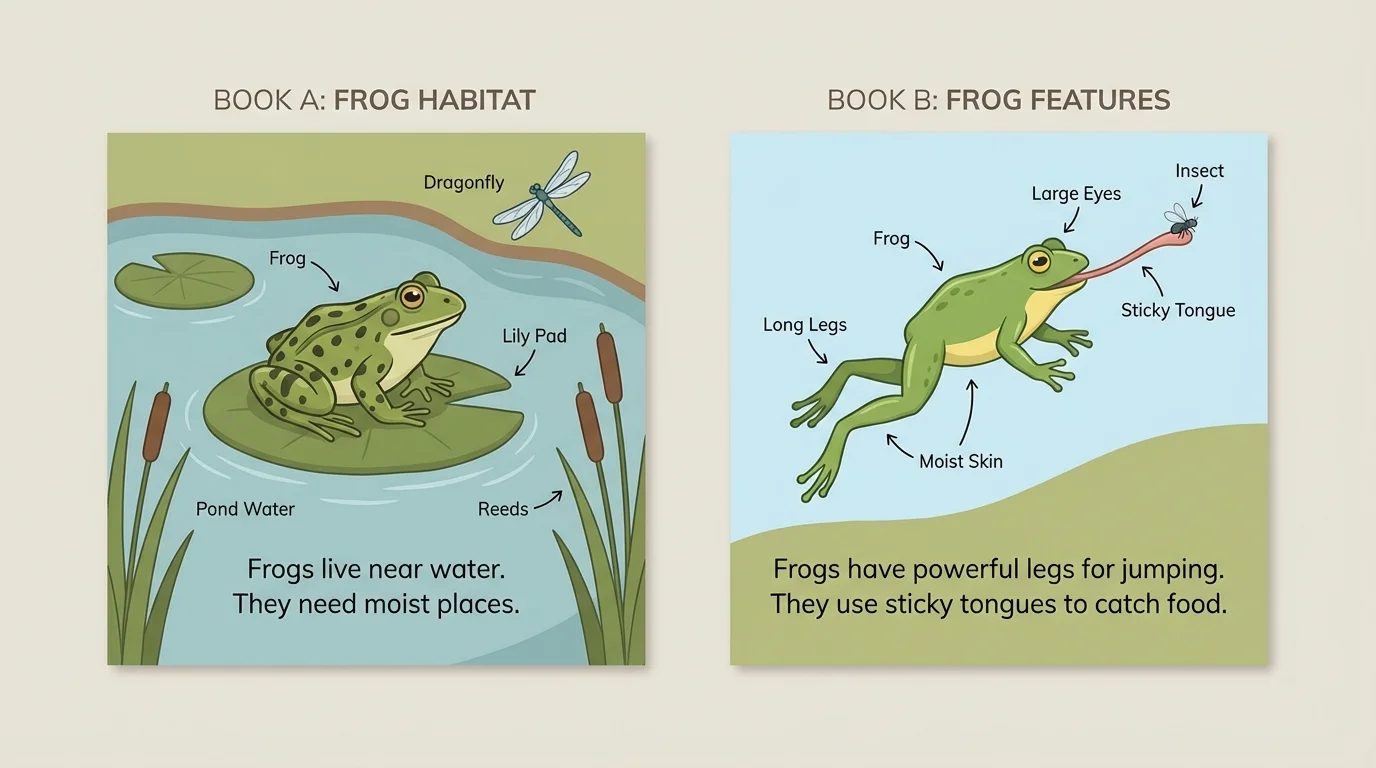
Readers can use the word similarity to talk about something that is alike. A similarity is a way two texts match. If both texts show a pond, both texts teach about frogs, or both texts use pictures of tadpoles, those are similarities.
Sometimes the same idea is shown in words and pictures together. One text may say, "Frogs live near water," and another may show a frog sitting by a pond. We can learn the same idea from both texts.
Some books teach with lots of pictures, and some teach with more words. Both kinds of texts can help readers learn about the same topic.
Later, when we compare other books, we can think back to the frogs in [Figure 1] and remember that "both" is a helpful word when two texts share the same topic or the same fact.
Two texts on the same topic can also have a difference. In [Figure 2], both texts are about apples, but one page looks different from the other. One may have a real-looking picture, and the other may have a cartoon picture.
One text might tell more about color. Another text might tell more about where apples grow. One text may show one big apple. Another may show many apples on a tree. These are differences.
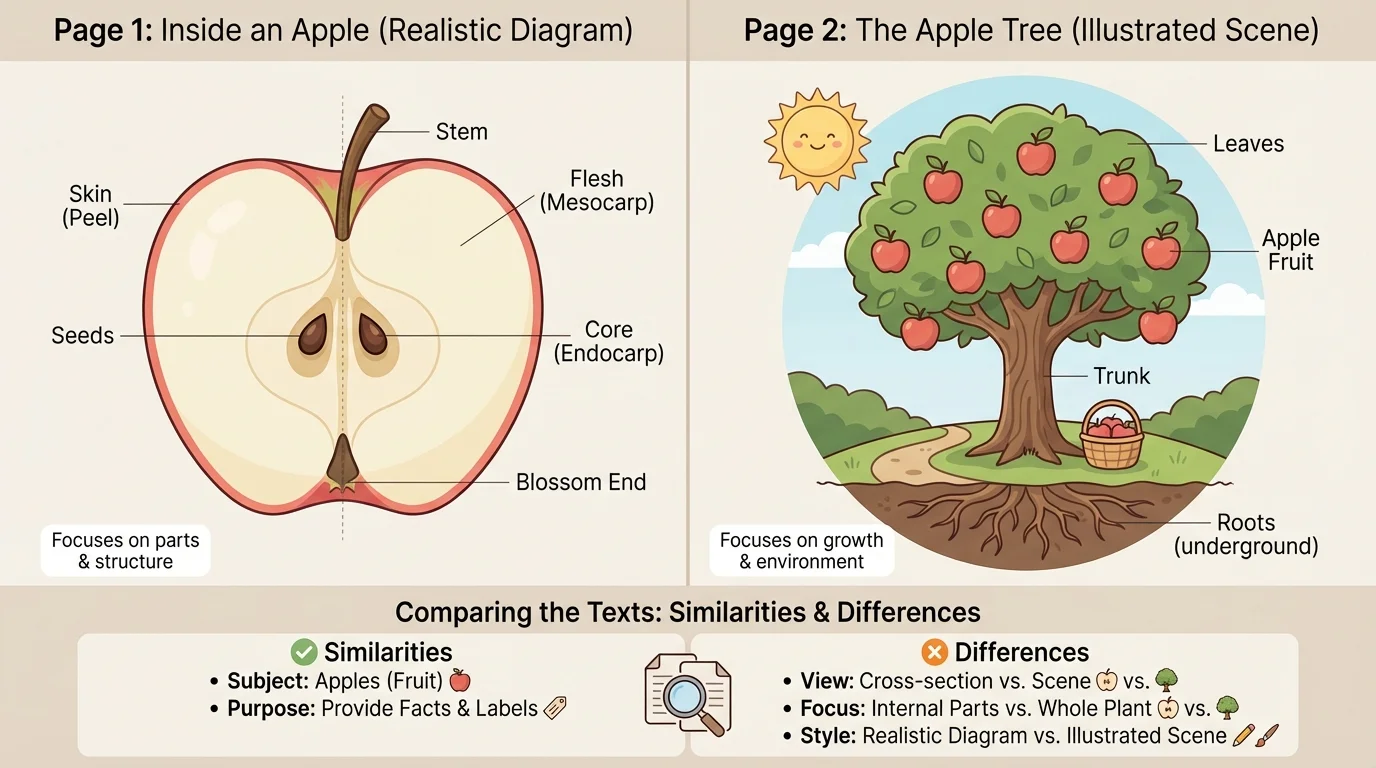
Readers can say, "Both texts are about apples, but this one shows a tree and this one shows one apple." That is a simple way to compare. We can also say, "This text tells more about taste, but that text tells more about growing."
Differences do not mean one text is wrong. They just mean the texts are not exactly the same. Each text may teach us something a little different.
Illustrations are the pictures in a text. Pictures help readers understand. Sometimes a picture gives us a clue even before we read all the words.
If two texts are about bees, one illustration may show bees on flowers, and another may show bees in a hive. Both pictures fit the same topic, but they give different details. One helps us learn where bees find food. The other helps us learn where bees live.
Pictures and descriptions work together. A text may describe something with words, and an illustration may show the same idea. When readers compare two texts, they can look at both the words and the pictures to find similarities and differences.
A description tells what something is like. A description might tell color, size, shape, or action. One text may describe a whale as very big. Another text may describe a whale as a strong swimmer. Both are about whales, but the descriptions are not the same.
When we compare, we can ask simple questions: What do I see in both texts? What do I see in only one text? What do the words tell me? What do the pictures show me?
Some texts teach us how to do something. A procedure is a set of steps. In [Figure 3], both texts teach how to plant a seed. That means the topic is the same, but the steps may not match exactly.
One text may say: get soil, put in the seed, water it. Another text may say: get a cup, add soil, put in the seed, water it, and place it in sunlight. Both procedures are about planting a seed, but one has more steps.
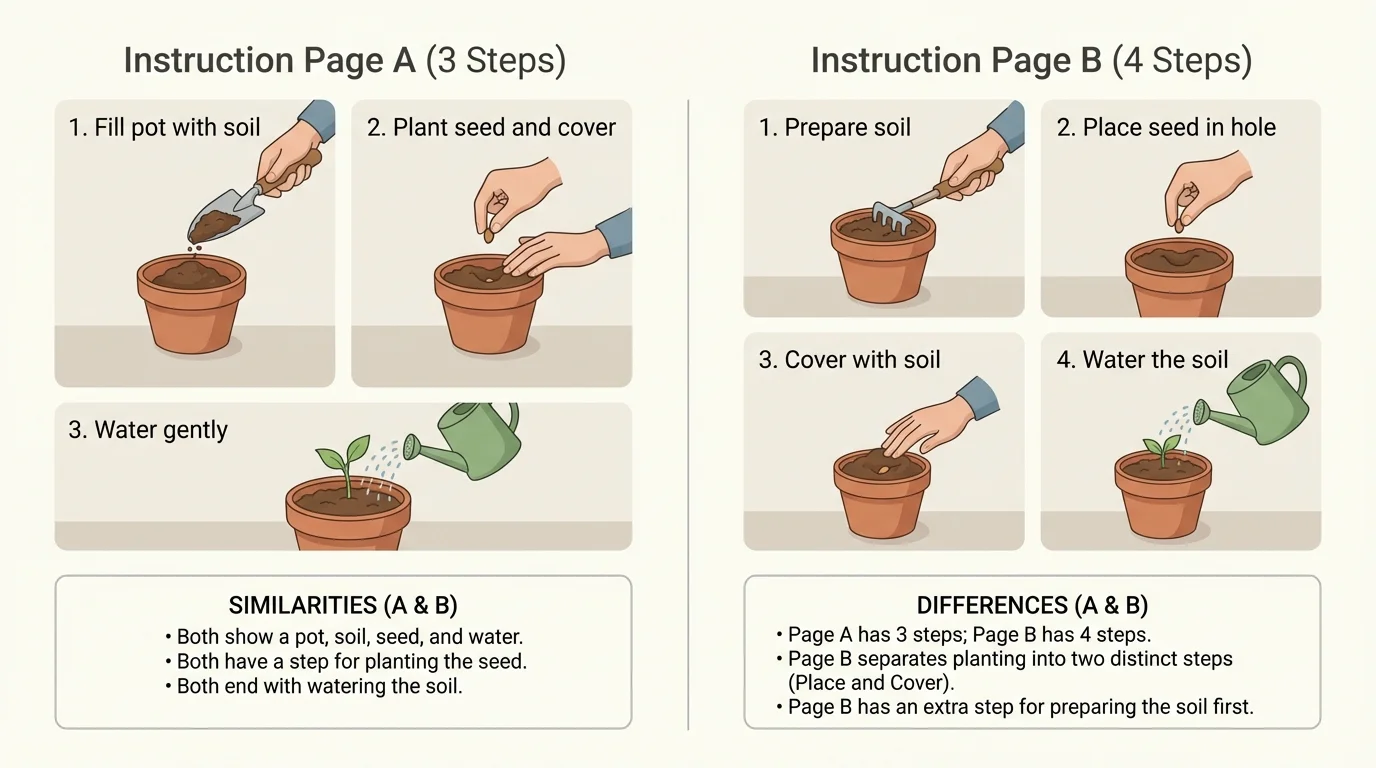
When readers compare procedures, they can notice if the texts use the same order, different order, fewer steps, or more steps. They can also notice if both texts include the same tools, such as soil, seeds, and water.
Example: Comparing two texts about making juice
Step 1: Find the topic.
Text A is about making orange juice. Text B is also about making orange juice. The topic is the same.
Step 2: Find one similarity.
Both texts use oranges.
Step 3: Find one difference.
One text shows a blender. The other text shows squeezing by hand.
A reader can say, "Both texts are about making orange juice, but they use different ways."
Later, when we compare another set of steps, we can remember the seed-planting procedures in [Figure 3] and look for what both texts do and what only one text does.
Good readers use compare words when they talk. These words help us explain our thinking clearly.
| Word | How to use it |
|---|---|
| both | Both texts are about rain. |
| same | The same topic is cats. |
| different | The pictures are different. |
| only one | Only one text shows snow. |
| but | Both are about birds, but one shows nests. |
Table 1. Helpful words students can use when comparing two texts on the same topic.
These words help us make clear comparison sentences. We do not need long answers. A clear answer can be short and smart.
You already know that pictures and words help tell meaning. Now you are using that same skill to compare two texts and talk about how they are alike and different.
You can say, "Both texts are about weather." You can say, "This one has more pictures." You can say, "Only one text tells how to stay dry in the rain." These are good comparison sentences.
Reading two texts on the same topic helps us learn more. One text may teach one part, and the other text may teach another part. When we put the ideas together, we understand the topic better.
For example, one text about butterflies may show the caterpillar and chrysalis. Another text may tell where butterflies find flowers. After reading both, we know more than we knew from just one text.
That is why comparing texts is an important reading skill. We look carefully, listen to the words, study the illustrations, and think about what is the same and what is different.
