Have you ever heard someone say, "Wear your boots because it is raining"? That person did not just tell you what to do. They also told you why. Authors do that too. When authors write informational texts, they often give a big idea and then give reasons to help us understand it.
An author is the person who writes the text. Sometimes the author wants to teach us something true about the world. Sometimes the author wants us to know why something is important. The main idea the author wants to say is called a point.
For example, an author might say, "Plants need water." That is the author's point. It is the big idea the author wants us to learn.
Point means the main idea the author wants to tell. Reason means why the author says the point is true, important, or helpful.
When we read or listen, we can ask, "What is the author trying to tell me?" That helps us find the point first.
[Figure 1] A reason supports the point. A reason answers a question like, "Why does the author think this?" or "Why is this important?"
If the point is "Helmets keep us safe," a reason might be "Helmets protect our heads." Another reason might be "Helmets help prevent injuries." Those reasons help the point make sense.
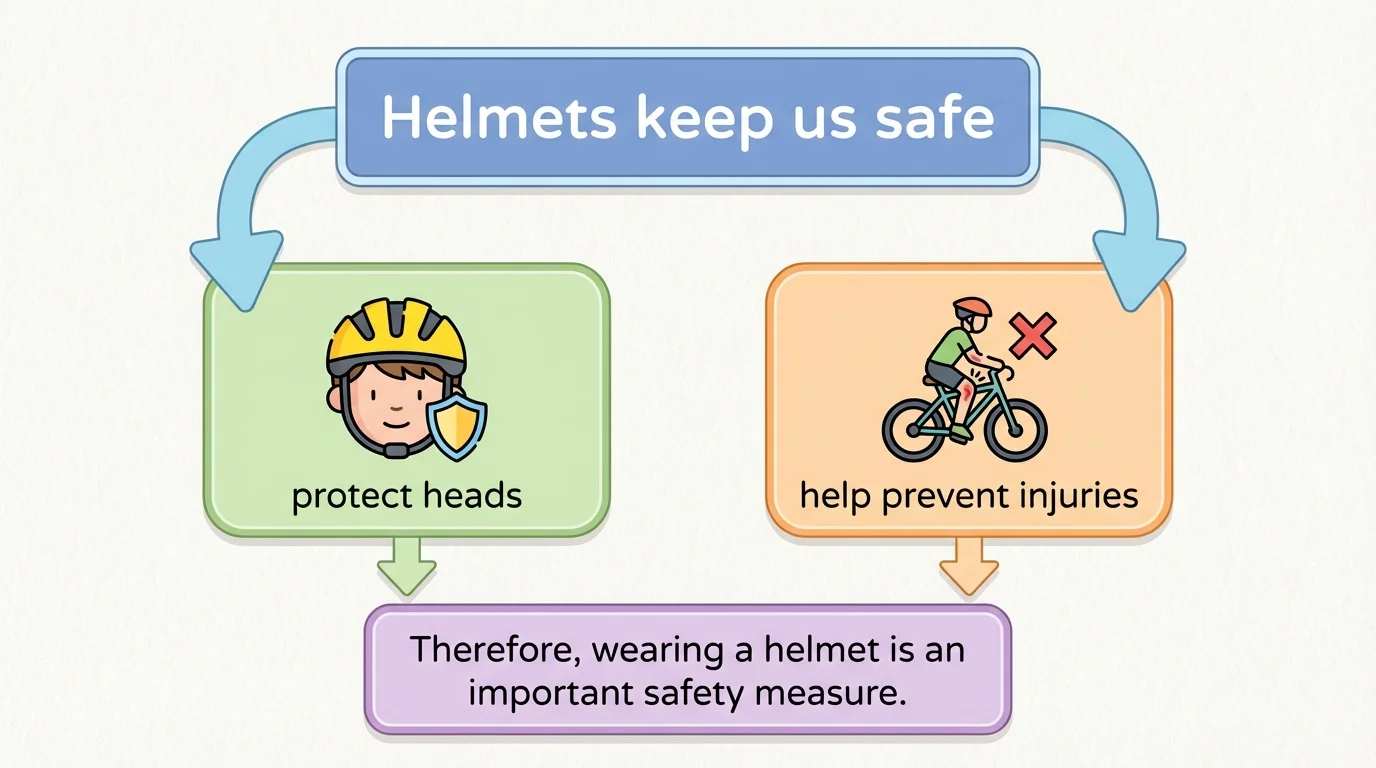
Sometimes the reason is right after the point. Sometimes it comes before. Sometimes we need a teacher or adult to help us hear how the ideas fit together.
Point and reason work together. The point is the author's big message. The reasons are the pieces that hold up that message. If we can say the point and then tell why, we are beginning to understand the text more deeply.
We do not have to do this all alone. At this age, it is okay to do this with prompting and support. That means a grown-up may ask helpful questions, repeat a sentence, or point to a picture.
One way to listen for reasons is to listen for clue words. Authors often use words like because, so, this helps, or that is why. These words can lead us to a reason.
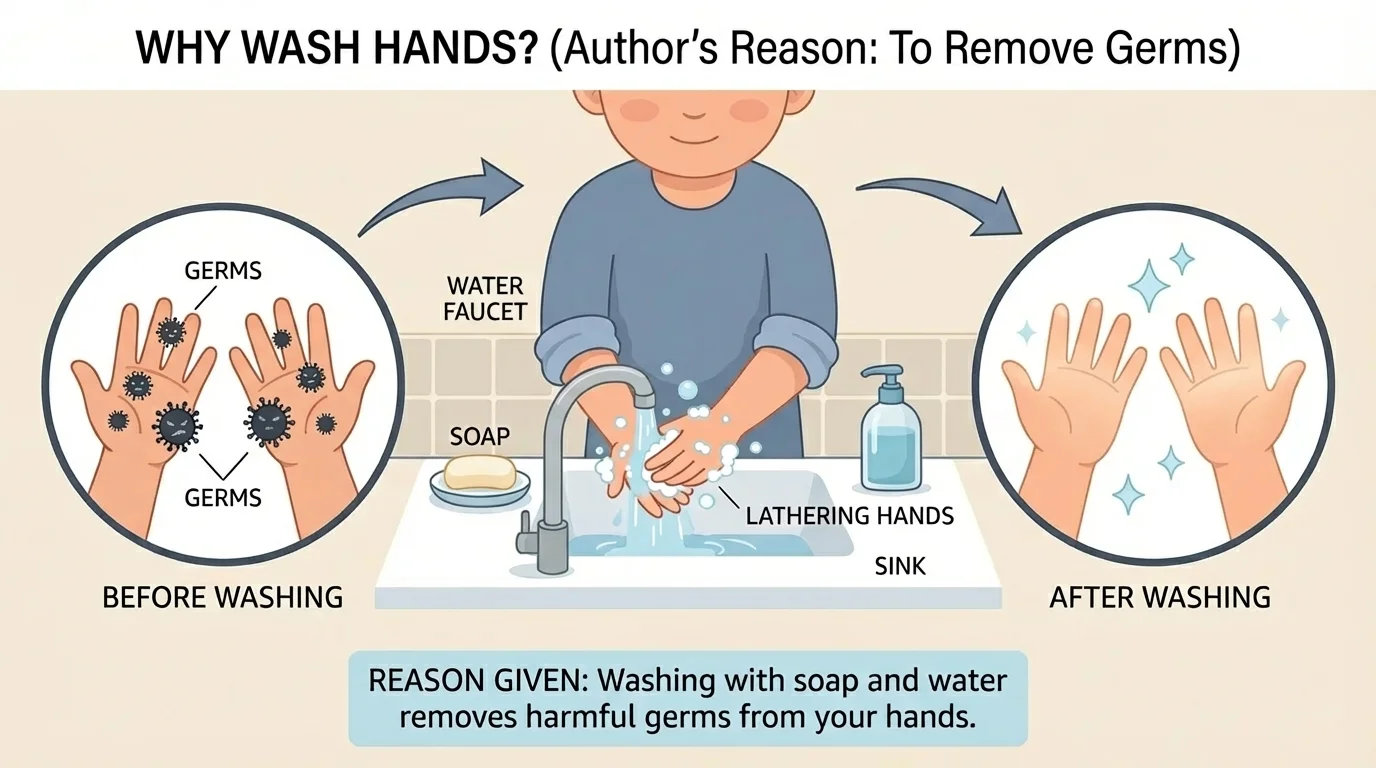
Listen to this: "We wash our hands because it helps remove germs." The point is "We wash our hands." The reason is "it helps remove germs."
Here is another one: "Birds build nests so their eggs have a safe place." The point is "Birds build nests." The reason is "their eggs have a safe place."
Example: Finding the point and reason
Text: "Rain boots help keep feet dry because puddles are wet."
Step 1: Listen for the big idea.
The big idea is "Rain boots help keep feet dry."
Step 2: Listen for the clue word.
The clue word is "because."
Step 3: Say the reason.
The reason is "puddles are wet."
The author gives the reason to help us understand why rain boots matter.
When we say, "The author says ___ because ___," we are putting the point and the reason together in a clear way.
Informational texts can be about animals, weather, health, plants, or how things work. In many of these texts, the author gives reasons to teach us.
Suppose a text says, "Bees are important because they help flowers grow seeds." The point is that bees are important. The reason is that they help flowers grow seeds.
Suppose a text says, "Sleep is important because your body needs rest." The point is that sleep is important. The reason is that the body needs rest.
Suppose a text says, "We recycle paper because it helps save trees." The point is that we recycle paper. The reason is that it helps save trees.
Many nonfiction books for young children use short sentences and clear pictures so readers can find the author's point and reasons more easily.
These examples show that the author is not only sharing facts. The author is also helping us understand why the facts matter.
Sometimes a teacher, parent, or other adult helps us find reasons by asking simple questions. They might ask, "What does the author want us to know?" Then they might ask, "Why?"
They may also point to a sentence and read it again slowly. They might say, "I heard the word 'because.' What comes after it?" That kind of help is called prompting and support.
Prompting does not give away the whole answer. It helps us notice something in the text. Support can also mean talking together, looking at a picture, or hearing the text read aloud one more time.
As the lesson moves from words to pictures, [Figure 2] illustrates how a child can use both parts of a page to understand the author's reason. Pictures often help us see what the words mean.
Sometimes the reason is in the words, and the picture helps explain it more clearly. A nonfiction page about handwashing may say, "Wash hands to stay healthy." The picture may show soap, water, and clean hands. Together, the words and picture help us understand the reason.
If a page says, "A coat keeps you warm," and the picture shows a child outside in cold snow wearing a coat, the picture helps support the reason. We see why the coat matters.
Readers use both what they hear and what they see. That is part of understanding informational texts. Later, when we think again about the page in [Figure 2], we can explain that the author gives a reason about health, and the picture helps make that reason easier to understand.
You already know how to listen to a story and look closely at pictures. Now you are using those same smart habits to understand facts and reasons in informational texts.
Talking about the text is important too. When we tell a partner or a teacher, "The author says this because...," we practice putting ideas together.
[Figure 3] Sometimes one point has more than one reason. Authors do this when they want to make the point stronger.
For example, an author may say, "Plants need water." Then the text may give several reasons: "Water helps plants grow. Water helps plants stay green. Water keeps plants from drying out." Each sentence gives a reason for the same point.
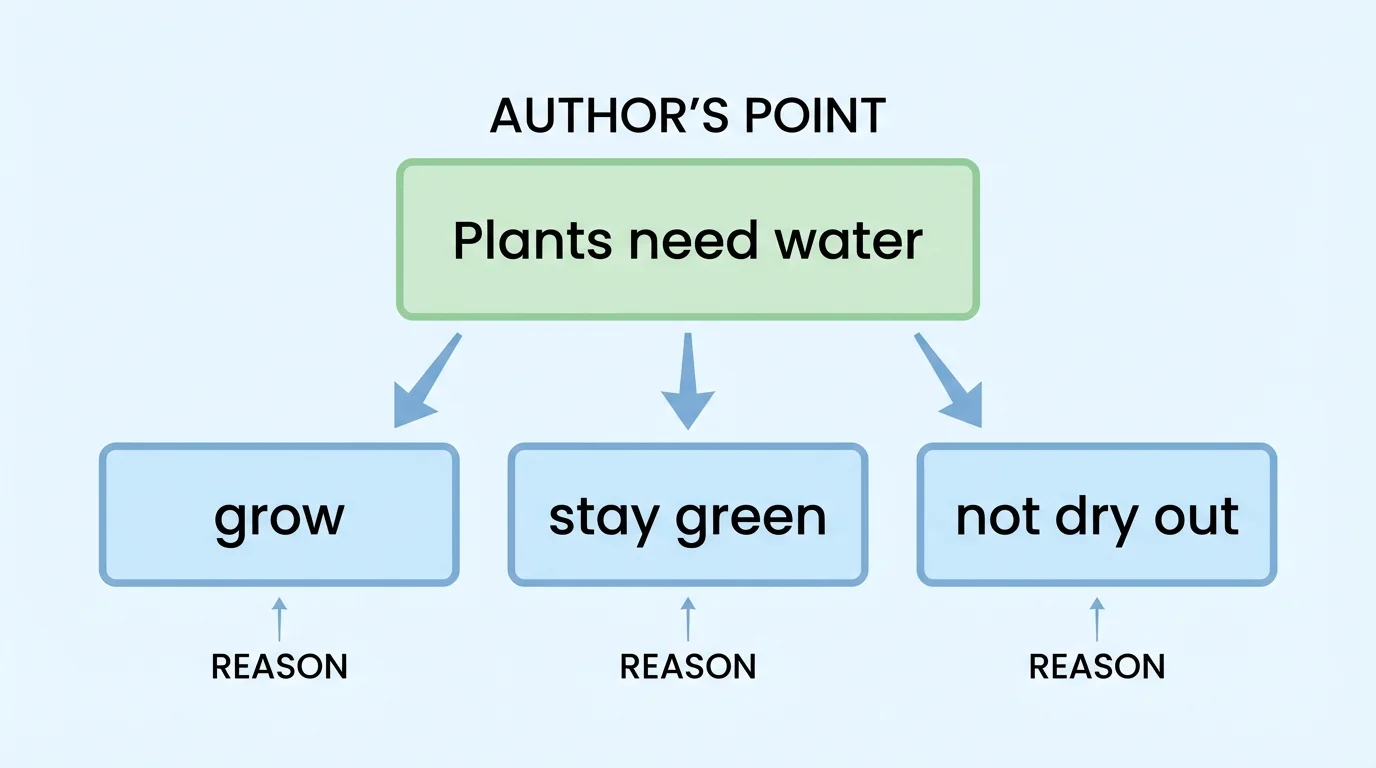
If we hear many reasons, we can still go back to the big idea. We can ask, "What is the author teaching me?" Then we can name one reason or more than one reason.
When we look back at the way ideas are grouped in [Figure 3], it becomes easier to notice that several little ideas can all support one big point.
Example: More than one reason
Text: "Pets need food and water. Food helps them grow. Water helps them stay healthy."
Step 1: Find the point.
The point is "Pets need food and water."
Step 2: Find the reasons.
One reason is "Food helps them grow." Another reason is "Water helps them stay healthy."
Step 3: Put them together.
The author says pets need food and water because food helps them grow and water helps them stay healthy.
It is fine if we name just one good reason at first. With help, we can often find more.
Some words in a text can help us notice a reason. These words do not always appear, but they are useful clues.
| Clue word or phrase | What it may tell us |
|---|---|
| because | A reason is coming next. |
| so | It may tell why something happens or matters. |
| this helps | The author may explain why something is useful. |
| that is why | The author may connect an idea to a reason. |
Table 1. Simple clue words and phrases that often introduce or connect reasons.
Even when these words are not there, we can still think about what the author wants us to know and what details explain why. Those details often act like reasons.
Good readers of informational text listen, look, and think. They ask, "What is the point?" and "What reasons does the author give?" With support, young readers can do this more and more clearly.
