Have you ever heard a book read aloud and wanted to say, "Wait, why?" Good readers do that. They listen, look closely, and think about what the book is telling them. When we read or listen to a text, we can ask questions and answer questions about the important parts.
Some books tell stories, and some books teach us about the world. A book about bears, rain, plants, or buses is an informational text. It gives facts. When we listen to an informational text, we think about the big ideas and the important details.
Sometimes a teacher, parent, or helper gives prompting. That means they help us get started. They might ask, "What do you notice?" or "Can you tell me one important thing?" They also give support. That means they help us keep going when a text feels tricky.
Question means something we ask because we want to know more.
Answer means what we say after we find out.
Key details are the most important little parts that help us understand the text.
When we ask and answer questions, we do not have to know everything all by ourselves. We can listen again, look again, and talk with a grown-up or classmate.
Good readers ask questions to learn more. As [Figure 1] shows, question words help us think. We can ask who, what, where, and when questions about the text.
If a text is about frogs, we might ask: "What do frogs eat?" "Where do frogs live?" "What color is the frog?" These questions help us pay attention to the important facts.
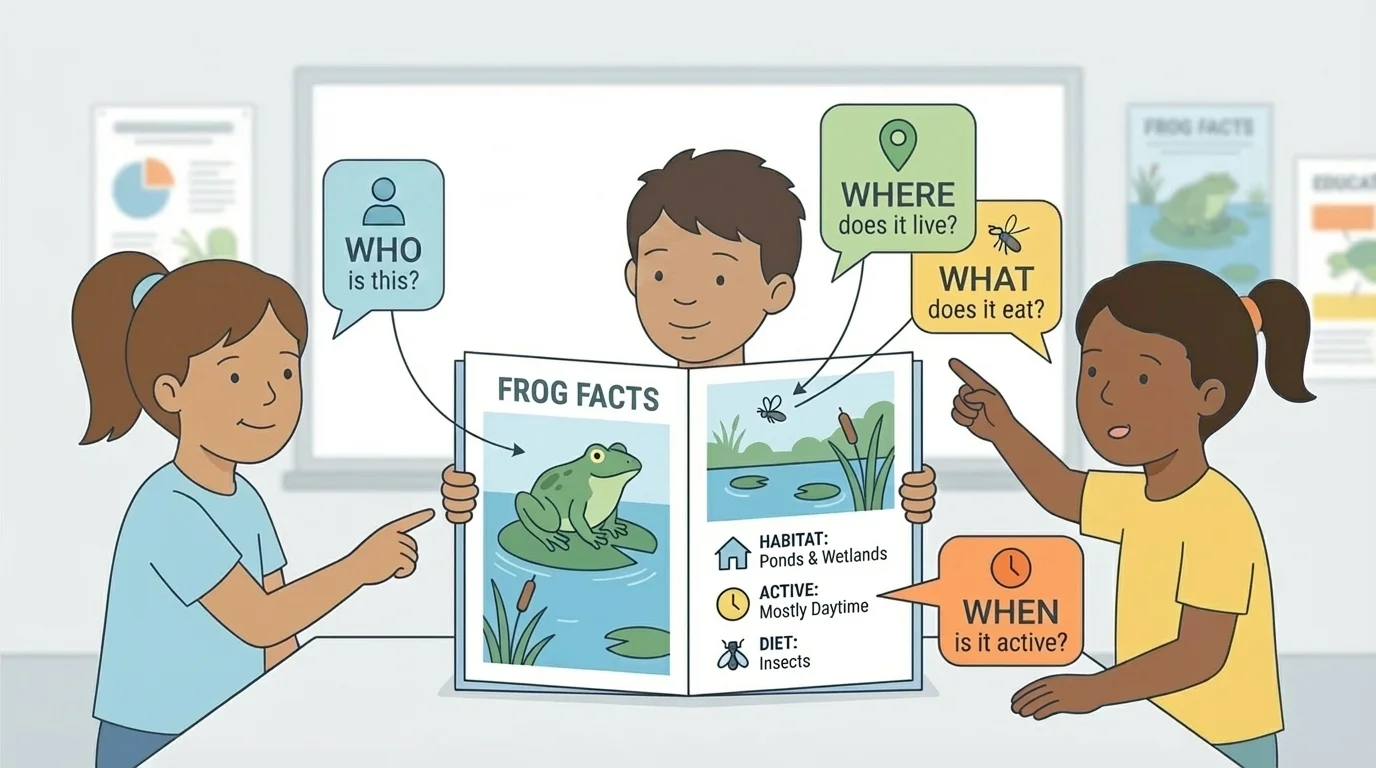
Sometimes we ask a question before we know the answer. Then we listen carefully to find it. Sometimes a teacher helps by saying, "Let's ask a what question," or "Can you ask about where the animal lives?" That is a helpful way to begin.
Example: Asking questions about a text on bees
Step 1: Listen to the text idea.
The text says bees visit flowers.
Step 2: Ask a question.
"What do bees visit?"
Step 3: Ask another question.
"Where do bees go?"
These questions help us think about the facts in the text.
When we ask a question, we are showing that we are thinking. That is what readers do.
A key detail is an important piece of information. In [Figure 2], the text about apples has details that help answer questions. Not every word is a key detail, but some words tell the most important facts.
If the text says, "Apples grow on trees. Apples can be red, green, or yellow. Apples have seeds inside," then the key details are that apples grow on trees, have colors, and have seeds. Those details help us understand apples.
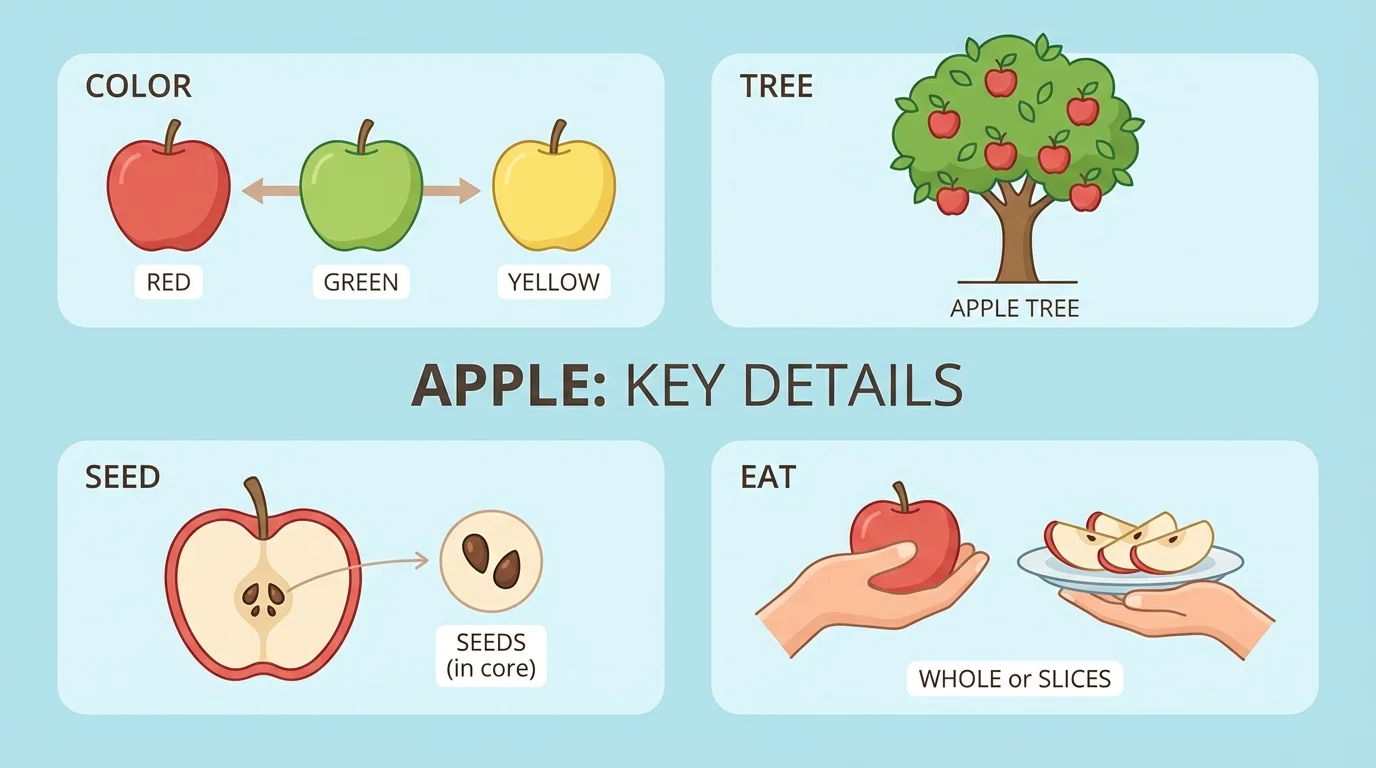
We can ask, "Where do apples grow?" The answer is "on trees." We can ask, "What is inside an apple?" The answer is "seeds." We use the text to help us answer.
Sometimes a text has pictures and labels too. A label might say "seed" or "leaf." Those are clues that help us find important details.
Many informational books for young readers teach with both short sentences and clear pictures. That makes it easier to find important facts.
Later, when we think again about important facts, we can return to the apple details in [Figure 2] and use them to answer new questions about what apples look like and where they grow.
When we answer a question, we try to use what the text says. We may use our own words, but our answer should match the information in the book.
For example, if the text says, "Penguins live in cold places," and someone asks, "Where do penguins live?" a good answer is, "Penguins live in cold places." That answer comes from the text.
Answering from the text means listening for information, remembering an important detail, and saying that detail back as an answer. Young readers often need a teacher to reread a sentence, point to a picture, or ask a smaller question first.
If the answer is hard to find, a grown-up might help by saying, "Let's look at this page again," or "What does the picture show?" That kind of support helps us become stronger readers.
Pictures can help us understand the text. In [Figure 3], the picture gives clues about the animal and its home. When words and pictures work together, we can often answer questions more easily.
If a text says, "Penguins eat fish," and the picture shows a penguin with fish, the picture helps us remember the detail. If we ask, "What do penguins eat?" we can use both the words and the picture to answer.
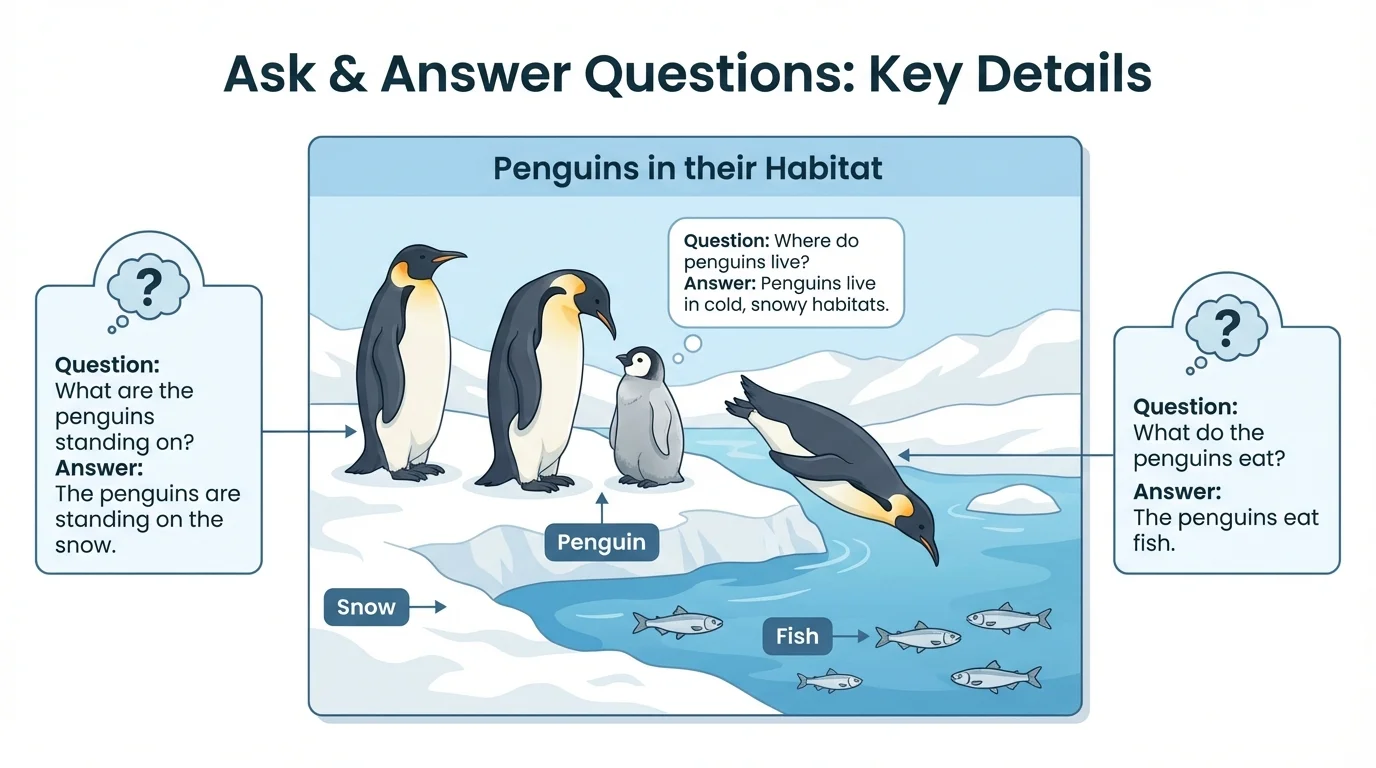
Pictures do not replace the text, but they help explain it. We can look for shapes, places, animals, labels, and actions in the picture.
When readers go back to the penguin page in [Figure 3], they can answer more than one question, such as where penguins live and what they eat, because both the words and the illustration give useful clues.
Sometimes we hear a text once and still need help. That is okay. We can listen again. We can ask another question. We can think again about the key details.
A teacher might ask, "What was this page mostly about?" Then the teacher might ask, "What detail tells us more?" These little helps guide us toward the answer.
Example: Answering questions about a text on dogs
Step 1: Hear the text.
The text says, "Dogs can use their noses to smell many things."
Step 2: Listen to the question.
"What do dogs use to smell?"
Step 3: Answer with a key detail.
"Dogs use their noses."
The answer uses an important detail from the text.
Asking and answering questions helps us become careful readers. We learn to notice important information, use the text, and talk about what we learn.
