Have you ever heard a word in a book that felt like a tiny mystery? Good readers do not get stuck when that happens. They wonder, they look for clues, and they ask questions. That is how readers learn new words and understand the text better.
Sometimes a book teaches us about animals, weather, plants, or machines. This kind of book is called an informational text. Informational texts give true facts. Because they teach new ideas, they often have new words too.
An unknown word is a word you do not know yet. That is okay. Every reader learns new words. What matters is what you do next. You can ask questions to help your brain think.
Unknown word means a word a reader does not know yet.
Question means something we ask because we want to know more.
Clue means something that helps us figure out an answer.
When you hear or see a word you do not know, you can pause and think, "What could this word mean?" That simple question helps you keep learning.
An unknown word might be a long word, a new science word, or even a word you have heard before but do not understand in this book. Maybe the text says, "A penguin lives in a cold habitat." If you do not know the word habitat, that is the word to think about.
You do not need to know every word right away. Good readers notice the tricky word and keep thinking. They ask, "Is this a place, a thing, or an action?" They ask, "What is happening in the sentence?"
Asking helps understanding
When readers ask questions about a new word, they are not just learning one word. They are also helping themselves understand the whole sentence and the whole text. One new word can unlock a big idea.
If the text is about bears, and it says, "Bears hibernate in winter," you may ask, "What does hibernate mean?" Then you listen to the rest of the sentence and think about what bears do in winter.
You can ask simple questions when you find a new word. These questions are helpful because they point your eyes and ears to the best clues.
Here are some good questions to ask:
These questions help you become an active reader. Active readers do not just look at words. They think while they read.
Many words in books are learned from reading again and again. The more you read and ask questions, the more your vocabulary grows.
You can also answer your own question with a short idea. For example, "I think enormous means very big." Your answer does not have to be perfect at first. It just needs to fit the text.
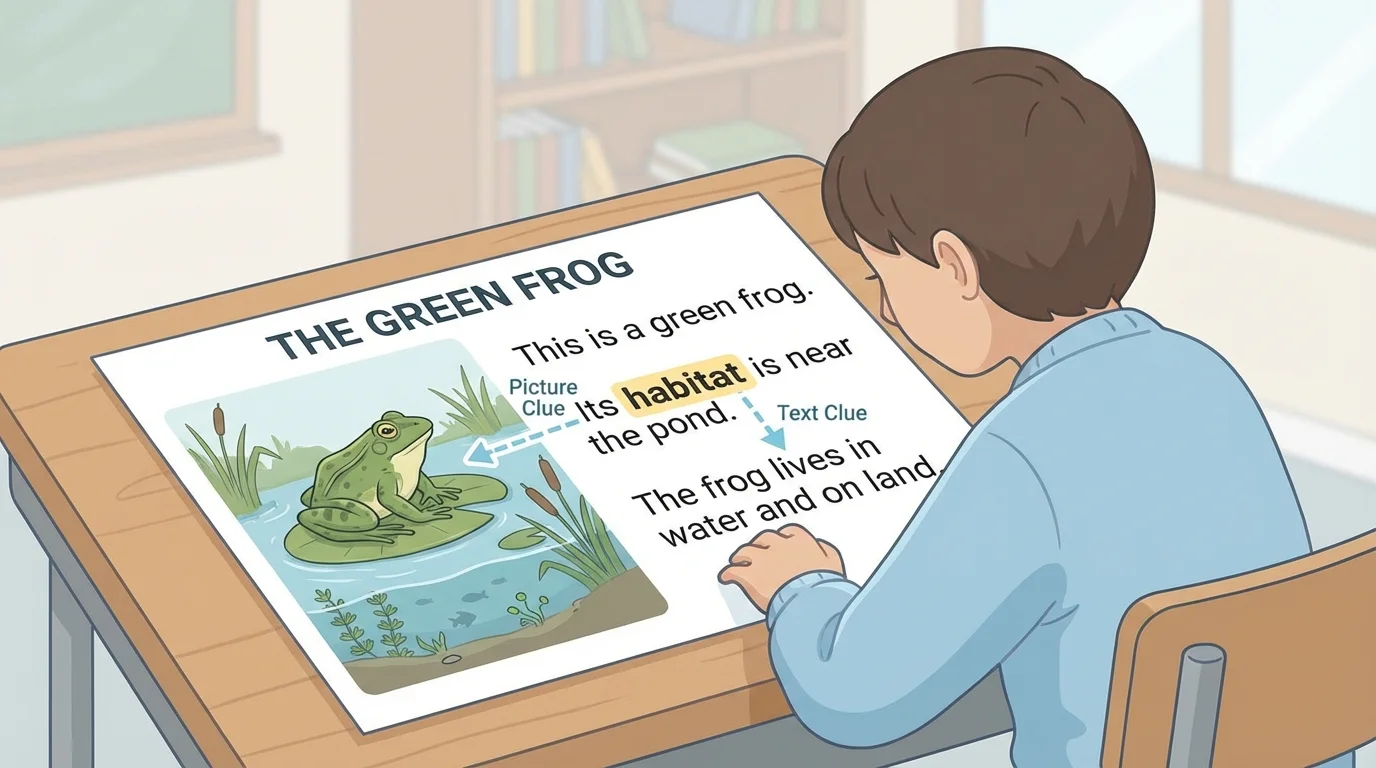
[Figure 1] Readers use context clues to help figure out a word. Context clues are hints from the picture, the words around the unknown word, and the whole idea of the page.
If a page shows a frog sitting near water and the sentence says, "A frog's habitat may be a pond," the picture and the sentence both help. You can ask, "Is habitat the place where the frog lives?" That answer makes sense.
Sometimes a clue is in a word that comes right after the unknown word. For example: "The cub was tiny, or very small." The words very small help explain tiny.
Sometimes the whole sentence helps. If the text says, "The sun is enormous. It is much bigger than Earth," the words much bigger help you understand that enormous means very big.
Pictures are important in many kindergarten texts. Labels, diagrams, and photos can help too. Later, when you see a new animal word again, you can remember how the clues worked in the example.
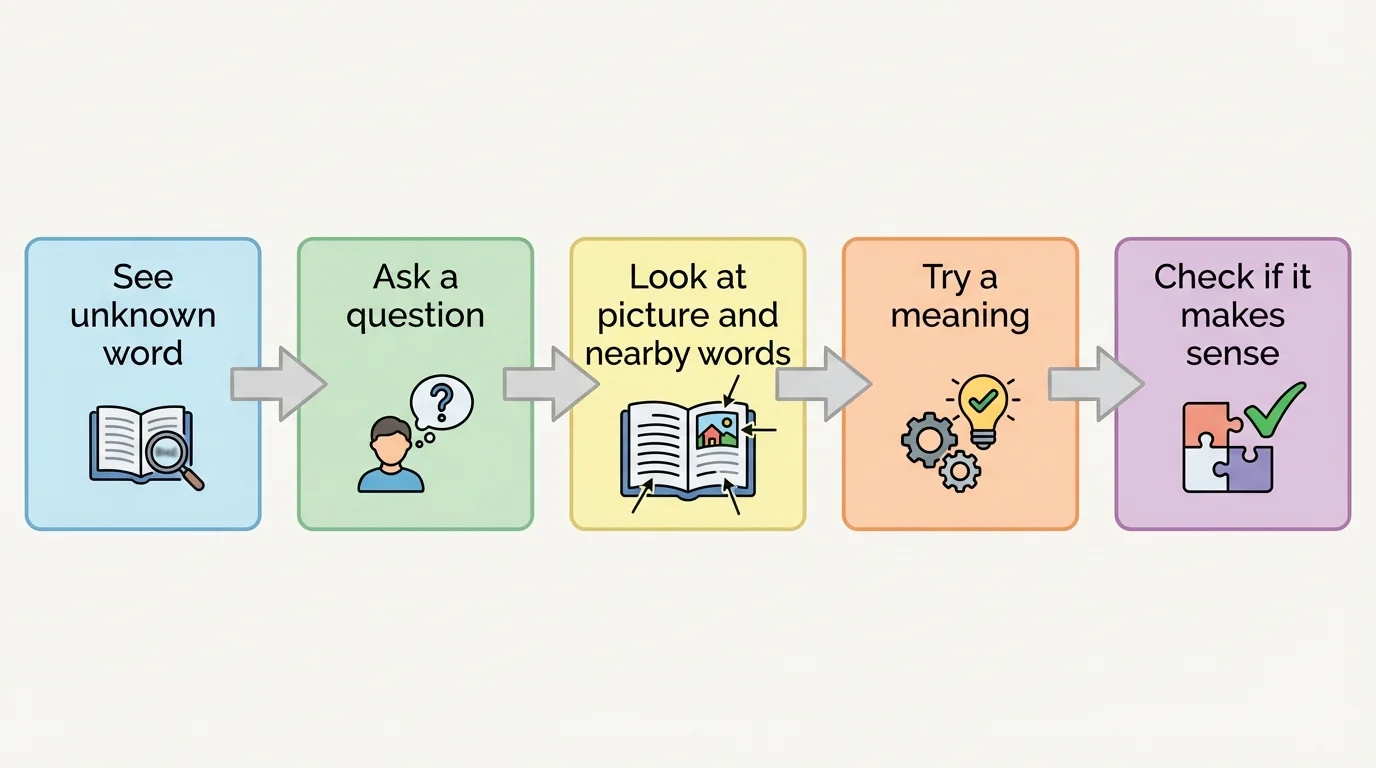
There is a simple way to work through a new word. First notice the word. Next ask a question. Then look for clues. After that, try a meaning and check whether it makes sense.
[Figure 2] Let's look at short examples from informational reading.
Example 1
Text: "Bees collect nectar from flowers."
Step 1: Notice the unknown word.
The word nectar may be new.
Step 2: Ask a question.
"What is nectar?"
Step 3: Use clues.
The sentence says bees collect it from flowers. So nectar is something in flowers that bees get.
Step 4: Answer.
"Nectar is something bees get from flowers."
That answer may not use a dictionary definition, but it shows understanding. For beginning readers, a simple meaning that fits the text shows good thinking.
Example 2
Text: "Owls observe the woods at night."
Step 1: Ask the question.
"What does observe mean?"
Step 2: Think about the sentence.
Owls are looking around at night.
Step 3: Answer.
"Observe means watch or look at."
Here, the action in the sentence helps. The owl is doing something with its eyes, so observe is about watching carefully.
Example 3
Text: "The seed begins to sprout after rain."
Step 1: Ask a question.
"What does sprout mean?"
Step 2: Use what the text is about.
The sentence is about a seed after rain. Seeds start to grow.
Step 3: Answer.
"Sprout means start to grow."
The same steps can be used again and again. That is why the process in [Figure 2] is so useful during reading.
Sometimes you ask a question, look for clues, and still feel unsure. That is normal. Then you can reread, listen again, or ask a teacher, family member, or reading partner.
You might say, "I do not know this word yet. Can you help me?" That is what thoughtful readers do. They keep learning.
You already know how to look at pictures, listen to words, and talk about what a text means. Those same reading habits help you figure out new words.
Some informational books also have labels, bold words, or a little word list. Those parts can help explain a new word. The important thing is not to give up when a word is new.
When you ask and answer questions about unknown words, you understand more of the book. You learn facts more clearly. You also grow your vocabulary one word at a time.
If you know what words like habitat, observe, and sprout mean, the whole text becomes easier to understand. New words are not roadblocks. They are doors to new learning.
"Good readers ask questions."
Each time you stop, wonder, and use clues, you are doing the work of a strong reader. You are learning how words help tell true ideas about the world.
