Have you ever told someone about your dog, your classroom, or a birthday party, and they smiled because they could picture it in their minds? That is how good descriptions work. When we describe, we use words to help other people know what we are talking about.
To describe means to tell what someone or something is like. We can describe using words about color, size, shape, sound, feeling, action, and place. We can also tell what happened.
Describe means to tell about someone or something by giving details. A detail is a small piece of information that helps listeners understand more.
When we speak, we want our listener to understand us. Instead of saying, "It was nice," we can add more detail. We can say, "It was a nice park with green grass and a tall slide." The extra words make the idea clearer.
We can describe a person we know, such as a family member, a friend, or a teacher. Good describing words help listeners make a picture in their minds, as [Figure 1] shows. We can tell who the person is, what the person looks like, what the person likes, and what the person does.
A person description might include hair color, clothes, feelings, or actions. We can say, "My dad is tall. He has brown hair. He wears a blue hat. He likes to read stories." We can also say, "My friend Ava is kind. She has curly hair. She runs fast at recess."
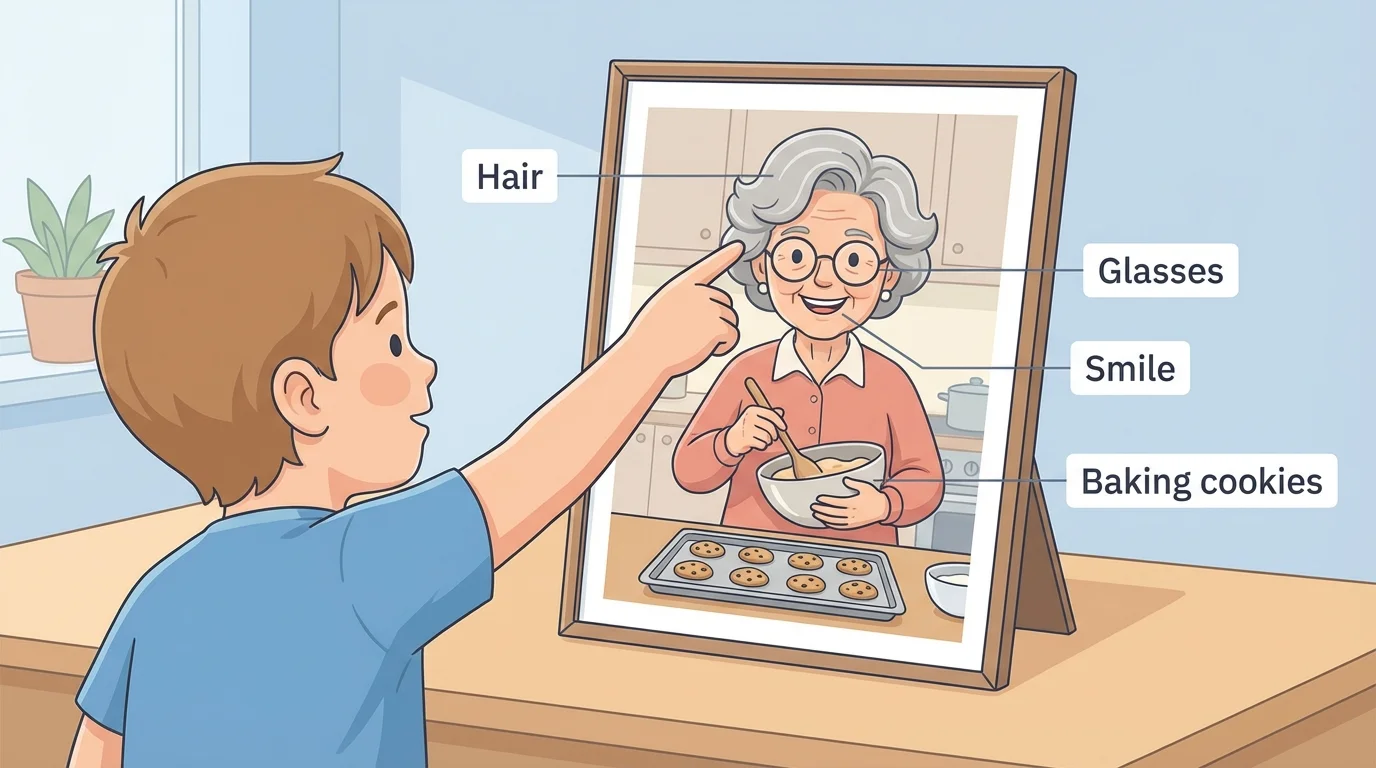
Sometimes we add details about how the person is special to us. We might say, "My grandma makes warm soup," or "My teacher helps me learn letters." These details help the listener know more than just what the person looks like.
Example: describing a familiar person
"My sister is little and funny. She has black hair and a big smile. She likes pink shoes. She sings in the car."
Notice how that description gives more than one detail. It tells about looks, personality, and actions. That is stronger than only saying, "My sister is nice." As we saw in [Figure 1], adding details helps the listener picture the person more clearly.
[Figure 2] A place is where something happens. It can be your home, your classroom, a park, or a store. When we describe a place, we can tell where it is and what we see there.
We can use words about what the place looks like, sounds like, or feels like. We might say, "My classroom has bright walls, little tables, and a big rug." Or we might say, "The park has swings, a slide, and birds in the trees."
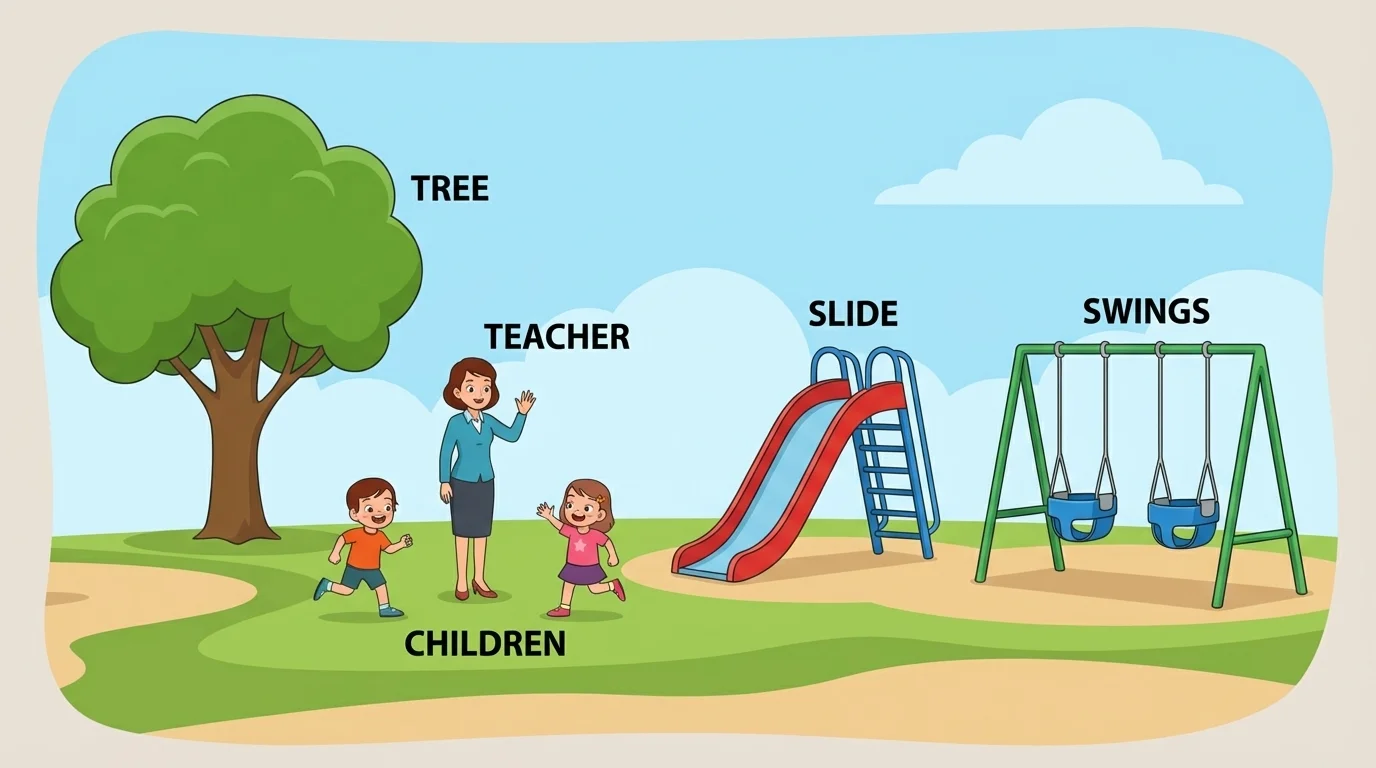
Places can also be quiet, loud, busy, or calm. A child might say, "The library is quiet and has many books," or "The kitchen smells like cookies when my mom bakes." Those details help make the place come alive in the listener's mind.
Strong descriptions often tell what happens in the place too. "At my grandma's house, we read books on the couch," gives more information than just, "Her house is big." Later, when we speak about events, the setting of the place still matters, just like the playground details in [Figure 2] help explain what children do there.
A thing can be a toy, a book, a snack, or something from nature. We can describe things by telling their color, size, shape, texture, and use.
For example, a child might say, "My ball is red, round, and bouncy." Another child might say, "My blanket is soft and warm." These describing words tell what the thing is like.
Good describing words help us say more. Words like big, small, soft, rough, shiny, cold, and sweet give the listener better information.
We can also tell what the thing does or why it matters. "My teddy bear is soft and brown. I sleep with it every night," gives both details and meaning. A good speaker stays on one topic and gives details that match that topic.
[Figure 3] An event is something that happens, like a trip, a party, a game, or story time. Events are easier to describe when we tell them in order. We can use words like first, next, and last.
For example, a child might say, "First we got to the party. Next we sang a song. Last we ate cake." That helps the listener understand what happened and when it happened.
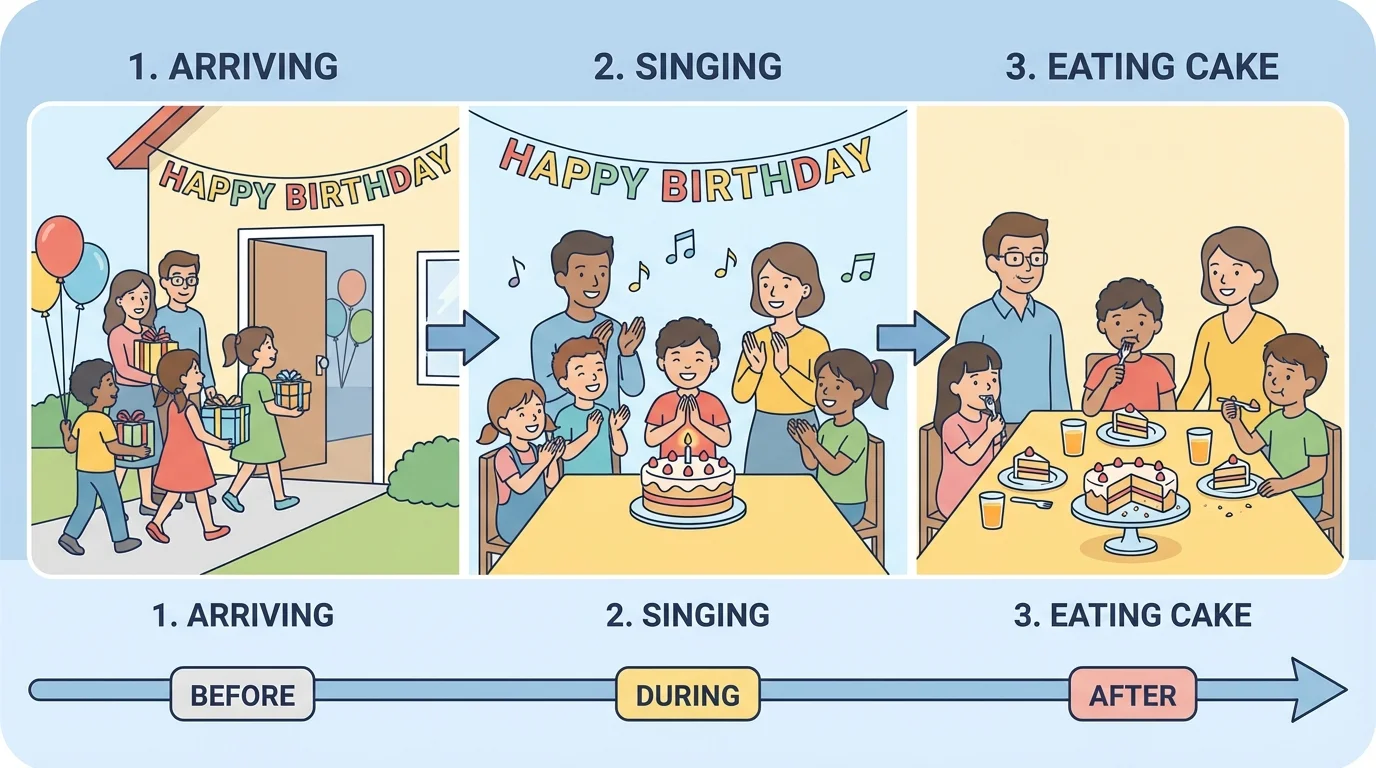
We can add more details to make the event clearer. "First we got to the party and saw balloons. Next we sang to my cousin. Last we ate chocolate cake." Now the listener knows more about the event.
Example: adding details to an event
Short description: "I went to the zoo."
Better description: "I went to the zoo with my class. I saw a tall giraffe, loud monkeys, and a sleepy lion."
Order words help us stay clear, and extra details help us stay interesting. The sequence in [Figure 3] reminds us that events are not just about what happened, but also when each part happened.
Sometimes a teacher, parent, or friend helps us say more. This is called getting prompts and support. A grown-up might ask, "What color was it?" "Who was there?" or "What happened next?" These questions help us add details.
If a child says, "I saw a dog," a helper might ask, "What did the dog look like?" Then the child can say, "It was small, brown, and fluffy." If a child says, "I went somewhere," a helper might ask, "Where did you go?" Then the child can say, "I went to the park with my mom."
Listeners understand much more when a speaker adds just one or two extra details. Small details can make a big difference.
Good listening is important too. When we listen carefully, we can answer the question that was asked. We can also notice how other people describe things and learn new words from them.
When we talk, we try to speak in complete sentences. Instead of one word, we can say a full sentence. Instead of "Blue," we can say, "My backpack is blue." Instead of "Park," we can say, "I play at the park after school."
Speaking clearly means using a voice that others can hear, looking at the listener when we can, and saying enough words to explain our thinking. We do not have to say everything at once. We can begin with a simple idea and then add another detail.
A strong description often answers simple questions: Who? What? Where? What is it like? What happened? These questions help us improve our speaking.
| What we describe | Helpful details |
|---|---|
| People | looks, feelings, actions, likes |
| Places | where, what we see, sounds, what happens there |
| Things | color, size, shape, texture, use |
| Events | first, next, last, who was there, what happened |
Table 1. Helpful details to use when describing people, places, things, and events.
As speakers grow, they learn to say more than one detail, stay on topic, and respond to helpful questions. That is how oral language becomes stronger.
