Have you ever said, "That is my favorite!"? Writers do that too. When we write an opinion piece, we tell what we think, what we like best, or what we choose. We can write about a book, a food, a game, an animal, or another topic we know. Good opinion writing helps a reader know what we are talking about and how we feel about it.
An opinion is what someone thinks or likes. One child may say, "I like red." Another child may say, "I like blue." Both are opinions. An opinion is not the same as the topic. The topic is what the writing is about. If the topic is apples, the opinion might be "I like red apples best."
Opinion means what you think or how you feel about something. Topic means what your writing is about. If you write about a book, the book is the topic. If you say you like it best, that is your opinion.
Sometimes we write about a book. Then we should tell the reader the name of the book. For example, "My favorite book is The Very Hungry Caterpillar." Now the reader knows the book. Then we add the opinion: "I like it because the pictures are bright."
Young writers make pieces in more than one way. We can use drawing, dictating, and writing. These three ways work together, as [Figure 1] shows. A picture can show the idea, spoken words can tell the sentence, and written words can help the reader know the message.
A drawing helps show the topic. If you are writing that your favorite book is about a caterpillar, you might draw the caterpillar and the book cover. If you are writing that you like swings best, you might draw yourself on a swing. The picture should match the opinion.
Dictating means saying your words out loud for someone else to write. A child might say, "My favorite book is Brown Bear, Brown Bear, What Do You See?." The adult writes the words the child says. This helps children share big ideas even before they can write every word by themselves.
Writing means adding letters, words, labels, or a sentence. A child might write "book," "bear," or "I like it." Even a few letters that match the sounds in the words are part of early writing. Writers can use drawing, dictating, and writing all on one page.
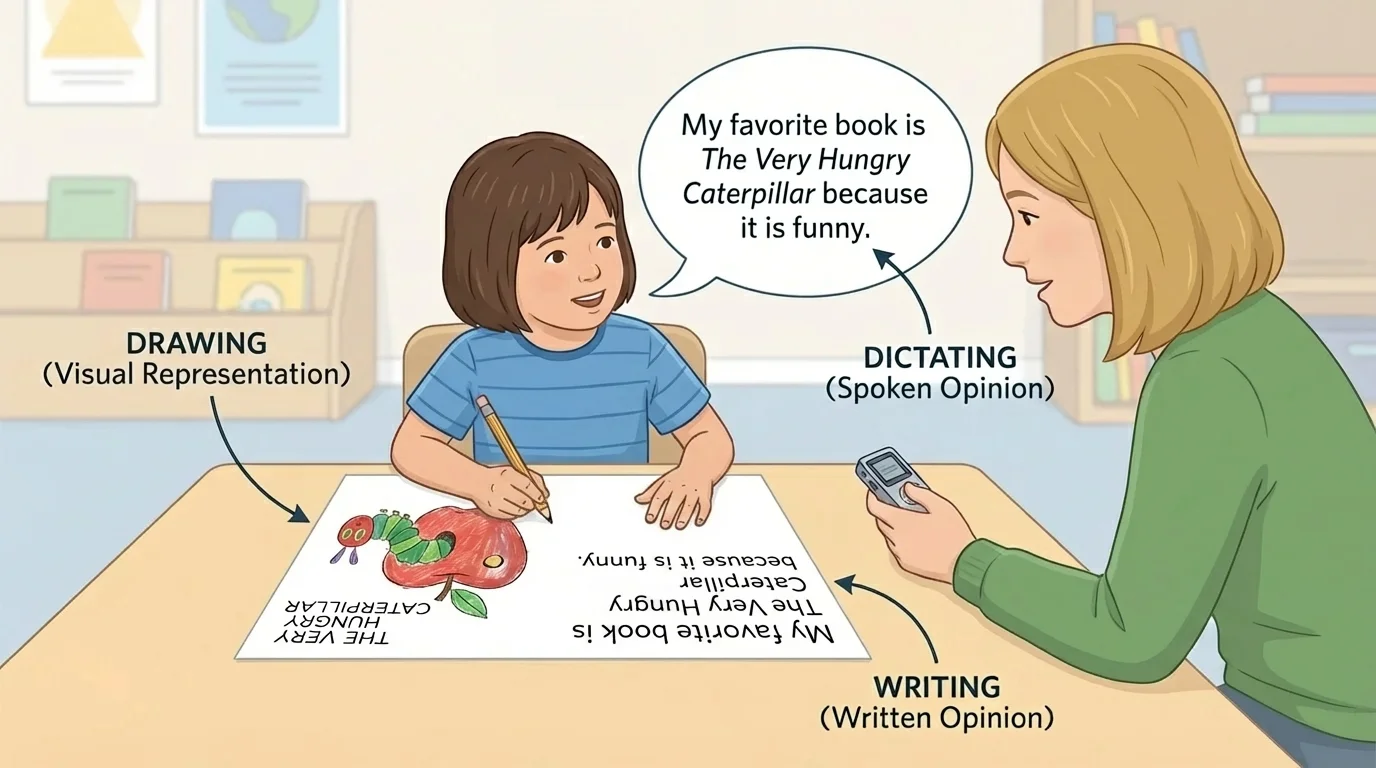
When we use all three parts, our message becomes stronger. The drawing shows, the spoken words explain, and the writing helps the reader read our idea. That is why opinion pieces in early writing often include all of them together.
A strong opinion piece tells the reader what it is about right away. If you are writing about a book, name the book. If you are writing about a thing, name the thing. You can start with sentence frames like these:
My favorite book is...
I like...
I like this book: ...
My favorite animal is...
These beginnings help the reader know the topic quickly. For example, "My favorite book is Goodnight Moon." Or, "I like dogs." Or, "My favorite snack is apples." Each one names the topic first.
Naming the topic first helps your reader understand your opinion. If the reader knows what you are writing about, the opinion makes sense right away. First say the book or topic. Then tell what you think.
Labels can help too. A child can label a drawing with words such as "book," "dog," "apple," or the book title. Labels are small words that tell what parts of the picture are. They support the main opinion.
After you tell the topic, say your opinion clearly. A preference is what you like better or best. You can say, "My favorite book is Caps for Sale." You can say, "I like ice cream best." You can say, "I like rain boots because they splash in puddles."
Opinion sentences can be short and strong. Here are some examples:
My favorite book is Chicka Chicka Boom Boom.
I like cats best.
I like painting.
My favorite fruit is bananas.
Sometimes writers add a reason. A reason tells why. For example, "My favorite book is Llama Llama Red Pajama because it is funny." The reason is not always long. Even one simple reason helps the reader understand the opinion better.
Some of the shortest sentences can still be strong opinion writing. A sentence like "I like trucks best" clearly tells the topic and the writer's choice.
If two children have different opinions, that is okay. One child may like one book, and another child may like a different book. Opinion writing shares what you think.
An opinion page has parts that work together, as [Figure 2] illustrates. One part tells the topic or the book name. One part tells the opinion. One part shows the idea with a picture, labels, or both.
For example, a child may draw the cover of Pete the Cat, write "Pete," and say, "My favorite book is Pete the Cat." That is an opinion piece. Another child may draw a soccer ball and write, "I like soccer." That is also an opinion piece.
The picture and words should match. If the sentence says "My favorite book is The Snowy Day," the drawing should be about that book, not a zoo. Matching details help the reader understand the writing.
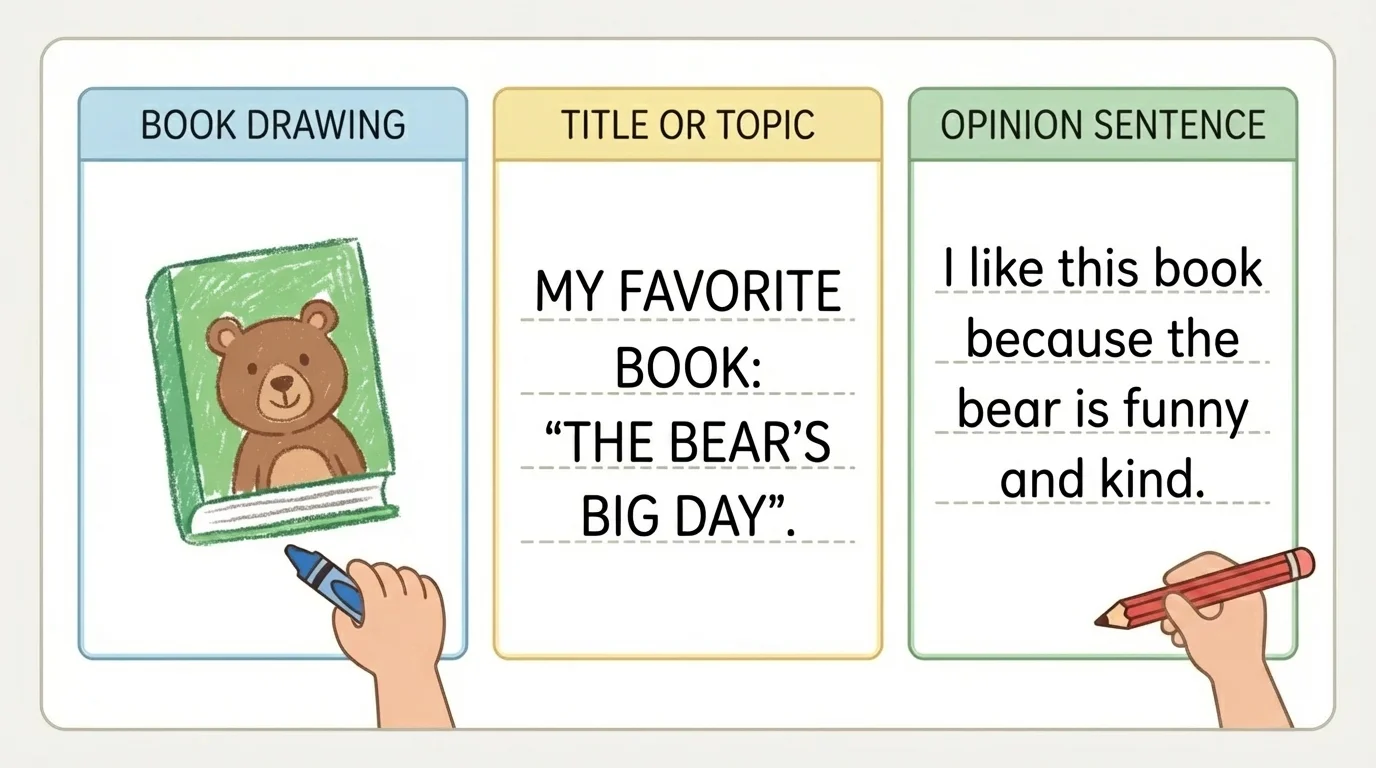
Writers do not need many sentences to make an opinion piece. One clear sentence, a matching drawing, and a label can be enough. What matters most is that the reader can tell the topic and the writer's opinion.
As we saw earlier in [Figure 1], a child can use speaking and writing together. A student might dictate a full sentence and then write one or two important words alone. That still counts as composing a complete opinion piece.
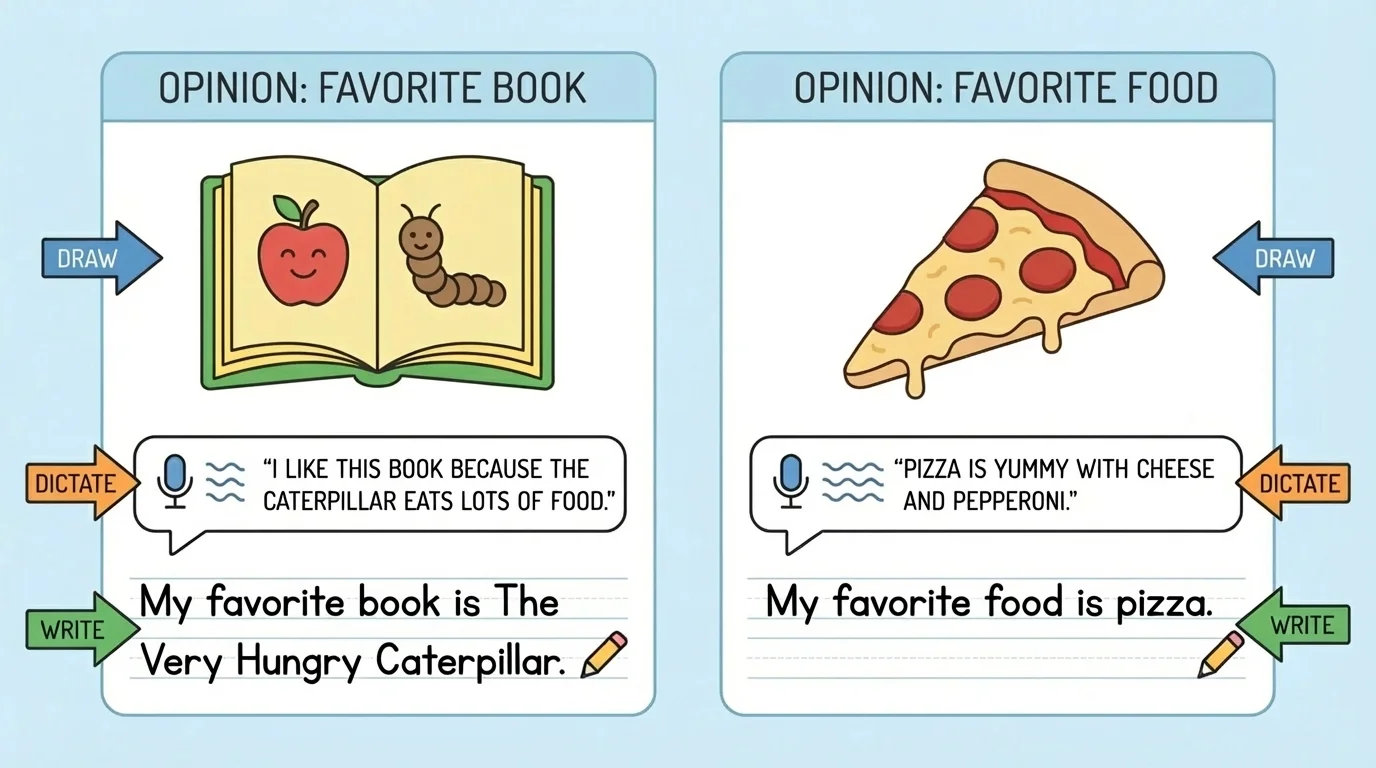
Different kinds of pages can show opinions, and [Figure 3] presents simple examples. One page may be about a favorite book. Another may be about a favorite food. In both cases, the writer names the topic and tells what they like.
Example about a book: "My favorite book is Where the Wild Things Are." The child draws the book and labels it "book." The reader knows the topic and the opinion.
Example about a food: "I like pizza best." The child draws a slice of pizza and writes "pizza." That page also shares a clear opinion.
Sample opinion piece ideas
Step 1: Name the topic.
"My favorite book is Frog and Toad."
Step 2: Tell the opinion.
"I like it best."
Step 3: Add a picture or label.
Draw Frog and Toad and add a label such as "book."
This makes a complete early opinion piece.
Another example might say, "I like teddy bears." The picture shows a teddy bear. The label says "bear." A child may also dictate, "It is soft." The page now has a topic, an opinion, and a supporting detail.
Later, the same idea from [Figure 2] still helps us: the parts should fit together. The sentence, labels, and drawing all need to match the same topic.
Opinion writing is for someone to hear or read. That is why we think about the audience. The audience may be a teacher, a family member, or classmates. When we say the topic clearly and state our opinion, the audience understands our message.
Sometimes children read their opinion piece aloud. They might point to the picture, say the book name, and read the sentence. This helps them connect spoken language with writing. It also reminds them that writing shares ideas with other people.
You already know how to draw a picture and tell about it with words. Opinion writing uses that same skill and adds one important idea: tell what you think or like.
When writers keep the topic clear and say their opinion simply, their writing is easy to understand. A favorite book, a favorite snack, or a favorite animal can all become strong opinion writing when the page includes a matching picture, clear words, and a clear choice.
