Have you ever drawn a picture and then heard a friend say, "Tell me more"? That is something writers experience all the time. Writers do not have to do everything alone. They can listen, think, and make their work even better.
When young writers share ideas, they often use drawings, labels, and spoken words. A writer may draw a favorite food, toy, pet, or place. Then the writer may add a label like "dog" or tell an adult a sentence to write down. This kind of writing can show an opinion, which is what the writer thinks or feels.
A opinion is a feeling or choice. A child might say, "I like apples," or "My red boots are the best." Writers can show this opinion in a picture and add words to help others understand.
Respond means to answer with words or actions. Suggestion means an idea that may help. Detail means an extra part that gives more information.
Sometimes a drawing or label is a good start, but it may need more. Writers can make their work stronger by adding one more idea, one more label, or one more sentence.
Friends can help writers grow, as [Figure 1] shows in a sharing time. A peer may ask a question like, "What is this?" "Why do you like it?" or "What color is it?" A peer may also give a kind suggestion such as, "You can add a label," or "You can draw the tail."
These questions and suggestions are not meant to be mean. They help the writer think more carefully. Sometimes another person notices something the writer forgot to say.
An adult, like a teacher, can help the writer listen carefully. The adult may repeat the question slowly, help the child answer, or ask, "What detail can you add?" This support helps the writer know what to do next.
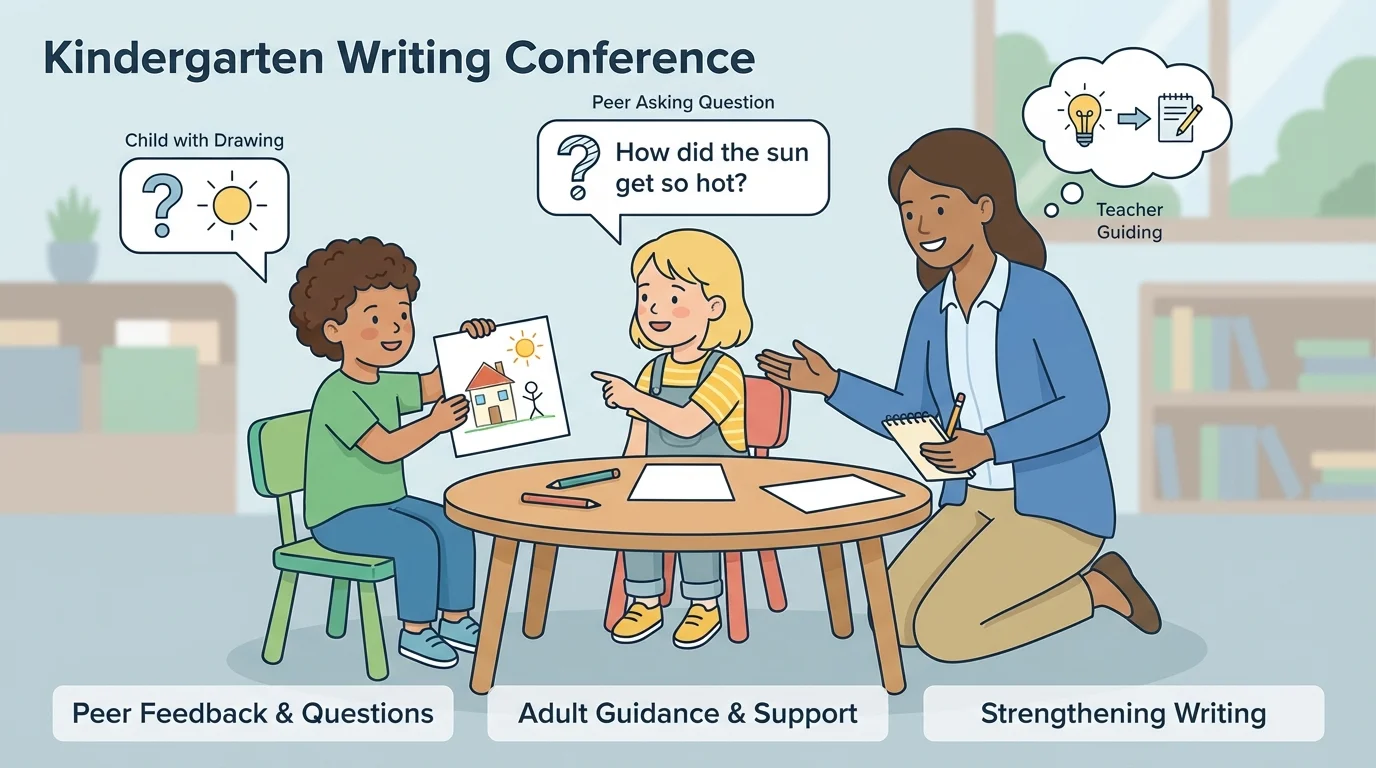
Questions may be simple. "What is your favorite part?" "Where is the cat?" "Can you tell why you chose this?" Suggestions may also be simple. "Add a color word." "Draw the ball." "Tell more about your favorite part."
A writer does not need a big answer. A writer can respond in simple ways. The writer can say, "It is a puppy." The writer can say, "I like it because it is soft." The writer can nod, point, add to the picture, or ask an adult to help write the words.
Sometimes the writer agrees with the suggestion. If a friend says, "Add the sun," the writer might think, "Yes, the sun is in my picture," and add it. Sometimes the writer may keep the writing as it is. With adult help, the writer learns to decide what makes the writing clearer.
Writers listen, think, and choose. Good writers do not just change everything. They listen to a question or suggestion, think about what their message is, and choose a detail that helps the reader understand their opinion better.
Adults give support by helping writers use kind words. A teacher may say, "My friend is asking about your picture. Can you tell one more thing?" Then the child can answer and add a new part.
Details help a reader know exactly what the writer means, and [Figure 2] shows how a simple piece can grow. If a child draws a dog and says, "I like my dog," the writing becomes stronger when the child adds details such as "brown dog," "soft ears," or "runs fast."
Details can be added in different ways. A writer can add a label to the picture. A writer can draw more parts. A writer can dictate a sentence for an adult to write. A writer can even add a reason, like "I like my dog because he plays with me."
Opinion writing often gets stronger when the writer tells why. The reason helps others understand the opinion. Instead of only saying, "I like ice cream," the writer can add, "I like ice cream because it is cold and sweet."
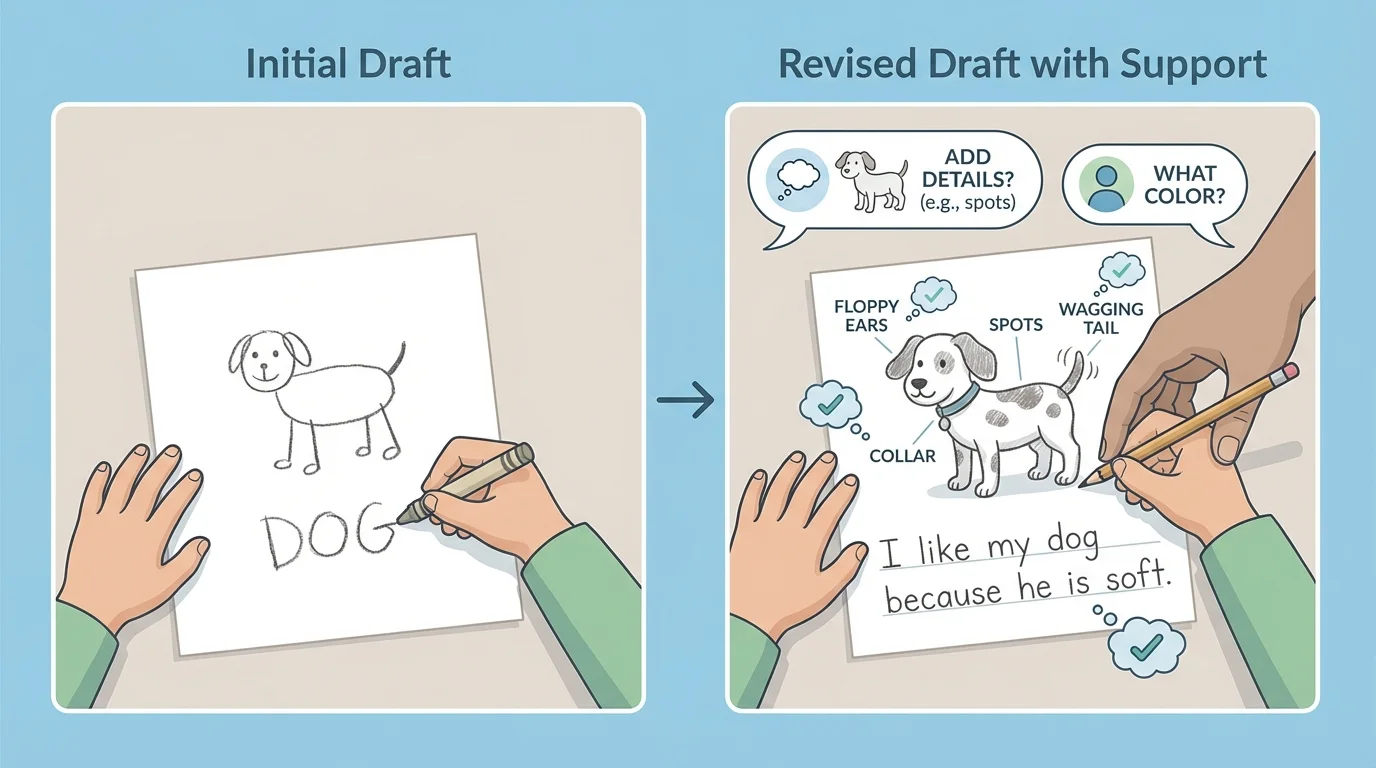
Even one new label or one new spoken sentence can make writing easier to understand. Small changes can make a big difference.
Many authors revise their work again and again. Even adult writers ask other people to read their writing and share ideas.
When children revise, they are doing real writing work. They are learning that first ideas are important, and better ideas can come after talking and listening.
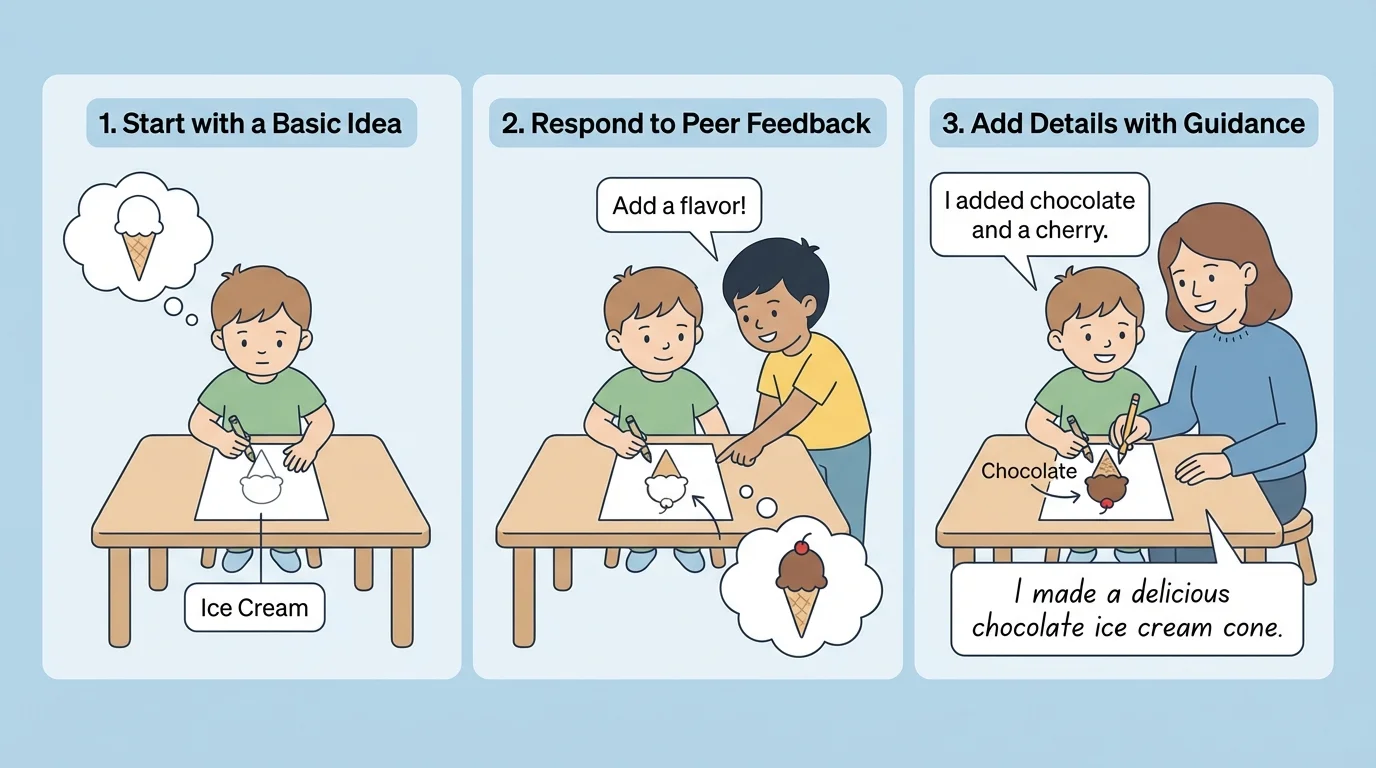
Here is a simple example that follows the change from first draft to stronger writing. A child draws ice cream and says, "I like ice cream." That is a clear opinion. Then a friend asks, "What kind?" Another friend says, "Add your favorite flavor."
Example: Making an opinion piece stronger
Step 1: First writing
The child draws one scoop and says, "I like ice cream."
Step 2: Listen to peers
A friend asks, "What flavor is it?" Another says, "You can add a color."
Step 3: Get adult help
The teacher helps the child answer: "It is chocolate."
Step 4: Add details
The child colors the scoop brown, adds a label, and dictates: "I like chocolate ice cream because it is delicious."
The new writing is stronger because it has an opinion, a detail, and a reason.
[Figure 3] The writer did not begin again. The writer kept the main idea and added more. That is what revision means. Revise means to make writing better by changing or adding something.
Later, the same kind of thinking can help with other topics. A writer about a favorite animal can add fur color, body parts, and a reason for liking it.
Writers and peers should speak kindly. Helpful words sound like "Can you tell more?" "I like your picture." "Maybe add a label." Kind words help everyone feel safe and ready to learn.
A peer is another student. Peers can be good helpers because they look at writing with fresh eyes. A label is a word that names part of a picture. A label can help the reader know what the writer drew.
Adults support writers by guiding the talk. They help children take turns, answer questions, and choose details that match the opinion. With support, young writers learn that talking, listening, drawing, and adding words all work together.
Every time a child listens to a question, answers a friend, and adds a detail, that child is growing as a writer. Strong writing can begin with one picture, one idea, and one helpful conversation.
