Have you ever heard a favorite story so many times that you can almost tell it by yourself? That is what children begin to do as they learn to understand stories. When we retell a story, we tell it again using the important parts. We do not have to say every single word. We remember the big ideas and tell them in order.
A retell is when you say a story again after hearing it or reading it. You can use your own words. A good retell helps a listener know what happened in the story.
Retell means to tell a story again. Key details are the important parts that help us understand the story.
When children retell, they often need help. A teacher, parent, or friend may ask questions like, "Who was in the story?" or "What happened first?" That kind of help is called support. Support helps you remember and organize your ideas.
Stories have parts. They move in order, as [Figure 1] shows. First comes the beginning. Then comes the middle. Last comes the end. When we retell, we try to keep the story in that order.
The beginning tells who is in the story and where it happens. The middle tells the big things that happen. The end tells how the story finishes.
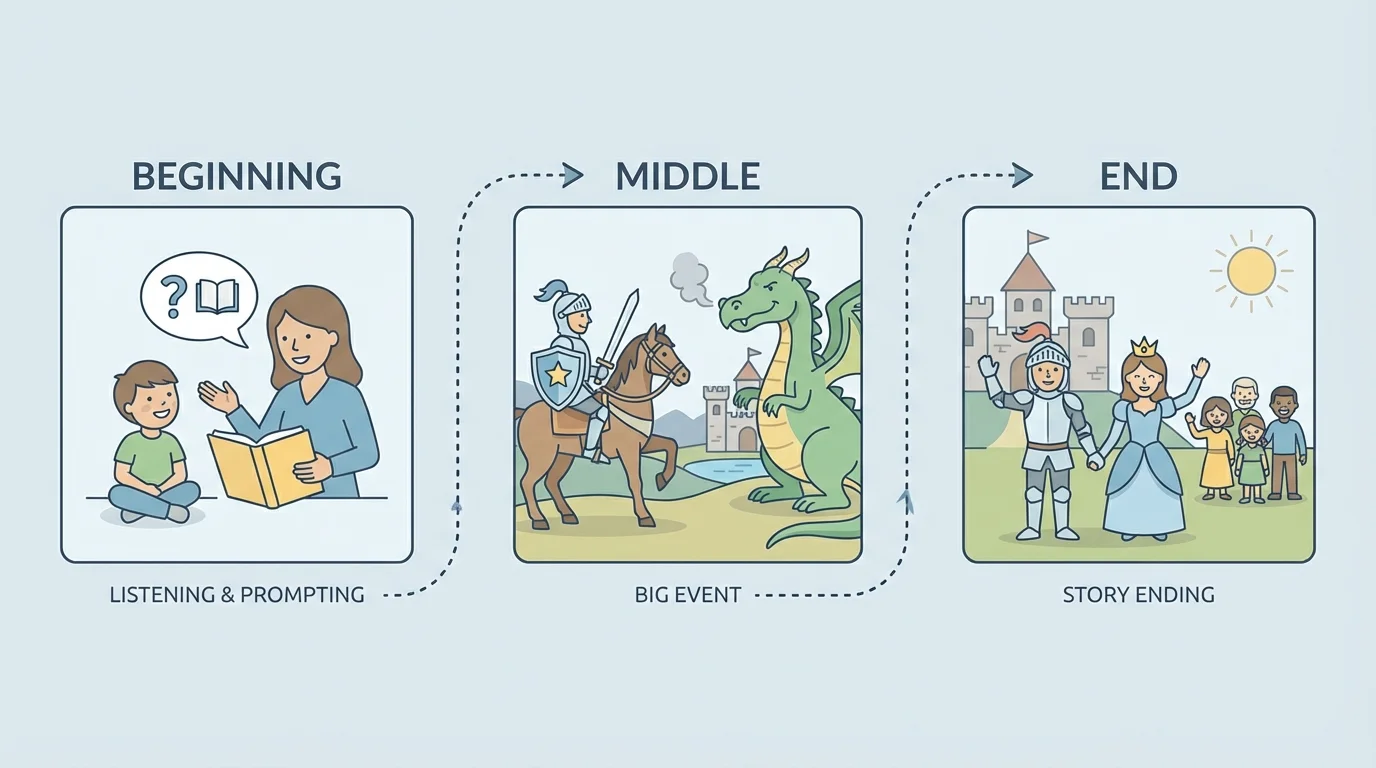
If a child says the ending before the beginning, the story can sound mixed up. Retelling in order helps the story make sense. You can think, "What happened first? What happened next? What happened last?"
For example, in a familiar story about a lost puppy, the beginning might tell that the puppy ran away from home. The middle might tell that people looked in many places. The end might tell that the puppy came back home safely.
Some parts of a story are extra, but some parts are very important. A story map, as [Figure 2] illustrates, helps us remember the most important details. These details help us make a strong retell.
Important details often include the character, the setting, the problem, the important events, and the ending. The character is who the story is about. The setting is where the story happens. The problem is what goes wrong or what needs to be solved.
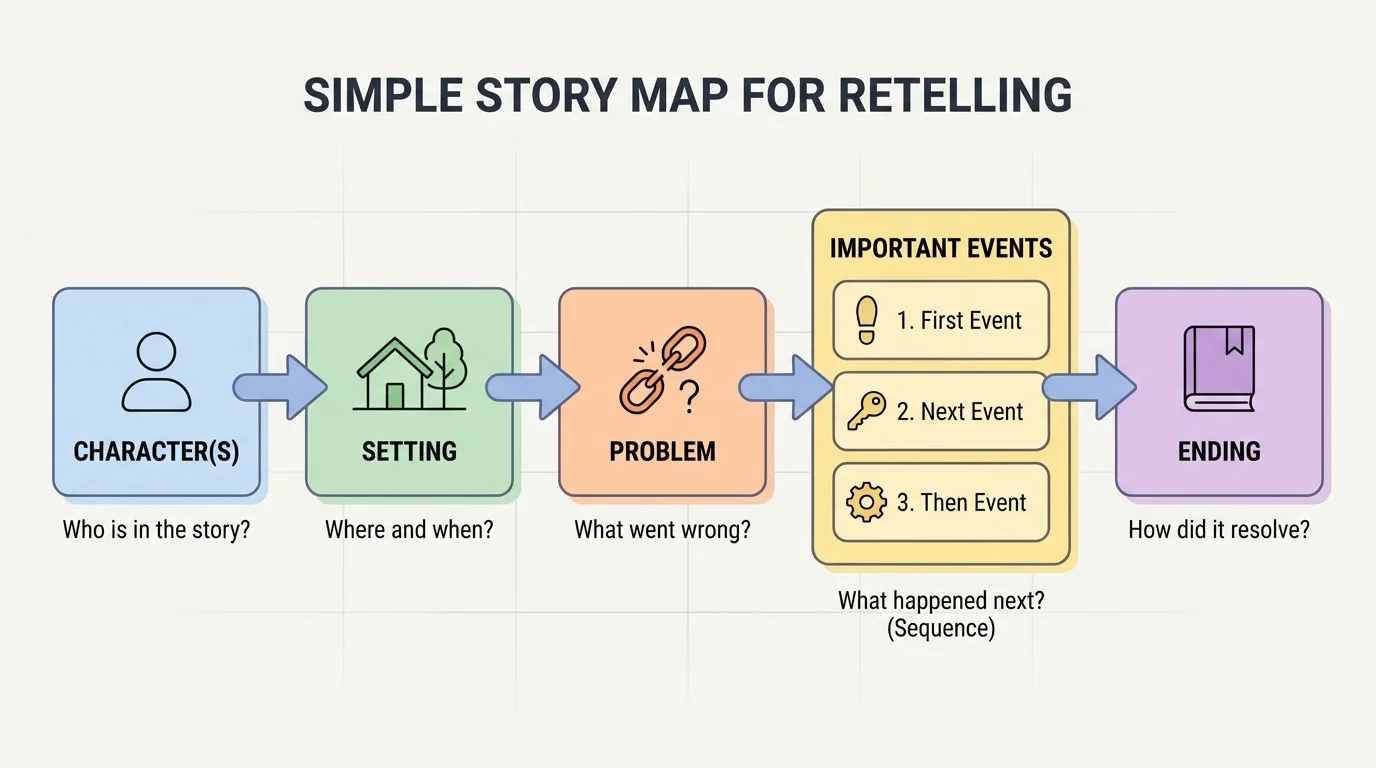
If you leave out key details, the listener may not understand the story well. For example, if you say, "The girl went there and then she did something," it is hard to know who the girl is or where she went. But if you say, "Little Red Riding Hood walked through the forest to Grandma's house," the listener understands much more.
Important details help the story stay clear. A retell does not need every tiny part, but it should include the most important people, places, and events. That way, the story sounds complete and makes sense.
Sometimes the support comes from looking at pictures in the book. A picture may remind you who was there, where the story happened, or what happened next.
Good retellers often use special words to show order. These words help the listener follow along. Helpful words include first, next, then, and last.
You can also use sentence starters such as "In the beginning...," "After that...," and "At the end..." These helpful phrases make retelling easier, especially when you are just learning.
Example retell starter
Here is a simple way to begin retelling a story:
Step 1: Name the story or character.
"This story is about Goldilocks."
Step 2: Tell what happened first.
"First, Goldilocks went into the bears' house."
Step 3: Tell the important middle events.
"Next, she tried the food and sat in the chairs. Then she fell asleep in a bed."
Step 4: Tell the ending.
"Last, the bears came home, and Goldilocks ran away."
Notice that the retell is short, clear, and in order. It includes big events instead of every tiny detail.
Sometimes it can feel hard to remember a whole story. That is okay. Young readers and listeners use clues to help them. They listen carefully, look at pictures, and answer questions.
A grown-up might ask, "Who was in the story?" "Where did it happen?" "What was the problem?" These questions are prompts. Prompts help your brain find the important parts. With prompting and support, children get stronger at retelling.
Many children can remember more story details when they look at pictures while they talk. Pictures help the brain connect words and events.
You can also remember by thinking about the story like a path. It starts somewhere, something happens, and it ends somewhere. This is the same idea we saw earlier in [Figure 1], where the story moves from beginning to middle to end.
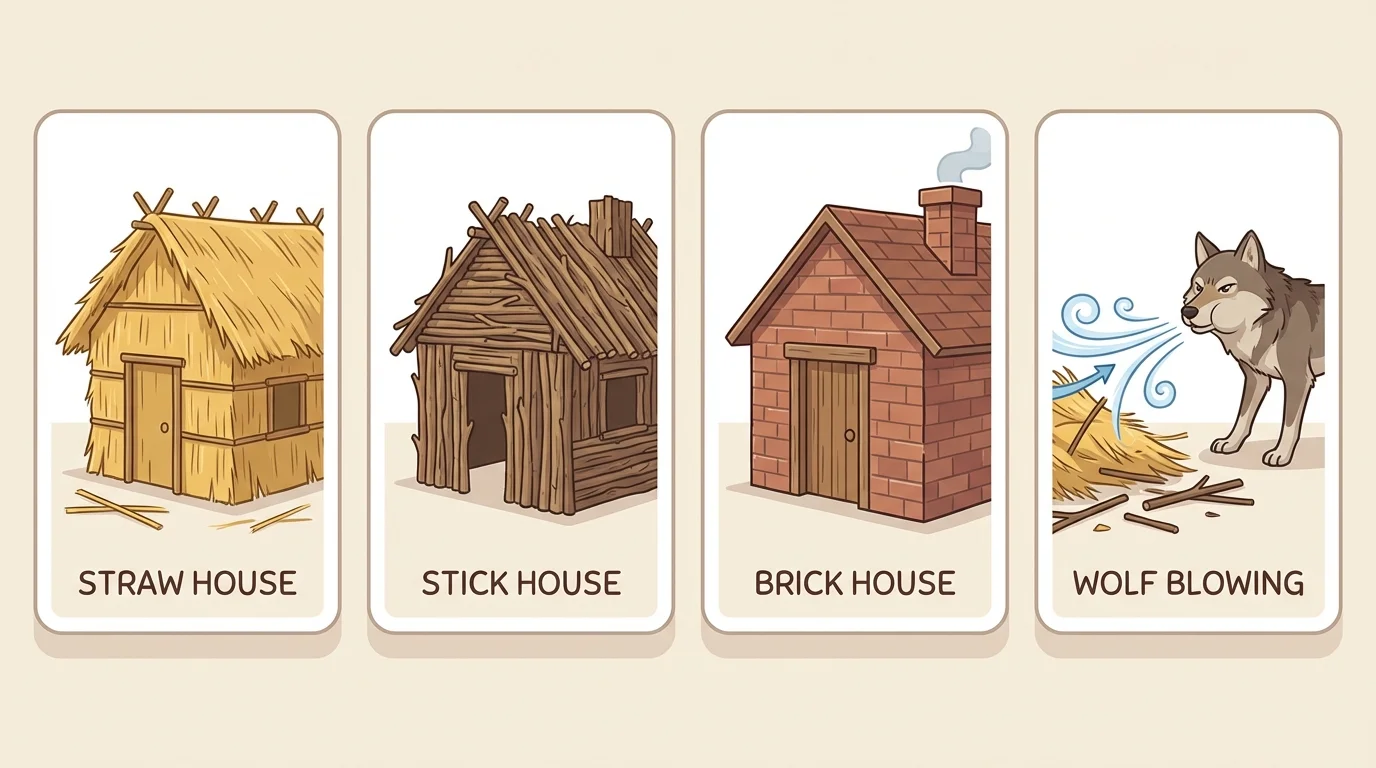
Picture cards help us tell a story in order, as [Figure 3] shows with one familiar tale. Looking at each card can remind us what to say next.
The Three Little Pigs is a good story to retell. A simple retell might sound like this: "First, the three little pigs built houses. One made a straw house, one made a stick house, and one made a brick house. Next, the wolf blew down the straw house and the stick house. Last, he could not blow down the brick house, and the pigs were safe."
Here is another example with Little Red Riding Hood: "First, Little Red Riding Hood went to take food to her grandma. Next, she met the wolf in the forest. Then the wolf got to Grandma's house first. Last, Grandma and Little Red Riding Hood were safe."
Both retells include important characters, where the story happens, and the big events. They do not need every word from the book. They need the key details.
As children learn, they may start with lots of support. A teacher may point to pictures, ask questions, or give sentence starters. Later, children can do more of the retell on their own.
That support does not mean the child is doing it wrong. It means the child is learning how stories work. Using a story map like the one in [Figure 2] helps children remember what to include, and picture cards like those in [Figure 3] help them keep events in order.
When you retell, try to remember: who was in the story, where it happened, what happened first, what happened next, and how it ended. Those are the pieces that make your retell strong and clear.
