Have you ever opened one book and found a silly adventure, then opened another and found words that bounce and rhyme, and then another that teaches true facts about animals? Books may all look a little alike on the outside, but inside they can be very different. Good readers learn to notice what kind of text they are reading or hearing. That helps them understand the words, pictures, and ideas.
A text is something we read or look at in order to get meaning. A text might be a book, a page, a poem, or a page with facts. Some texts tell made-up stories. Some texts share feelings and sounds. Some texts teach true information about the world.
When we recognize the type of text, we can think, "What is this trying to do?" A storybook usually tells about characters and what happens to them. A poem often uses special sounds and short lines. An informational text teaches facts about real things, such as weather, plants, or trucks.
Storybook is a text that tells a story with characters and events. Poem is a text that often uses short lines, rhythm, rhyme, or repeated words. Informational text is a text that gives true facts and teaches about a topic.
Readers do not have to guess wildly. They can look for clues in the words, pictures, and page design. These clues are part of how a text is made. They help us understand the text's job.
As [Figure 1] shows, a storybook usually tells about someone or something. It has characters, a place, and things that happen. In many storybooks, there is a beginning, a middle, and an ending.
Storybooks may be funny, exciting, gentle, or surprising. The pictures often help tell what is happening. If you see a bear baking a cake, a girl looking for her hat, or a puppy splashing in puddles, you are probably looking at a storybook. The words often tell what the characters say, do, and feel.
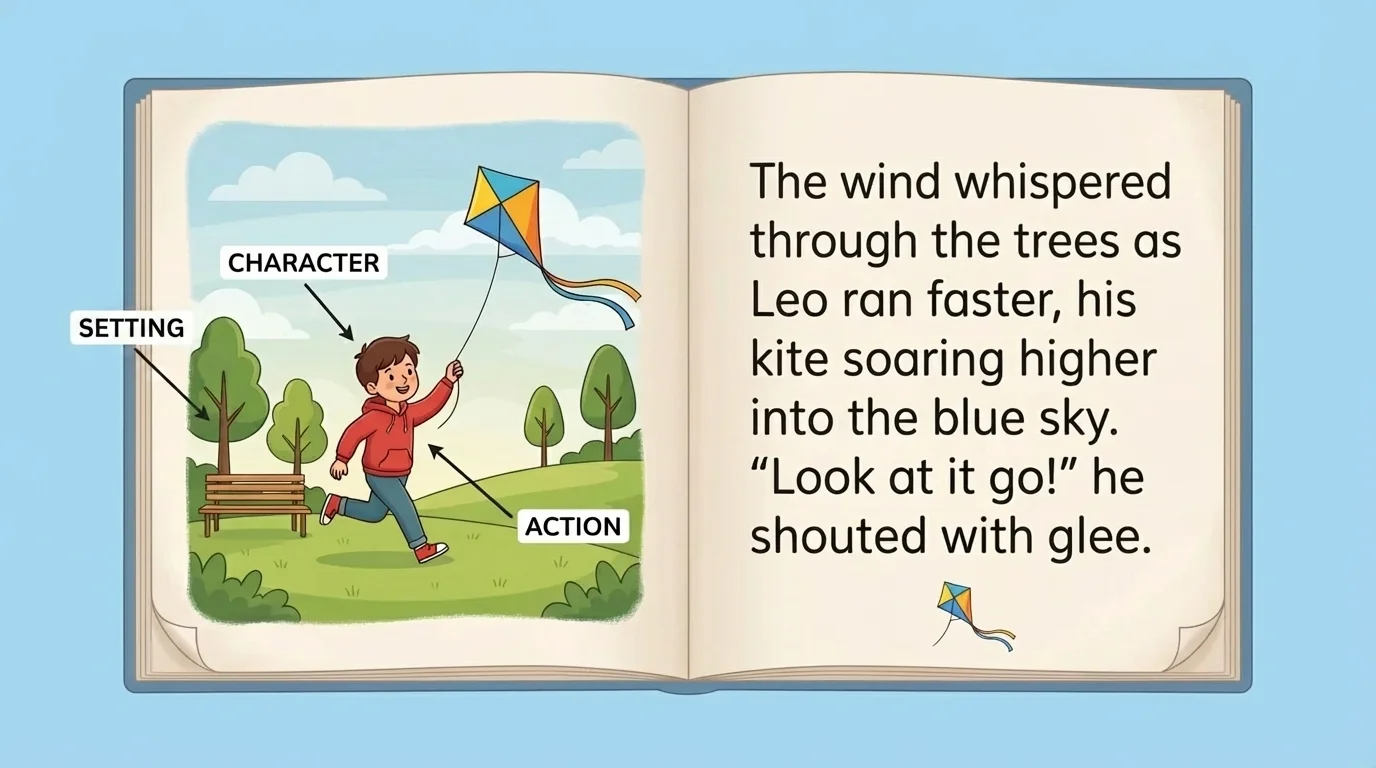
Here is an example of a storybook idea: "Mina lost her red boot at the playground. She looked under the slide and by the swing. Then she saw it stuck in the sandbox bucket." This sounds like a story because someone is in it, something happens, and the events move along.
Example: Is it a storybook?
Listen to this text: "The little fox ran into the forest. It heard a rustle behind a tree. Then it found its friend."
Step 1: Look for a character.
The little fox is a character.
Step 2: Look for events.
The fox ran, heard a sound, and found a friend.
Step 3: Decide the type.
This is a storybook type of text because it tells what happens to characters in a story.
Many storybooks are make-believe, but some may feel very real. Even when the story feels real, the big clue is still the same: it tells a story with characters and events. Later, when you compare texts, remember the scene in [Figure 1]. The page is built to show a story happening, not to list facts.
As [Figure 2] illustrates, a poem often looks different from a storybook page. It may have short lines instead of long sentences across the page. It may use rhythm, rhyme, or repeated words.
Poems can be about rain, pets, bedtime, sunshine, or almost anything else. A poem may tell a tiny story, but its words are chosen to sound special. Some poems rhyme, like "cat" and "hat." Some do not rhyme, but they still have a strong beat or repeated sounds.
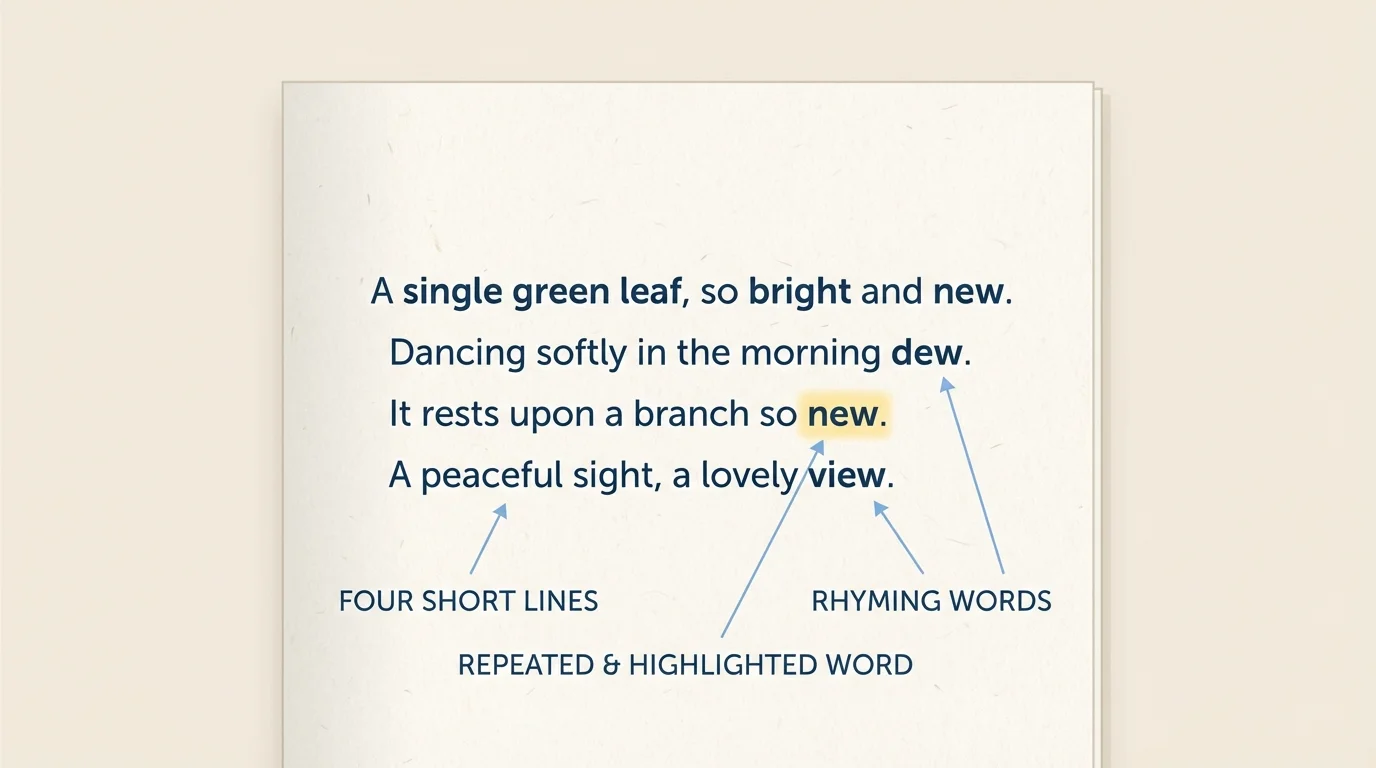
Here is an example of a poem: "Drip, drip, rain on the tree. / Drip, drip, rain on me. / Tap the roof and tap the ground. / Rain makes music all around." This looks and sounds like a poem because it has short lines and repeating sounds.
Poems often help us notice feelings, sounds, and images. A poem about snow may make us feel quiet. A poem about thunder may sound loud and quick. When readers recognize a poem, they listen closely to how the words sound, just as the page in [Figure 2] uses short lines and repeated sounds to create a poem-like pattern.
Some poems are very tiny. A poem can be just a few lines long and still paint a big picture in your mind.
Not every poem rhymes. That is important to remember. Short lines, repeated words, and strong feelings can still make a text a poem, even without rhyme.
As [Figure 3] shows, an informational text teaches true facts. It helps readers learn about the world. These texts often have special features such as headings, labels, photographs or drawings of real things, and facts about one topic.
If a page says that butterflies begin as caterpillars, or that firefighters use special gear, or that trees need water and sunlight, the text is giving information. The goal is to teach, explain, or describe something real.
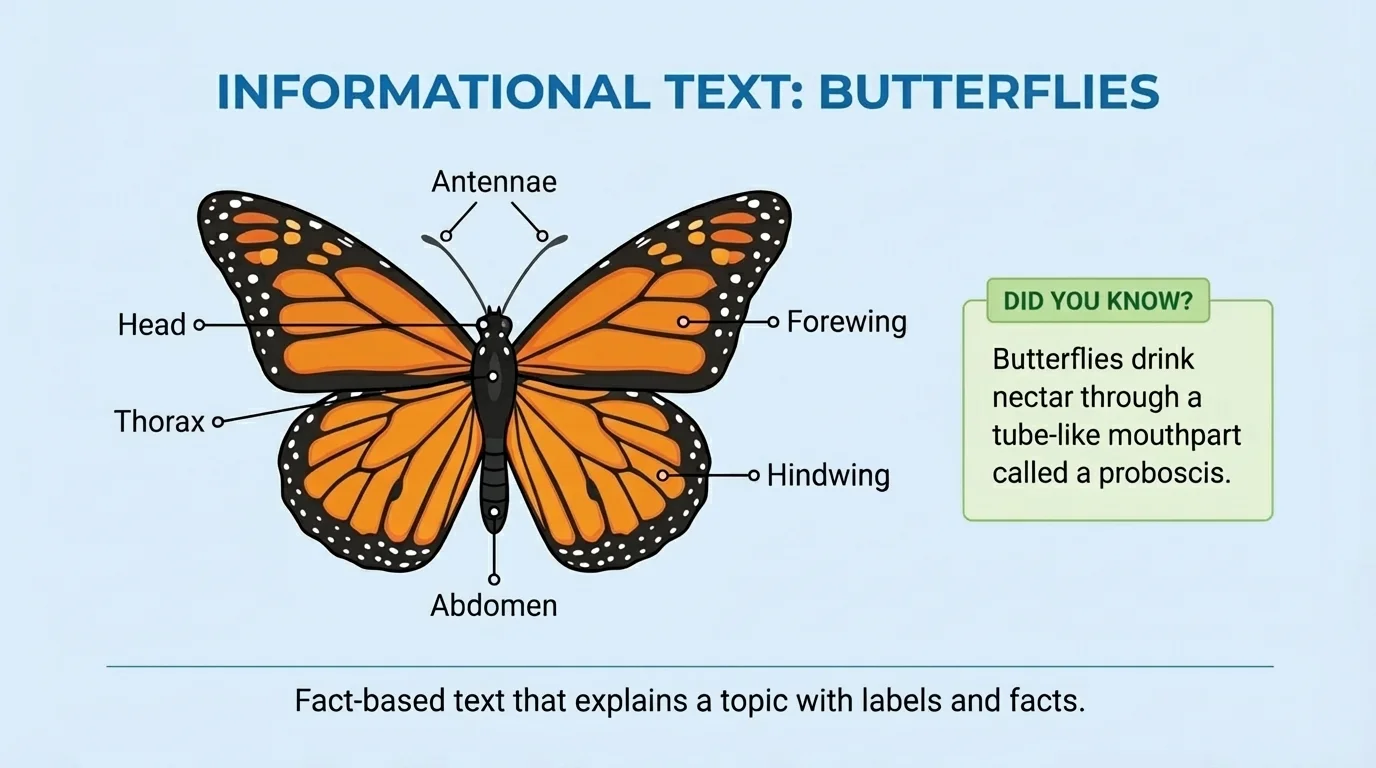
Informational texts may be in books, magazines, signs, or classroom charts. They often use clear words and pictures that match the facts. A page might have a big title such as Frogs, then show a picture with labels like "legs" and "eyes."
| Text type | Main job | Common clues |
|---|---|---|
| Storybook | Tells a story | Characters, events, beginning/middle/end, talking, actions |
| Poem | Uses special words and sounds | Short lines, rhyme, rhythm, repeated words, strong feelings |
| Informational text | Teaches facts | Real topic, headings, labels, facts, photographs or realistic drawings |
Table 1. Comparison of common text types and the clues readers can use to recognize them.
Suppose a page says, "Bees help flowers grow by moving pollen." That sounds like information, not a made-up adventure. The same idea appears in pages like [Figure 3], where the structure of the page helps readers learn facts.
Example: Is it informational?
Listen to this text: "Turtles carry hard shells on their backs. Their shells help protect them."
Step 1: Check for real facts.
The text tells true things about turtles.
Step 2: Look for a teaching purpose.
The text is teaching, not telling a made-up story.
Step 3: Decide the type.
This is an informational text.
Sometimes texts can feel a little alike, so readers look carefully. A storybook may have beautiful pictures, and an informational book may also have pictures. The important question is: What is the text doing? Is it telling about characters in events? Is it using short, special lines? Is it teaching true facts?
Readers can also notice rhyme, repetition, labels, and headings. These are clues from the text's craft and structure. Craft means how the author makes the text. Structure means how the text is put together on the page.
Using clues from the page
Readers use words, pictures, line breaks, headings, and labels to identify a text type. A storybook is structured to show events. A poem is structured in lines and sound patterns. An informational text is structured to teach facts clearly.
Here are some quick clues. If you hear "Once there was a duck who lost his hat," that sounds like a storybook. If you hear "Quack, quack, splash and play," that may be a poem. If you hear "Ducks have webbed feet that help them swim," that is informational text.
When children know the type of text, they understand it better. With a storybook, they listen for what happens next. With a poem, they listen for sound and feeling. With an informational text, they listen for facts they can learn and remember.
This also helps during read-aloud time. If the teacher opens a page and you hear rhyming lines, you can think, "This is a poem." If you see labels on a picture of a plant, you can think, "This teaches facts." Recognizing the text type makes readers more thoughtful and confident.
Pictures are important in many texts, but pictures do not decide the type all by themselves. Readers must also think about the words and the job of the text.
As you become a stronger reader, you will notice these clues faster and faster. You will know that texts are built in different ways for different purposes, and that helps you make meaning from what you read.
