Have you ever forgotten something, and then a grown-up helped you remember? That is a big part of learning. Sometimes we answer a question by thinking about what happened to us. Sometimes we answer by looking at a book, a picture, or another source. Good learners do both.
When children learn to find answers, they are beginning to do research. Research at this age means asking a question, listening, looking, remembering, and sharing what they found out. We do not have to do it alone. Teachers, family members, and other adults can guide us.
A question is something we want to know. Questions often begin with words like who, what, where, when, or how. A question helps our brain know what to look for.
Question means something you ask because you want to know more. Answer means the information that helps explain the question.
Here are some simple questions: "What did we see on our walk?" "How does a plant start growing?" "Where do firefighters work?" Each question points us toward information we can find.
There are two important ways to answer questions, as shown in [Figure 1]. One way is to recall information from our own experiences. The other way is to gather information from a source, such as a read-aloud book, a photo, a chart, or an object a teacher shares.
If the class asks, "What did we do in the garden?" children can think back and remember: "We dug the dirt," "We planted seeds," and "We watered them." Those details come from experience. If the class asks, "What does a seed need?" children may look at a picture book or chart to find ideas like water, sunlight, and soil. Those details come from a source.
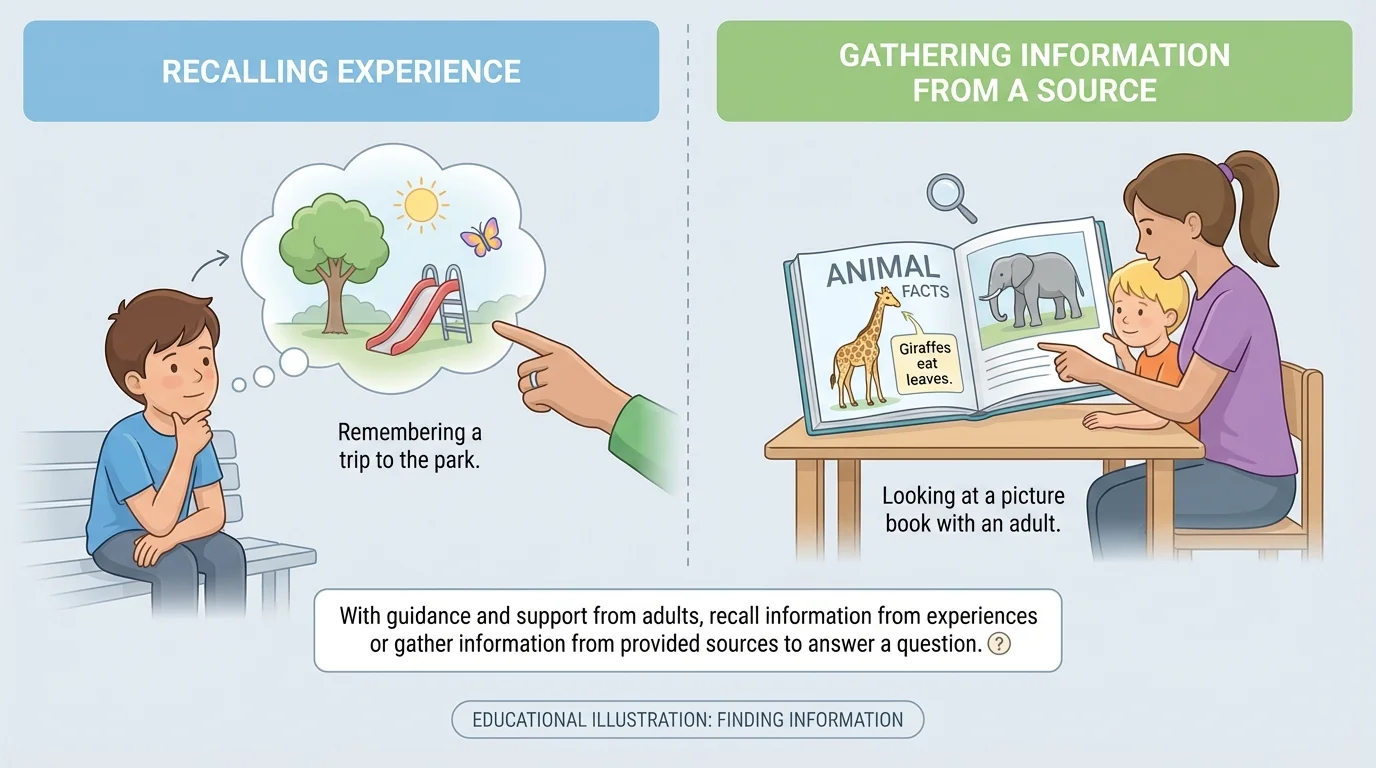
Both ways matter. Sometimes memory helps first. Sometimes a source helps first. Strong learners can use what they remember and what they see or hear from provided materials.
You already know how to talk about something you did, like visiting the playground or making a snack. That is helpful because recalling information means bringing those memories back to tell about them.
Adults often help children notice which details matter most. If a child says, "I liked the garden," a teacher may gently ask, "What did you do there?" That support helps the child move from a feeling to useful information.
Adults guide learning in many ways. They may read a page aloud, ask a helpful question, point to a picture, or remind children about something they already experienced. This kind of help makes it easier to find the answer.
Working together is also important. In a group, one child may remember seeing a worm. Another may remember watering the plants. The teacher helps everyone listen and put the ideas together. Learning can be a shared effort.
Many scientists, writers, and inventors work with other people. Asking questions and gathering information together is something real researchers do too.
When adults support children, they also help them stay on the question. If the question is "What do birds use to build nests?" the teacher helps children focus on sticks, grass, and leaves instead of talking about unrelated things.
[Figure 2] A source can be a book, a photograph, a chart, a classroom poster, or a real object to observe. A source gives us information we can use to answer a question.
Children need to look closely. In a picture of a farm, they might notice animals, a barn, or a tractor. In a chart about weather, they might notice a sun for a sunny day or a cloud for a rainy day. With adult help, they learn to pick out details that match the question.
If the class is asking, "What happens first when a plant grows?" a teacher might show a simple sequence picture. The children can look for the beginning picture and say, "First there is a seed." Then they can gather more information by looking at the next pictures.
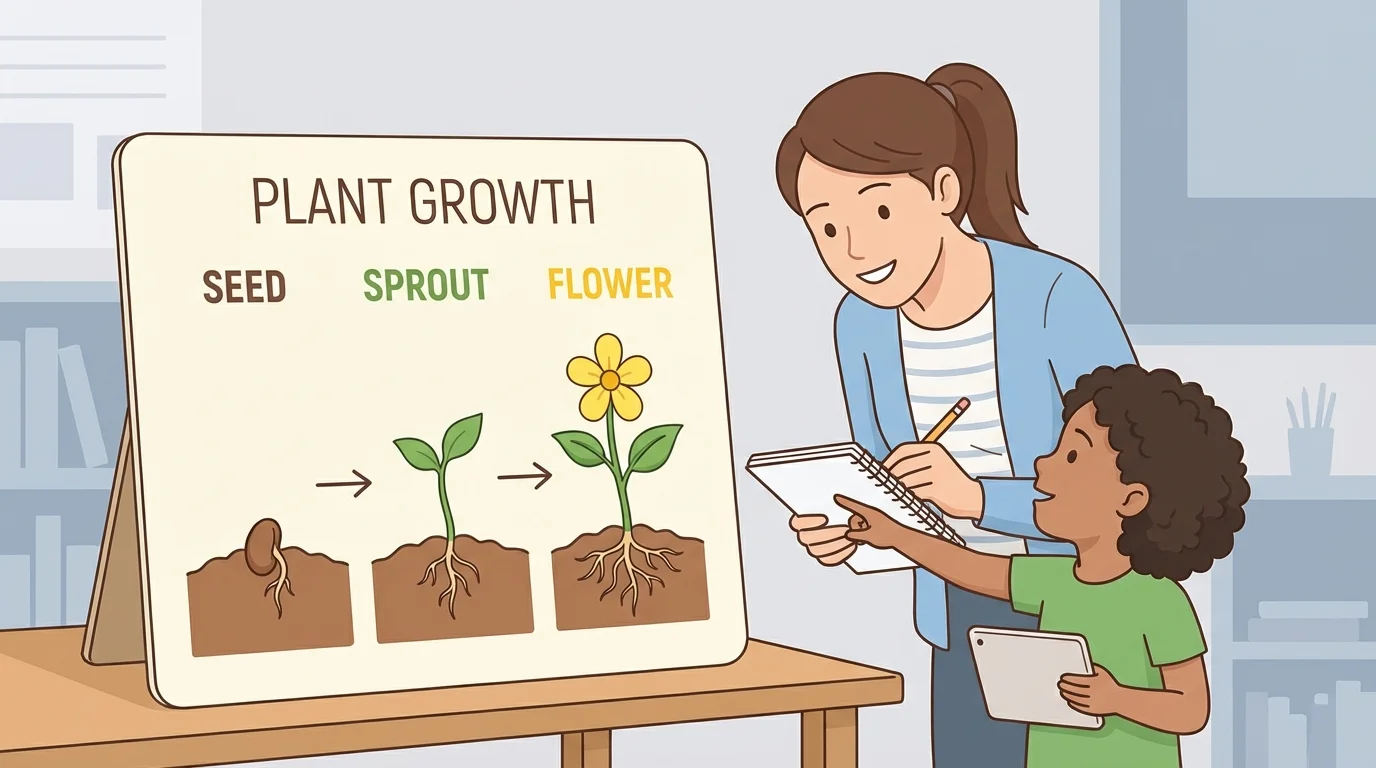
Sometimes a source is read aloud. Children listen for important words. If a book says, "Bees visit flowers," that detail can help answer a question about how bees and flowers are connected. Adults help children listen carefully and repeat key facts.
Later, when children compare memory and sources, [Figure 1] still helps: one side reminds us to think back, and the other reminds us to look carefully at provided materials.
[Figure 3] After children remember or gather facts, they put the pieces together into an answer. The answer should match the question and use important details.
A child does not need a long answer. A clear answer can be short and strong. If the question is "Where do fish live?" a good answer is "Fish live in water." If the question is "What did we use to paint?" a good answer is "We used brushes and paint."
Sometimes children answer with words. Sometimes they answer with a drawing and a few spoken ideas. A teacher may ask, "What did you find out?" or "How do you know?" That helps children connect the question, the information, and the answer.
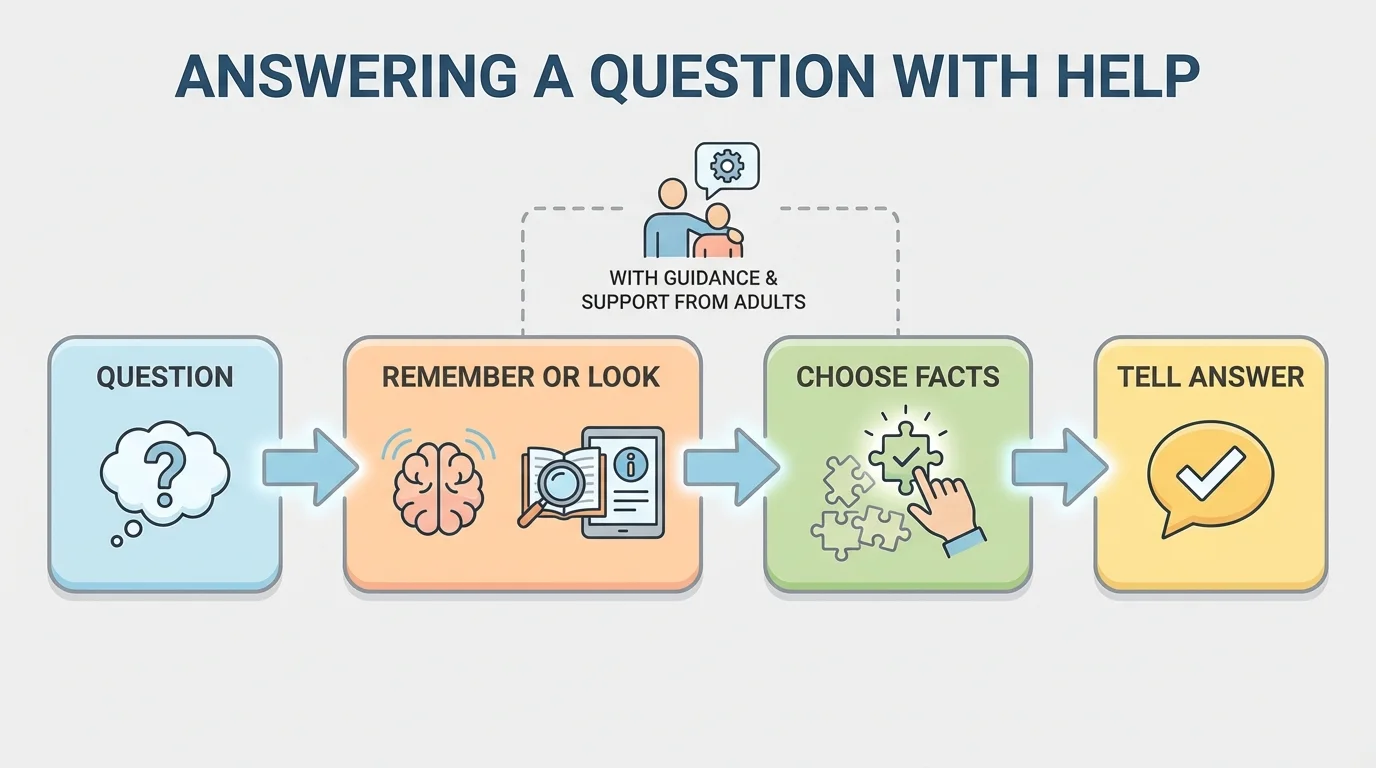
Choosing important details means picking the facts that help answer the question best. Not every detail belongs in every answer. Good thinkers stay close to the question.
If the question is "What do we wear in the rain?" the important details are boots, a raincoat, or an umbrella. Saying "I like puddles" may be true, but it does not answer the question as clearly.
Children can use experiences and sources in many ways. Here are some examples of how that works in school.
Example 1: Using experience
Question: "What did we do during our apple tasting?"
Step 1: Think back to the experience.
The child remembers seeing red and green apples.
Step 2: Recall actions.
The child remembers tasting, smelling, and talking about which apple was crunchy.
Step 3: Give the answer.
"We tasted red and green apples and talked about how they looked and felt."
This answer comes mostly from memory because the child was there and experienced it.
Example 2: Using a provided source
Question: "What do caterpillars become?"
Step 1: Look at the class book or poster.
The teacher reads the page and shows the pictures.
Step 2: Find the important fact.
The child notices the picture of the butterfly after the caterpillar stage.
Step 3: Give the answer.
"Caterpillars become butterflies."
This answer comes from a source because the child gathered information from the book or poster.
Example 3: Using both memory and a source
Question: "What do plants need?"
Step 1: Remember the class plant.
The child recalls watering the plant near the window.
Step 2: Look at the chart.
The chart shows sunlight, water, and soil.
Step 3: Put the ideas together.
"Plants need water, sunlight, and soil."
A learner can move from a question to facts and then to a clear answer.
Research with others means taking turns, listening, and being respectful. When another child is sharing what they remember, we listen. When a teacher is reading a source, we watch and wait for our turn to speak.
It is also okay not to know the answer right away. Good learners ask for help. They may say, "Can you read that again?" or "Can you help me remember?" Asking for support is part of learning.
Sometimes we check our answer with an adult. The teacher may say, "Let's look at the picture one more time," or "Tell me what happened first." This checking helps children make sure the answer fits the question.
| Way to find information | What it means | Example |
|---|---|---|
| Remembering | Thinking back to something you did or saw | "We planted seeds in the garden." |
| Looking at a source | Using a book, picture, chart, or object | "The chart shows that plants need sunlight." |
| Working with an adult | Getting guidance and support | "My teacher helped me find the answer in the book." |
Table 1. Different ways young learners can find information to answer a question.
When children learn to ask, remember, look, listen, and answer, they are building strong learning habits. These habits help in reading, science, social studies, and everyday life.
