Have you ever heard a new word in a story and then wanted to say it yourself right away? That is how word learning begins. Every day, children hear words in conversations, in books, and when someone reads to them. Then those words become part of what they can say, understand, and use. The more words we know, the better we can share ideas, tell about things, and answer questions.
Words are all around us. We hear them at home, at school, on the playground, and in books. When someone says, "The puppy is tiny," we can learn the word tiny. When a story says, "The giant was enormous," we can learn enormous. New words help us say exactly what we mean.
Sometimes we learn a word because someone tells us what it means. Sometimes we learn it because we see a picture, a face, or an action. If a teacher reads, "The girl whispered," and uses a soft voice, children begin to understand that whisper means speaking very quietly.
Vocabulary means the words we know and use. Respond means to answer, tell, or show what we think about something we heard or read. Nonverbal means communication without words, like pointing, nodding, smiling, or using facial expressions.
Learning words is not only about hearing them once. Children grow strong vocabulary when they hear words again and again and then try using them in real talk.
Conversations help us learn many new words. When we talk with others, we hear how words are used. We also use our ears, eyes, face, and body. In a conversation, conversation and body clues work together, as [Figure 1] shows. A child may say, "Look at my tall tower," while pointing to blocks. The pointing helps the listener know what tower means in that moment.
Listening is just as important as talking. When we listen carefully, we can hear new describing words, action words, and feeling words. A friend might say, "I am frustrated because my shoe is stuck." If we did not know the word frustrated before, the friend's voice and face can help us understand it means upset or bothered.
Children also learn words by taking turns. One person speaks, another listens, and then answers. Clear speaking can include words such as please, because, first, and next. A nod, a smile, or a shrug can add meaning too.
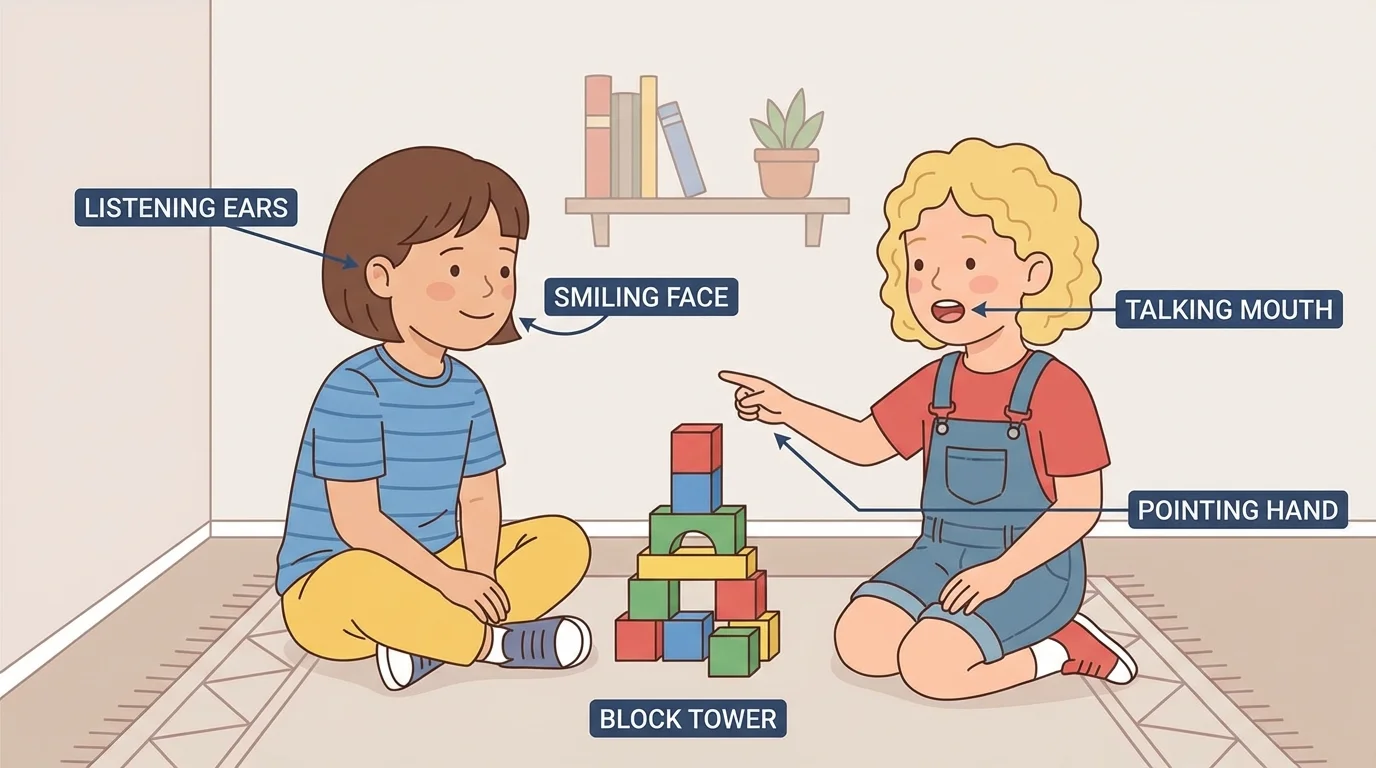
When children use both words and actions, communication becomes stronger. If someone says, "I found a smooth rock," and gently rubs the rock, the word smooth becomes easier to understand. Later, the child may reuse that word: "My shell is smooth too." That is how a new word moves from hearing to speaking.
Children can learn many new words just by hearing rich talk during everyday moments like snack time, cleanup, and story time. Simple conversations can become powerful word lessons.
Good listeners also watch the speaker. A raised eyebrow, a pointing finger, or a big smile gives clues. These clues do not replace words, but they help us understand words better.
Books are full of interesting language. When adults read aloud, children hear words they may not hear every day. Story time builds vocabulary because the reader's voice, the pictures, and the story all give clues, as [Figure 2] shows. A book may use words like forest, giggle, search, or enormous.
Pictures in books help children connect words to meaning. If a page shows a bear in a dark forest, the word setting can be explained as where the story happens. If the bear is hiding behind a tree, children can connect the action to words like hide or peek.
Being read to also helps children hear how sentences sound. They hear complete thoughts and story words such as once, after, suddenly, and finally. These words help organize ideas and tell what happens in order.
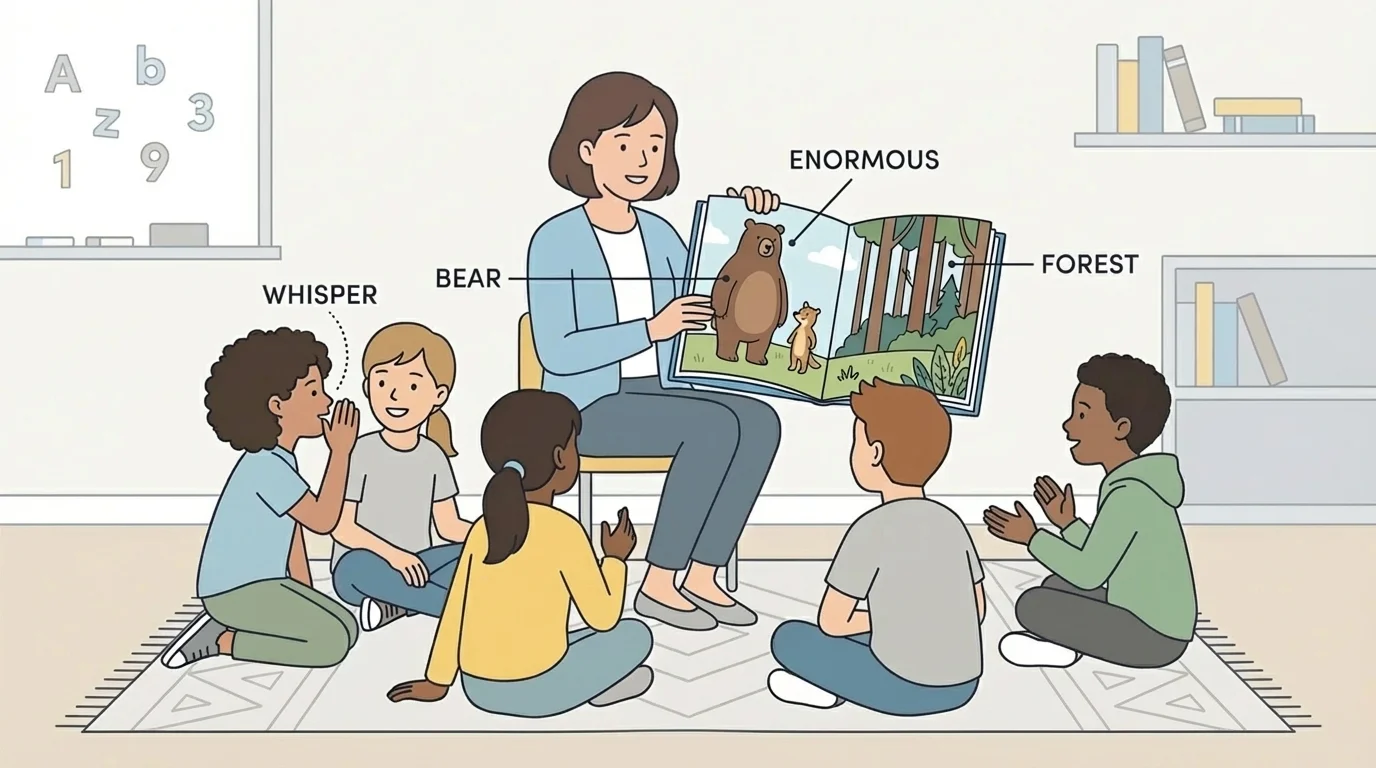
Sometimes one new word can be understood in many ways. The word tiny can describe a bug, a seed, or a toy. Hearing the same word in different stories helps children use it more easily in their own speech.
As children listen to more stories, they begin to remember favorite words. They may say, "That rabbit is enormous!" or "The baby is whispering." Reusing book words shows that the words are becoming part of everyday language.
After hearing or reading a story, children can use story words to answer questions clearly. Responding becomes easier when children know words such as character, setting, beginning, middle, end, favorite, and feeling words, as [Figure 3] illustrates.
Instead of saying only, "I liked it," a child can say, "My favorite character is the dog because he is helpful." Instead of saying, "It was there," a child can say, "The setting is the farm." These answers are clearer because they use words learned from books and talk.
Children can also answer with order words. They might say, "First the hen found seeds. Next she planted them. Last she made bread." Words like first, next, and last help tell events in order.
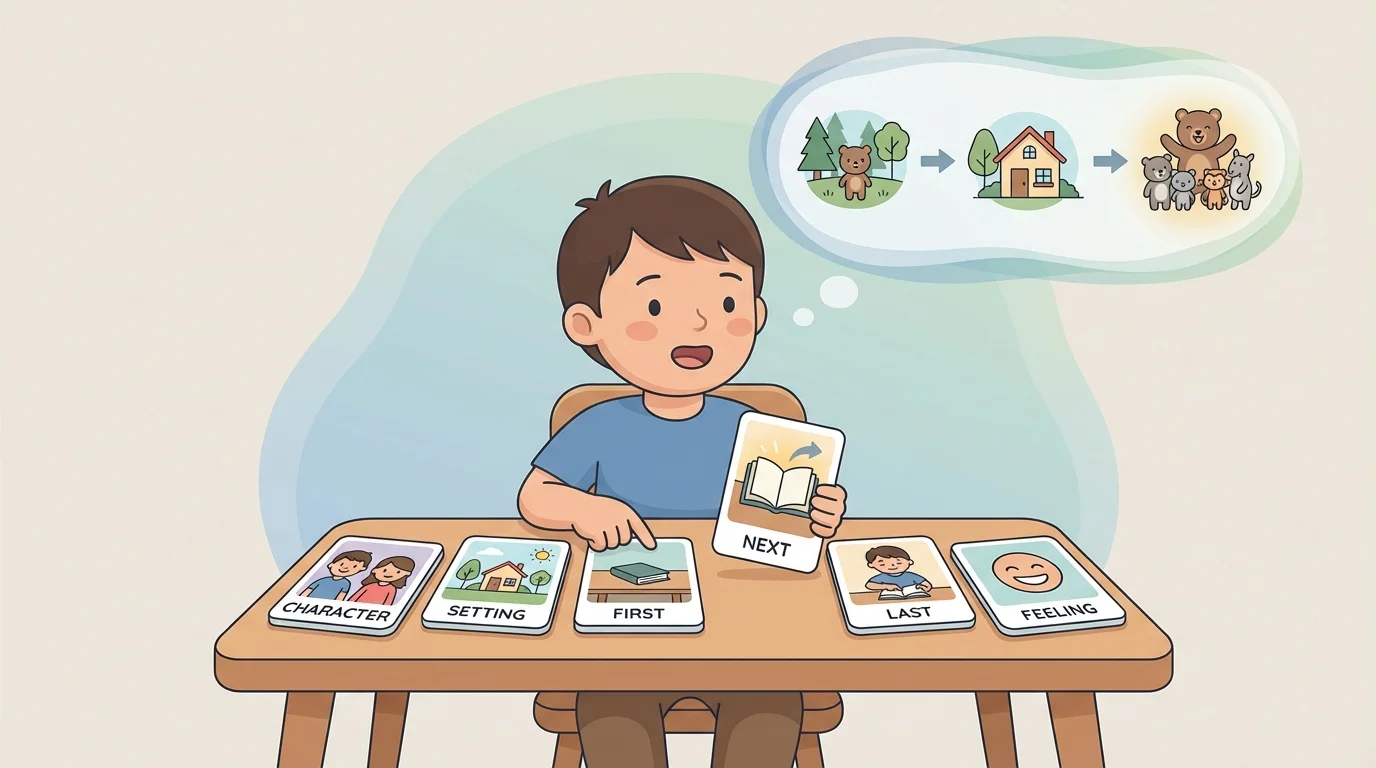
Feeling words help too. A child may say, "The boy felt nervous," or "The girl was proud." These words make responses stronger and more exact. They help others understand the story better.
Using stronger story words
Here is how a simple answer can grow.
Step 1: Start with a short answer.
"I liked the story."
Step 2: Add a story word.
"My favorite character is the cat."
Step 3: Add a reason.
"My favorite character is the cat because she was brave."
The answer becomes clearer and more interesting.
When children answer about stories, they do not need very long sentences. They need meaningful words. A few well-chosen words can make an answer strong.
Some words are general, and some words are more exact. Saying good tells a little. Saying delicious, gentle, or shiny tells much more. The best word depends on what we want to say.
Children also learn to match voice and body to their words. A soft voice can match the word whisper. A wide smile can match the word excited. Looking at the listener and speaking clearly helps the message make sense. We saw this teamwork of words and body language earlier in [Figure 1], where pointing and looking support speaking.
When answering about stories, children can combine what they know from reading and conversation. They may say, "The character was sad at first, but later she felt joyful." That response uses feeling words and order words together.
Why repeated use matters
A new word becomes easier to remember when children hear it, notice it, understand it, and then say it themselves. Hearing a word in a story, hearing it again in conversation, and using it in a response helps the word stay in memory.
Children should be encouraged to try new words even if they are still learning them. Practice in real talk helps build confidence. A child who says, "This leaf is enormous," may later learn a more accurate match like tiny or large, depending on the leaf, but trying the new word is an important step.
Word learning happens all day long. At lunch, children can use words like crunchy or sweet. During play, they can say build, balance, or collapse. During story time, they can use words from books to tell what happened and how characters felt.
Listening closely, watching carefully, and answering with meaningful words all help language grow. Pictures, actions, voice, and story details support understanding. Later, those words come back when children speak, ask, explain, or retell.
Books and conversations work together. A child may hear the word forest in a read-aloud, then use it later while drawing trees. A child may hear the word frustrated from a friend, then notice it in another story. As we also saw with story-response words in [Figure 3], learning words is not only about knowing them. It is about using them to share ideas.
