Have you ever looked at a book and noticed that one person wrote the words, but another person made the pictures? That is because books are often a team effort. In many books, one person writes the words as the author, and another person creates the pictures as the illustrator.
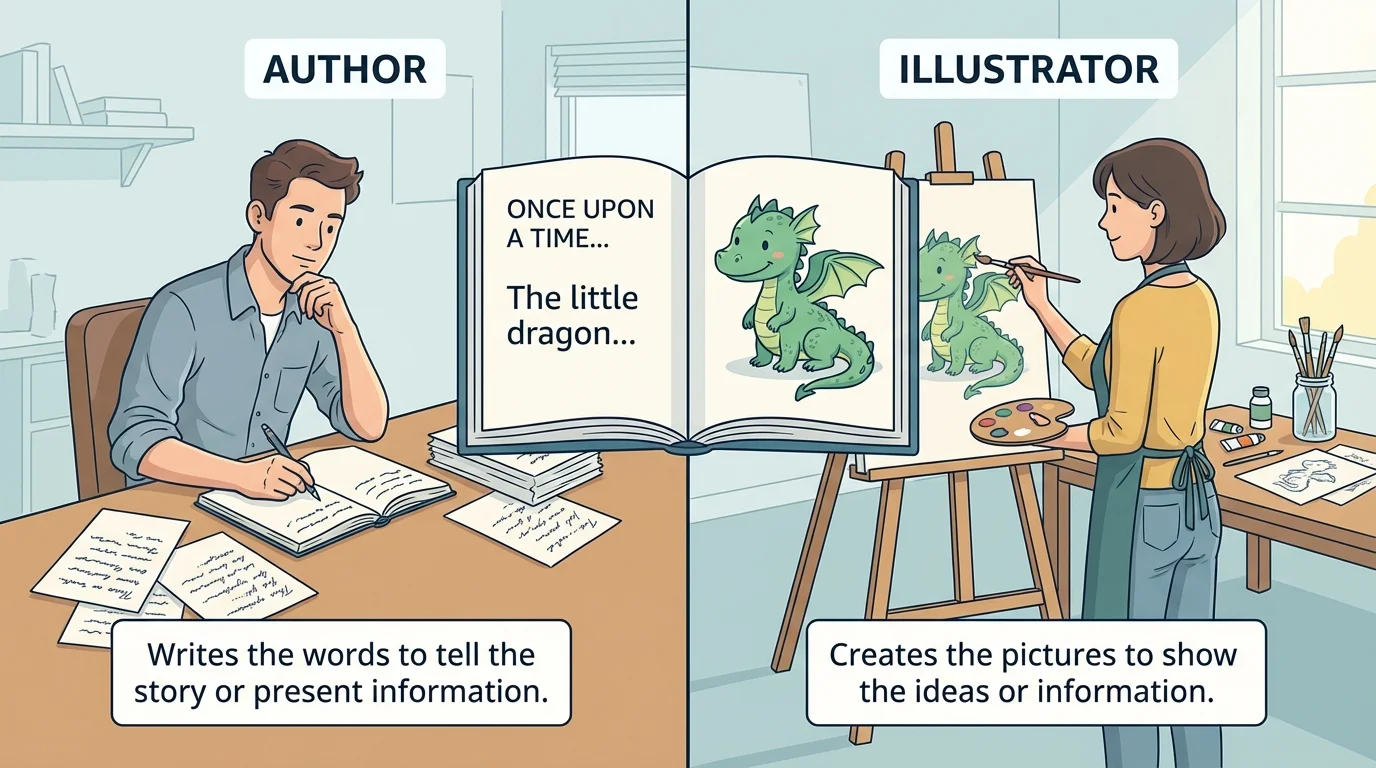
Books have helpers, and [Figure 1] shows two important helpers working on the same book. The author writes the words. The illustrator makes the pictures. Both help the reader understand the book.
If a book tells us about animals, weather, plants, or trucks, the author gives us the ideas and information with words. The illustrator adds pictures that match those ideas and make them easier to understand.
Author means the person who writes the words in a text.
Illustrator means the person who creates the pictures for a text.
Text means the words in a book or other piece of writing.
When we read, we can name both people. We can say, "The author wrote the words," and "The illustrator made the pictures."
The author thinks about what the book will say. In an informational book, the author shares true ideas and facts. The author may write, "A frog can jump," or "Leaves grow on trees." Those words teach the reader something new.
The author chooses which ideas are important. The author helps the reader know what the book is about. If the book is about apples, the author might write that apples grow on trees, can be red or green, and can be eaten.
Words carry the main message. The author uses words to tell the information clearly. The words answer questions like "What is it?" "What does it do?" and "Where does it live?"
When you name the author, you are naming the person who wrote the text. Even if the pictures are beautiful, the author is the one who wrote the words in the book.
The illustrator helps the reader see the ideas. A picture can show what a seed looks like, how a bus moves, or what a penguin's body looks like. The illustrator does not usually write the main words, but the pictures help explain them.
Sometimes a young reader understands more because of the pictures. If the author writes about a butterfly, the illustrator can show wings, colors, and body parts. The picture helps make the information clearer and more real to the reader.
The illustrator's work is very important. Pictures can help us notice details. They can show size, shape, color, and action. As we saw in [Figure 1], the illustrator supports the author by turning ideas into images the reader can look at.
The author and illustrator do different jobs, but they work together. The author writes the information. The illustrator adds pictures that fit the information. Together, they help the reader learn.
Think about a book about weather. The author might write, "Rain falls from clouds." The illustrator might draw dark clouds and falling rain. The words tell the fact. The picture helps the reader see the fact.
Example: A book about bears
Step 1: Read the words.
The author writes, "Bears have fur."
Step 2: Look at the picture.
The illustrator draws a bear with thick fur.
Step 3: Put them together.
The words tell the information, and the picture helps the reader understand it better.
That is how both people present ideas in one text.
Sometimes the picture gives a clue before the child can read all the words. Sometimes the words explain something the picture cannot show by itself. Both matter.
When you want to know who made a book, start by looking at the cover and the title page. [Figure 2] shows the places where readers often find the author's name and the illustrator's name.
You may see words like by before the author's name. You may also see words like illustrated by before the illustrator's name. These labels tell you each person's job.
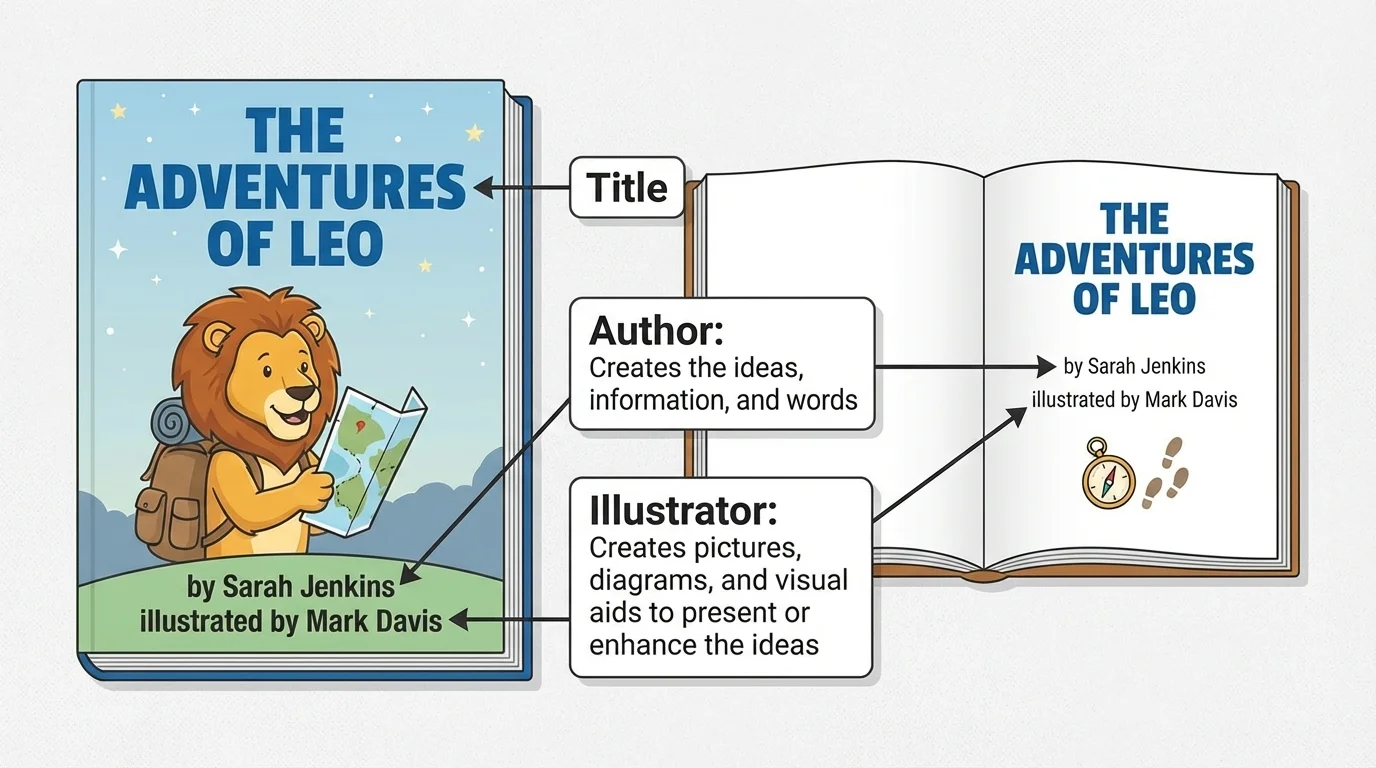
For example, a cover might say Animals in Winter by Ana Lopez, illustrated by Sam Reed. Ana Lopez is the author. Sam Reed is the illustrator.
Later, when you open a new book, you can check these places again. [Figure 2] shows the same places to check when you want to know where to look first.
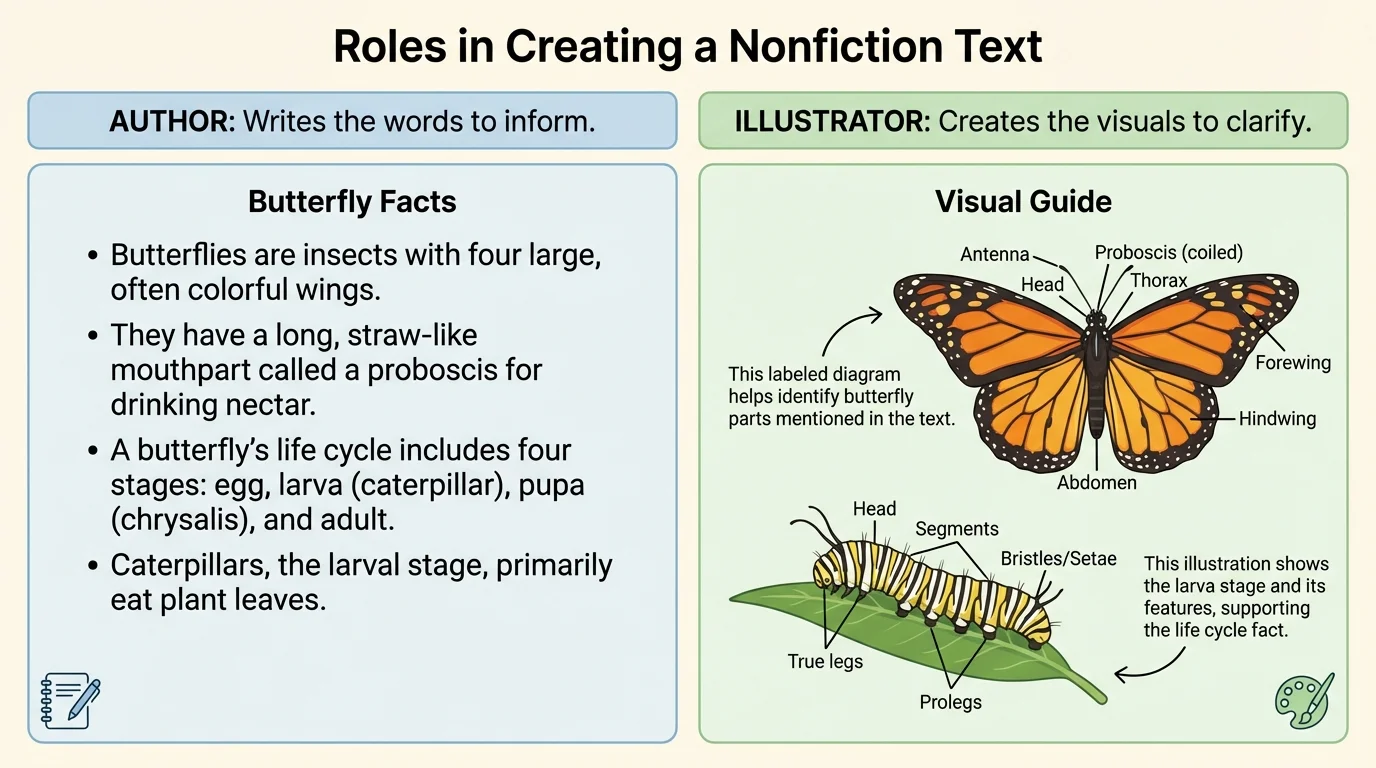
In a nonfiction page about butterflies, [Figure 3] shows how information can come from both words and pictures. The author may write, "Butterflies begin life as caterpillars." The illustrator may draw the butterfly and caterpillar so the reader can see the difference.
On that same page, the words give the fact. The picture gives a visual clue. If the picture is labeled, it can help the child match the fact to the animal body.
Some books are made by one person who is both the author and the illustrator. That person writes the words and makes the pictures too.
But in many books, the jobs are shared. When you name each person correctly, you show that you understand how the text was made.
You can also think about what each person helped you learn. In the butterfly example from [Figure 3], the author teaches with words, and the illustrator teaches with pictures.
Readers learn more when they pay attention to both the author and the illustrator. The author presents ideas through text. The illustrator presents ideas through pictures. In informational texts, both can help explain the topic.
If a child says, "The author drew the pictures," that mixes up the jobs. If a child says, "The illustrator wrote the book," that also mixes up the jobs. It is important to match the right job to the right person.
When you talk about a book, you can use strong reading words: "The author wrote the information," and "The illustrator showed the information in pictures." That helps you understand the book in a careful way.
