Who is in the story? Where does the story happen? What big thing happens? When we listen to or read a story, we can look for these important parts. They help us understand the story better and talk about it with others.
A story is like a little world. It has someone in it, a place for it to happen, and important actions. When we know these parts, the story makes sense.
A story is about someone and something that happens. Sometimes the story is funny. Sometimes it is exciting. Sometimes it is quiet and sweet. No matter what kind of story it is, we can look for the same important parts.
Characters are who is in the story. Setting is where and when the story happens. Major events are the big things that happen in the story.
We do not have to find every tiny detail. We listen for the big parts. A teacher, parent, or friend can help by asking questions like, "Who is this story about?" or "What happened at the end?"
[Figure 1] Characters are the people or animals in a story. They are who the story is about. A character can be a girl, a boy, a bear, a dog, or even a talking truck in a pretend story.
Sometimes a story has one main character. Sometimes it has many characters. We can ask, "Who is in the story?" to help find them. We can also look at the pictures for clues.
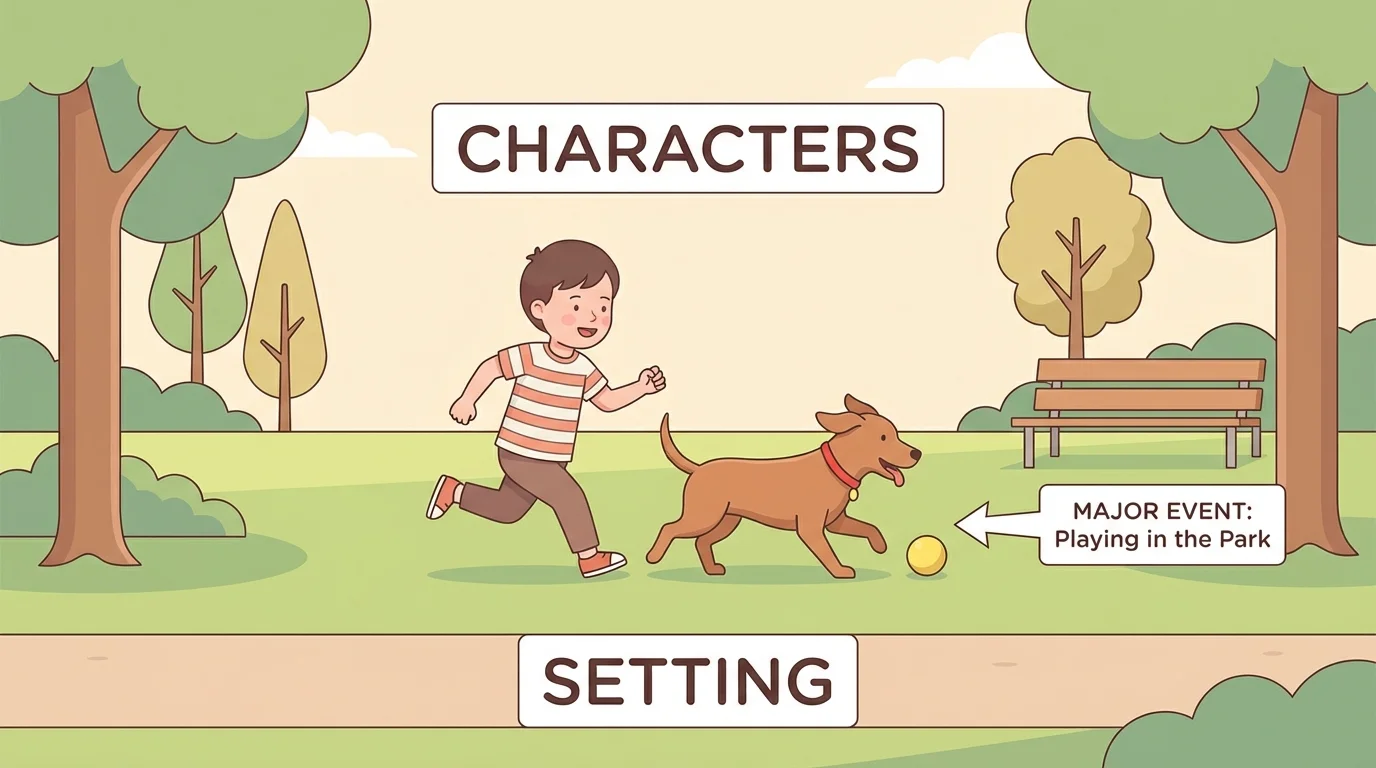
If a story says, "Mia and her puppy ran to the red ball," the characters are Mia and her puppy. If a picture shows a duck family walking to a pond, the ducks are the characters.
Characters often talk, move, feel, and make choices. Those actions help us know more about them. Later, when we think again about [Figure 1], we can see that both the child and the dog matter because both help the story happen.
Some stories have animal characters that act like people. A rabbit might wear clothes, talk, and go to school in a pretend story.
When grown-ups give support, they may point to a picture and ask, "Who do you see?" That kind of help makes it easier to name the characters.
[Figure 2] The setting tells where and when a story happens. The setting might be a house, a school, a farm, a forest, or a beach. The "when" can be day, night, winter, or morning.
We can ask, "Where is the story happening?" and "When is it happening?" Pictures often help us see the setting. Words help too. If the story says, "Snow fell on the playground before school," we know the setting is outside at a playground, and the time is a snowy morning.
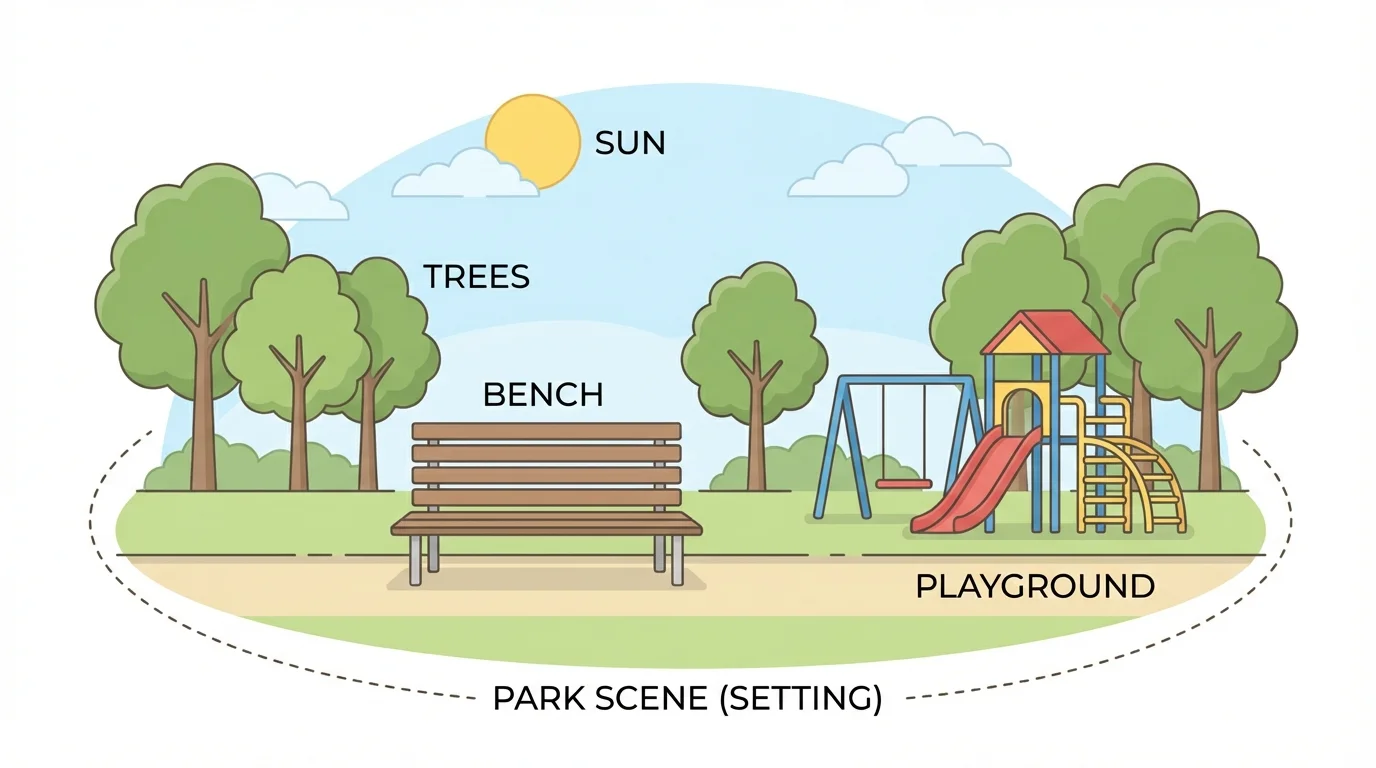
A setting can stay the same for the whole story, or it can change. A story may begin at home and then move to the park. A story may begin in the daytime and end at night.
When we return to [Figure 2], we notice clues like the sun, grass, and playground. Those details help us say, "The story happens at the park during the day."
Pictures and words work together. Sometimes the words tell the place, and the picture tells the time. Sometimes the picture shows the place, and the words tell the season. Good readers use both to understand the setting.
If an adult asks, "Are they inside or outside?" that prompt can help us think about the setting in a simple way.
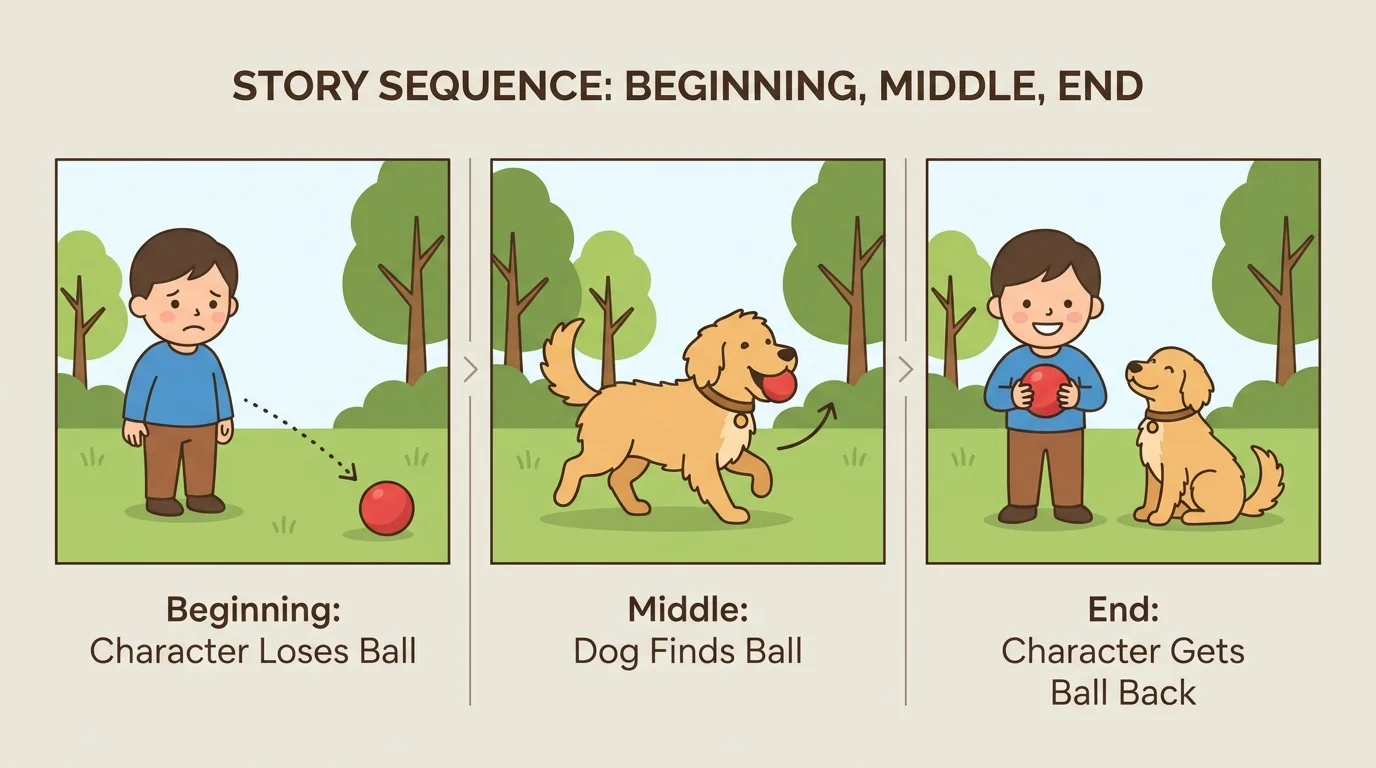
[Figure 3] Major events are the big things that happen in a story. They are not every little thing. They are the important parts. We often tell them in order: first, next, and last.
For example, in a story about a lost ball, the major events might be: first the ball rolls away, next the dog finds it, and last the child gets the ball back. Those are the big events that move the story along.
Small details can be nice, but major events are the most important actions. If the story says the child wore blue shoes, that is a detail. If the story says the child fell, then got help, then stood up again, those are major events.
Looking again at [Figure 3], we can retell the story by following the order of the pictures. This helps us remember what happened first, next, and last.
You already know that stories have a beginning, middle, and end. Major events are the big happenings in those parts.
A teacher may support us by asking, "What happened first?" or "What happened at the end?" Those questions help us choose the most important events.
Let us put everything together in one simple story. "Ben and his grandma planted a seed in the garden. Rain came. Soon a flower grew." In this story, the characters are Ben and his grandma. The setting is the garden, and the time may be during a rainy growing season. The major events are planting the seed, the rain coming, and the flower growing.
Story example
"Lila went to the library after lunch. She chose a book about frogs. Then she sat on a beanbag and read."
Step 1: Find the characters.
The character is Lila.
Step 2: Find the setting.
The setting is the library after lunch.
Step 3: Find the major events.
Lila went to the library, chose a book, and read it.
When we talk about a story, it helps to use clear words: "The characters are...," "The setting is...," and "The major events are...." These sentence starters make it easier to share our thinking.
Sometimes we need help, and that is okay. Prompting and support mean that a grown-up helps us think. They may reread a page, point to a picture, or ask a small question. That support helps us find the right answer.
Clues can come from the words we hear and the pictures we see. If a page shows a dark sky and a bed, we may know it is nighttime. If the words say, "The kitten climbed the tree," we know the kitten is an important character and climbing the tree is a major event.
The more we listen, look, and think, the easier it becomes to identify story parts. Soon, we can hear a story and say who is in it, where it happens, and what important things take place.
