Have you ever opened a book and wondered, "Who made this story?" A storybook has words and pictures, and both are important. The words help tell what happens. The pictures help us see the people, animals, and places in the story. Books are made by real people, and two important people are the author and the illustrator.
When we read a story, we can learn the names of the people who helped make it. The author is one person who helps make the story. The illustrator is another person who helps make the story. Sometimes they are two different people. Sometimes one person does both jobs.
Author means the person who writes the words of the story.
Illustrator means the person who makes the pictures for the story.
[Figure 1] When we talk about a book, we can say, "The author wrote the story," and "The illustrator drew the pictures." These two jobs are different, but they work together.
The author writes the words of the story. The author thinks about the characters, the setting, and what happens first, next, and last. If a story says, "The puppy ran through the mud and jumped into a big puddle," those words were written by the author.
The author helps us know what is happening in the story. The author may make the story funny, exciting, gentle, or surprising. The author chooses the names of characters and tells what they say and do.
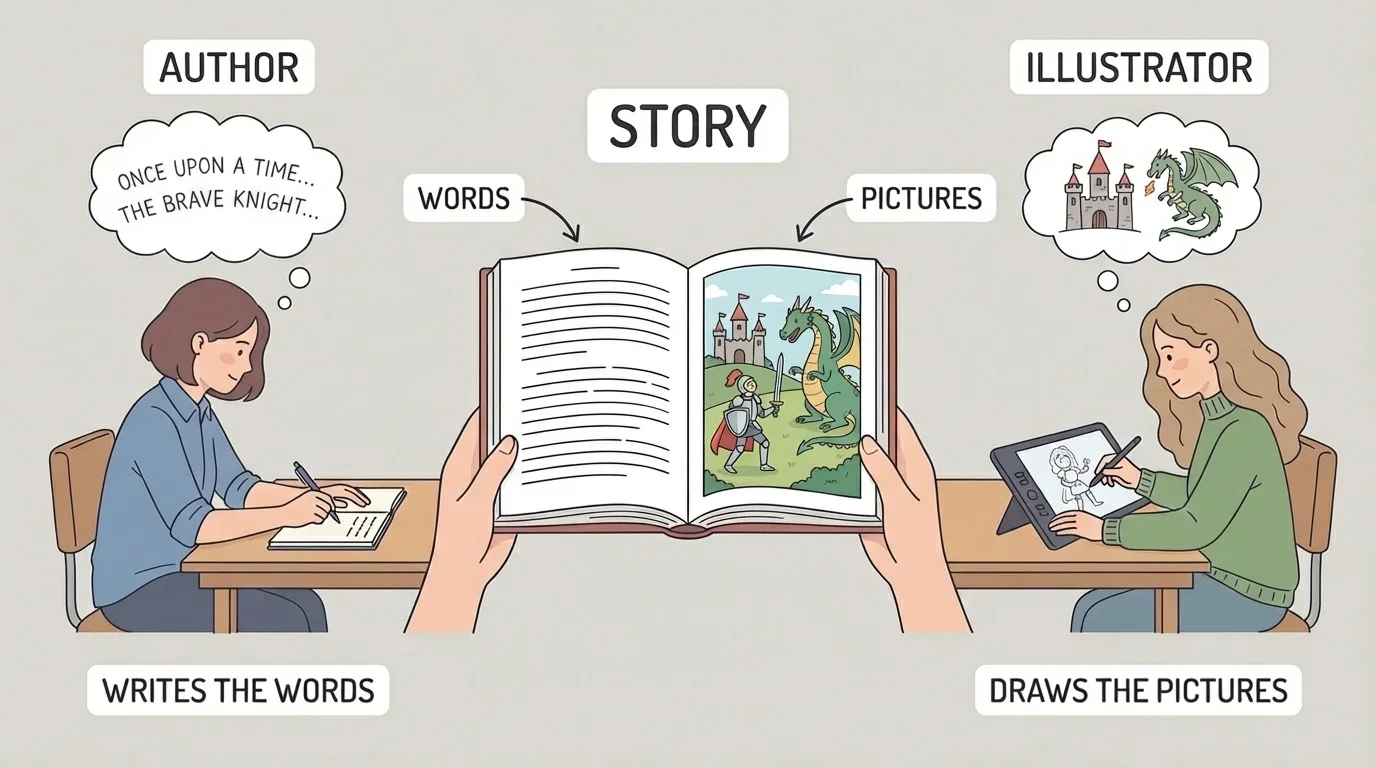
If a teacher asks, "Who wrote this story?" the answer is the author. That is the author's role in telling the story. The role of the author is to tell the story with words.
Some authors write stories about things they know well, like pets, families, school, or nature. Their ideas can come from everyday life.
When you listen to a book being read aloud, you are hearing the author's words. Even if you are not reading every word by yourself yet, you are still learning that the author is the one who wrote them.
[Figure 2] The illustrator makes the pictures. The illustrator helps us see what the characters and places might look like. If the story is about a red bird in a snowy tree, the illustrator can draw the red bird, the white snow, and the tree branches.
The pictures can help us understand the story better. A picture may show a character feeling happy, sleepy, scared, or silly. A picture may also show where the story happens, like a park, a farm, or a bedroom.
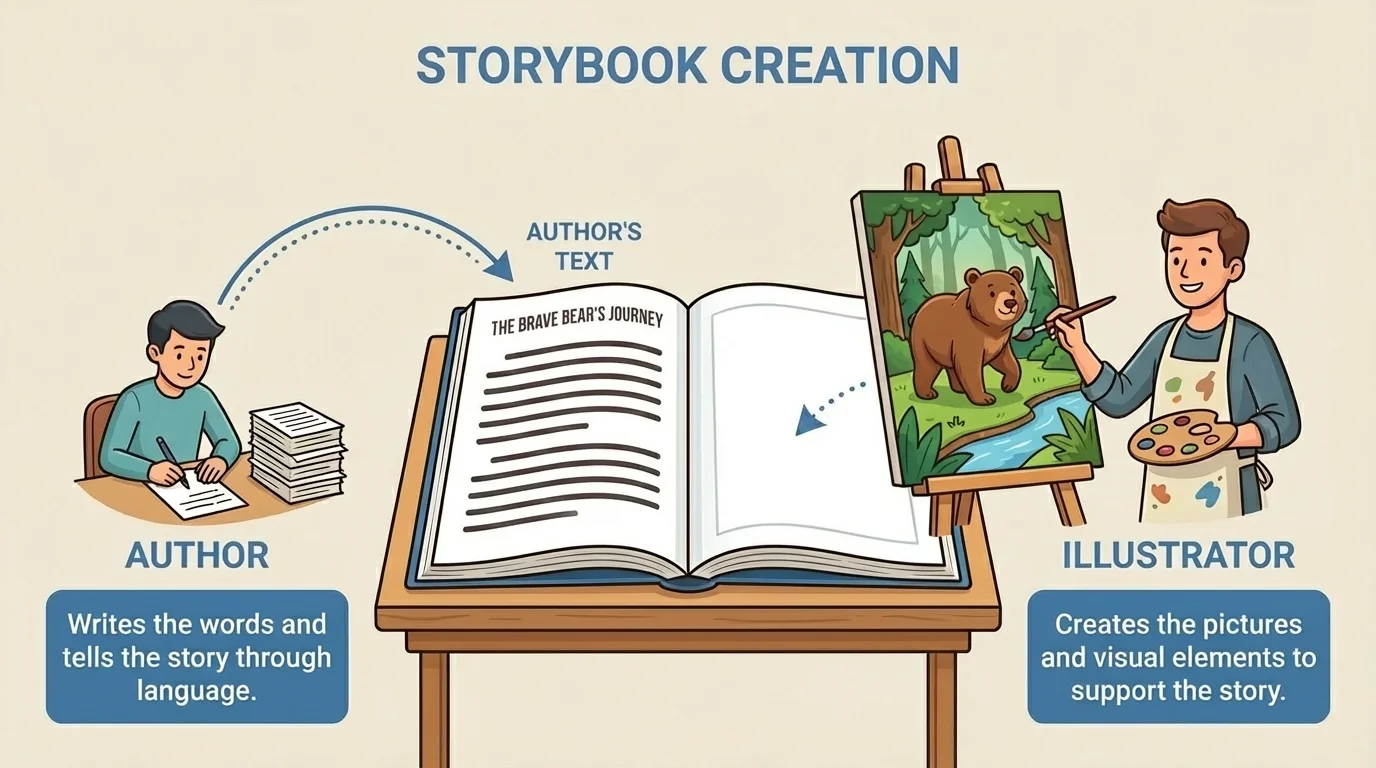
If a teacher asks, "Who made the pictures?" the answer is the illustrator. That is the illustrator's role in telling the story. The role of the illustrator is to help tell the story with pictures.
Sometimes a picture shows details that the words do not say directly. We might see that a character is tiny next to a giant tree, or that it is nighttime because the moon is out. The illustrator adds meaning to the story.
A good storybook often uses both words and pictures. The author and illustrator work together so readers can understand and enjoy the story. The author tells with words. The illustrator tells with pictures.
Think about a story about a little bear looking for honey. The author might write, "Bear climbed up the hill and smelled something sweet." The illustrator might draw Bear sniffing the air near flowers and a beehive. The words tell the action, and the picture helps us see it clearly.
Words and pictures tell the story together. In many children's books, the words and the pictures both matter. The author provides the words of the story, and the illustrator adds visual clues that help the reader understand characters, setting, and feelings.
We can also compare their jobs. The author does not usually draw the pictures unless the same person is also the illustrator. The illustrator does not usually write all the story words unless that person is also the author.
| Person | Main Job | Helps Tell the Story By |
|---|---|---|
| Author | Writes | Using words |
| Illustrator | Draws or paints | Using pictures |
Table 1. A simple comparison of the author's job and the illustrator's job.
[Figure 3] We can find these names by looking at the book carefully. Many books put the author's name and the illustrator's name on the cover. We can also look on the title page near the front of the book.
When an adult gives support, a child can point and say the names. For example, if the cover says "by Ana Hill" and "pictures by Lee Fox," then Ana Hill is the author and Lee Fox is the illustrator.
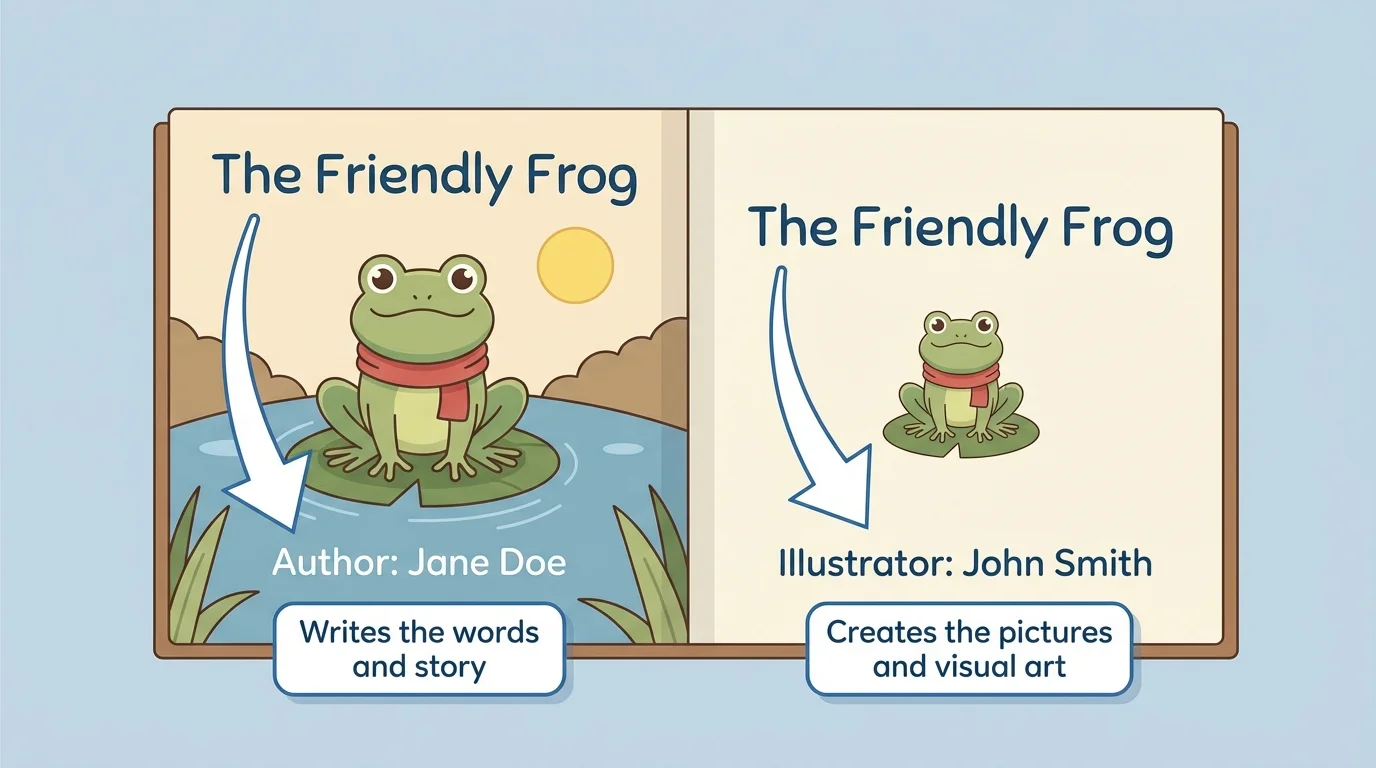
Sometimes the words on the cover say by before the author's name. Sometimes they say illustrated by before the illustrator's name. These clues help us know who did each job.
Looking for these names is part of understanding a book. It helps us talk about the book correctly. Instead of saying only "the book," we can name the people who made it.
Let's look at a few simple examples. Suppose a book cover says Rainy Day Fun by Mia Lopez, illustrated by Ben Carter. Mia Lopez is the author because she wrote the words. Ben Carter is the illustrator because he made the pictures.
Example 1
A book says: The Sleepy Kitten by Nora Green, illustrated by Sam Reed.
Step 1: Find the author.
The words by Nora Green tell us Nora Green is the author.
Step 2: Find the illustrator.
The words illustrated by Sam Reed tell us Sam Reed is the illustrator.
Step 3: Tell each role.
Nora Green wrote the words of the story. Sam Reed made the pictures.
Here is another example. A book about ducks might have short words on each page, but big bright pictures of a pond. The author still wrote the words, even if there are not many. The illustrator still helped tell the story by showing the ducks, the water, and the plants.
Example 2
A teacher asks, "Who is the author of this story?" The cover says: Lost in the Garden by Kim Park, pictures by Rosa Diaz.
Step 1: Read the name after by.
Kim Park is the author.
Step 2: Read the name after pictures by.
Rosa Diaz is the illustrator.
Step 3: Tell the jobs.
Kim Park wrote the story. Rosa Diaz made the pictures.
The pictures and words may give different kinds of help. Remember how the illustrator adds visual details, just as we saw earlier in [Figure 2]. The author provides the words of the story, and the illustrator helps us see those words come to life.
Sometimes one person writes the words and makes the pictures. That person is both the author and the illustrator. If a cover says, "written and illustrated by Taylor Jones," then Taylor Jones did both jobs.
This is important because not every book has two different names. We still use the same ideas. We ask: Who wrote the words? Who made the pictures? Sometimes the answer is the same person.
When you hold a book, look at the front and the first pages. Those places often tell you the title, the author, and the illustrator.
When you name the author and illustrator, you are learning how books are made. You are also learning to use book words correctly. That helps you talk about stories clearly and confidently.
Finding names on the cover or title page, as in [Figure 3], helps readers remember that books come from people's ideas and hard work. Every story has a creator of words, and many stories also have a creator of pictures.
