Have you ever heard two stories with very different characters, but both of them had a big problem to solve? Stories can feel like little journeys. When we listen closely, we can find ways characters are alike and ways they are different. That helps us understand stories even better.
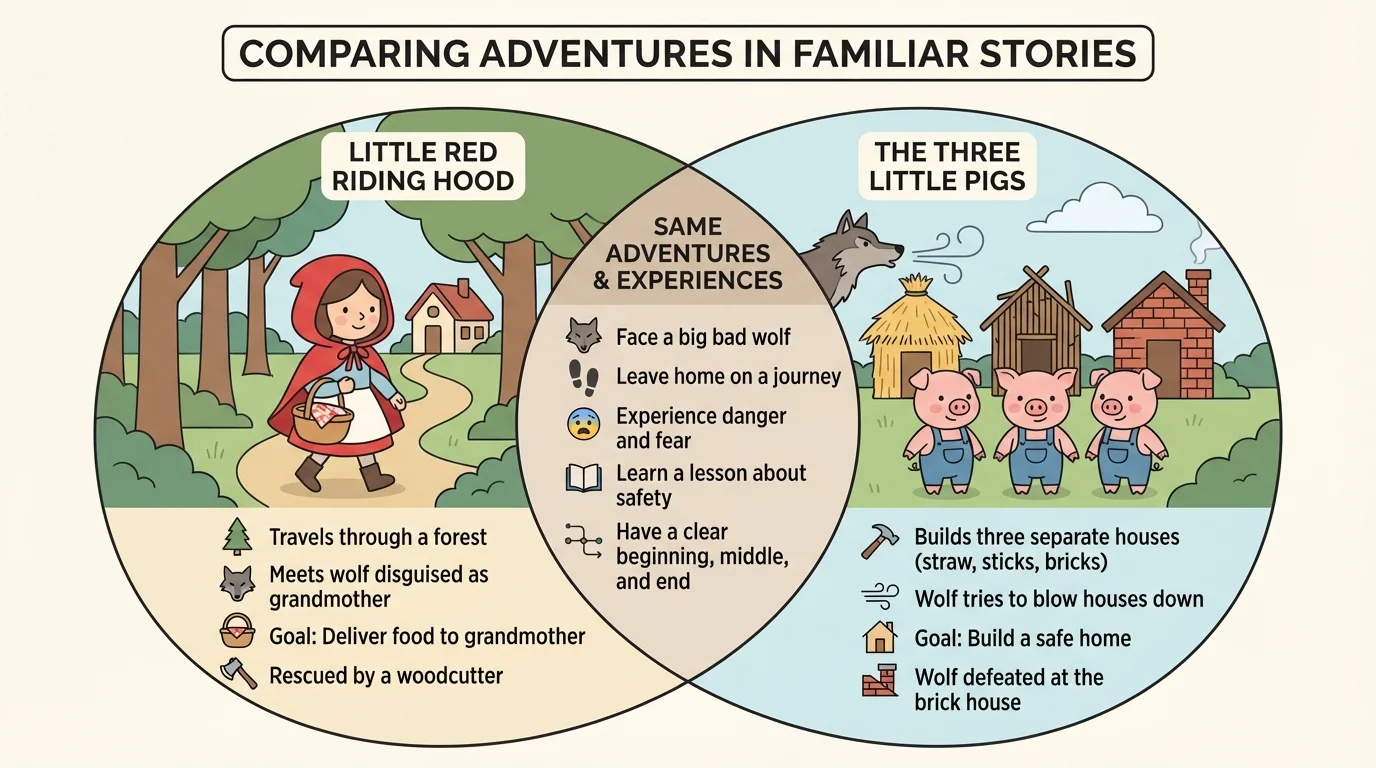
When we compare stories, we tell what is the same. When we contrast stories, we tell what is different. We can compare and contrast characters, places, problems, and endings, as [Figure 1] shows with a simple same-and-different picture idea.
For example, two characters might both go on a trip. That is the same. But one character may feel brave while the other feels scared. That is different.
We do not have to use big, hard words. We can say simple things like, "Both characters ran," or "This character had help, but that character did not."
Comparing and contrasting helps us become careful readers and listeners. It helps us notice important parts of a story instead of only remembering one tiny detail.
Compare means to tell how things are the same. Contrast means to tell how things are different. A character is a person or animal in a story.
Sometimes we compare one part of a story at a time. We might ask: Are the characters alike? Are the settings alike? Are the problems alike? This makes our thinking clear.
A character can have an adventure. An adventure is something exciting, important, or surprising that happens in a story.
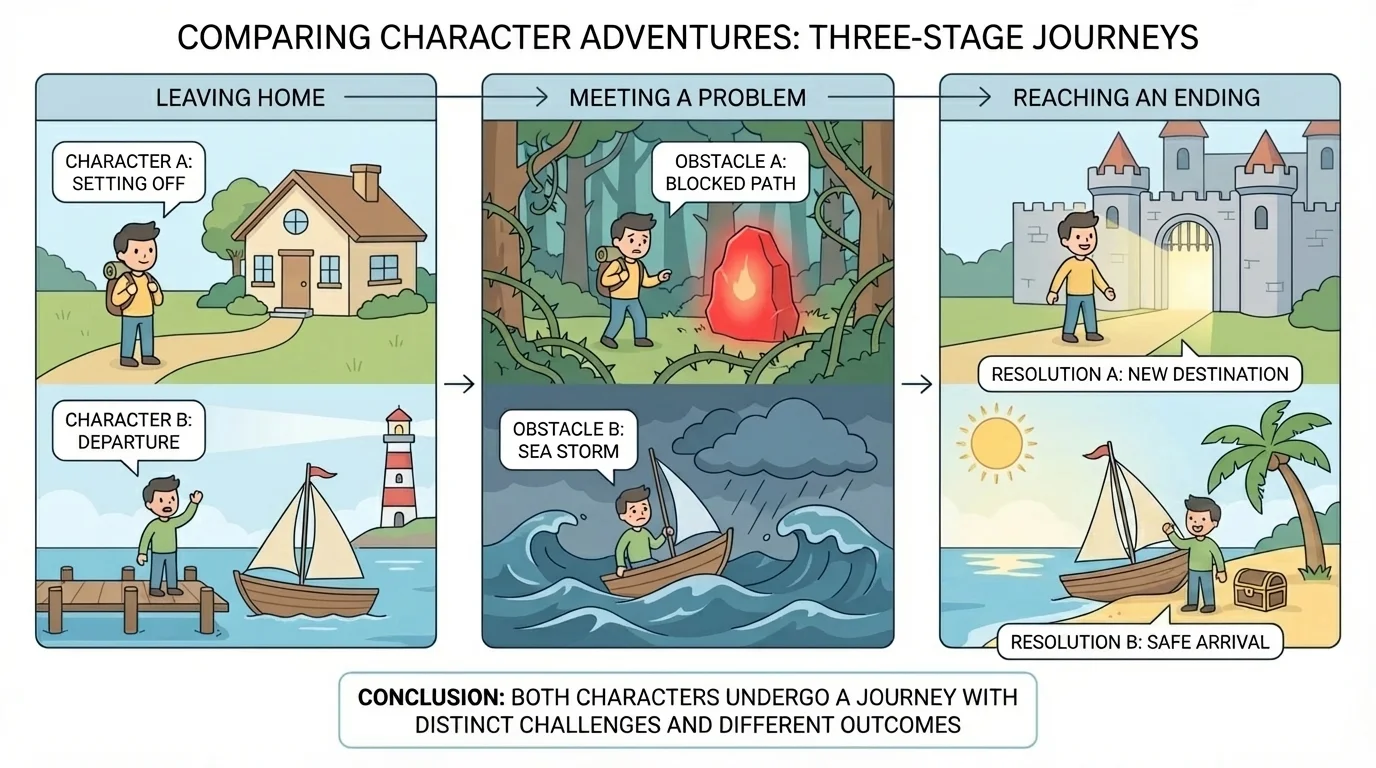
A character also has an experience. An experience is something that happens to the character. Going through the woods, meeting a wolf, building a house, or running away from someone are all experiences. The story sequence in [Figure 2] shows how a character can move from the beginning of a story to a problem and then to an ending.
When we think about adventures and experiences, we can ask: Where did the character go? What happened there? Who did the character meet? How did the character feel? What did the character do next?
These questions help us listen for the important parts of a story. They also help us talk about two stories together.
Many familiar stories have characters who face trouble. Some characters are clever. Some are kind. Some make mistakes. Looking at these experiences helps us understand the whole story, not just one moment.
Adventures can be alike even when stories look different. One character may walk through a forest, and another may run from a house. Even though the places are not the same, both characters may be trying to stay safe. That is an important comparison.
Stories often have a beginning, a middle, and an end. In the beginning, we meet the character. In the middle, the character has a problem or adventure. In the end, we learn what happens because of the character's choices.
When we look for what is the same, we can listen for shared actions and feelings. Two characters may both get tricked. Two characters may both need help. Two characters may both learn to be careful.
We can also compare settings. Maybe both stories happen in a home. Maybe both happen outside. Maybe both have animals that talk.
Another good thing to compare is the problem. If both characters are trying to get away from danger, then their adventures have something important in common.
We can say, "Both characters had a problem," or "Both characters met someone scary." Those simple sentences show careful thinking.
Many fairy tales from different places around the world have similar problems, such as getting lost, meeting a trickster, or trying to get home safely.
When we notice the same kinds of events, it helps us connect one story to another. That makes reading feel richer and more exciting.
Now we can look for differences. One character may be fast, while another is slow. One may ask for help, while another solves the problem alone.
The setting might be different too. A story in a forest feels different from a story on a farm or in a house. The place can change what happens to the character.
The ending may also be different. One character may be safe at the end. Another may still be in trouble. One story may be funny, while another feels a little scary.
We can also notice different choices. Characters do not always act the same way. One may be careful. One may be foolish. Those choices change the adventure.
Simple compare-and-contrast talk
Step 1: Name the two characters.
"I am thinking about Little Red Riding Hood and the Gingerbread Man."
Step 2: Say one thing that is the same.
"Both characters travel away from where they started."
Step 3: Say one thing that is different.
"Little Red Riding Hood meets a wolf, but the Gingerbread Man runs from many people and animals."
When we contrast carefully, we do not just say, "They are different." We explain how they are different.
Good readers and listeners use clues from the story. We can look at the pictures, listen to the words, and remember what happened first, next, and last.
If a picture shows a character hiding, we can think that the character may feel afraid. If the words say a character shouted or ran, we can use those details to talk about the experience.
Story clues help us say more than guesses. We can say, "I know both characters were scared because both of them ran away," or "I know these adventures are different because one happened at night and one happened during the day."
Later, when we compare familiar tales again, the same idea from [Figure 1] still helps us sort details into same and different parts.
Remember that stories have important parts: characters, setting, problem, and ending. These parts help us compare two stories in an organized way.
We can use words such as both, same, different, but, and also when we talk about stories.
Let us think about some stories many children know. When we place details side by side, as [Figure 3] does for two familiar tales, it becomes easier to see the adventures clearly.
In Little Red Riding Hood, a girl travels through the woods to visit her grandmother. In The Three Little Pigs, three pigs build houses and try to stay safe from a wolf. Both stories have a wolf. Both stories have danger. But the characters are different, and the problems happen in different ways.
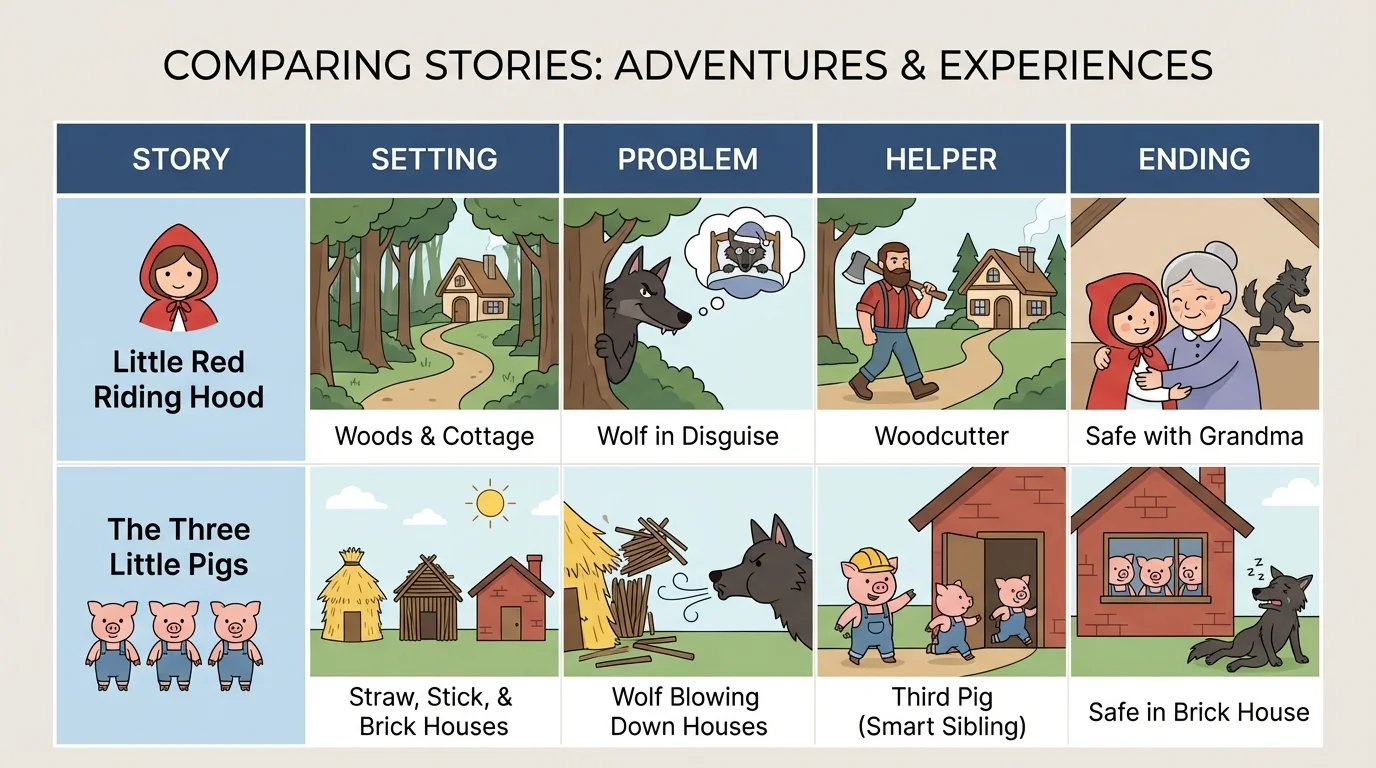
Little Red Riding Hood goes on her adventure mostly alone. The three pigs are part of a group, even though each pig has a different house. One story focuses on a visit through the forest. The other focuses on building homes and staying safe.
Now think about Goldilocks and the Three Bears and The Gingerbread Man. In both stories, someone moves from place to place. But Goldilocks goes into a house and tries different things there. The Gingerbread Man keeps running and meeting new characters.
These examples show that adventures can be alike in one way and different in another way. That is why we use more than one detail when we compare stories.
When we look back at [Figure 2], we can see that many story adventures follow a path: start, problem, and ending. But the people, places, and choices on that path are not always the same.
| Story | Who is the character? | What adventure does the character have? | What is one special detail? |
|---|---|---|---|
| Little Red Riding Hood | A girl | She walks through the woods | She meets a wolf |
| The Three Little Pigs | Three pigs | They build houses and stay safe | A wolf blows on houses |
| Goldilocks and the Three Bears | A girl | She explores a house | She tries chairs, porridge, and beds |
| The Gingerbread Man | A cookie that can run | He runs away | Many characters chase him |
Table 1. A simple comparison of characters and adventures in four familiar stories.
When we talk about stories, we can use clear sentence starters. We can say, "Both characters...," "One difference is...," "In this story...," and "But in that story...." These help us share our thinking.
We can also listen to a friend's idea and add another detail. One person might compare the problem, and another person might compare the ending. That is how discussion about stories grows.
Comparing and contrasting is not about finding only one right answer. It is about noticing true details from the story and explaining them clearly.
The more familiar stories we know, the more connections we can make. Soon we begin to notice patterns: brave helpers, tricky animals, dangerous journeys, and happy endings.
