A tiny whisper can get lost, and a very loud shout can hurt ears. A just-right voice helps people understand us. When we speak so others can hear and when we say what we mean clearly, we help our friends, teachers, and family know our thoughts, feelings, and ideas.
People talk for many reasons. We talk to tell what we know, ask for help, share how we feel, and tell our ideas. When we speak clearly, other people do not have to guess. They can listen, understand, and answer us.
Oral communication means talking and listening. Good speakers do not only use their mouths. They also think about their words, look at the person they are talking to, and wait for their turn. Good listeners help speakers too.
Audibly means in a way that can be heard clearly. Thoughts are things we think in our minds. Feelings are emotions like happy, sad, excited, or worried. Ideas are things we want to share, make, or try.
When you say, "I need help with my zipper," you share a thought clearly. When you say, "I feel proud of my picture," you share a feeling. When you say, "Let's build a tall block tower," you share an idea.
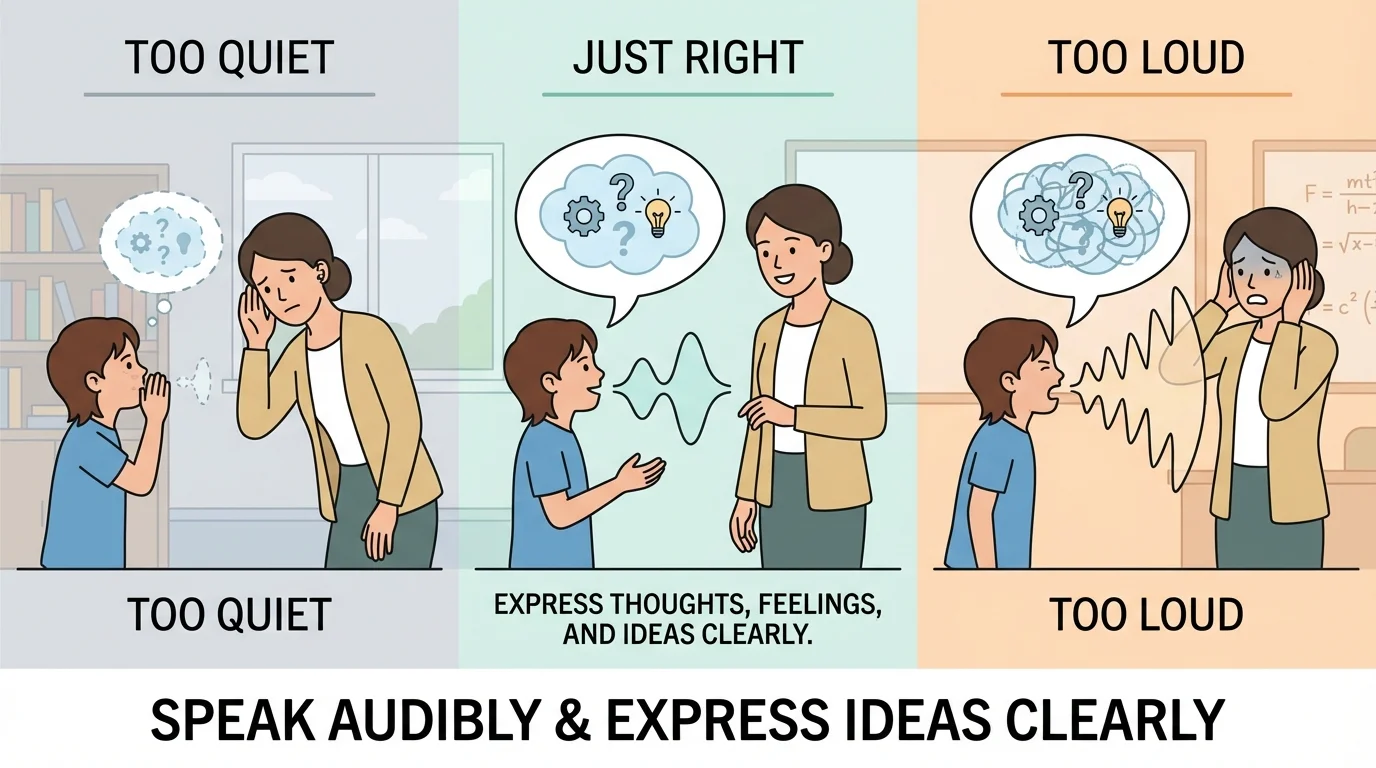
To speak audibly, we use a voice that is easy to hear, as [Figure 1] shows. If a voice is too quiet, listeners may miss the words. If a voice is too loud, listeners may feel uncomfortable. A classroom voice is often in the middle: strong, calm, and clear.
Your mouth should open enough to make words clearly. Facing the person you are talking to helps your voice travel to them. Standing still for a moment and speaking a little more slowly can also help people hear every word.
Sometimes the place matters. Outside on the playground, your voice may need to be a little stronger. During story time, your voice may need to be softer but still clear. The goal is the same: the listener can hear and understand you.
Your voice changes when you feel excited, sleepy, shy, or upset. Taking a breath before speaking can help your voice sound calm and clear.
If someone says, "What?" or "I didn't hear you," that is a clue to try again with a stronger voice. The just-right voice in [Figure 1] helps speakers share their message kindly.
We can say different kinds of messages, and [Figure 2] shows simple ways children do this. A thought tells what you know or think. A feeling tells your emotion. An idea tells something you want to do, make, or try.
Helpful sentence starters make speaking easier. You can say, "I think...," "I feel...," or "My idea is...." These starters help the listener know what kind of message you are sharing.
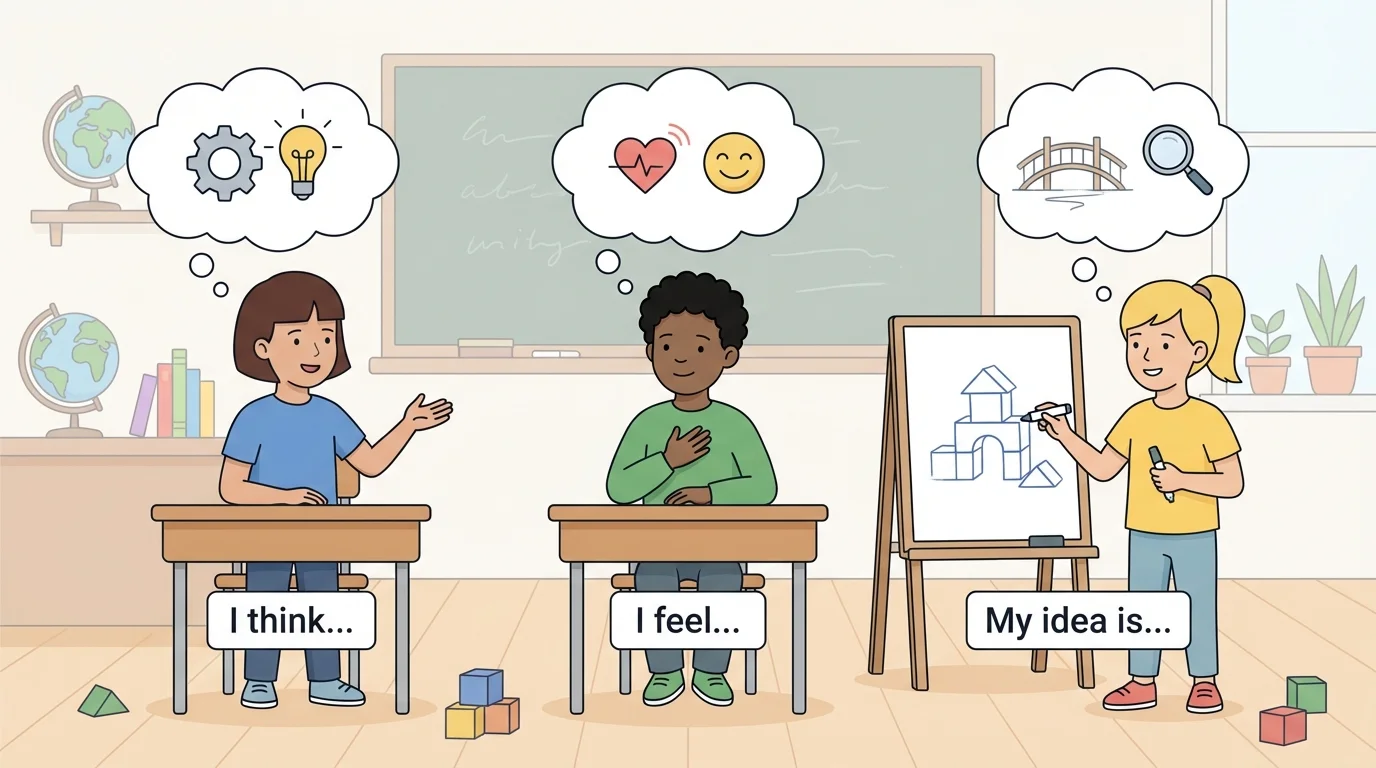
Here are clear examples: "I think the caterpillar will turn into a butterfly." "I feel excited for music time." "My idea is to sort the crayons by color." Each sentence tells one message clearly.
Sometimes children say only one word, like "Mad!" or "Blocks!" A listener may not know exactly what that means. Clear speaking gives more information: "I feel mad because my block tower fell." "My idea is to build with the big blocks." The examples in [Figure 2] help us notice the difference between the kinds of messages we share.
Clear messages help other people respond. When your words tell exactly what you think, feel, or want, the listener knows how to answer. If you say, "I feel sad because I miss my mom," a teacher knows you may need comfort. If you say, "I think this puzzle piece goes here," a friend knows what you are trying to explain.
Sharing feelings clearly is important too. You can use words such as happy, sad, angry, surprised, nervous, calm, and proud. Naming a feeling helps other people understand you better.
Clear speaking uses words that paint a picture in the listener's mind. Instead of saying, "That one," you can say, "I want the red marker." Instead of saying, "He did it," you can say, "Sam knocked over the cup." Names and details make meaning stronger.
A sentence is a group of words that tells a complete idea. Complete sentences help listeners know who, what, and sometimes where. "The puppy is sleeping." "I made a paper boat." "We are lining up at the door."
Making speech clearer
Listen to how a short answer can become a clear answer.
Step 1: A short answer
"Paint."
Step 2: Add who and what
"I want paint."
Step 3: Add details
"I want blue paint for my sky."
The last sentence gives the listener much more information.
Words should be said carefully enough that the listener can tell them apart. If you rush, words may sound jumbled. Slowing down just a little can make your message easier to understand.
When you ask for help, clear words are very useful. "Can you help me tie my shoe?" is clearer than "Help!" Both tell something important, but the first sentence tells exactly what is needed.
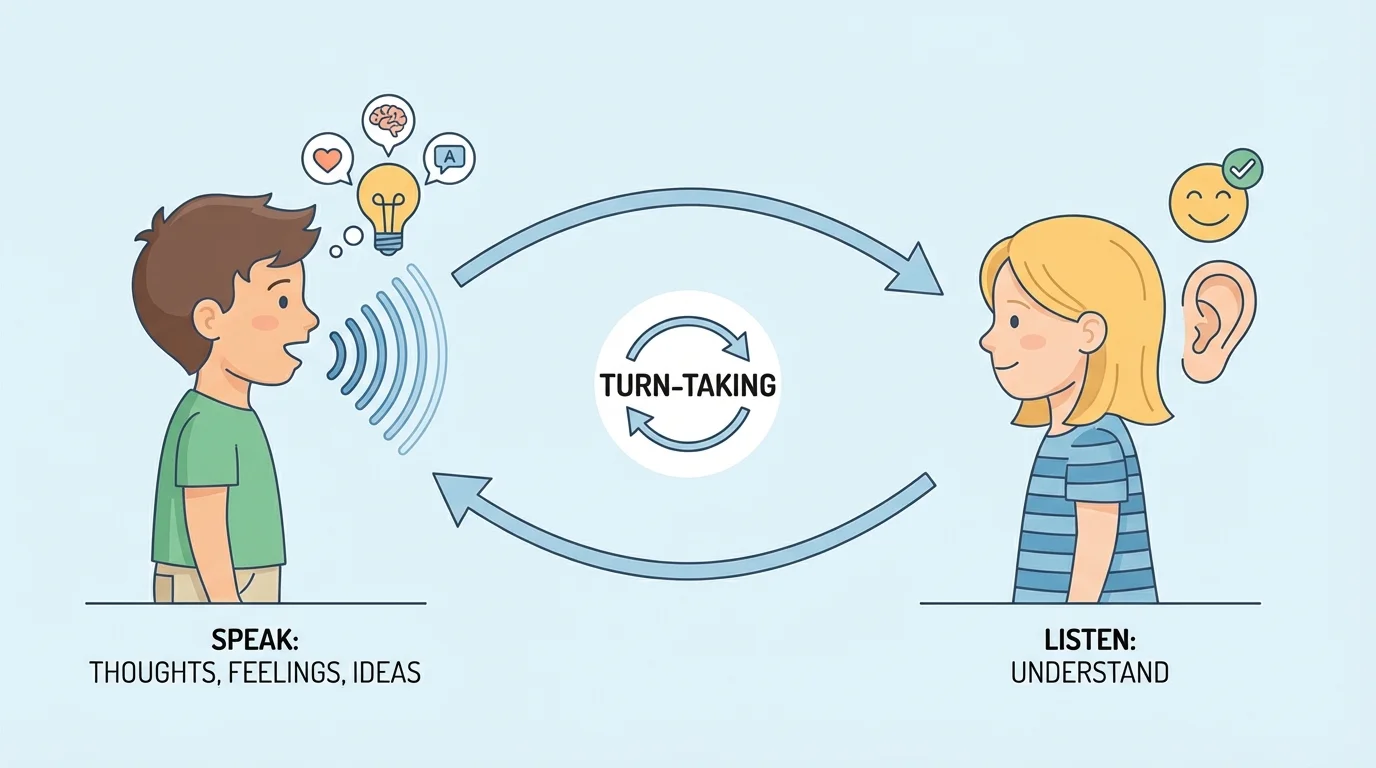
Good speaking and good listening work together, and [Figure 3] shows how two people take turns. When one person talks, the other person listens. Then they switch. This makes a conversation fair and calm.
Listeners can look at the speaker, keep their bodies still, and think about the words they hear. They do not need to interrupt. Waiting helps everyone feel respected.
After listening, you can answer the speaker. If a friend says, "I feel sad," you might say, "Do you want to talk?" If a teacher says, "Please put the books away," you can show listening by doing it. Listening is not only hearing sounds. It means paying attention.
You already know how to raise your hand, look at the speaker, and wait. Those skills help you join conversations kindly and clearly.
Sometimes two people want to speak at once. That can happen during exciting moments. Taking a breath and waiting for your turn-taking makes the conversation smoother. The pattern in [Figure 3] reminds us that speaking and listening go back and forth.
We do not always speak the same way in every place. In circle time, you may use a classroom voice and speak to the whole group. With one partner, you may use a softer voice. If there is an emergency, you speak strongly and quickly so an adult can help.
You can also change your words to match the situation. To a friend, you might say, "Will you play with me?" To a teacher, you might say, "Can you please help me?" Both are clear, but each fits the listener.
Questions are an important part of oral communication. Clear questions help you learn. "Where does this puzzle piece go?" "May I have a turn?" "What do we do next?" A clear question often gets a clear answer.
"Use your words."
— A helpful classroom reminder
When children use words instead of grabbing, yelling, or walking away, they solve problems better. Saying, "I do not like that," or "Can I have a turn when you are done?" helps others understand what you need.
Speaking audibly and clearly is a skill that grows with practice. Every time you share a thought, name a feeling, explain an idea, or listen for your turn, you become a stronger communicator.
