Have you ever opened a book and noticed that words follow a path across the page? Reading has a special path. When we know the path, books make sense. When we follow print the right way, we can tell where a story starts, where it goes next, and what comes at the end.
When we read English, our eyes move across the print from the left side to the right side. A finger can help us follow that path. If a sentence says, The cat naps., we start at The on the left and move across to cat and then naps.
[Figure 1] This is called left to right reading. We do not start at the end of the sentence. We do not jump to the middle first. We begin at the left and move across until the line is finished.
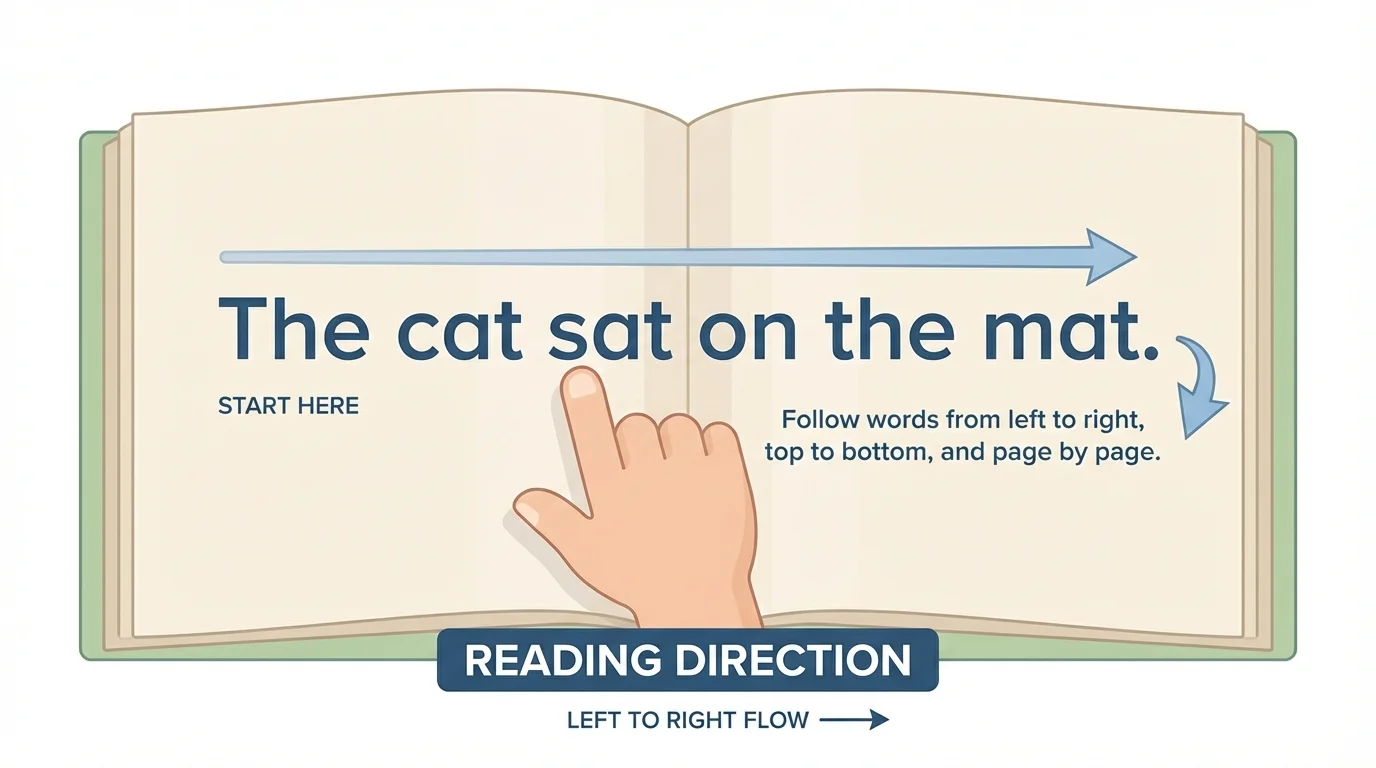
Spaces help us see where one word ends and the next word begins. In the sentence I see a dog., each word has its own place. The spaces between words help our eyes move in the correct direction and help us read one word at a time.
Print is the words and letters we see on a page. Left to right means we start on the left side and move across to the right side when we read a line of words.
When children first learn to read, they often use a finger under the words. That is a helpful reading tool. It helps the reader stay on the line and keep the words in order. Later, eyes can do more of the work, but the path stays the same.
A page usually has more than one line. After we read the first line, we go back to the left side of the next line below it. We read across, then move down to the next line, and then read across again.
[Figure 2] This is called reading top to bottom. The line at the top comes first. The line underneath comes next. If we skip around, the words may not make sense.
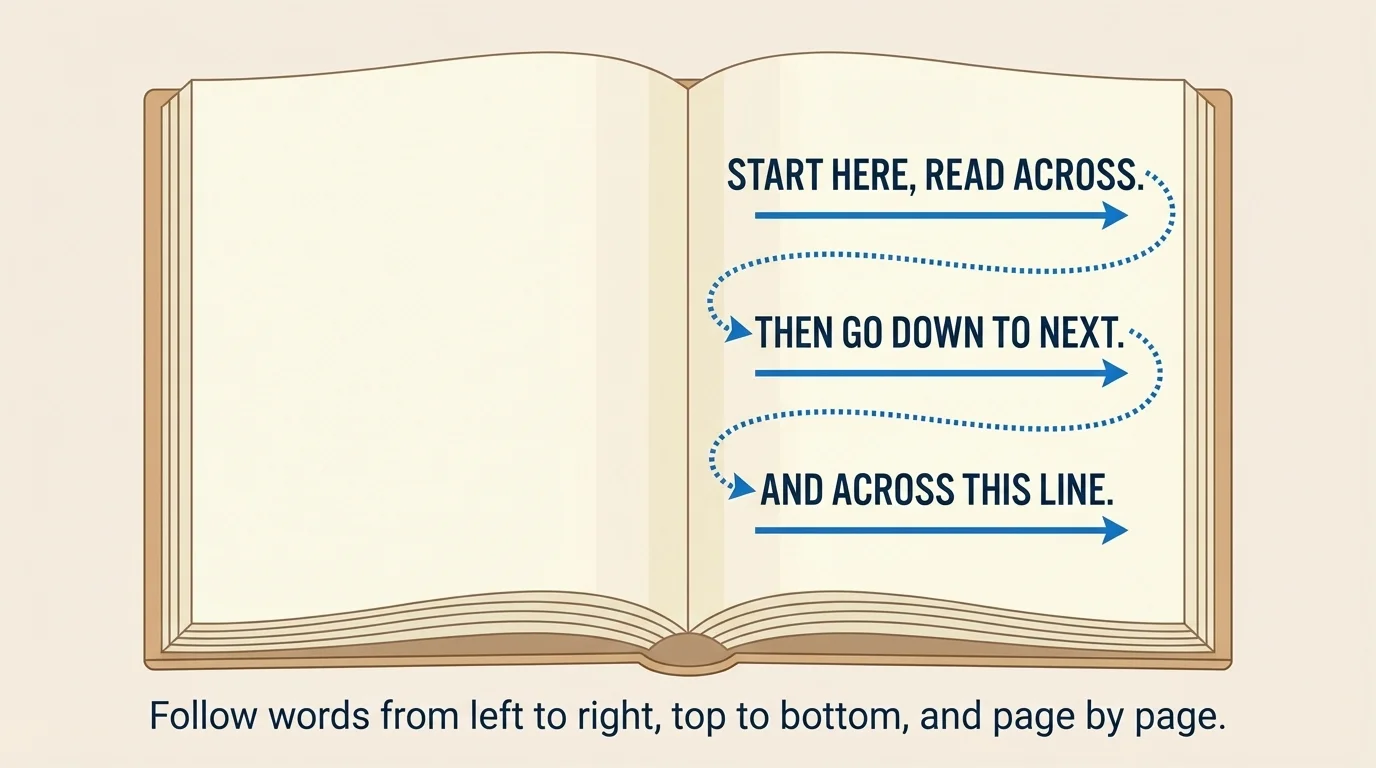
Think about a short page like this: first line, I like rain. Next line, I like sun. Last line, I like snow. We read the top line first, then the middle line, then the bottom line. That order helps the page sound right.
Pictures can be on a page too, but the words still have their own reading order. We can enjoy the picture and then return to the words, keeping our place on the line we are reading.
Reading direction helps meaning. The order of words matters. If we follow the page in the correct direction, the sentence sounds the way the author meant it to sound. The direction of print is one of the basic features of books and pages.
Sometimes a teacher points to each word while reading aloud. This helps children match the spoken words to the printed words. It also shows that print is read in a steady order, not in random spots around the page.
Books have a beginning, a middle, and an end. We read them page by page. We start near the front of the book and move through the pages in order. One page comes before the next page.
[Figure 3] If a story begins on one page and we jump far ahead, we may miss important parts. Turning pages in order helps us understand what happens first, next, and last.
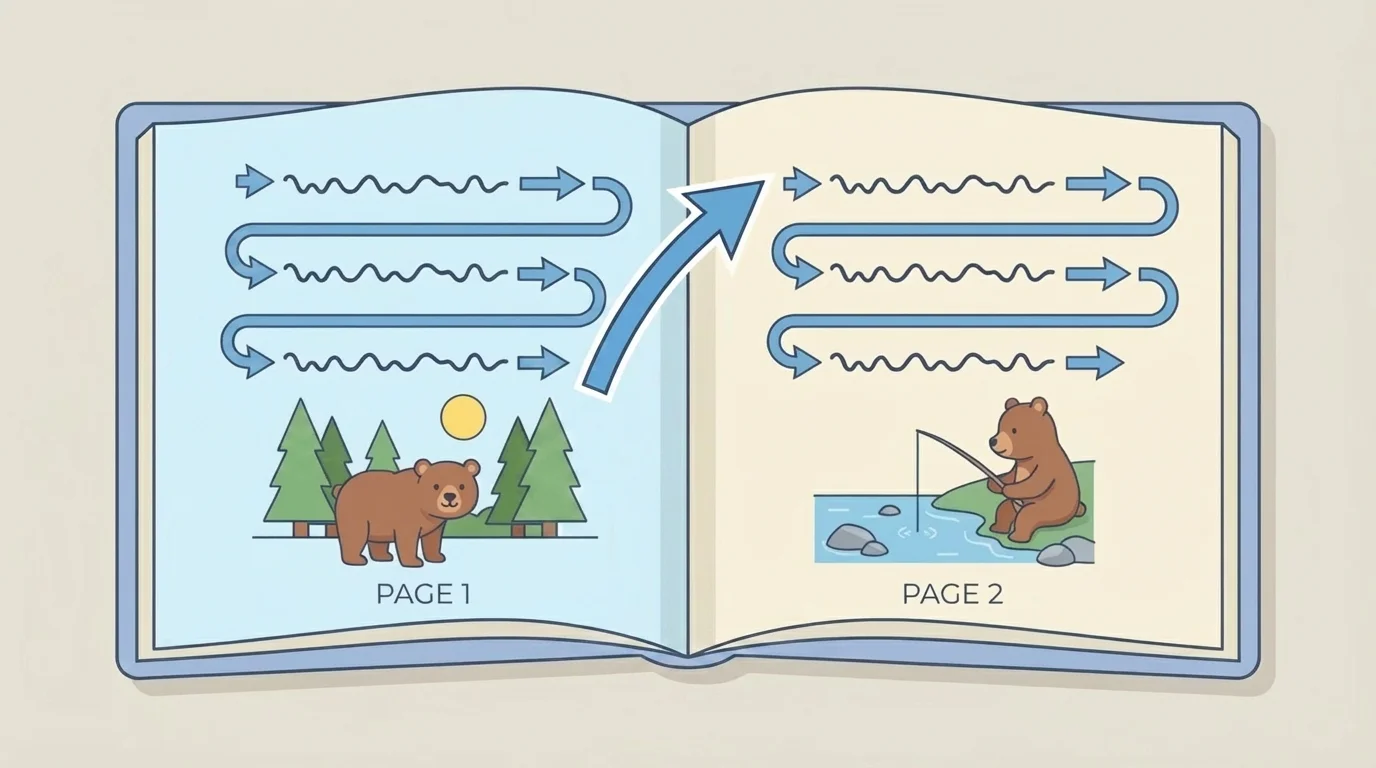
Page numbers can help too. If one page is before another, it usually has a smaller number. A reader can use page order to follow the story and know where to go next.
When someone reads a bedtime story, they do not begin at the last page. They begin at the start and keep going until the story is finished. That is how books work best.
Many books tell a story that changes a little on each page. Turning pages in order helps readers notice how the characters, places, and events change from beginning to end.
Later, when readers learn more, they may use a table of contents or look for a page number. Even then, once they begin reading a page, they still follow the same print path across the lines and down the page.
A page can have letters, words, spaces, lines, and pictures. Good readers learn where the print begins. On many pages, the first line starts near the top. Then the reader moves across the words from left to right and goes down line by line.
Sometimes a page has only a few words. Sometimes it has many words. Sometimes the print is big. Sometimes it is small. No matter how the page looks, the reading direction stays the same. We still read left to right, top to bottom, and page by page.
We also learn that the front of a book is where reading usually begins. The cover opens, and then the first pages come before the later pages. This order helps us understand books as organized pieces of print.
You already know that letters make words and words make sentences. Now you are adding another important reading skill: knowing exactly how to move through the print so the words stay in the right order.
When we keep words in order, a sentence like I can hop. is easy to read. If we pointed to the last word first, the sentence would not sound right. Direction helps reading stay clear.
In a classroom big book, a teacher may point to each word while the class reads together. Just as we saw in [Figure 1], the finger moves smoothly across the line. Then, like the page in [Figure 2], the finger returns to the left side of the next line below.
In a picture book, readers turn the pages one at a time. That matches the book order shown in [Figure 3]. The story keeps moving forward because the reader follows the print in the correct sequence.
Reading a tiny page
Look at this simple page: We run. On the next line: We jump.
Step 1: Start at the first word on the left.
Read We, then move right to run.
Step 2: Go to the next line below.
Return to the left side of the new line.
Step 3: Read across again.
Read We, then move right to jump.
This keeps the words in the right order.
These print rules help everywhere: in storybooks, charts, poems, labels, and classroom signs. When children understand where to start and which way to go, they are building strong early reading habits.
Following print is one of the first big reading skills. It helps readers connect spoken words to written words. It also helps them enjoy stories, learn information, and feel confident with books.
