Have you ever heard a word you know and then discovered it means something new? That can happen in reading all the time. A word may look the same and sound the same, but it can mean different things. Learning these new meanings helps us understand stories, directions, and conversations.
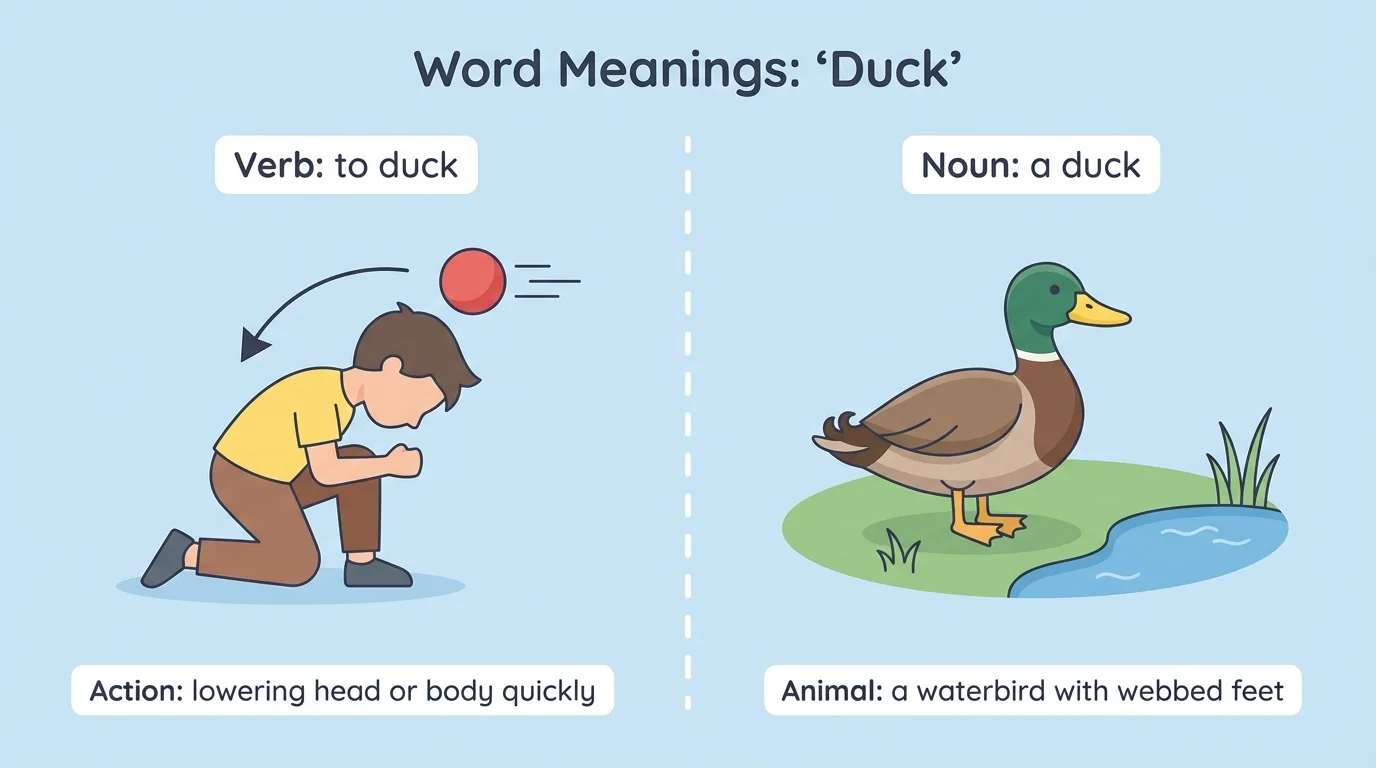
Some words are multiple-meaning words. That means one word can have two or more meanings. For example, duck can be a bird. But duck can also mean to bend down fast. If someone says, "Duck!" they are not talking about the bird. They are telling you to move your head down quickly.
Readers and listeners have to think carefully. As [Figure 1] shows, we ask, "What is happening here?" The sentence helps us choose the right meaning. The picture can help too.
Multiple-meaning word means a word that has more than one meaning. The meaning we choose depends on the sentence, the picture, and what is happening.
Knowing more than one meaning for a word makes you a stronger reader. It helps you understand books better and use words effectively when you speak.
Good readers use context clues to find the right meaning. Context clues are hints from the words around the tricky word, from the picture, and from the action in the sentence.
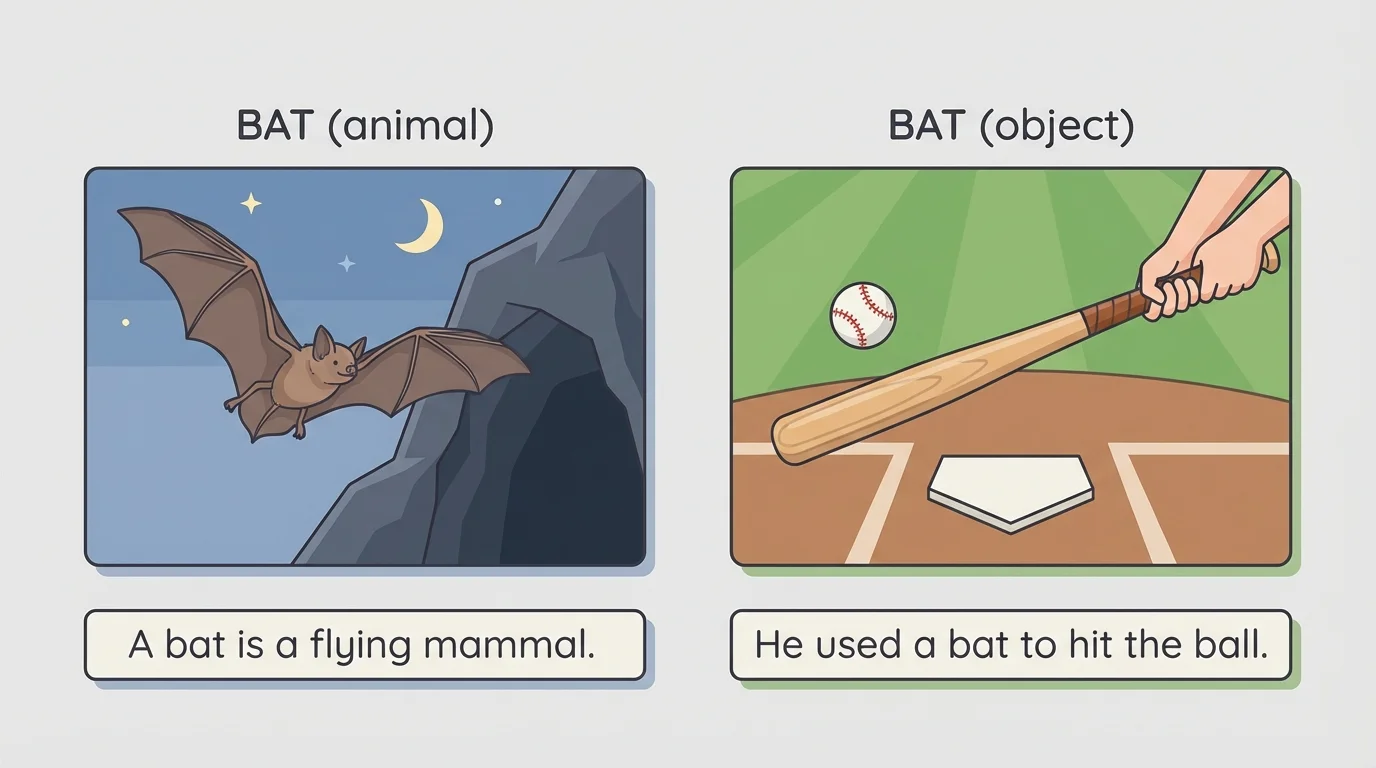
If a book says, "The bat flew out of the cave," the word bat means the animal. If a book says, "Sam hit the ball with the bat," the word bat means the thing used in baseball. The rest of the sentence tells us which meaning is right.
Pictures can help too. If you see wings and a cave, you know bat means the animal. If you see a ball field, you know bat means the piece of sports equipment.
Another way to figure out meaning is to think about what makes sense. If the sentence says, "We park the car," the word park means to put a car in a place. If the sentence says, "We play at the park," the word park means a place for fun outside.
How context helps
When a word has more than one meaning, readers do not guess randomly. They look at the whole sentence, the picture, and what is happening in the story. These clues work together to show the correct meaning.
Sometimes you know one meaning first and learn a new one later. That is exciting, because your word knowledge grows.
Let's look at some familiar words that can mean new things. The word duck, as [Figure 2] illustrates, can name a bird or tell someone to bend down quickly. In "The duck swims on the pond," it is the bird. In "Duck under the branch," it is the action.
The word ring can be a piece of jewelry, and it can also mean a sound. In "Mom wears a ring," it means jewelry. In "I hear the bell ring," it means a sound.
The word wave can be a movement of water, and it can also mean moving your hand to say hello. In "The wave splashed on the sand," it means water. In "I wave to my friend," it means a hand motion.
The word fly can mean to move through the air, and it can also be a small insect. In "Birds fly in the sky," it is an action. In "A fly buzzes near the window," it is an insect.
The word watch can mean to look carefully, or it can mean a timepiece. In "Watch the puppy run," it means look. In "My watch tells time," it means the thing you wear.
Some very common words in everyday talking have more than one meaning. That is one reason reading carefully is so important.
Later, when you hear these words again, you can stop and ask, "Which meaning fits here?" That small question helps a lot.
When we apply a word accurately, we use the meaning that matches the sentence. We do not just know the meanings. We choose the right one.
If we say, "Please duck when the ball comes," we mean bend down. If we say, "The duck has orange feet," we mean the bird. The same word is correct in both sentences, but the meaning changes.
Choosing the correct meaning
Read each sentence and think about what is happening.
Step 1: "We had lunch at the park."
Here, park means an outdoor place.
Step 2: "Dad will park the car."
Here, park means to put the car in a place.
Step 3: "I wave when Grandma arrives."
Here, wave means to move your hand to say hello.
The sentence tells us which meaning to use.
We can also compare two sentences with the same word. "The ring is shiny" means jewelry. "Hear the phone ring" means sound. This is why reading the whole sentence matters.
Earlier, [Figure 2] showed the two meanings of duck clearly. That same idea works for many other words too. The word stays the same, but the meaning changes with the sentence.
You hear multiple-meaning words at home, at school, and in books. During story time, a teacher may read a sentence with a word you know, but the story gives it a new meaning. When that happens, stop and think.
You can ask yourself simple questions: "What is happening?" "What do I see in the picture?" "What word would make sense here?" These questions help you become a careful reader and listener.
Words and pictures work together in many books. When a word has more than one meaning, both the sentence and the picture can help you understand it.
As you keep reading, you will find more words like duck, bat, park, ring, and wave. Each new meaning you learn makes your reading stronger and your speaking clearer.
