Have you ever heard many people talk at the same time? It can sound like a noisy jumble. But when a class follows discussion rules, everyone can hear, think, and share. Good discussions help us learn from books, from topics we study, and from each other.
A discussion is when people talk together about the same thing. The class may talk about a story, a science topic, a picture, or something that happened in the classroom. In a discussion, we do not all talk at once. We listen, think, and speak one at a time.
Discussion rules are agreed-upon ways to help everyone talk and listen fairly. They help people know when to speak, how to listen, and how to be respectful.
When children and adults follow the same rules, talking feels safe and fair. Everyone gets a chance to join. That means each person can learn something new. [Figure 1]
Good discussion rules help everyone know when to listen and when to speak. One important rule is listening to the speaker. Listening means our ears are ready, our bodies are calm, and our minds are paying attention.
Another important rule is taking turns. Taking turns means one person speaks, then another person speaks. We wait until it is our turn instead of calling out.
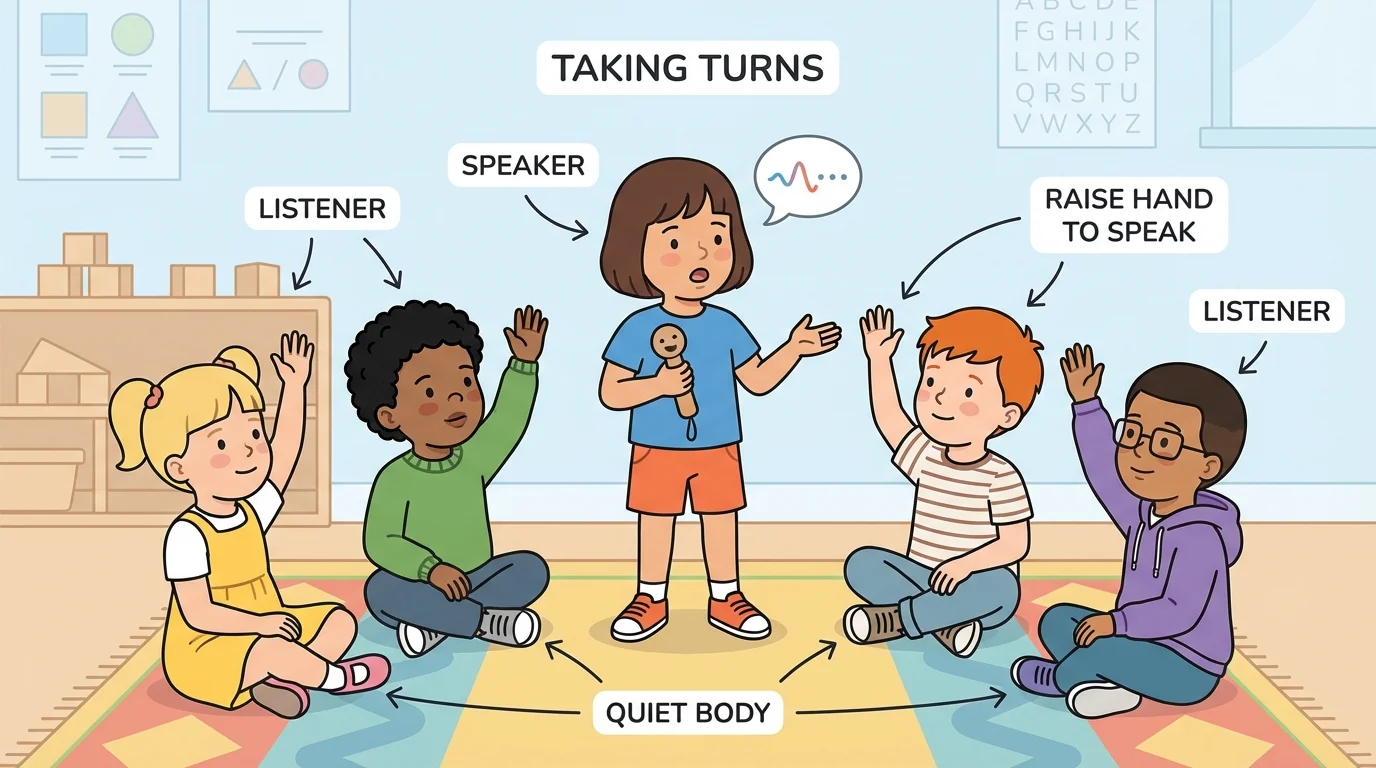
Children often use simple rules such as these: look at the speaker, keep a quiet body, raise a hand if the teacher asks, wait for your turn, use kind words, and talk about the same topic. These rules help the whole group stay ready to learn.
| Rule | What it looks like |
|---|---|
| Listen | Eyes and ears are on the speaker |
| Take turns | Wait until another person is finished |
| Stay on topic | Talk about the book or idea being discussed |
| Use kind words | Speak politely to classmates and adults |
| Speak clearly | Use a voice others can hear |
Table 1. Common discussion rules and what they look like in class.
Sometimes students feel excited and want to talk right away. That feeling is normal. Following rules means stopping, waiting, and then speaking when it is the right time. That helps every voice be heard. [Figure 2]
We use verbal language when we speak with words. We use nonverbal language when our bodies show meaning without words. Both kinds of communication matter in a discussion.
Verbal language can sound like, "I think the bear is sad," or "I want to add on." Nonverbal language can look like facing the speaker, nodding, keeping hands still, or waiting quietly. A student may not be talking, but their body can still show respect.
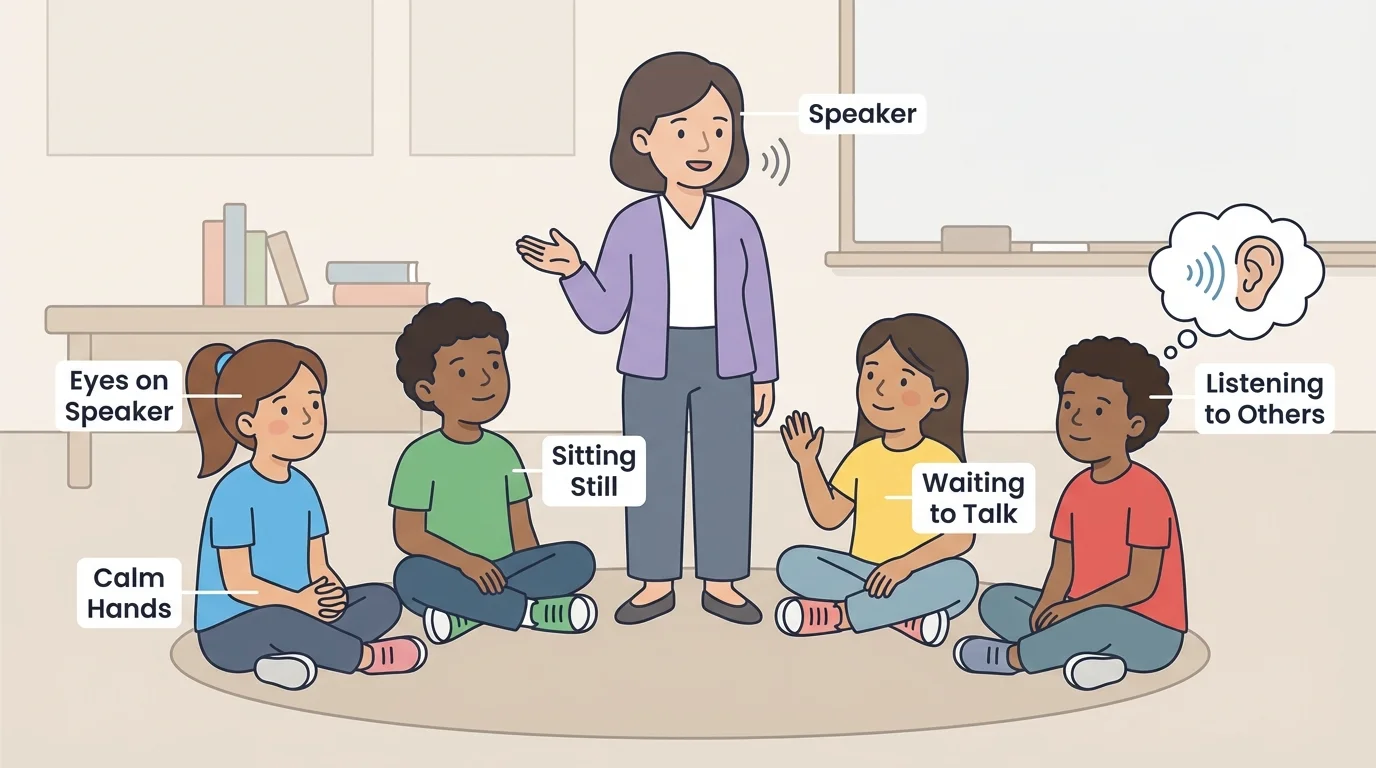
Sometimes nonverbal language can also show when a person is not listening. Looking away, playing with objects, or talking to someone else sends a different message. Respectful bodies help discussions go smoothly.
Words and bodies work together
When students use kind words and respectful body signals at the same time, others know they are listening and ready to learn. A calm body, patient waiting, and clear speaking all help a conversation feel safe and organized.
Later, when students talk in groups again, the listening signals from [Figure 2] still matter. Even before speaking, children can show they are ready by watching the speaker and waiting calmly.
In school, discussions are often about a shared topic or a text. A text can be a storybook, an informational book, a poem, or something read aloud. When we discuss a text, we talk about what happened, what we noticed, or what we think.
Staying on topic means our words match the thing the group is discussing. If the class is talking about a story about ducks, a helpful comment might be, "The ducklings followed their mother." A comment about a birthday party at home may be interesting, but it does not fit that discussion.
Examples of staying on topic
Step 1: Listen to the shared topic.
The class is discussing a book about a seed growing into a flower.
Step 2: Think of a matching idea.
A student says, "First the seed went into the dirt."
Step 3: Add on or answer.
Another student says, "Then it needed water and sun."
Both students are talking about the same text, so the discussion stays clear and useful.
Good discussion words can help. Students might say, "I agree," "I noticed...," "My idea is...," or "I want to add...". These sentence starters make speaking easier and more organized.
[Figure 3] The same discussion rules work with many kinds of partners and groups. Sometimes a child talks with one classmate. Sometimes the child talks with a small group. Sometimes the whole class talks together with the teacher.
In partner talk, each person has more time to speak. In a small group, students still take turns, but they also listen to several people. In a large group, students may need to wait longer and pay attention to many ideas.
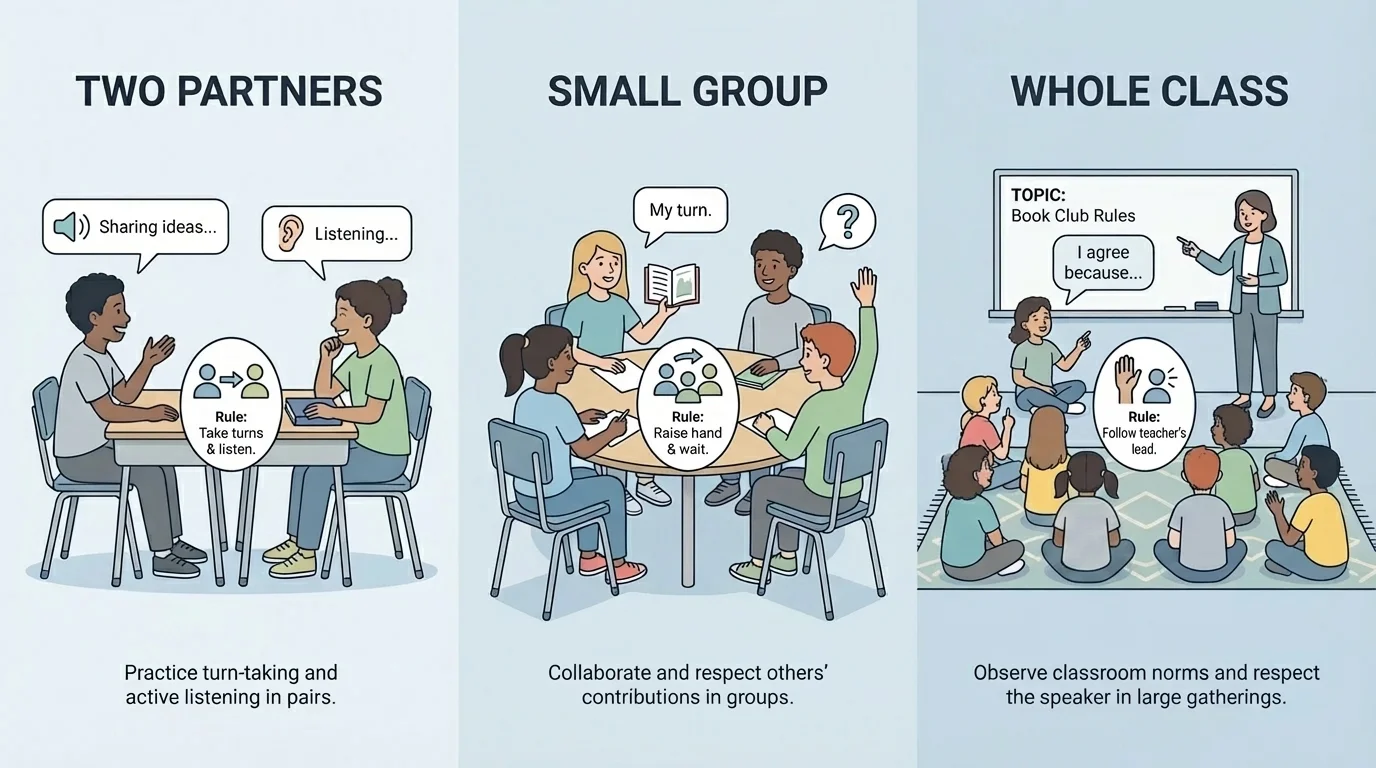
Students also talk with different people. A partner may be a friend, a new classmate, or an adult. Good discussion behavior stays the same: listen carefully, speak kindly, wait your turn, and stay on the shared topic.
As students move from one setting to another, the picture in [Figure 3] helps us remember that discussion rules do not change just because the group changes. Respect works everywhere.
Sometimes two children want to speak at once. That is okay. They can pause and let one person go first. A teacher may choose who speaks, or students may use a signal such as raising a hand.
Helpful words include, "You can go first," "I will wait," or "Now it is your turn." These words solve small problems in a peaceful way. They help keep the discussion friendly.
Classrooms become easier places to learn when children know the rules for speaking and listening. Simple habits such as waiting and looking at the speaker help every child join the conversation.
Waiting can be hard, especially when a student has an exciting idea. But waiting is part of teamwork. It shows respect for the person who is speaking now.
Discussion rules are not only for one lesson. Children use them during morning meeting, story time, partner sharing, science talks, and class questions. The more we practice, the easier the rules become.
When a class follows agreed-upon rules, everyone has a better chance to learn. Students hear new ideas, remember details from texts, and feel proud when they share. Listening and taking turns are not just classroom rules. They are ways to care for other people.
