Have you ever seen a big word that looked a little familiar? That is because many words are built like blocks. A word can have a middle part you know and a tiny part added at the beginning or end. Those tiny parts can help you become a strong reader.
When readers look closely at words, they can notice affixes. An affix is a small part added to a word. Some affixes go at the beginning, and some go at the end. A word can also have an inflection. An inflection is a little ending that changes how the word works, such as showing more than one or showing that something already happened.
Base word means the word part we start with. In the word helpful, the base word is help. The ending -ful gives a clue that the word means "full of help" or "giving help."
Readers do not need to know every word right away. They can look for the part they know. Then they can look at the small part added on. That gives a clue to the whole word.
Some endings tell us very important things about a word, as [Figure 1] shows with one base word changing into many new words. These endings can tell us about one or more, now or before, or a special meaning.
The ending -s can mean more than one. If you know cat, then cats means more than one cat. If you know dog, then dogs means more than one dog.
The ending -ed can mean already happened. If you know jump, then jumped means the jump happened before. If you know paint, then painted means the painting happened already.
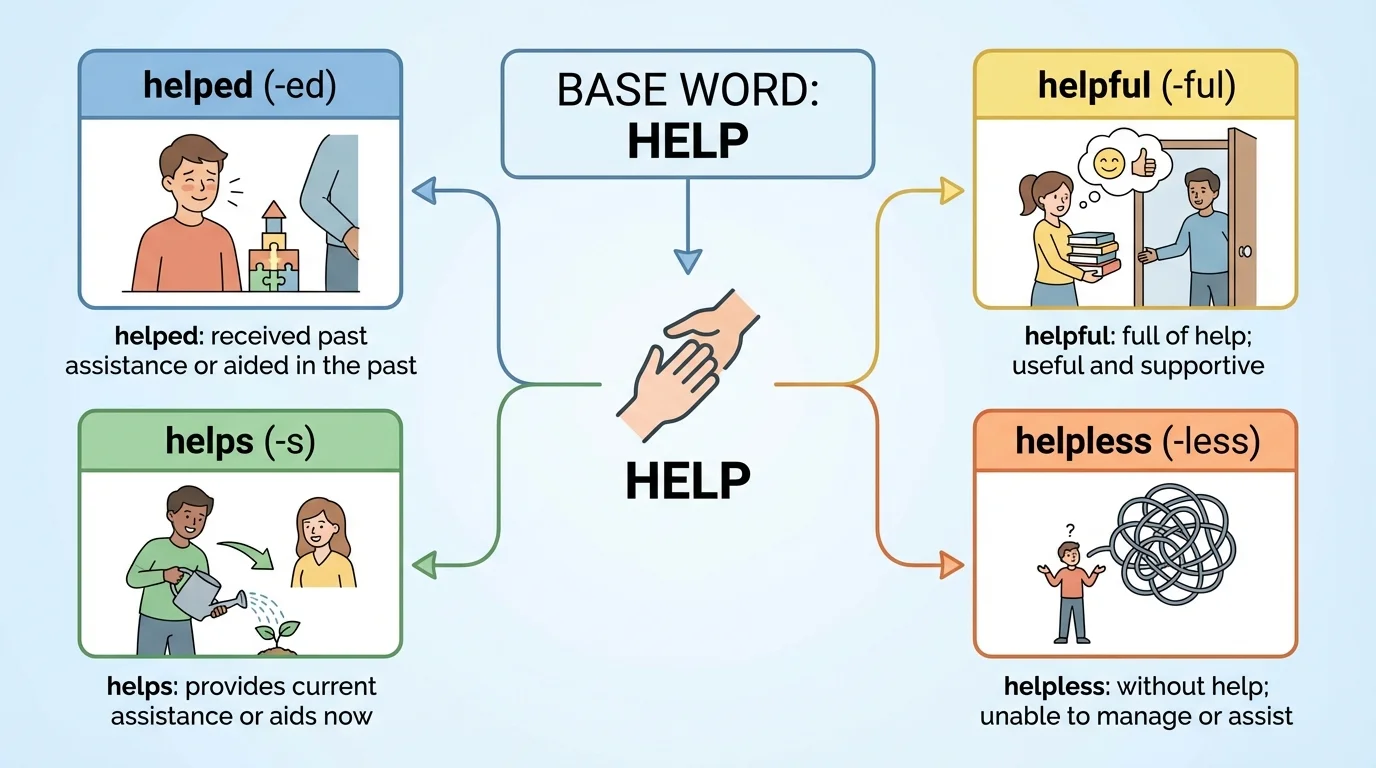
The ending -ful means full of or having. Helpful means full of help. Joyful means full of joy. Playful means full of play.
The ending -less means without. Hopeless means without hope. Careless means without care. Harmless means without harm.
Look at how much we learn from tiny endings. In the word family from [Figure 1], the base word stays important, but each ending changes the meaning in a new way.
Reading with endings
Step 1: Read the base word help.
Step 2: Notice the ending in helped, helps, or helpful.
Step 3: Use the ending as a clue. Helped already happened, helps can mean one person helps now, and helpful means giving help.
Sometimes an ending changes meaning just a little, and sometimes it changes meaning a lot. A good reader pays attention to both the base word and the ending.
Some word clues come at the beginning. These beginnings are called prefixes, and [Figure 2] shows how they change a word before we even finish reading it. A beginning can tell us to do something again, to mean not, or to tell that something happens before.
The beginning re- means again. Reread means read again. Replay means play again. Repaint means paint again.
The beginning un- can mean not or the opposite. Unhappy means not happy. Undo means to reverse what was done. Untie means to loosen or undo a tie.
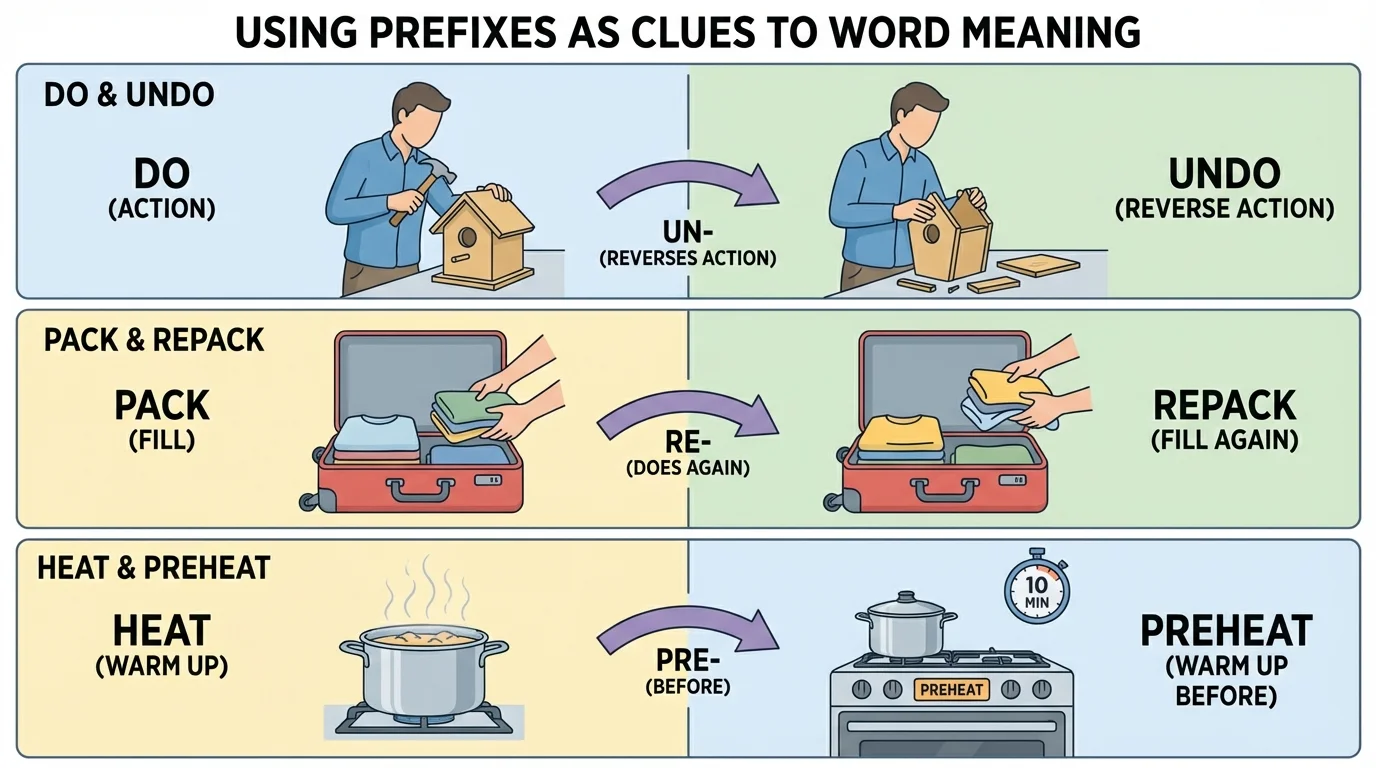
The beginning pre- means before. Preview means to view before. Preheat means heat before. Preschool means school before kindergarten.
These beginnings are powerful clues. If a reader knows heat and sees preheat, the word starts to make sense. Just like the words in [Figure 2], the base word gives one clue and the beginning gives another clue.
Many long words are really made from small words and word parts stuck together. When you spot a part you know, the whole word can feel less tricky.
Beginnings and endings both matter. Sometimes a word has only one added part, and sometimes it has more than one.
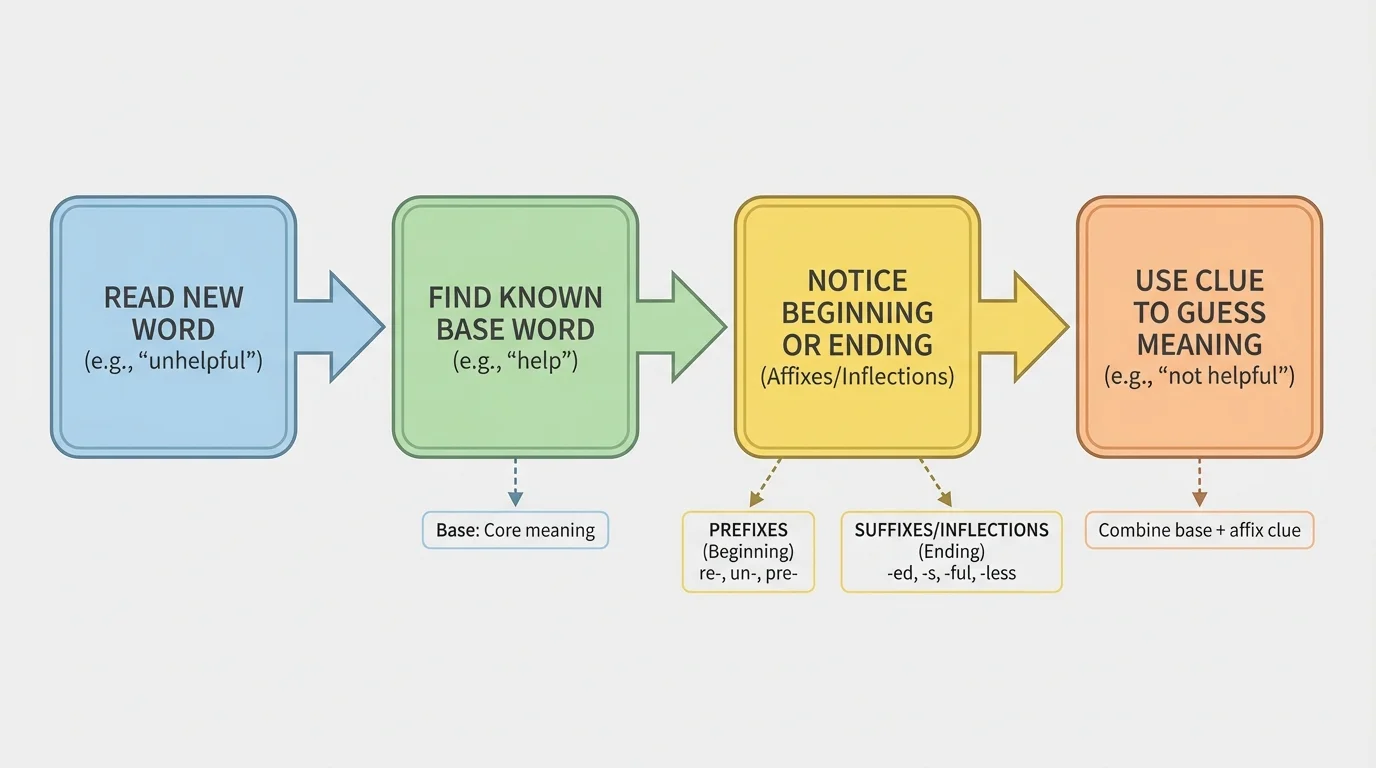
[Figure 3] shows a simple reading strategy you can use when you come to a new word. First, look for the part you know. That known part is often the base word. Then look at the beginning or ending. Last, put the clues together.
For example, if you know the word base word kind, you can read unkind. The beginning un- means not, so unkind means not kind.
If you know play, you can read playful. The ending -ful means full of, so playful means full of play. If you know care, then careless means without care.
If you know read, then reread means read again. If you know cook, then cooked means it already happened. If you know book, then books means more than one book.
This kind of thinking helps in storybooks, on signs, and in classroom directions. Later, when you meet a longer word, you can still use the same plan from [Figure 3]: find the known part and use the small word part as a clue.
How word parts help meaning
A reader does not guess wildly. A reader uses clues in the word. The base word gives the main idea, and the prefix or suffix changes that idea in a small but important way.
Sometimes a word can feel new, but its parts are old friends. That is why learning common word parts makes reading easier and faster.
You can find these word parts everywhere. In a story, looked tells you something already happened. On a classroom shelf, books tells you there is more than one. In the kitchen, preheat tells what to do before cooking. In a game, replay means play again.
These clues help readers understand words even when the whole word is new. A child who knows happy can use unhappy as a clue. A child who knows hope can use hopeful and hopeless as clues too.
You already know many small words like play, look, jump, and care. Those known words can help you unlock bigger words with added parts.
Good readers listen for meaning and look for parts. They use both their eyes and their thinking.
Here is a smart way to figure out an unknown word. First, say the word slowly. Next, look for a word part you know. Then, look for a beginning or ending you know. Last, think about what the whole word means in the sentence.
If the word is rested, you may know rest. The ending -ed tells you it already happened. If the word is unsafe, you may know safe. The beginning un- tells you it means not safe.
The more word parts you know, the more reading power you have. Tiny parts like -s, -ed, re-, un-, pre-, -ful, and -less are strong clues that help you understand unfamiliar words.
