What happens when a door is not open? It is closed. What happens when a body is not sitting? It is standing. Our language is full of word pairs like these. Opposites help us talk clearly, listen carefully, and understand what other people mean.
An opposite is a word with a meaning that is very different from another word. Another word for opposites is antonyms. When we know one word, learning its opposite helps us learn two words together.
Opposites are words that mean very different things from each other. Some opposites are action words, and some opposites are describing words.
We can listen for opposites in stories, songs, and classroom directions. We can also say opposites when we talk. If someone says, "The box is open," we can understand that "closed" is the opposite word.
Verbs are action words. Many action words have opposites, as [Figure 1] shows with easy actions we see every day. When we hear one action word, we can often name the action that means the other way.
Here are some common opposite action words: go/stop, open/close, sit/stand, come/go, and laugh/cry. These are words children hear often at home and at school.
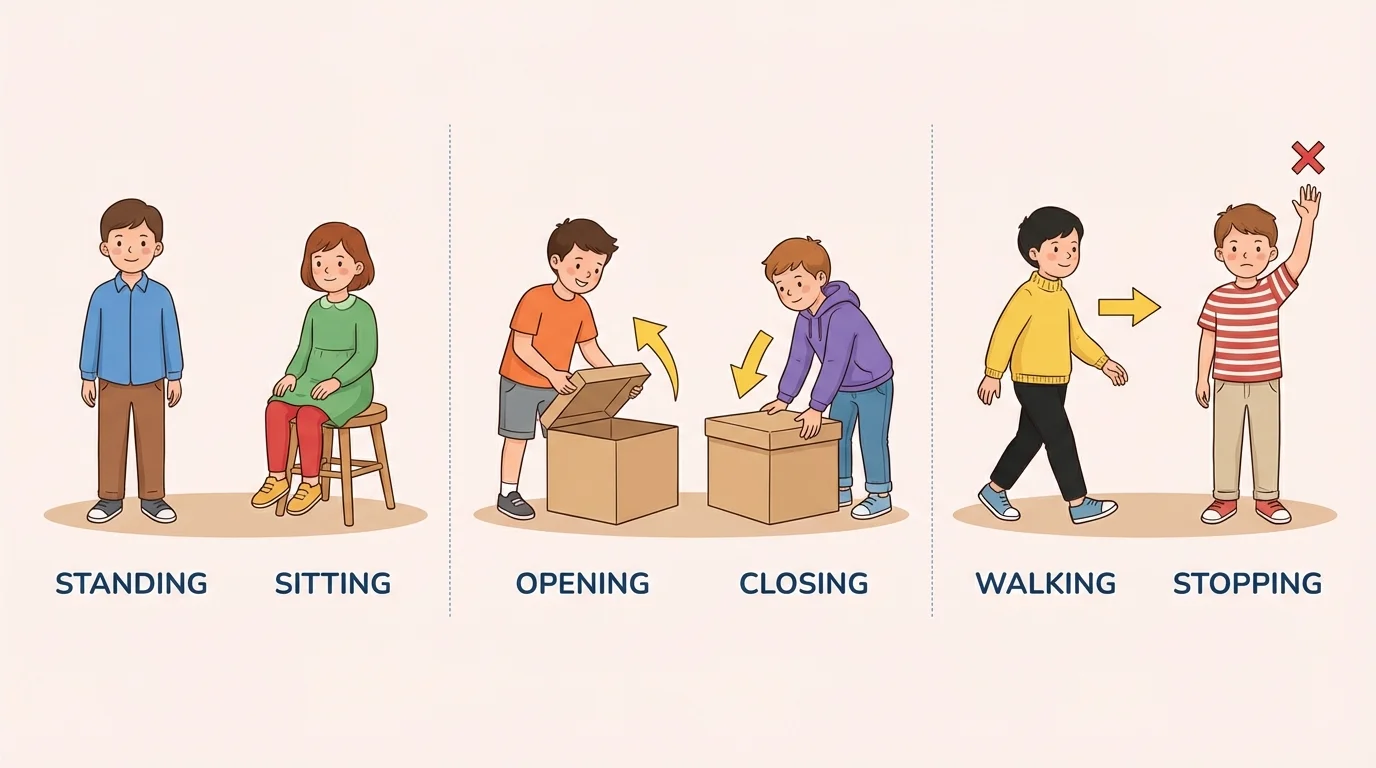
We can use opposite action words in short sentences. "Please sit on the rug." The opposite action is "Now stand up." "Please open your book." The opposite action is "Now close your book."
Listening matters here. If a teacher says "stop," that does not mean "go." If a parent says "come here," that is different from "go there." Knowing opposite action words helps us follow directions.
Speaking with opposite action words
Step 1: Hear the word open.
Step 2: Think of the opposite: close.
Step 3: Say both in a sentence: "I open the box. Then I close the box."
Sometimes the same action can have different opposite partners in different situations. We might hear "come" and think of "go." We might hear "up" and think of "down." Good listening helps us choose the best opposite.
Adjectives are words that tell more about a person, place, or thing. Many adjectives have opposites too, and [Figure 2] illustrates some easy pairs children can notice right away.
Common opposite describing words are big/small, hot/cold, happy/sad, fast/slow, and loud/quiet. These words help us describe how something looks, feels, sounds, or moves.
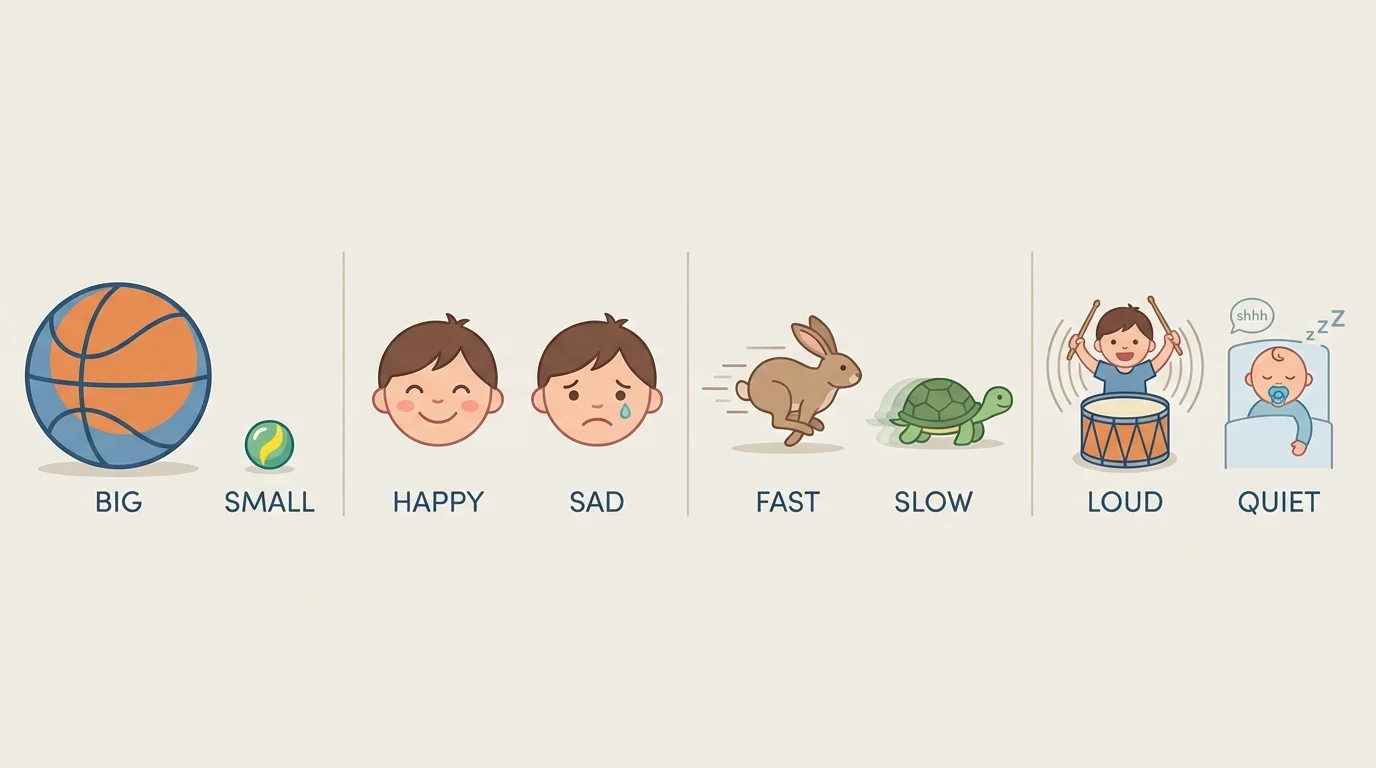
We hear these words all the time. A big backpack and a small backpack are not the same. Soup can be hot, and ice can be cold. A song can be loud, and a whisper can be quiet.
We can also use opposite adjectives in speaking. "The puppy is happy." The opposite idea is "The puppy is sad." "The car is fast." The opposite idea is "The turtle is slow." Opposite adjectives help our speech become clearer and more interesting.
How opposite describing words help listening
When children hear two opposite describing words, they can compare. If someone says "Find the small ball," a child can listen for size. If someone says "Use your quiet voice," a child can think of the opposite of loud and understand what kind of voice to use.
As we saw with action words in [Figure 1], opposites help us notice differences. The same is true for describing words in [Figure 2]. Opposites help our ears and our minds sort ideas into pairs.
When children practice opposites aloud, they build strong oral language. A child hears "big" and says "small." A child hears "stand" and says "sit." This kind of speaking and listening helps children remember words and use them correctly.
Opposites also make conversations easier to understand. If a friend says, "I am sad today," we know that is not the same as happy. If someone says, "The music is loud," we know it is not quiet. Words become more meaningful when we can compare them to their opposites.
Many books for young children use opposites because the pairs are easy to hear, easy to remember, and fun to say. Learning words in pairs helps growing brains organize language.
Teachers often use opposite words in directions: "Line up quietly." "Stand up." "Close your folder." At home, families use them too: "Come inside." "The water is hot." "That toy is small." Children learn by hearing these words again and again.
On the playground, one child may run fast while another moves slowly. In the classroom, one block tower may be big and another may be small. During story time, a character may feel happy at first and sad later. Opposites help us talk about all of these changes.
At snack time, milk can be cold. At rest time, voices should be quiet. During clean-up, children may open a bin, put toys in, and close the bin again. Language is all around us, and opposite words are part of daily life.
Action words tell what someone or something does. Describing words tell what someone or something is like. Opposites can belong to both kinds of words.
We can also hear opposites in stories. A bear may be big, but a mouse may be small. A child may laugh in one part of a story and cry in another part. When we listen for opposites, stories become easier to understand.
Some words can match with different opposites depending on what we mean. For movement, "up" often goes with "down." For place, "in" often goes with "out." For direction, "come" may go with "go." We choose the best opposite by listening to the whole sentence.
That is why careful listening is important. Words do not live alone. They live in sentences. When we hear the whole idea, we can say the opposite that fits best.
