When you say a word like cat, you can hear it with your ears. When you see the word cat in a book, on a card, or on a label, you can see it with your eyes. This shows that words we speak can also be written on a page. Reading begins when we learn that spoken words are shown in written language by letters.
A spoken word is a word we say out loud, like mom, ball, or go. A written word is a word we see in print. The spoken word and the written word match. If you say sun, the letters in the written word sun stand for that word.
Letters are the marks we see in print. When letters are put together in the right order, they make words. A word we say can be represented in writing by a specific sequence of letters.
People use written words everywhere. We see them in storybooks, on cubbies, on name tags, on food boxes, and on signs. A word is not just a picture. It is made of letters that stay in order.
A sequence is the order of things. In words, the order of letters matters, as [Figure 1] shows. The word cat has the letters c, a, and t in a special order. If the letters move, it is not the same written word.
The word dog is written with d-o-g. The word sun is written with s-u-n. Each spoken word has its own sequence of letters. That pattern helps readers know which word they are seeing.
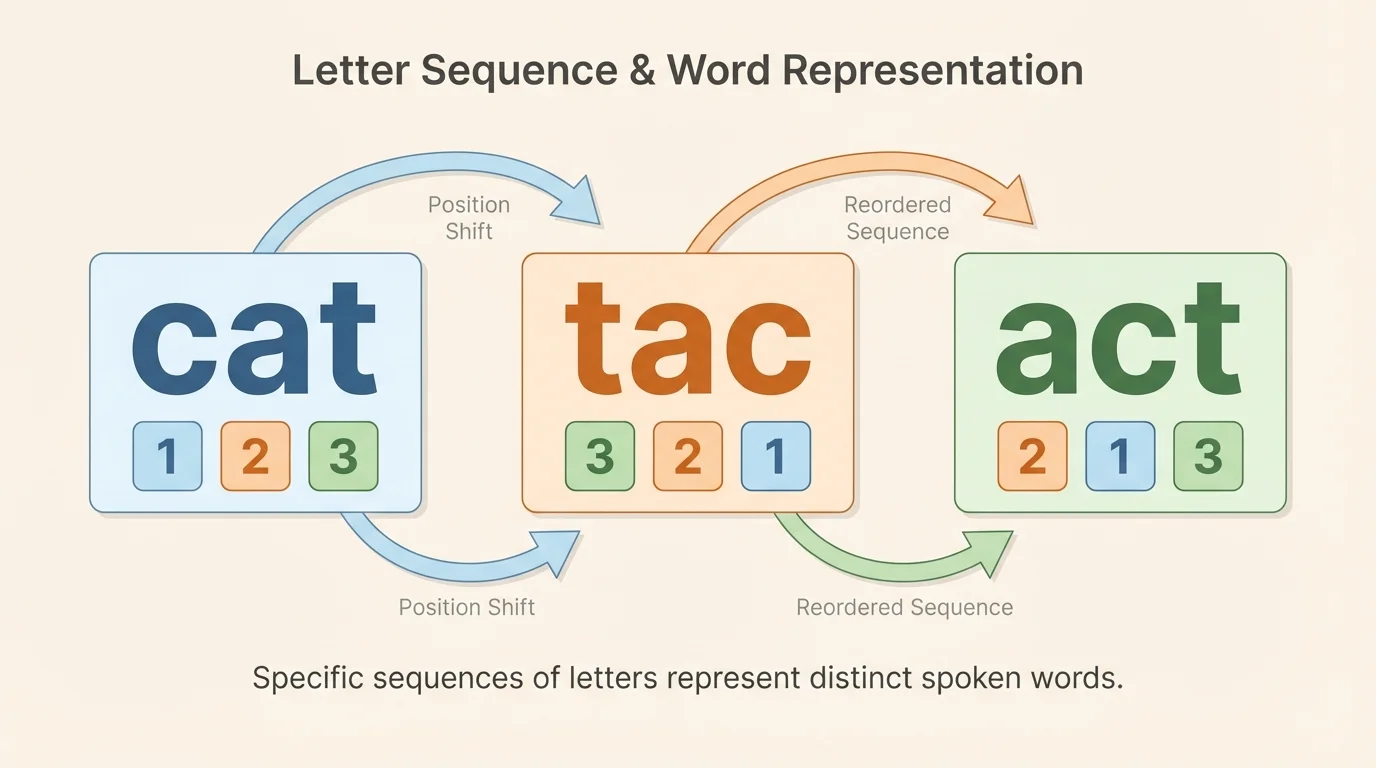
Sometimes words can look almost the same, but one letter changes the word. Hat and hot are not the same. Pin and pig are not the same. Readers look carefully at the letters and their order.
Why letter order matters
If the letters are in the wrong order, the written word changes. That is why readers pay attention to each letter from the beginning of the word to the end of the word.
We can also think about names. The name Sam is written one way. If the letters are changed, it does not say Sam anymore. Names, labels, and simple words all show that writing uses exact letter sequences.
When a teacher says ball and then shows the word ball, the spoken word matches the written word. This helps children understand that print carries the words they say and hear.
Here are some simple matches: spoken red matches written red; spoken jump matches written jump; spoken me matches written me. The letters in each word tell us which word it is.
Matching words we say to words we see
Step 1: Say the word cat.
Step 2: Look for the letters c-a-t.
Step 3: When you see cat, you know the written word matches the word you said.
The spoken word and the written word go together.
This is one reason books are so useful. The words an author wants us to hear in our minds are written down with letters, so many people can read the same message.
Print has rules that help us read. In English, we read from left to right. We start at one side and move across the line. We also move from the top of the page to the bottom.
[Figure 2] Written words are separated by spaces. A space shows where one word ends and the next word begins. In the sentence I see a sun, each word has its own place.
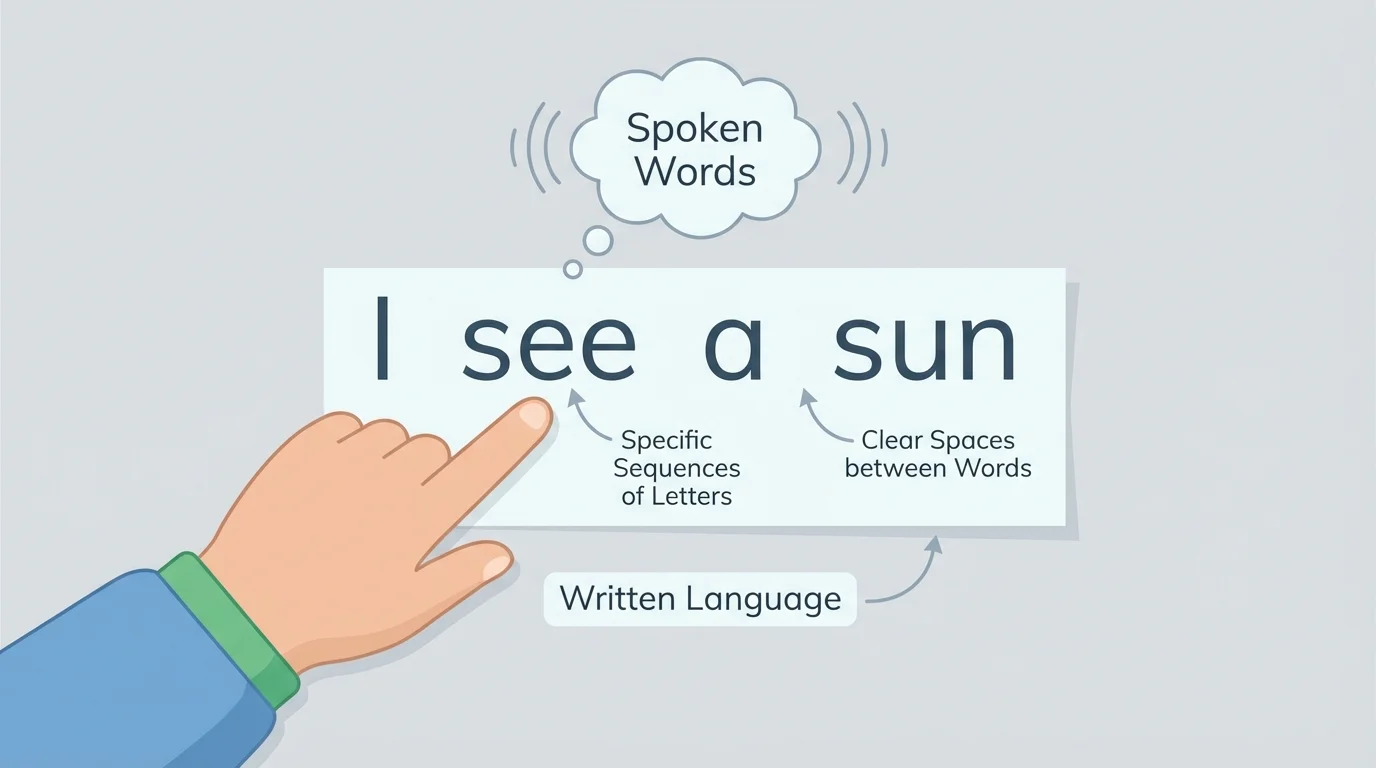
Pointing under words while reading can help a child notice that each spoken word matches one written word. When someone says the sentence slowly and points to each word, print becomes easier to understand.
You already know that books have a front and back, pages turn in order, and print tells a story or gives information. Now you are adding a new idea: the words you hear are shown by written words made of letters.
As readers grow, they learn more letter patterns, but the big idea stays the same. Print is organized, and each word is shown in a special way.
A word stays the same when it is written again and again. If the word is stop, the letters are still s-t-o-p on a sign, in a book, or on a card. The place may change, but the written word stays the same.
[Figure 3] This helps readers recognize words in many places. A child may see mom in a little book and later see Mom on a card. The word can be recognized because the letters represent the same spoken word.
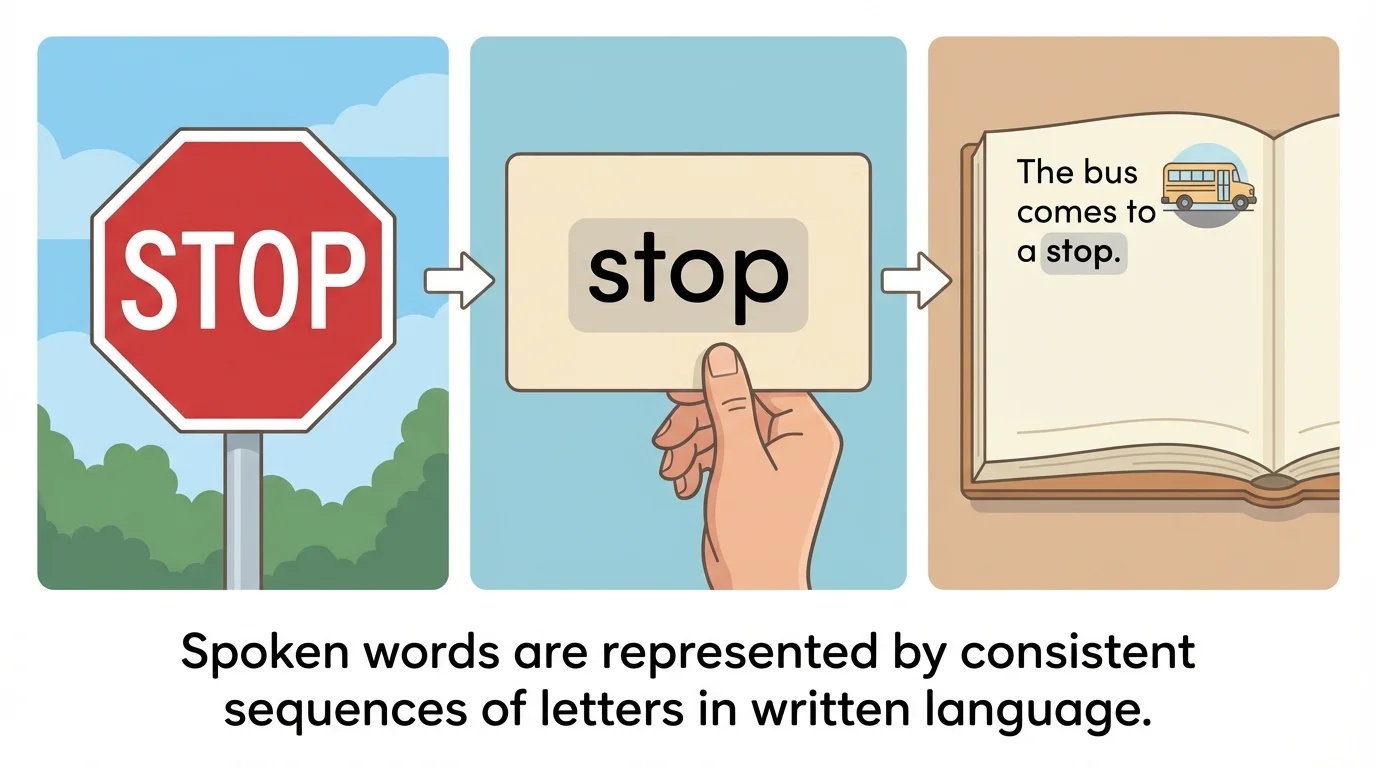
Environmental print is all around us. Labels on bins, classroom charts, favorite cereal boxes, and street signs help children notice that writing is meaningful. The printed words stand for real words people say.
Many children first recognize written words from their own names. A name tag is often one of the first places a child learns that letters stand for a specific spoken word.
Later, this same idea helps with more words. Once children understand that written language represents spoken language, they are ready to connect more sounds, letters, and words.
Good readers listen to the words, look at the print, and notice how the print matches what is said. When an adult reads aloud and points to each word, children see that spoken language and written language work together.
We saw earlier in [Figure 1] that letter order matters. We also saw in [Figure 2] that readers move from left to right and use spaces to tell words apart. These ideas help children follow print correctly.
We also know from [Figure 3] that the same word can appear in different places and still be the same word. This helps children build confidence as they begin to read familiar words again and again.
Every time you see letters making a word, you are seeing speech written down. That is one of the most important ideas in learning to read.
