Have you ever started talking about a puppy, and then someone asked, "What is its name?" and then you answered, and then they asked another question? That is how a conversation keeps going. A conversation is not just one sentence. It can be many turns back and forth, like tossing a ball gently from one person to another.
A conversation is when people talk and listen to each other. In a good conversation, one person talks, the other person listens, and then they switch. This is called turn-taking, as shown in [Figure 1]. Each person gets a turn to speak and a turn to listen.
When you continue a conversation through multiple exchanges, you do not stop after one answer. You can say more about your idea. You can answer a question. You can ask a question back. You can make a comment that matches the topic.
Listen to this example: "I went to the park." "What did you do there?" "I went on the swings." "Who went with you?" "My dad went with me." This conversation keeps going because each person says something connected to the same idea.
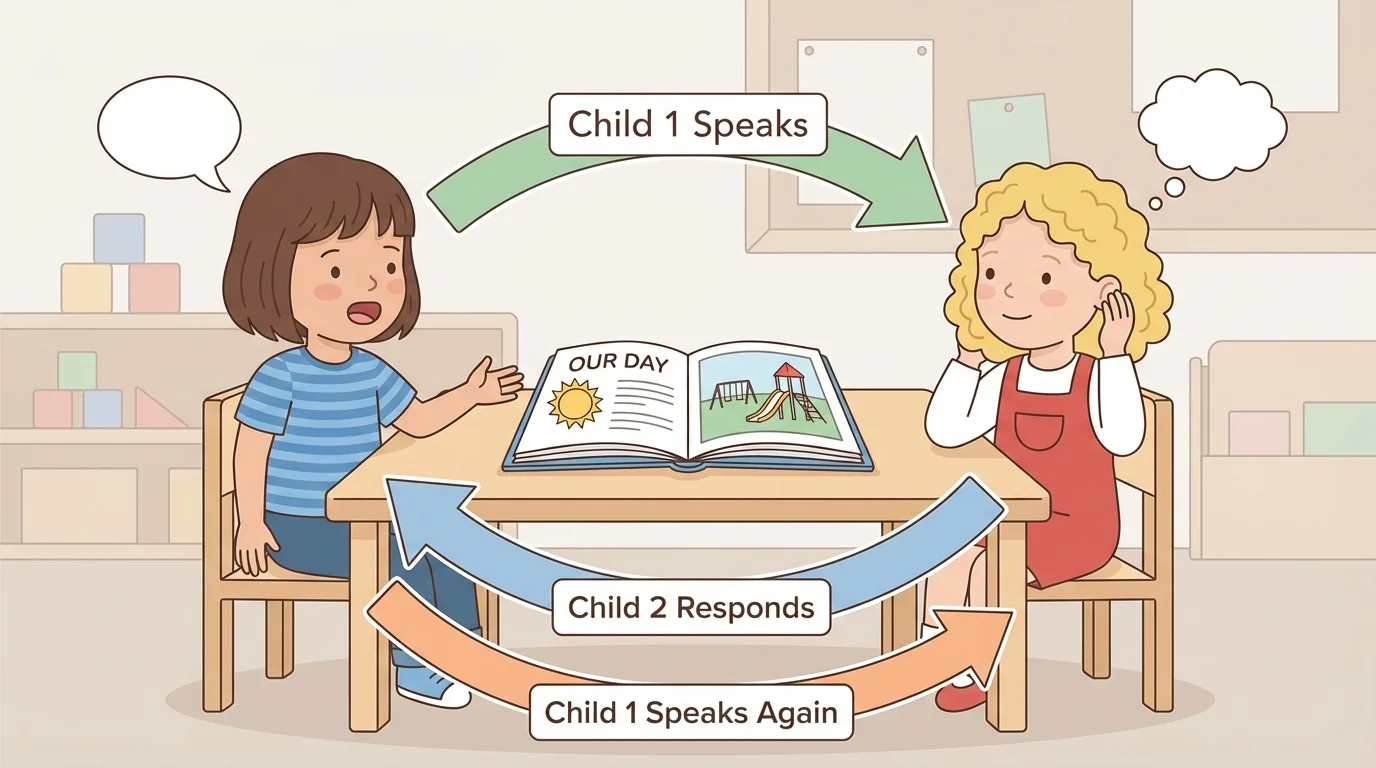
Conversation means talking and listening with another person or a group.
Turn-taking means people speak one at a time instead of all at once.
Sometimes a person gives a very short answer, like "yes" or "no." That can be okay, but often a conversation grows better when you add more words. If someone says, "Do you like apples?" you can say, "Yes, I like red apples," instead of only saying, "Yes."
There are several easy ways to keep a conversation going. One way is to respond by answering what someone asked. Another way is to ask a question that fits the topic. A third way is to add a new detail.
If a friend says, "I built a tall tower," you might say, "What blocks did you use?" You could also say, "I built one too." You could add, "Mine fell down." All of these keep the talk going because they match the topic.
Example conversation about a drawing
Step 1: One person starts.
"I drew a butterfly."
Step 2: Another person responds.
"It has big wings."
Step 3: The first person adds more.
"Yes, and I used purple and blue."
Step 4: The other person asks a related question.
"Where is the butterfly going?"
The conversation continues because each sentence stays connected.
Good conversations often stay on one topic. A topic is what people are talking about. If the class is talking about a story, your words should match the story. If your partner is talking about a pet fish, your answer should connect to the fish.
We can keep a conversation going by using sentence starters like these: "I think...," "I noticed...," "Me too," "What happened next?" and "Can you tell me more?" These words help us know what to say next.
Talking is important, but listening is important too. Nonverbal language means the messages we send without words. Your body can show that you are listening, as [Figure 2] shows. You can look at the speaker, keep a quiet body, nod, and wait for your turn.
Your face can help too. A smile can show kindness. A calm face can show attention. If you turn away, talk over others, or play with something loudly, it can make the conversation harder.
Listening with your whole body helps everyone. It shows respect. It helps you remember what the other person said, so your next words fit the conversation.
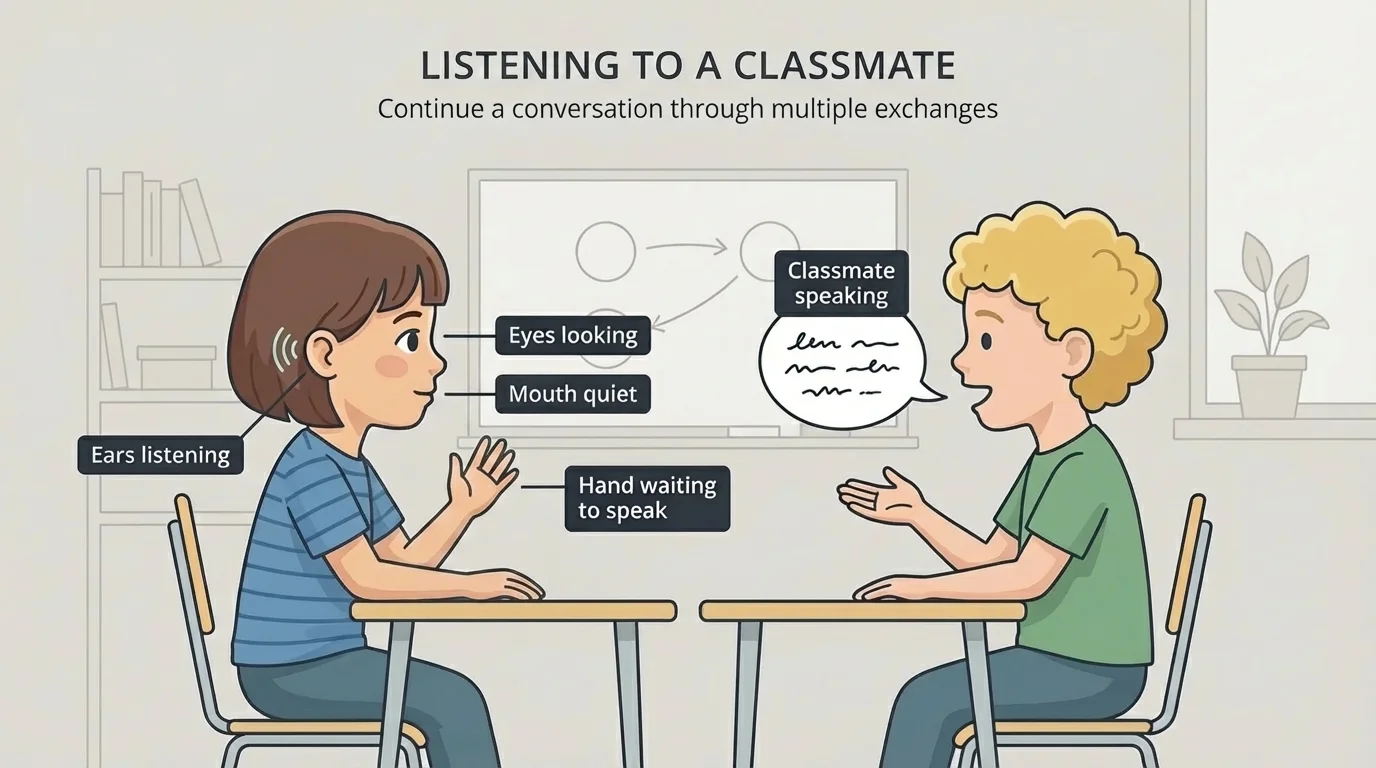
Your eyes and face can help people know you are listening even before you say a word. A nod or a quiet wait can keep a conversation peaceful and clear.
If you want to speak, wait for a pause. Then you can add your idea. If two people talk at once, they can stop, smile, and try again. That helps the conversation continue kindly.
You can have conversations with a friend, with a teacher, or with a whole small group. In group talk, everyone shares one topic together, as [Figure 3] illustrates. You may need to listen longer because more people have turns.
With friends, your conversation might sound like this: "I made a road in the block area." "Can my car drive on it?" "Yes, but it has to stop here." "Why?" "Because this is the bridge." The talk continues because both children build the same idea together.
With an adult, your conversation might sound like this: "I found a shiny leaf." "Where did you find it?" "By the tree." "What color is it?" "It is yellow and brown." The child listens, answers, and adds details.
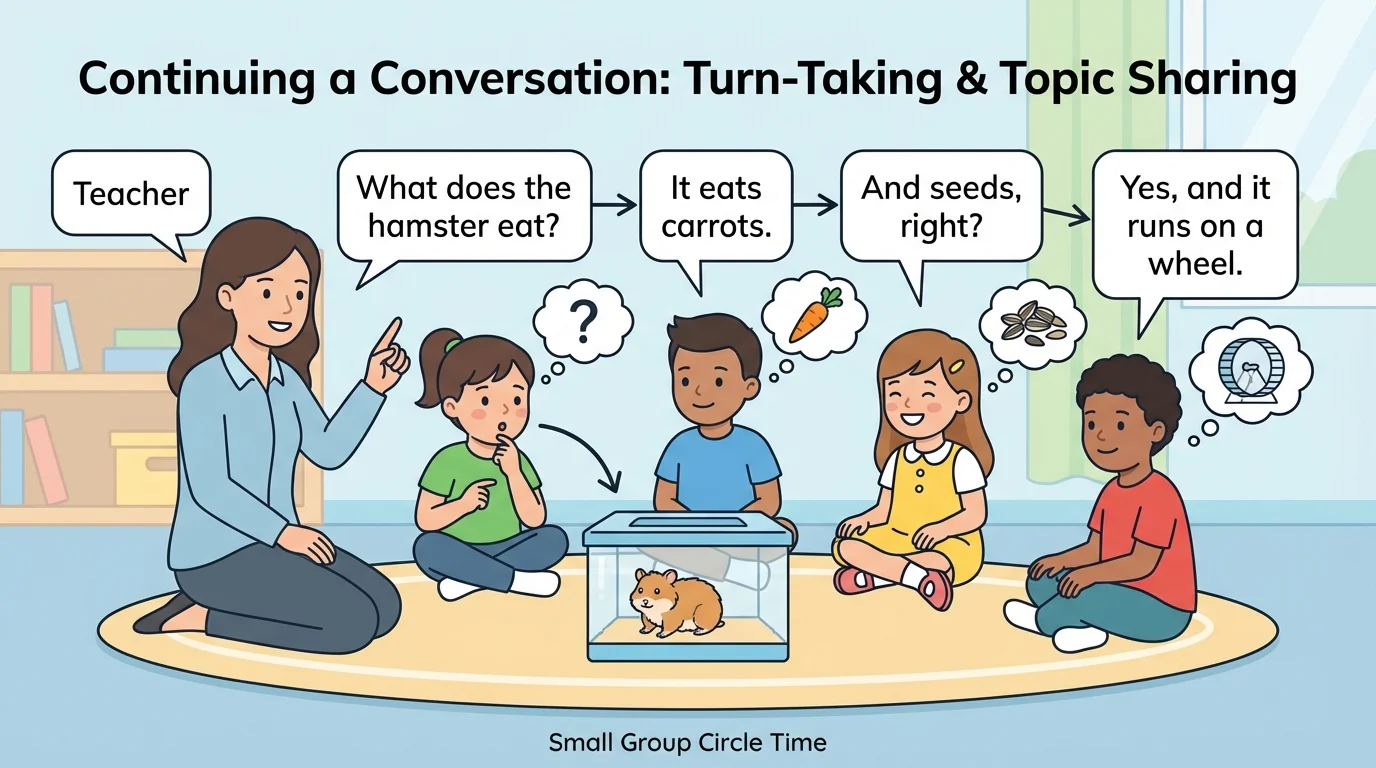
In a larger group, it is extra important to listen carefully. You might hear ideas from many people before you speak. When your turn comes, you can connect your answer to what someone else already said. That helps the group stay together on the same topic.
Conversations grow when ideas connect. A strong conversation is like linking paper chains. One idea connects to the next idea. When children answer, ask, add details, and listen carefully, the chain gets longer and stronger.
Earlier, [Figure 1] showed how speaking and listening take turns. That same turn-taking happens in class discussions, at lunch, on the playground, and during story time.
Sometimes a conversation gets stuck. A person may forget what to say. Someone may change the subject too fast. Someone may not hear the question. That is okay. You can get the conversation going again.
You can say, "Can you say that again?" You can say, "I want to tell you more." You can say, "What happened next?" These are helpful ways to keep talking and listening.
If the topic changes by accident, you can gently come back. If the class is talking about a butterfly story and someone starts talking about breakfast, a teacher or classmate might say, "We are talking about the butterfly." That helps everyone return to the topic.
Example of fixing a conversation
Step 1: A question is asked.
"What did the bear do in the story?"
Step 2: The answer does not fit.
"I like juice."
Step 3: A helper brings the talk back.
"We are talking about the bear. The bear was sleeping."
Step 4: The conversation continues.
"Yes, then he woke up."
Now the speakers are back on the same topic.
As we saw in [Figure 2], listening with eyes, face, and body helps you know when to talk and what to say. And the group in [Figure 3] shows that conversations are shared by everyone, not just one speaker.
When you continue a conversation through many exchanges, you help people learn about your ideas, and you learn about theirs too. That is one way people work, play, and learn together.
