When you say a word, your mouth makes little sounds. Those sounds are like tiny clues. Writers listen for the clues and write letters to match them. That is how we turn spoken words into words we can read and write.
Some words are short and easy to hear. If you say cat slowly, you can hear three sounds: /k/ /a/ /t/. We write those sounds with letters: c a t. Learning to hear sounds and write letters helps you spell simple words.
Phoneme means a sound we hear in a word. A letter is the mark we write to show that sound. In many simple words, one sound matches one letter.
A good writer also makes writing easy to read. We put spaces between words. We begin a sentence with a capital letter. We end with punctuation, like a period.
Words are made of sounds. When we listen carefully, we can hear a sound at the beginning, a sound in the middle, and a sound at the end. Then we choose letters to write those sounds. This helps us write words like map, pig, and sun.
If you hear /m/ at the start of man, you can write m. If you hear /t/ at the end of hat, you can write t. Listening and writing work together.
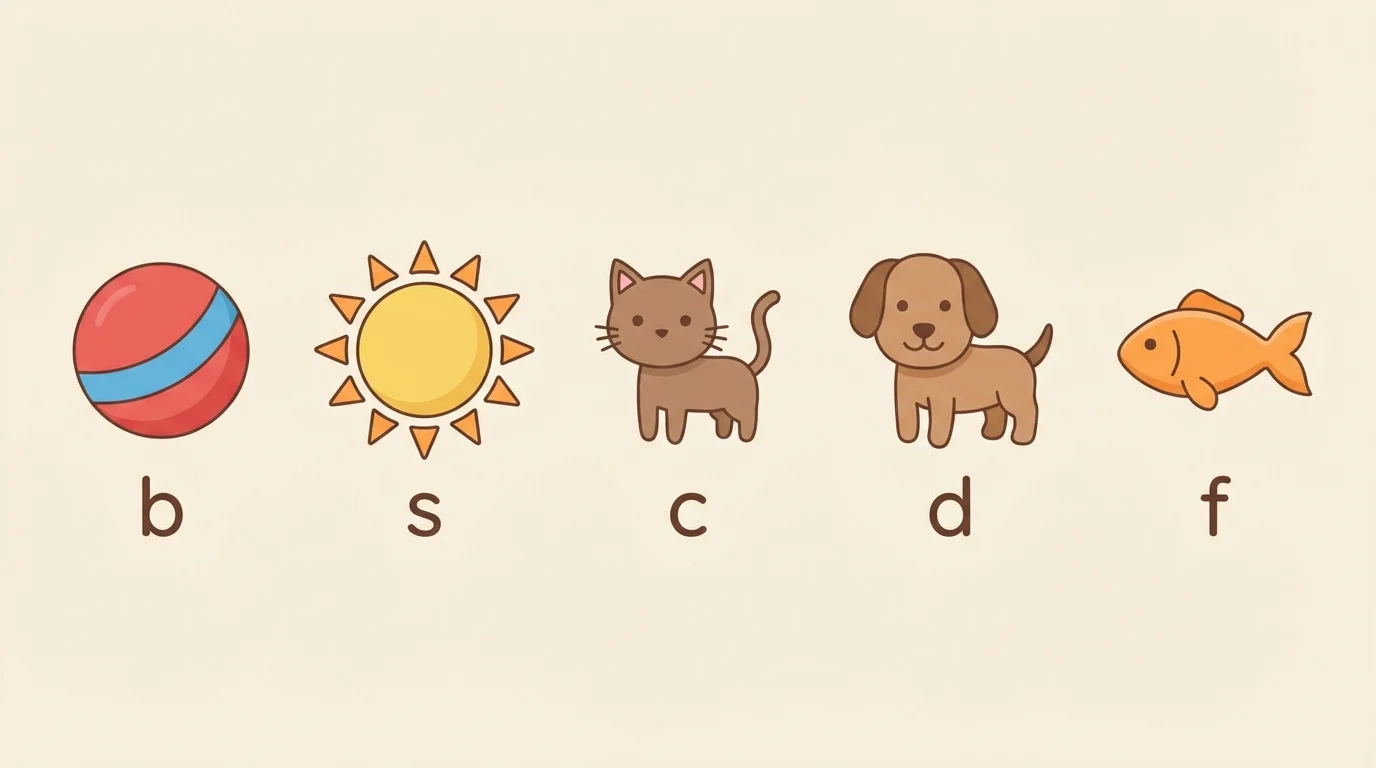
Many words begin or end with a consonant sound. These are sounds like /b/, /m/, /s/, and /t/. As [Figure 1] shows, when you hear the first sound in a word, you can often match it to a letter you know how to write.
Here are some consonant sounds and letters: b in ball, c in cat, d in dog, f in fish, m in moon, s in sun, and t in top. We can hear these sounds and write the matching letters.
Consonant sounds can also come at the end of a word. In cap, the last sound is /p/. In bed, the last sound is /d/. In jam, the last sound is /m/. Writing the last sound helps complete the word correctly.
Later, you will learn that some sounds can be written in more than one way. Right now, it is most important to learn the most common letter for many consonant sounds.
Your name is a great place to find consonant letters. Many children can hear and write the first sound in their own name before they can write many other words.
When you look back at [Figure 1], you can notice that each picture starts with a sound you can say and a letter you can write. That is what early spelling does: it helps your writing match the sounds you hear.
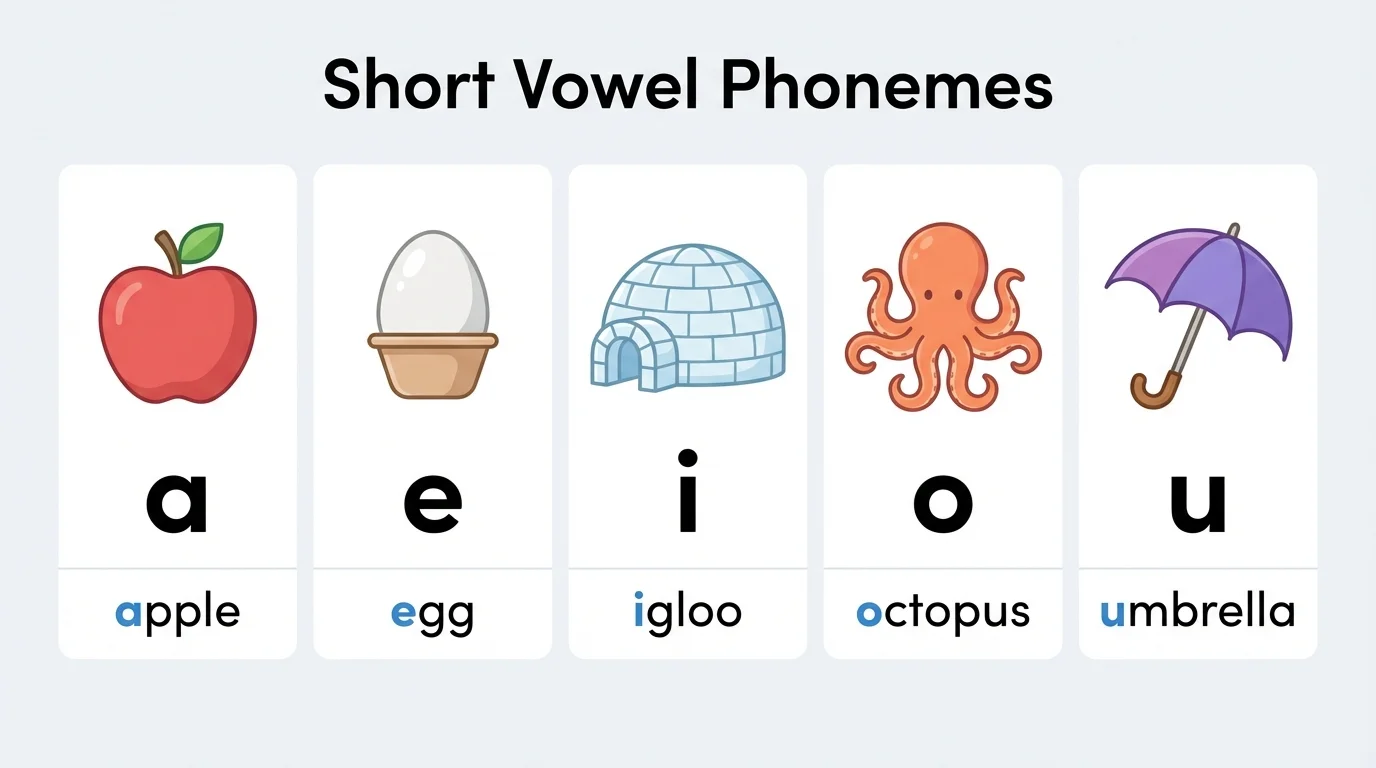
Every simple word needs a vowel sound. In many short words, the vowel has a short sound. As [Figure 2] illustrates, the five vowels are a, e, i, o, and u, and each one has a short sound you can hear in easy words.
Here are the short vowel sounds: short a in apple and cat, short e in egg and bed, short i in igloo and pig, short o in octopus and hot, and short u in umbrella and sun.
The middle sound in a short word is often the vowel sound. In map, the middle sound is short a. In pen, the middle sound is short e. In sit, the middle sound is short i.
Writers listen carefully because some short vowel sounds can feel tricky. If you say the word slowly, it is easier to hear the vowel in the middle. Looking again at [Figure 2] helps you remember one picture for each short vowel sound.
The middle sound matters
In many simple words with three sounds, the middle sound is the vowel. If a child writes the first and last letter but forgets the vowel, the word is not complete. Hearing the middle sound helps turn ct into cat and sn into sun.
Some easy words with short vowels are cat, bed, pig, hop, and bug. These are often called simple three-sound words.
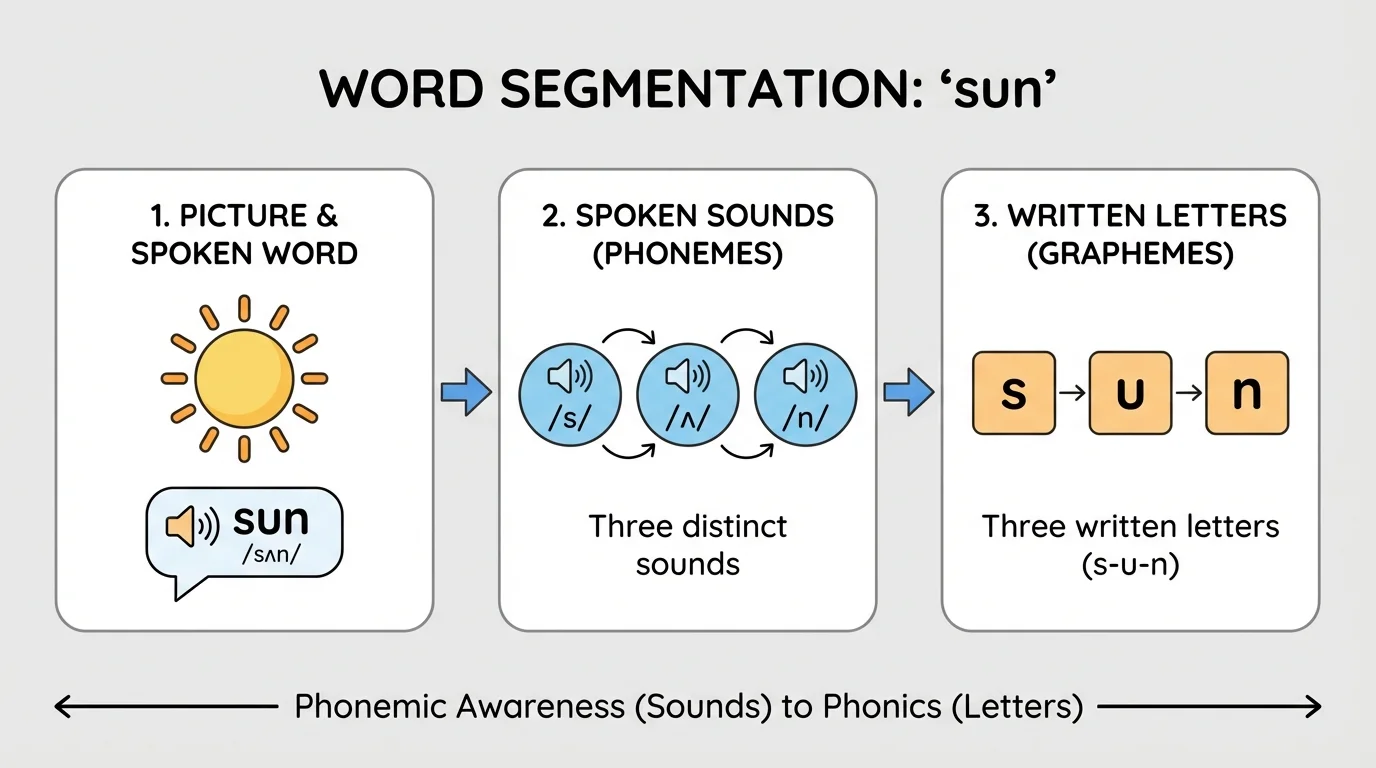
A helpful way to write a word is to stretch it. As [Figure 3] shows, when you say a word slowly, you can hear the first sound, the middle sound, and the last sound more clearly.
Take the word sun. Say it slowly: /s/ /u/ /n/. The first sound is /s/, so we write s. The middle sound is short u, so we write u. The last sound is /n/, so we write n.
Take the word map. We hear /m/ /a/ /p/. We write m for the first sound, a for the middle sound, and p for the last sound. Now the word is complete.
Listening to write words
Here are examples of writing letters for the sounds we hear.
Step 1: Listen to dog.
We hear /d/ /o/ /g/.
Step 2: Write the letters.
d o g
Step 3: Read the word.
dog
Step 4: Listen to pen.
We hear /p/ /e/ /n/.
Step 5: Write the letters.
p e n
Step 6: Listen to big.
We hear /b/ /i/ /g/ and write b i g.
When you return to [Figure 3], you can see how one spoken word becomes three written letters. That is a good way to begin spelling.
When we write a simple sentence, we use sound-letter knowledge and neat writing habits together. A sentence begins with a capital letter. Words have spaces between them. A telling sentence ends with a period.
Look at this simple sentence: Sam is on a mat. The first word begins with a capital S. Each word has a space. The sentence ends with a period. The words themselves use letters for the sounds we hear.
Another example is I can hop. The word I is always capitalized when you write about yourself. The word hop has the sounds /h/ /o/ /p/, and each sound is written with a letter.
You already know that print goes from left to right and words are separated by spaces. Now you are adding another big idea: words are built from sounds, and those sounds can be written with letters.
Good spelling at this stage means doing your best to match most consonant and short-vowel sounds. If you can hear the sounds in cat and write c a t, you are using letters in a smart and careful way.
Most of the time in simple kindergarten words, one sound matches one letter. That works well for words like sit, man, and top. As you grow, you will learn that some sounds are written with other letter patterns too.
For now, focus on the sounds you can hear most clearly. Write the beginning consonant, the middle short vowel, and the ending consonant when you hear them. That is how young writers build strong spelling habits.
Every time you write a word from sounds, you are doing the work of a real author. You are listening, choosing letters, and making your ideas readable for someone else.
