Have you ever looked around school and found bright colors, soft places, and noisy spots all in one day? Words help us talk about all of that. When we use words, we can name what we see, tell how something looks, and share what we notice with other people.
Words are not only in books. Words connect to real life. A child may see a red backpack, a blue rug, a quiet corner, or a tall slide. These words help us describe the world. When we notice words in real places, we become stronger speakers and listeners.
A describing word, also called an adjective, tells more about a person, place, or thing. Words like colorful, big, small, soft, and loud help us say what something is like. If we say, "The wall is colorful," we are connecting a word to something real we can see.
We also use words for places. A classroom, playground, library, hallway, and cafeteria are all places at school. Each place can match different words. The library may be quiet. The playground may be loud. The art area may be colorful.
Real-life connection means linking a word to something you really see, hear, touch, or do. Describing words, or adjectives, tell more about something, such as its color, size, sound, or feel.
When children talk about real places, they build strong language. They learn that words are useful every day, not only during story time. They also learn to listen when someone else says, "I see a shiny sink," or "The grass feels soft."
[Figure 1] At school, children can look around and connect words to what they see. A bulletin board filled with many colors can be called colorful. A reading corner with soft pillows can be called cozy or soft. A table with a flat, polished surface can be called smooth.
Some words match what we hear. The bell may sound loud. A whisper may sound quiet. Some words match what we do. Running is fast. Walking in line is slow. Cleaning up is helpful. Sharing crayons is kind.
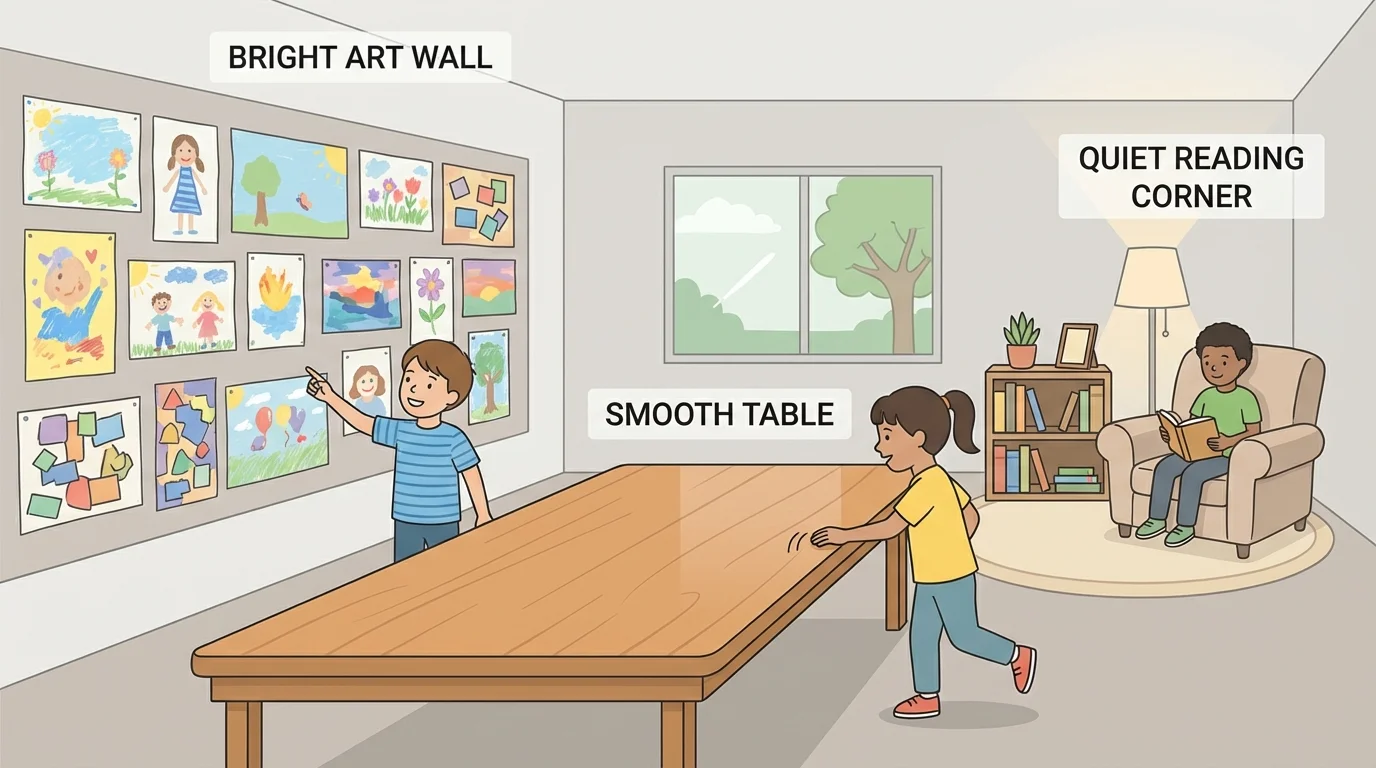
We can also match words to people's actions. A child who listens carefully is attentive. A child who raises their hand is respectful. For young learners, simple words work best: kind, gentle, helpful, happy, and careful.
Real-life word matches
Step 1: Look at a place.
The art wall has many bright papers and pictures.
Step 2: Choose a word that fits.
The word colorful fits the art wall.
Step 3: Say a full sentence.
"The art wall is colorful."
This helps children connect a word to a real thing or place.
These connections are important because they help children understand meaning. A word becomes easier to remember when it is attached to something real. After seeing a bright painting center many times, the word colorful becomes familiar and useful.
To listen is a big part of learning words. When one child says, "I see a shiny window," another child can listen, look, and understand. Talking and listening together help everyone learn new ways to describe the same world.
Children can use simple sentence frames when they speak. They might say, "I see a red chair." "The rug feels soft." "The hallway is long." "The playground is loud." These short sentences are clear, helpful, and easy to share.
Talking helps words grow
When children say words aloud, they practice choosing the best word for what they notice. When they listen to classmates, they hear new words and new ideas. Oral language grows when children look, think, speak, and listen together.
Taking turns matters too. One speaker talks, and one listener pays attention. Then the listener becomes the speaker. This helps children learn respectful conversation while building vocabulary.
Later, children may return to ideas from [Figure 1] and talk about why one place is colorful and another place is quiet. Using words for comparison helps them notice that different places have different features.
Children should hear and use many kinds of words, not only color words. Color words are important: red, blue, green, yellow, purple. But other words also help us tell about our world.
A texture-related word tells how something feels. A blanket can feel soft. A block can feel hard. A table can feel smooth. A doormat can feel rough. Size words tell how big or small something is. A ball may be big. A bead may be small.
One object can match more than one word. A backpack can be red, heavy, and soft all at the same time.
Location words also help. We may say a book is on the shelf, under the table, or next to a friend. Feeling words matter too. A child might feel calm in the reading corner or excited on the playground. These words connect language to real experiences and prepare children to notice school places.
[Figure 2] Each school place can connect to special words. The playground may be loud, open, and active. The library may be quiet, calm, and full of books. The cafeteria may be busy, clean, and bright. The hallway may be long and echoing. The classroom may be friendly, colorful, and busy.
| School place | Words that may fit |
|---|---|
| Classroom | colorful, busy, neat |
| Library | quiet, calm, cozy |
| Playground | loud, fast, fun |
| Cafeteria | busy, clean, bright |
| Hallway | long, wide, echoing |
Table 1. Examples of school places and words that match them.
When children use these words, they are doing more than naming a place. They are noticing features of that place. This helps them pay attention and speak clearly. It also helps them understand what others mean when they hear these words in stories or conversation.
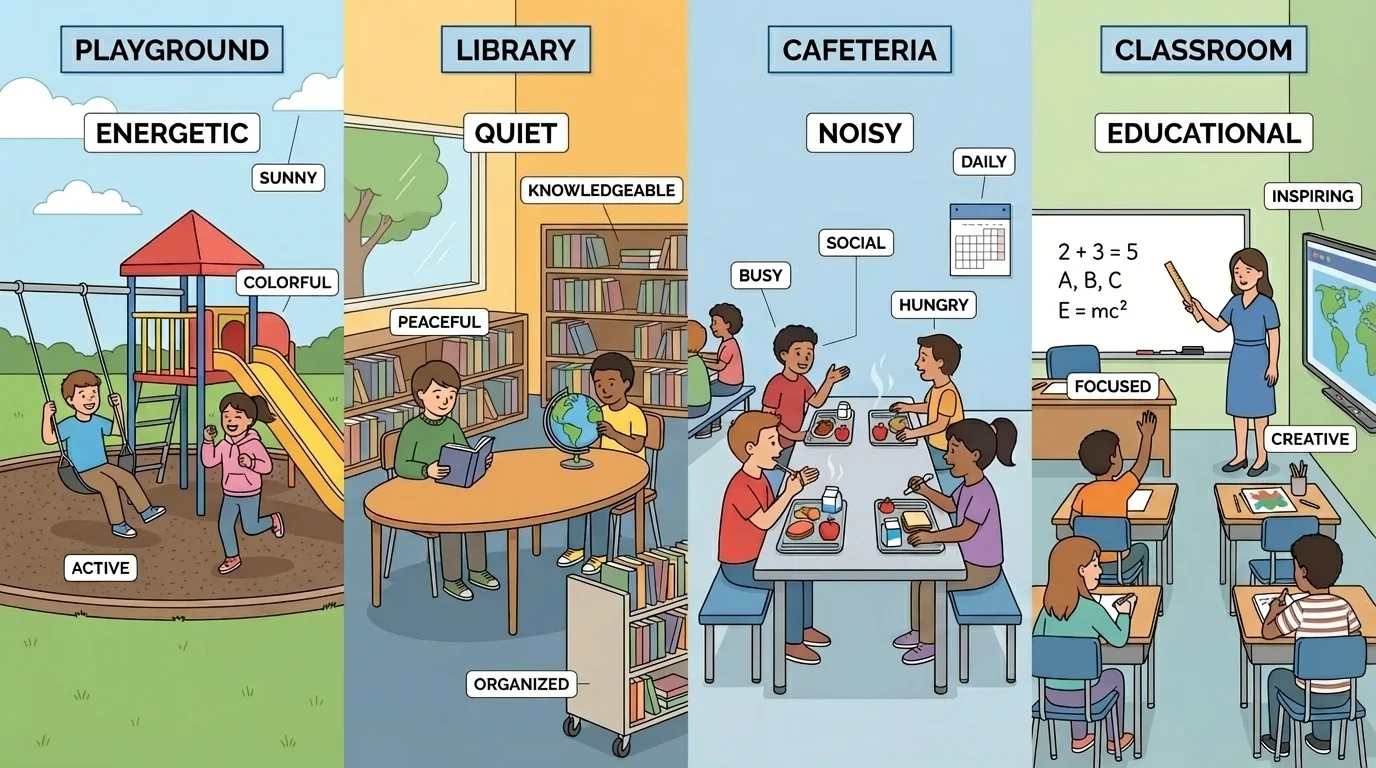
A child might say, "The library is quiet," and another might add, "The library is cozy too." Both can be right. A place can connect to more than one word. That is part of rich language learning.
Words can name people, places, things, and actions. Describing words add more information, so listeners can make a clearer picture in their minds.
Children can also compare places. The playground is louder than the library. The art center is more colorful than the hallway. The sink feels smoother than the carpet. These comparisons build careful observation.
When students think again about school places shown in [Figure 2], they can see how one building has many different word connections. School is full of chances to notice and use language.
Good word habits begin with noticing. Children look around, listen carefully, and say what they observe. They use real things to help choose the best word. Then they share their ideas in full sentences.
These habits support speaking and listening every day. When children say, "I see a colorful poster," "The blocks are hard," or "The room is quiet," they are using language with meaning. Their words fit the world around them.
As children grow, they learn more and more words. The best way to make those words strong is to connect them to real places, real objects, real sounds, and real experiences. That is how words become useful, clear, and alive.
