Have you ever seen letters all squished together so they looked hard to read? When we read print, our eyes look for a very helpful clue: the little empty gaps between words. Those gaps are called spaces, and they help us know what each word is.
Print on a page is organized in a special way. We see letters that make words, and words go together to make a sentence. When we look closely, we can see that the words are not glued together. They are separated by small blank places.
When you read a sentence such as I can hop., each word has its own place. We do not read it as one giant string of letters. We read one word, then the next word, then the next word.
Word means a group of letters that has meaning. Space means the empty blank gap between words in print. A space shows where one word ends and the next word begins.
Words can be short, like I or go. Words can be longer, like rabbit. No matter how long a word is, print uses spaces to keep it separate from the next word.
[Figure 1] A space is the blank gap between printed words. That empty place may look small, but it does a big job. It tells the reader, "This word is finished. The next word begins after the gap."
Look at this sentence: The sun is up. There is a space after The, a space after sun, and a space after is. The period comes at the end, but the spaces come between the words.
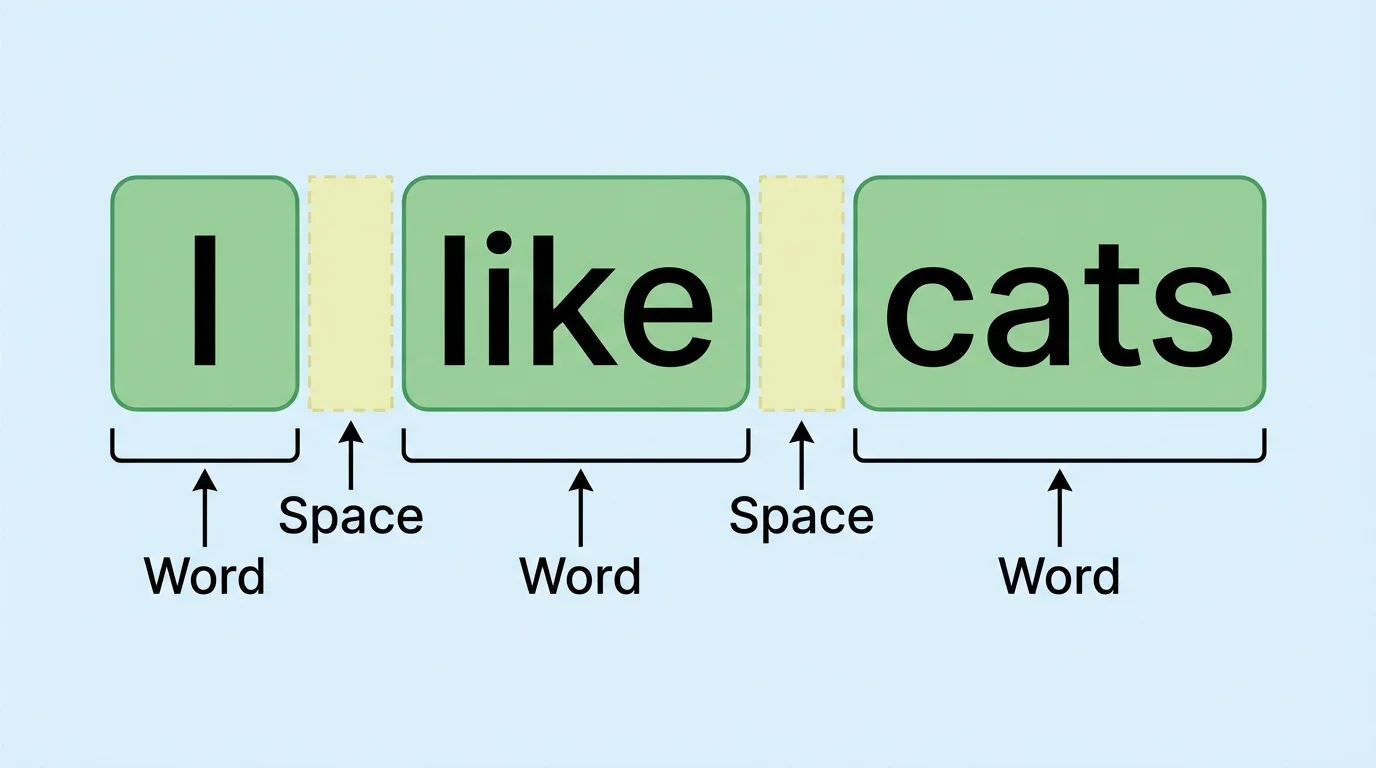
If there were no spaces, the sentence might look like Thesunisup. That is much harder to read. Our eyes would have to work extra hard to figure out where each word begins and ends.
Spaces are not letters. They are not punctuation marks. A space is an empty place, but it has an important job in print.
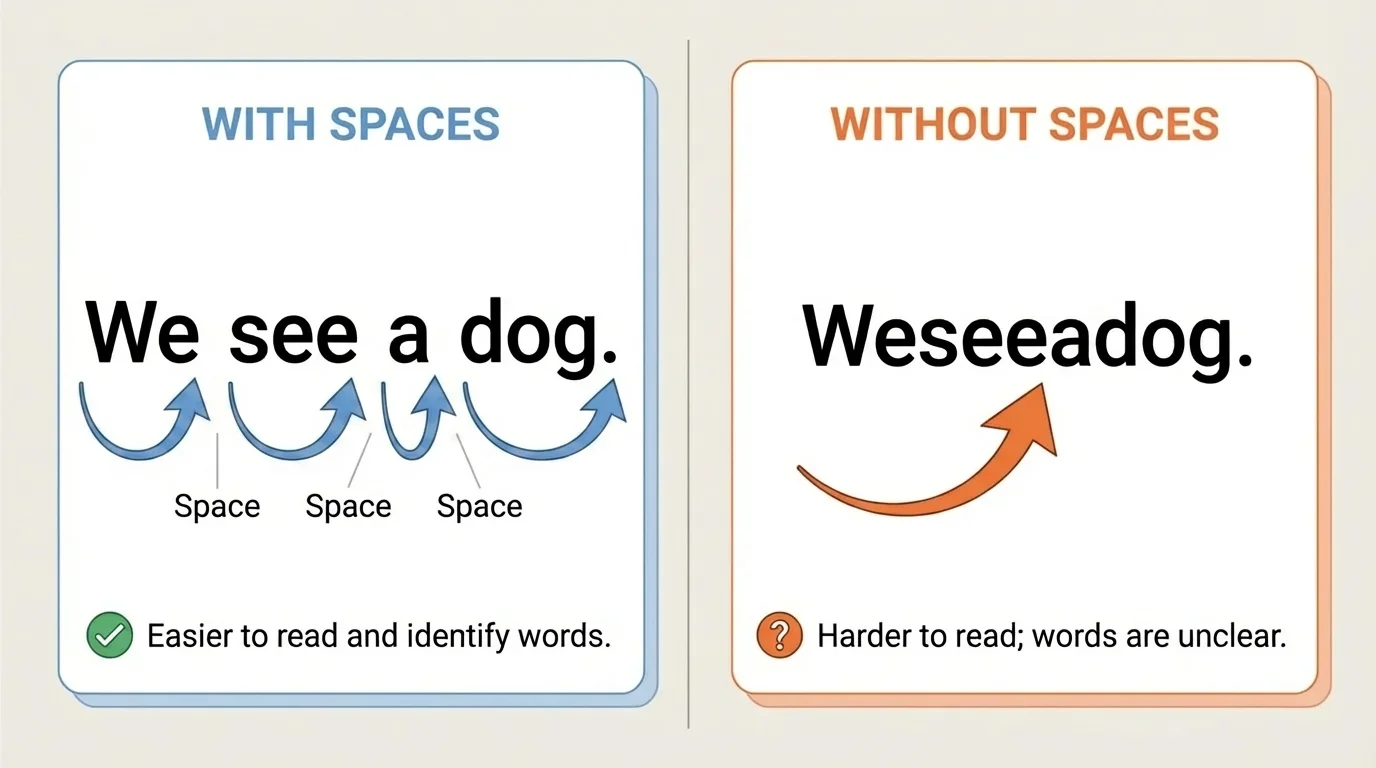
[Figure 2] A sentence is made of words in order, and spaces help us tell how many words are in that sentence. When we see spaces, we can count the words more easily and read them one at a time.
Read this sentence: We see a dog. It has four words: We, see, a, and dog. We know that because each word is separated by a space.
Now think about this: Weseeadog. The letters are all together. It is hard to tell where the words are. Spaces make print clear.
Books, poems, simple charts, and classroom messages all use spaces between words. Even when the font looks different, the job of the space stays the same.
Some of the shortest words in a book can be just one letter long, like I or a. Even tiny words need spaces around them so readers can see them clearly.
When we read aloud, spaces help us avoid mixing words together. We can say each word more clearly because the print shows us where one word ends and the next word begins.
[Figure 3] As our eyes move across a line of print from left to right, spaces help our eyes know when to move to the next word. A reader can point under each word and slide to the next word after each space.
When a child reads I like red hats., the eyes look at I, then move across the space to like, then across the next space to red, and then to hats. The voice can match the words the eyes see.
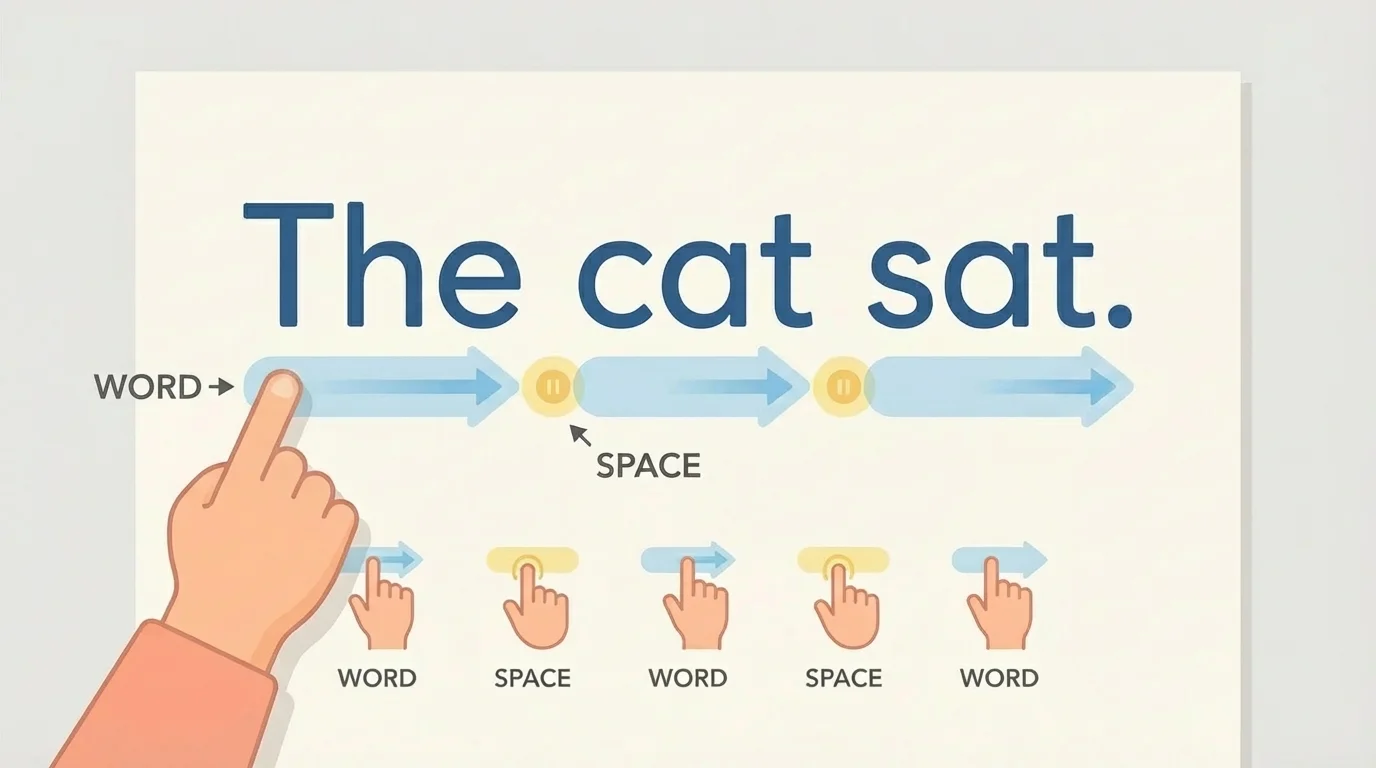
This is one reason teachers sometimes point to words while reading. The pointer or finger helps show that each word has its own spot, and each space leads to the next word.
Later, when reading gets smoother, readers may not need to point. But the spaces are still there, quietly helping the eyes and brain work together.
You can find spaces in many places, not just in storybooks. A sign might say Stop here. A label might say apple juice. A morning message might say Good morning class. In all of these, spaces separate the words.
Sometimes print is large, and sometimes it is small. Sometimes it is black, and sometimes it is colorful. Even so, readers still look for the spaces. The spaces help us read words in order and understand the message.
Why spaces matter
Spaces make print easier to read because they organize the words. Without spaces, letters would run together and readers would have trouble finding each word. Spaces are part of how print is designed to help people read.
We can also notice spaces when we listen to someone read and follow along in the text. The reader says one word at a time, and the printed words are separated by spaces.
Good readers learn to look at the first word, then move to the next word after the space. They keep going across the line until the sentence ends. In the earlier example in [Figure 1], each word stands alone, and that helps the reader see the message clearly.
When print is messy or letters are crowded, reading can feel tricky. That is why neat spacing matters when books are printed and when children begin to write. Clear spaces help everyone read the words more easily.
We can notice three important things: words are made of letters, sentences are made of words, and spaces separate the words. In the comparison from [Figure 2], the spaced sentence is easier to understand because each word has its own place.
Seeing spaces in simple text
Here are a few examples of how spaces help readers:
Step 1: Read I run.
There is a space between I and run. That shows there are two words.
Step 2: Read My dog jumps.
There is a space after My and a space after dog. That shows there are three words.
Step 3: Look at Mydogjumps.
Without spaces, the words are hard to separate. Spaces make the sentence easier to read.
When readers track words carefully, as in [Figure 3], they can match what they see with what they say. That helps reading become smoother and stronger over time.
