Have you ever said a word very, very slowly and noticed that it is made of little parts you can hear? That is how strong spellers begin. When we spell simple words phonetically, we listen to the sounds in a word and write the letters that match those sounds.
A sound is what we hear when we say a word. Many short words have a beginning sound, a middle sound, and an ending sound. In the word sun, we can hear /s/ at the beginning, /u/ in the middle, and /n/ at the end, as [Figure 1] shows.
When children learn to spell, they do not memorize every word at once. They learn to listen closely. If you can hear the sounds in cat, you can write c, a, and t. If you can hear the sounds in dog, you can write d, o, and g.
Some words are easier to hear when you say them slowly: map, sit, pen, hot. Each sound matters because each sound helps tell which letters belong in the word.
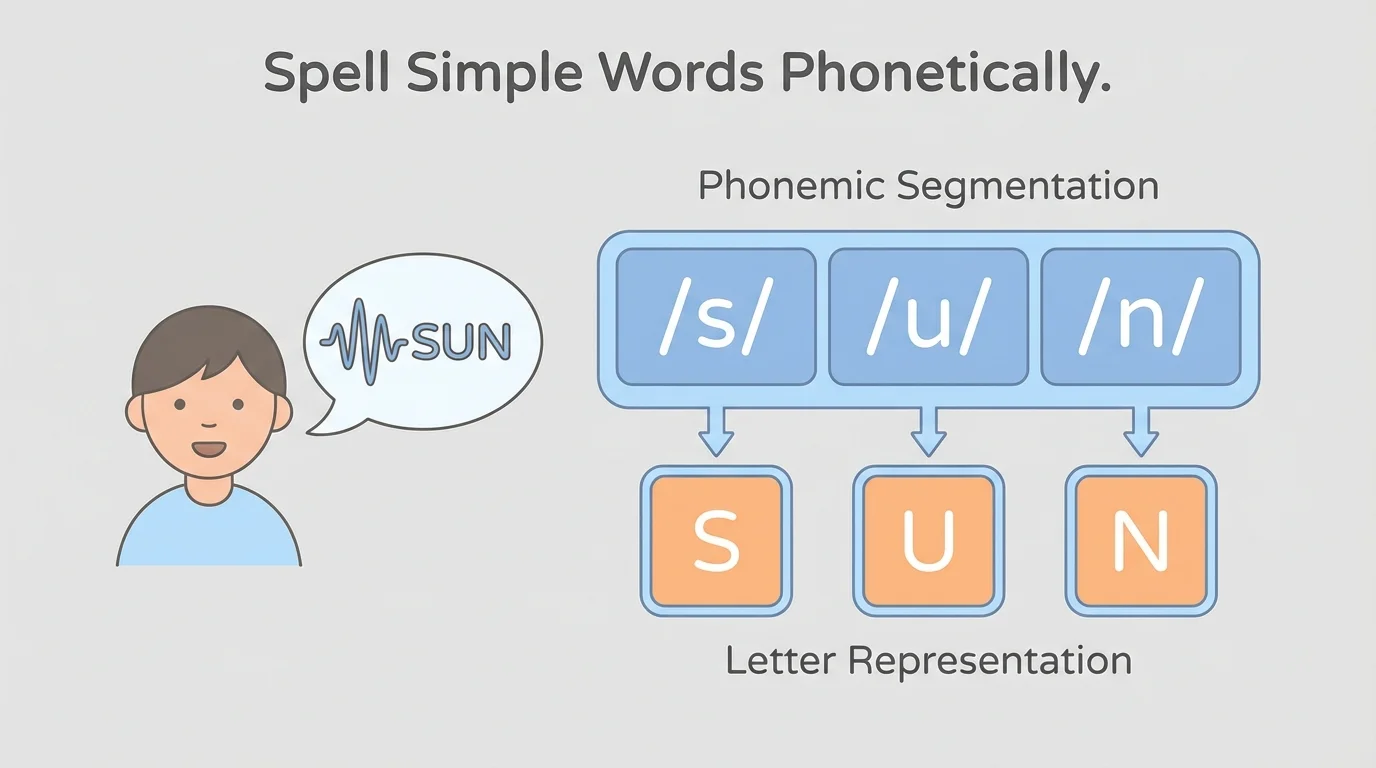
Phonetic spelling means spelling a word by listening to its sounds and choosing letters that match those sounds.
Sometimes a child may write kat for cat. That spelling is phonetic because the child heard the sounds and wrote letters for them. It is not the standard spelling yet, but it shows strong sound awareness.
A letter is a written symbol. A sound-letter relationship means that a sound we hear can match a letter we write. For example, the sound /m/ often matches the letter m, and the sound /t/ often matches the letter t.
When you know some sound-letter relationships, you can spell many simple words. The sound /b/ can help you write bat, big, and bun. The sound /p/ can help you write pig, pan, and pen.
The vowel in the middle is important too. In short words, a can sound like the middle of cat, e like the middle of bed, i like the middle of sit, o like the middle of hot, and u like the middle of sun.
| Word | Sounds Heard | Letters Written |
|---|---|---|
| map | /m/ /a/ /p/ | m a p |
| pet | /p/ /e/ /t/ | p e t |
| sit | /s/ /i/ /t/ | s i t |
| hot | /h/ /o/ /t/ | h o t |
| bug | /b/ /u/ /g/ | b u g |
Table 1. Examples of simple words with sounds matched to letters.
One helpful way to spell is to stretch the word. To stretch a word means to say it slowly so the sounds are easier to hear, as [Figure 2] illustrates.
If you want to spell map, say it slowly: mmm-aaa-ppp. First hear /m/ and write m. Next hear /a/ and write a. Last hear /p/ and write p. Now you have map.
Example: spelling a word by listening
Step 1: Say the word slowly.
Word: sit. Say it as sss-iii-ttt.
Step 2: Listen for the first sound.
You hear /s/, so write s.
Step 3: Listen for the middle sound.
You hear /i/, so write i.
Step 4: Listen for the last sound.
You hear /t/, so write t.
The word is sit.
This same idea works for many short words. You can stretch fan, bed, top, and rug. Listening in order helps you write the letters in order.
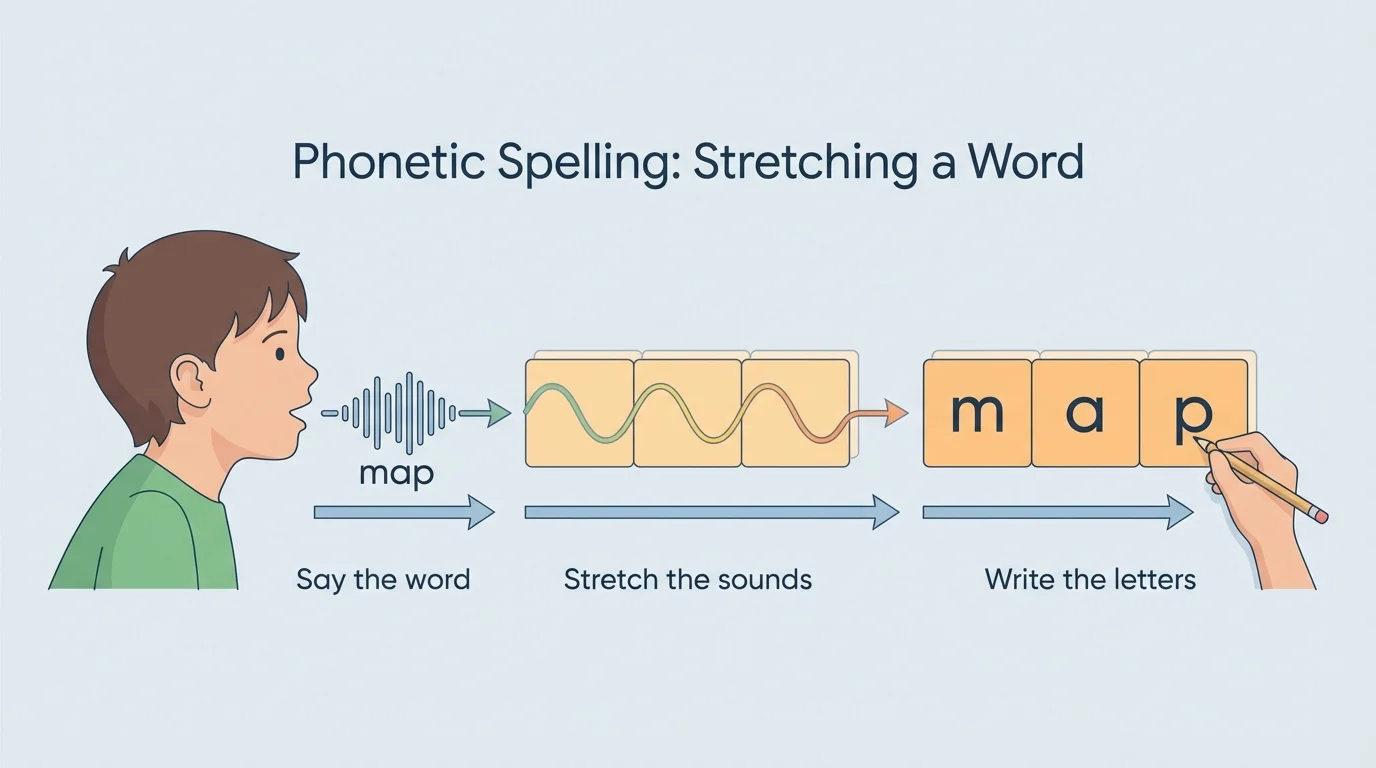
Later, when you read the word back, the letters remind you of the sounds you heard. That is why spelling and reading help each other grow.
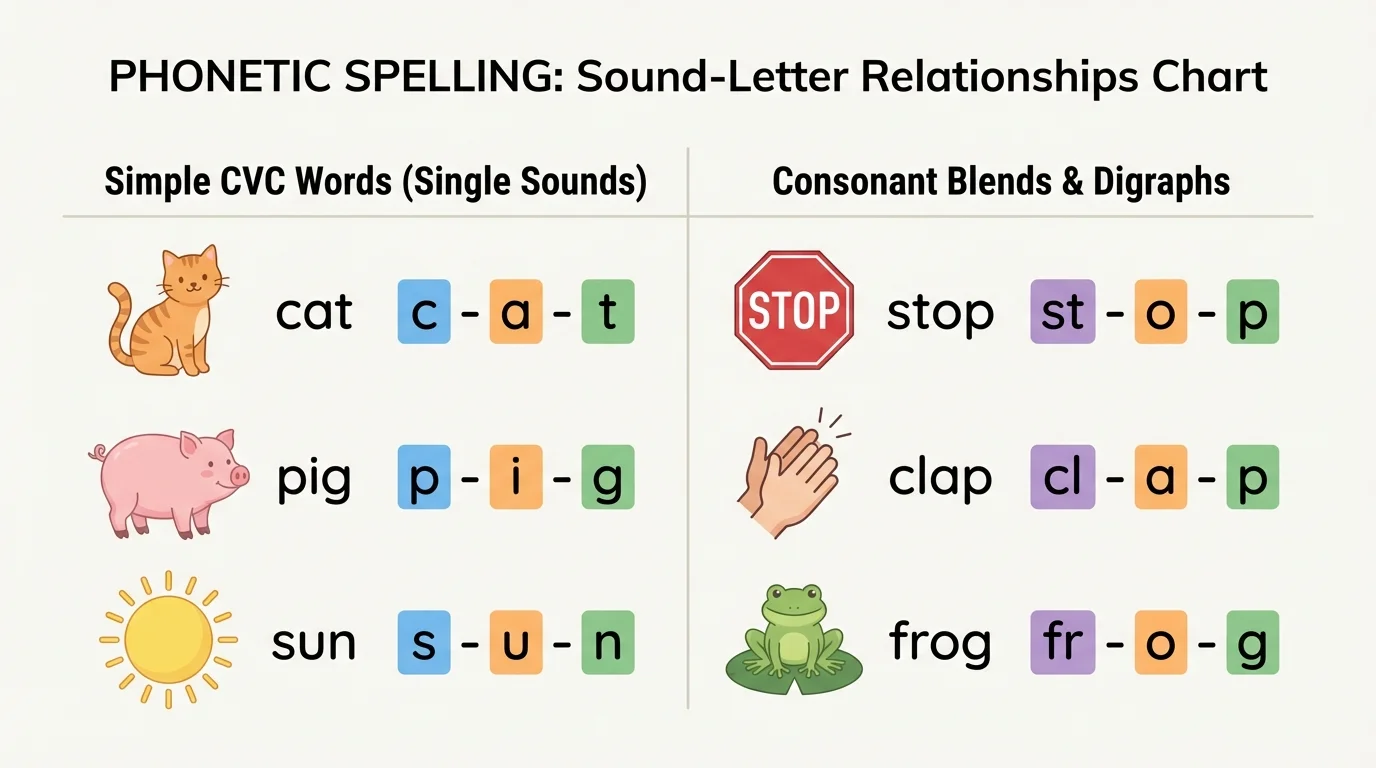
Many kindergarten words are CVC words. That means consonant-vowel-consonant. A CVC word has one consonant sound, then one vowel sound, then one consonant sound. Words like cat, pen, sit, dog, and bug are common examples, as [Figure 3] shows.
Some simple words also begin with two close sounds, such as clap, stop, or frog. These can be harder because you must hear more than one sound at the beginning. In clap, you hear /k/ and /l/ before the vowel sound.
Children also spell words from their own lives: mom, dad, pet, hop, run, bus. These familiar words are useful because students hear them often and can connect speech to writing.
Some very young writers spell a long word with only the first sound at first, like writing b for ball. That is a normal step on the way to hearing more sounds.
As students grow, they usually move from hearing just the first sound to hearing the first and last sounds, and then to hearing the middle vowel too. That growth is one reason phonetic spelling is important. It shows what sounds a child can hear.
When you look again at [Figure 3], you can notice that short words may have different shapes, but they still depend on hearing sounds in the right order.
Spelling is part of writing, and writing also needs clear conventions. A simple sentence begins with a capital letter. Words need spaces between them so we can read them. A sentence ends with punctuation such as a period.
Look at these examples: Sam ran. I hop. The bug is big. In each sentence, the words are spelled so the sounds can be read, the first word begins with a capital letter, and the sentence ends with a mark.
Good spelling helps clear writing
When children use phonetic spelling, they are learning how spoken words connect to written words. As they keep writing, they also learn the standard spellings that readers expect. Capitals, spaces, and punctuation make those words easier to understand in a sentence.
If a child writes the dg rn, we can still notice useful spelling work: the child heard sounds in dog and ran. The next step is adding the missing vowels in dog and ran and keeping each word separate.
Early spelling does not have to be perfect to be meaningful. A child may write laf for laugh or sed for said. These spellings show careful listening, even when the standard spelling is different.
English has some words that are not easy to spell just by sound. Still, phonetic spelling is a strong beginning because it teaches children to notice sounds, match them to letters, and try writing independently.
You already know that words are made of sounds you can hear when you speak. Now you are using that knowledge to put letters on the page.
As shown earlier in [Figure 1], hearing the first, middle, and last parts of a word helps writers build the whole word. The more children read, say, and write words, the stronger these sound-letter connections become.
Good beginning spellers listen carefully, choose letters that fit the sounds, and keep trying. Over time, phonetic spelling grows into more accurate standard spelling.
