A person can go from one place to another in many ways. One child may move quietly. Another may move proudly. Another may move with big bouncy steps. The action is still moving, but the word we choose can create a much richer picture.
A verb is an action word. It tells what someone or something does. Words like run, jump, sit, and sing are verbs. Movement words are also verbs. When we say someone will walk or march, we are naming an action.
Shades of meaning are small differences in meaning between words that are close in meaning. Two verbs may both tell about moving, but each verb gives its own special feeling and picture.
Good listeners pay attention to these small differences. Good speakers choose the word that matches what they mean. That helps people understand the picture in the speaker's mind.
[Figure 1] Some words belong in the same group because they describe a similar action. For moving on your feet, we might hear verbs such as walk, march, strut, and prance. These words are close in meaning, but they are not the same. A child who understands shades of meaning can hear the difference and picture the action more clearly.
Walk is a plain, everyday movement. March is strong and steady. Strut looks proud and showy. Prance looks light, springy, and bouncy. One general action can have many special kinds.
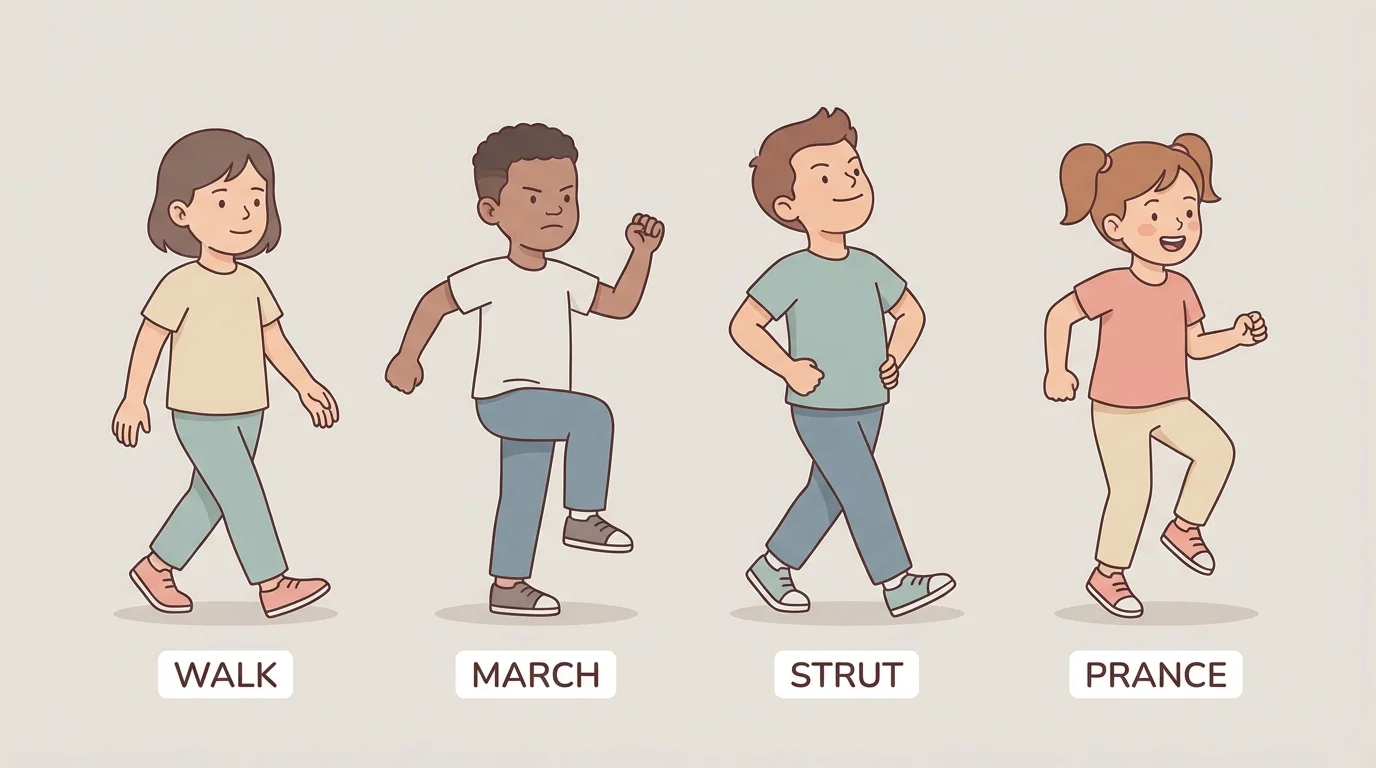
When we listen to a story, these words help us know more than just what happened. They help us know how it happened. That is why careful word choice matters when we speak and listen.
Walk means to move on your feet in a regular way. It often feels calm and ordinary. In a sentence, we might say, "We walk to the door." That sounds simple and natural.
March means to move with firm, even steps. Marching often has a beat. Soldiers march. Children can march in a line to music. The word gives a strong, steady feeling.
Strut means to walk in a proud way, often to be noticed. A person who struts may hold their head high and swing their arms. The word can sound playful or boastful.
Prance means to move with lively, springy steps. A pony might prance. A child pretending to be in a parade might prance too. The word gives a light, happy, bouncy feeling.
Many stories become more exciting because the author chooses a very exact action word. One little word can help you hear music, feel a mood, or picture a character more clearly.
These words do not just describe foot movement. They also show mood, energy, and attitude. That is why listening closely is important.
When someone speaks, you can listen for clues in the sentence. If you hear, "The band played, and the children moved in strong, even steps," the best word is probably march. If you hear, "The little pony took light, fancy steps," prance is a better match.
Sometimes the speaker's voice gives a clue too. A proud voice may match strut. A calm voice may match walk. A strong beat may match march. Listening is not only about hearing sounds. It is also about understanding meaning.
Listening examples
Step 1: Hear the sentence: "Dad went to the mailbox."
The verb walk fits because the action sounds ordinary and calm.
Step 2: Hear the sentence: "The drummer played, and the class moved together."
The verb march fits because the action sounds strong and steady.
Step 3: Hear the sentence: "The peacock moved around proudly."
The verb strut fits because the action sounds proud and showy.
Step 4: Hear the sentence: "The pony took bouncy little steps."
The verb prance fits because the action sounds light and springy.
As we saw earlier, body position also gives clues. A straight body and even steps suggest march, while lifted knees and playful movement suggest prance.
Acting out a word helps your brain connect language to action. When children hear a word and move their bodies to match it, the meaning becomes stronger. Oral language grows when words are spoken, heard, and felt through movement.
If you act out walk, your steps are easy and regular. If you act out march, your knees may lift a little and your steps may follow a beat. If you act out strut, your chest may be up and your face may look proud. If you act out prance, your steps may bounce and feel light.
Why acting helps learning
Young children learn language with their whole bodies. Hearing a word, saying it aloud, seeing someone do it, and acting it out all work together. This makes it easier to remember the word and use it correctly in speaking and listening.
Acting also helps children notice that two words can be close in meaning but still feel different. That is an important language skill.
[Figure 2] Sometimes many words could fit a sentence, but one word fits best. A simple comparison helps us choose the most exact word. Exact words make speaking clearer and storytelling stronger.
Listen to how the sentence changes: "The girl walked across the stage." Now change one word: "The girl strutted across the stage." The second sentence makes a stronger picture. It tells us the girl may feel proud or want people to notice her.
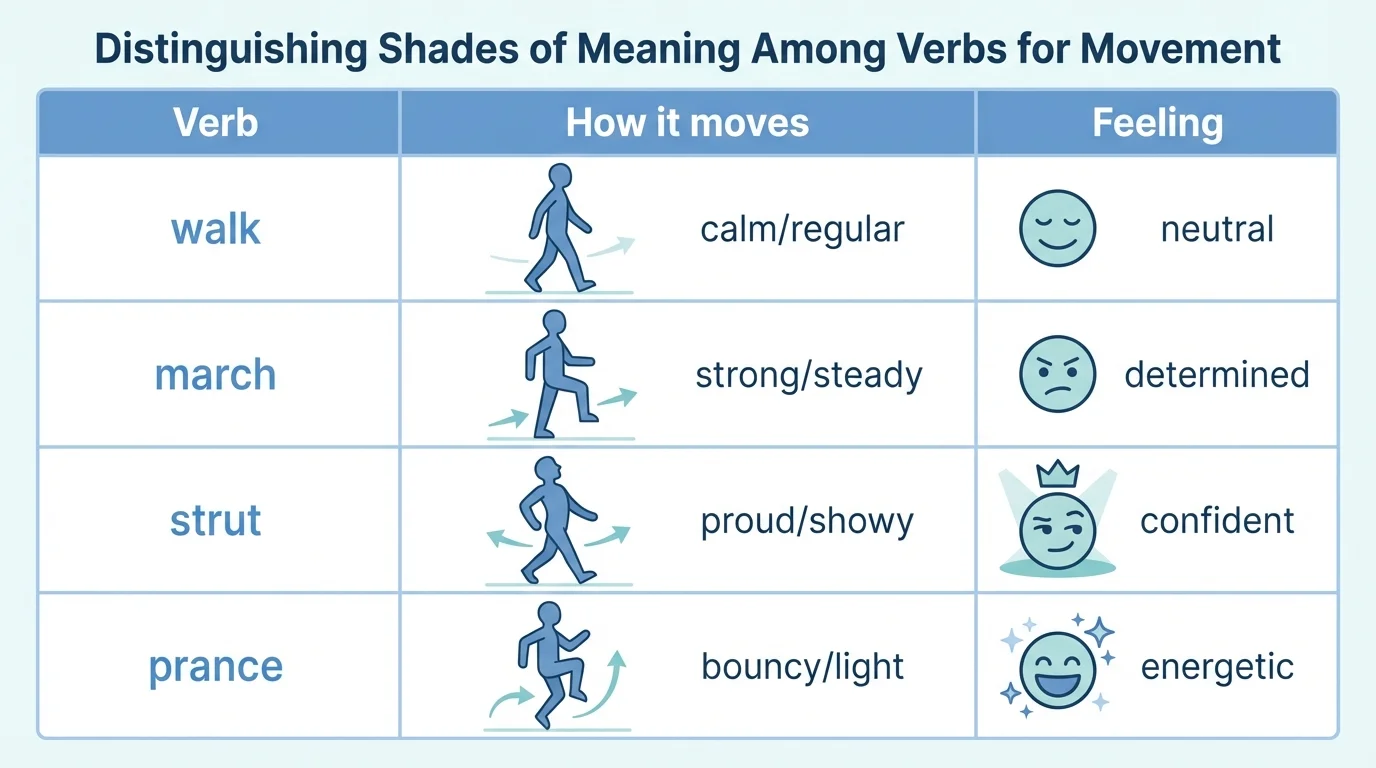
| Word | How it moves | Feeling it gives |
|---|---|---|
| walk | regular steps | calm, everyday |
| march | strong, even steps | steady, powerful |
| strut | proud, showy steps | confident, attention-seeking |
| prance | light, bouncy steps | playful, lively |
Table 1. A comparison of movement words and the different feelings they express.
The chart shows that close words can paint different pictures. When children choose a more precise word, they become stronger speakers.
When you tell a story out loud, the verbs you choose help your listener build a picture. If you say, "The puppy pranced to the bowl," the listener imagines a different scene than "The puppy walked to the bowl." The first sounds lively. The second sounds plain.
Listening and speaking work together. A careful listener notices the exact word. A careful speaker chooses the exact word. In conversations, songs, poems, and stories, these special action words make language more interesting and clearer.
You already know many action words. This lesson adds an important idea: some action words are close neighbors, but each one has its own little meaning. Paying attention to that little difference helps you understand and communicate better.
As children grow in language, they learn not just to name an action, but to name it well. That is how oral expression becomes richer, and that is how listening becomes sharper.
