Have you ever noticed that your name, a storybook title, and a stop sign are all made from the same small set of shapes? Those shapes are letters. When we learn the alphabet, we learn the names of the letters we see everywhere. That helps us get ready to read words, write our names, and understand print all around us.
The alphabet is a set of 26 letters. These letters are used to make words. Every word you read is built from letters. When you know letter names, you can talk about print more clearly. You can say, "My name starts with M," or "I see the letter s in that word."
Alphabet means all the letters in order from A to Z. A letter is one symbol we use to make words.
The letters in the alphabet are: A, B, C, D, E, F, G, H, I, J, K, L, M, N, O, P, Q, R, S, T, U, V, W, X, Y, Z. Each one has a name. Saying the letters in order helps us remember them, but we also want to recognize each letter when we see it by itself or in a word.
[Figure 1] Each uppercase letter has a matching lowercase letter. Uppercase letters are often called big letters. Lowercase letters are often called small letters. Both forms are important because books and signs use both kinds.
Some uppercase and lowercase letters look almost the same, like C and c, or O and o. Some look different, like A and a, or R and r. Even when they look different, they are still a matching pair and have the same letter name.
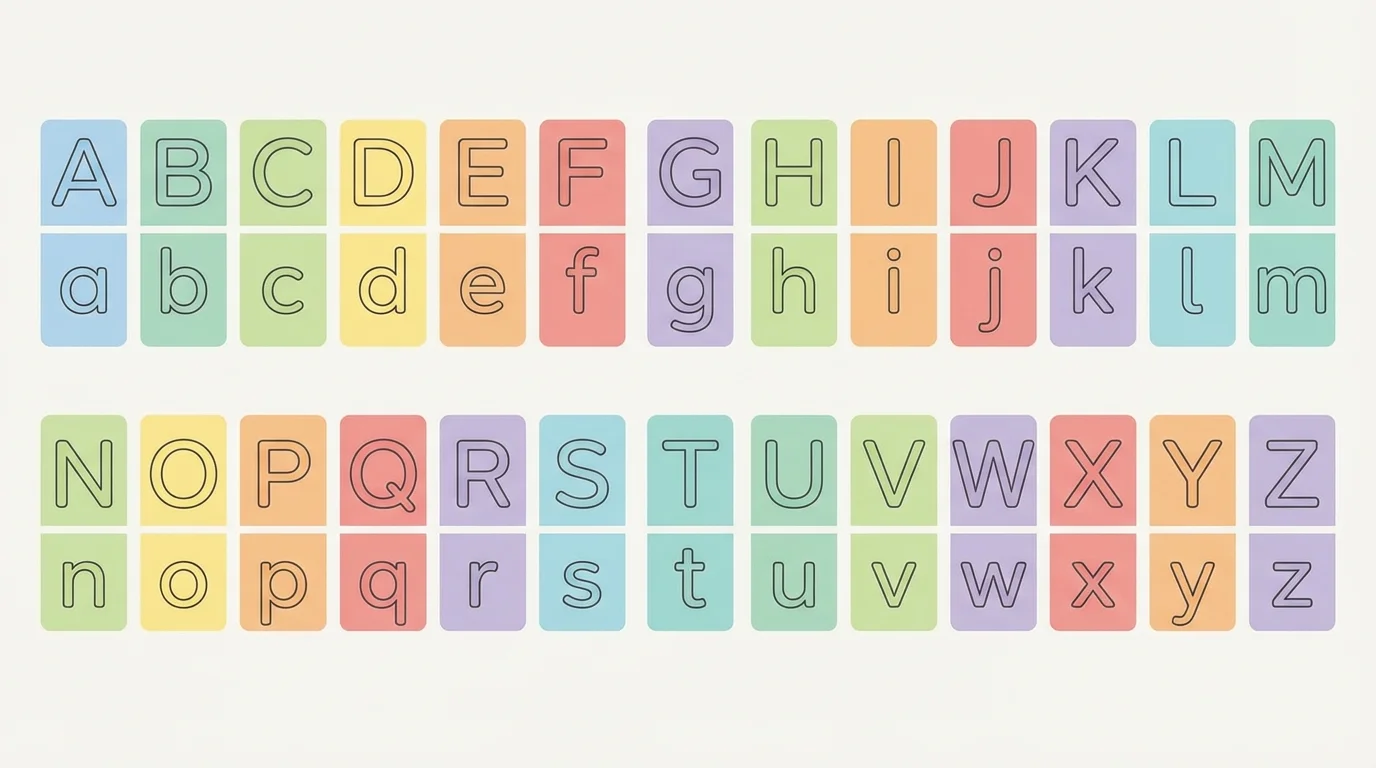
We often see uppercase letters at the beginning of names, like Liam, Mia, or Sofia. We also see uppercase letters at the beginning of a sentence. Lowercase letters appear in most of the rest of the words we read.
One letter, two forms
A single letter can have two shapes: an uppercase form and a lowercase form. For example, B and b are the same letter name, just written in two different ways.
When you learn letters, it helps to learn the pair together: Aa, Bb, Cc, Dd, Ee, and so on. Later, when you see T in a title or t in the middle of a word, you will know they match. The alphabet chart keeps those pairs lined up so the match is easy to see.
The alphabet has a special order. We say A first and Z last. Knowing the order helps when we sing the alphabet song, look for a letter on a classroom chart, or find a name in a list. But it is also important to know letters when they are not in order.
For example, if you see the letters M, a, t in a name tag, you can still name them one by one. Good readers can recognize letters in order and out of order.
| Uppercase | Lowercase | Letter Name |
|---|---|---|
| A | a | A |
| B | b | B |
| M | m | M |
| S | s | S |
| T | t | T |
| Z | z | Z |
Table 1. Examples of matching uppercase and lowercase letters with their letter names.
When we name letters, we say the letter name, not the whole word around it. In the word sun, we can point and say s, u, n. In the word Cat, we can point and say C, a, t.
[Figure 2] Some letters can trick our eyes if we look too fast. Careful readers study the letter shape closely. They notice straight lines, curved lines, tall parts, and where each part points.
For example, b and d are not the same. The tall line and the round part switch sides. The same thing happens with p and q. Letters such as m and n can also look similar, but m has more bumps.
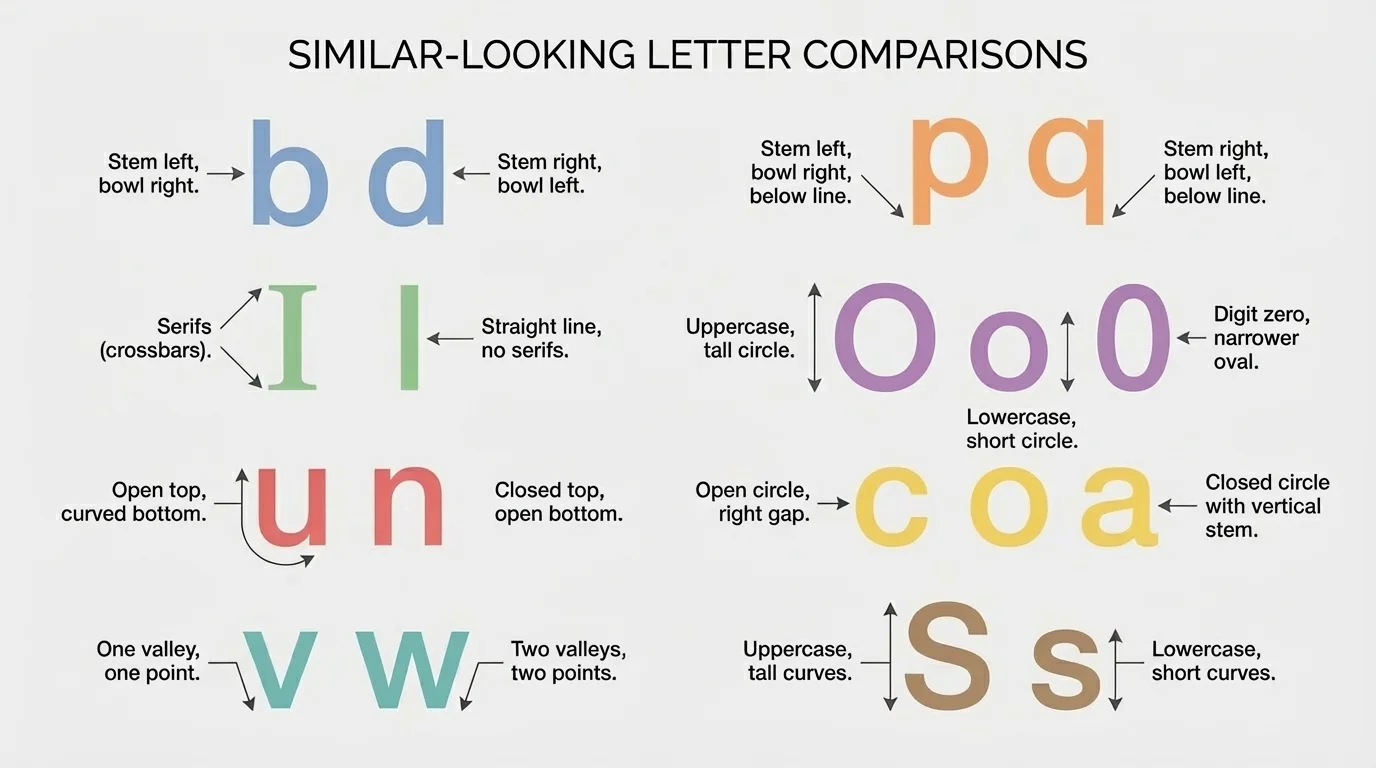
Some matching uppercase and lowercase letters are easy to spot, like S and s. Others look very different, like G and g. That is why we learn to recognize letters in many ways, not by guessing.
Your brain gets faster at spotting letters the more often you see them in books, labels, and names. Soon, many letters begin to feel as familiar as faces.
When you look carefully, you can tell letters apart by small details. The comparison helps you notice direction, curves, and line placement, which are all important for correct letter naming.
[Figure 3] Letters are all around us in print. We see them on book covers, food boxes, classroom labels, birthday cards, street signs, calendars, and computer screens. Knowing letters helps us make sense of those things.
If you look at a name tag, the first letter is often uppercase: Ethan. If you look at a sentence in a book, the first word often starts with an uppercase letter too. The other letters in the word are usually lowercase. This pattern helps us understand how print is organized.
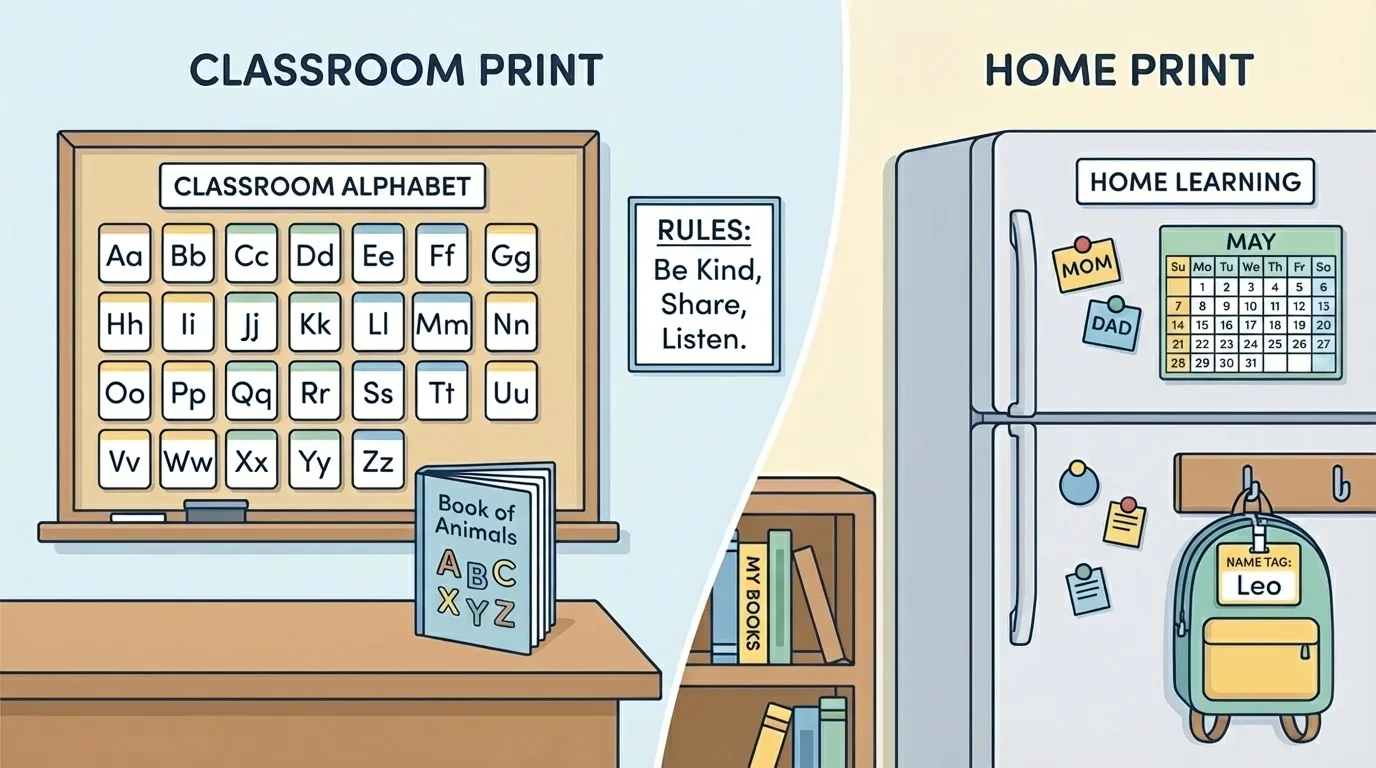
When children recognize letters in the world around them, reading starts to feel meaningful. A cereal box is not just a box. A sign is not just a shape. They are made of letters that carry meaning.
You already know that print has meaning and that we read words on a page. Recognizing letters helps you unlock those words one part at a time.
The everyday examples show that letters do not live only in alphabet charts. They are part of real books, real names, and real messages people use every day.
Each uppercase letter matches one lowercase letter. Here are some matching pairs: A-a, B-b, F-f, H-h, K-k, L-l, P-p, Y-y. When you can look at one form and name the other, you are building strong alphabet knowledge.
Some pairs are almost twins in shape, such as U and u, V and v, and W and w. Some pairs need extra memory because they do not look much alike, such as N and n, or Q and q.
Example: Naming matching letters
Step 1: Look at the uppercase letter D.
Step 2: Find its lowercase match, d.
Step 3: Say the letter name: D.
The uppercase letter D and the lowercase letter d are a pair.
Knowing pairs helps you whether a letter is standing alone or sitting inside a word. If you know J and j match, then you can name the letter in Jam and also in jar.
Letters can look a little different in different books or on different signs. One lowercase a in a storybook might look different from an a on a computer, but it is still the same letter. Good readers learn that letters can have small style changes while keeping their names.
Being a careful letter watcher means slowing down and noticing details. Is the letter tall? Does it have a curve? Does it point left or right? These questions help you recognize and name letters correctly.
When children know all upper- and lowercase letters, they are ready for more reading work. They can connect letters to sounds, read simple words, and write more clearly. Alphabet knowledge is one of the big first steps on the road to reading.
