How can one tiny word change everything? A toy can be in a box, on a box, or off a box. The toy is the same, and the box is the same, but the little word changes the whole idea. These little helper words are important when we speak and when we write.
A preposition is a little word that helps tell how one thing is connected to another thing. A preposition can tell where something is, where it is going, or how things are related.
Prepositions are words like in, on, to, from, and with. They help us describe place, direction, and connection.
We use prepositions all the time. We say, "Sit on the rug," "Put the book in the bag," and "Come to me." These words may be small, but they do big jobs in sentences.
Some prepositions tell place. They show where something is with the same toy and box in different places. When we know the preposition, we understand the picture in our minds.
In means inside. "The bear is in the bed."
On means resting on top. "The cup is on the table."
Out can mean not inside. "The ball is out of the box."
Off means not on anymore. "The hat fell off the hook."
By means next to or near. "The dog is by the door."
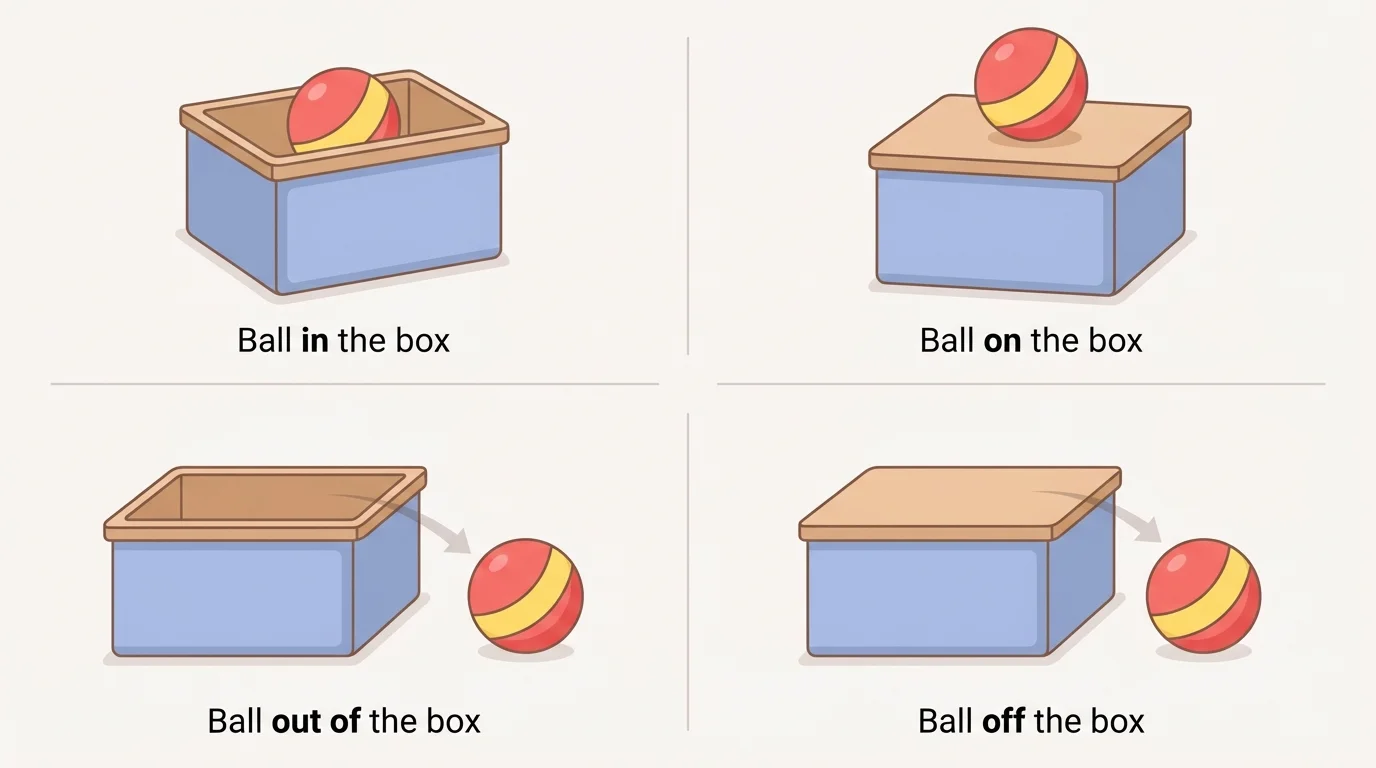
Listen to how the place changes with one word: "The cat is in the basket" is different from "The cat is on the basket." One means inside. The other means on top.
Very short words can be some of the busiest words in English. Words like in and on are used again and again in speaking and writing.
We also use place words in school every day. A pencil can be in a desk. A paper can be on a desk. A backpack can be by a chair. As we saw in [Figure 1], the object may stay the same, but the preposition changes the meaning.
Some prepositions tell about movement or direction. They help us say where someone or something is going or where it came from.
To tells where someone is going. "We walk to school."
From tells where someone starts. "Dad came home from work."
By can also mean near, and it can show how something happens in simple expressions. "We go by car."
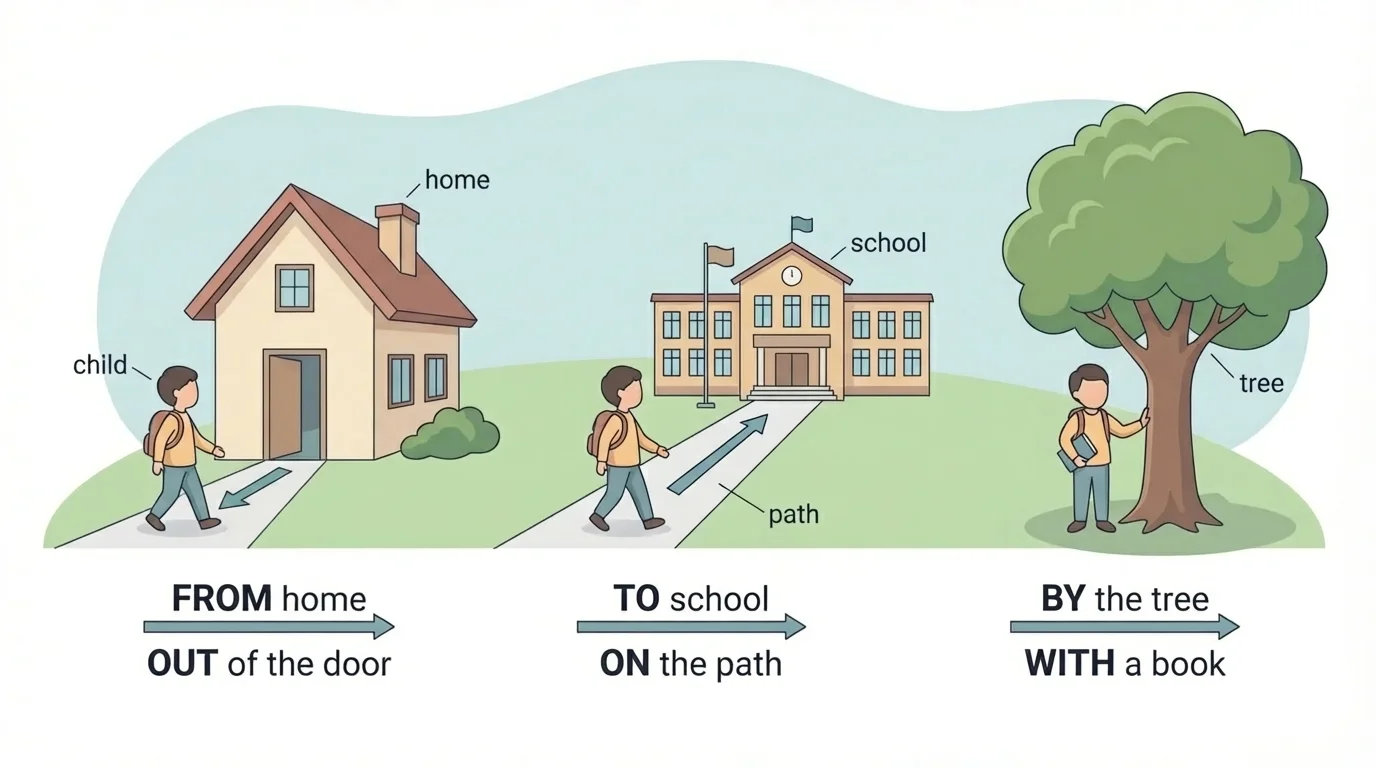
Think about these two sentences: "The bird flew to the tree." "The bird flew from the tree." The word changes the direction. To points toward something. From points away from where it started.
Direction words in sentences
Step 1: Start with the action.
The girl runs.
Step 2: Add a direction preposition.
The girl runs to the slide.
Step 3: Change the preposition and notice the new meaning.
The girl runs from the slide.
The action stays the same, but the direction changes.
When you give directions, these words are very helpful. You may say, "Come to the door," or "Take your shoes off." Clear prepositions help listeners understand exactly what to do.
Some prepositions show connection in other ways. They do not always tell place. They can tell belonging, purpose, or being together.
Of can show belonging. "The pages of the book are torn." "The tail of the kite is long."
For can show who something is meant for. "This card is for Mom." "The snack is for the class."
With means together or having something. "I paint with a brush." "Sam walks with his friend."
One little word can show a new relationship. The preposition helps us understand how two ideas fit together. In "a gift for Dad," the word for tells who gets the gift. In "the cover of the book," the word of tells what the cover belongs to. In "play with a friend," the word with tells who is together.
These words help our writing sound complete. Without them, many sentences sound unfinished or confusing.
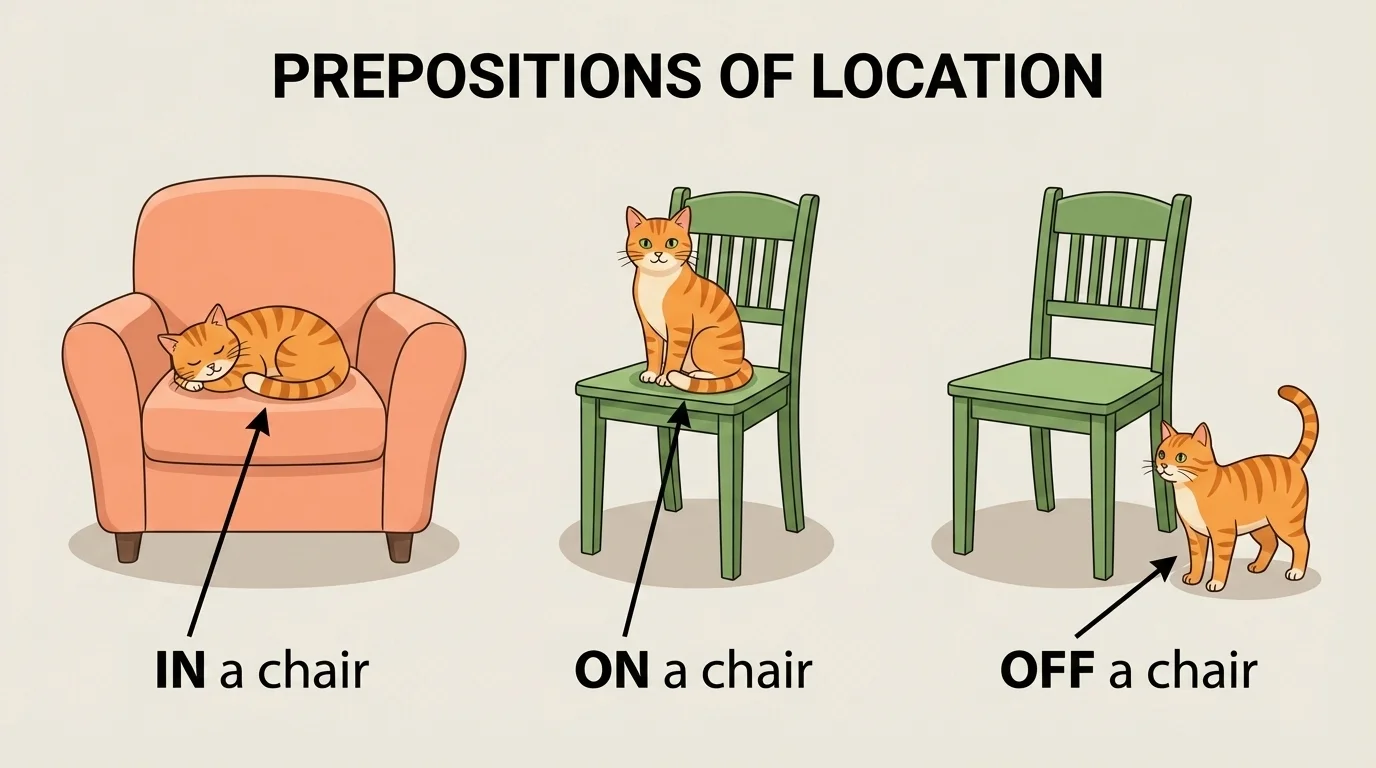
One small preposition can change the whole meaning of a sentence with the cat and the chair. Good writers and speakers choose the word that matches what is really happening.
Look at these sentences:
"The frog is in the pond."
"The frog is on the rock."
"The frog jumped off the rock."
Each sentence uses a different preposition, and each one tells a different idea.
You can also hear prepositions in everyday talk: "Come with me." "Get in line." "Take the crayons out." "Stand by your partner." These are simple sentences, but the prepositions make them clear.
| Preposition | What it helps tell | Example |
|---|---|---|
| in | inside | The coin is in the jar. |
| on | on top | The book is on the shelf. |
| out | not inside | The toy came out of the bag. |
| off | not on | The sock came off. |
| to | going toward | We walk to lunch. |
| from | starting place | I came from home. |
| by | near | The cup is by the sink. |
| with | together or using | I draw with a marker. |
| for | meant to help or give | This flower is for you. |
| of | belonging to | The door of the house is red. |
Table 1. Common prepositions, what they help tell, and a simple example of each one.
Later, when you read or write, you can check whether the preposition matches the picture in your mind. If the block is inside the bucket, use in. If it is resting on top, use on. If it moves away, maybe you need off or from. The contrasts in [Figure 3] make these changes easy to notice.
Some prepositions are easy to mix up. That is okay. We can slow down and think about what the sentence really means.
In and on are different. A toy is in the basket when it is inside. A toy is on the basket when it is on top.
To and from are opposites in many sentences. You go to a place. You come from a place. The direction pictures from [Figure 2] help us remember that these words point different ways.
On and off are also opposites in many sentences. A coat is on your body. When you take it off, it is not on anymore.
Sentences begin with a capital letter and end with an ending mark. When you add the right preposition, your sentence becomes clearer and stronger.
Using prepositions well helps you speak clearly, follow directions, and write simple sentences that make sense. These little words are powerful because they connect ideas in just the right way.
