Have you ever looked at a toy box and known right away that the cars go in one place and the stuffed animals go in another? Your brain is already very good at sorting. Sorting helps us understand the world. When we sort, we put objects into groups that have something the same.
Sorting is not only about moving things. It is also about talking and listening. We can say what we notice, hear what someone else notices, and use words to explain our thinking. When children learn to sort common objects, they also learn the meaning of a category, or a kind of group.
Sorting means putting objects into groups by something they share.
Category means a group of things that belong together.
Attribute means a feature we notice, such as shape, color, or use.
When we sort, we look for an attribute. An attribute can be a shape, a color, a kind of food, or something else we can notice. If two things have the same important feature, they can go in the same category.
To sort means to look carefully and decide, "What is the same?" and "What is different?" A red apple and a green apple may look a little different in color, but both are apples, so they can go in the same food category. A spoon and a fork may look different too, but both are tools we use for eating.
Sometimes sorting is easy. A banana belongs with other foods, not with shoes. Sometimes we need to think more carefully. A toy pizza is shaped like food, but it is really a toy. Good sorting means paying attention and using words to explain our choice.
Many categories are part of everyday life. We sort clothes into socks, shirts, and pants. We sort classroom items into books, crayons, and blocks. We sort animals into birds, fish, and insects. We sort foods into fruits, vegetables, drinks, and snacks.
As we speak about categories, we can use sentence frames like: "This belongs with ___ because ___." We can also listen for words that tell us why, such as same, different, belongs, and group.
| Object | Category | Why it belongs |
|---|---|---|
| apple | food | We can eat it. |
| triangle sign | shape | It has three sides. |
| sock | clothing | We wear it on a foot. |
| book | classroom item | We read it. |
Table 1. Examples of common objects, their categories, and simple reasons they belong.
One easy way to sort is by shape. Shapes help us notice what is the same when we place everyday objects into shape groups. A plate and a ball can both be circle-shaped. A window may look like a square or a rectangle. A sign may have a triangular shape.
Some common shape categories are circle, square, triangle, and rectangle. If an object has three straight sides, it belongs in the triangle category. If it is round with no corners, it belongs in the circle category.
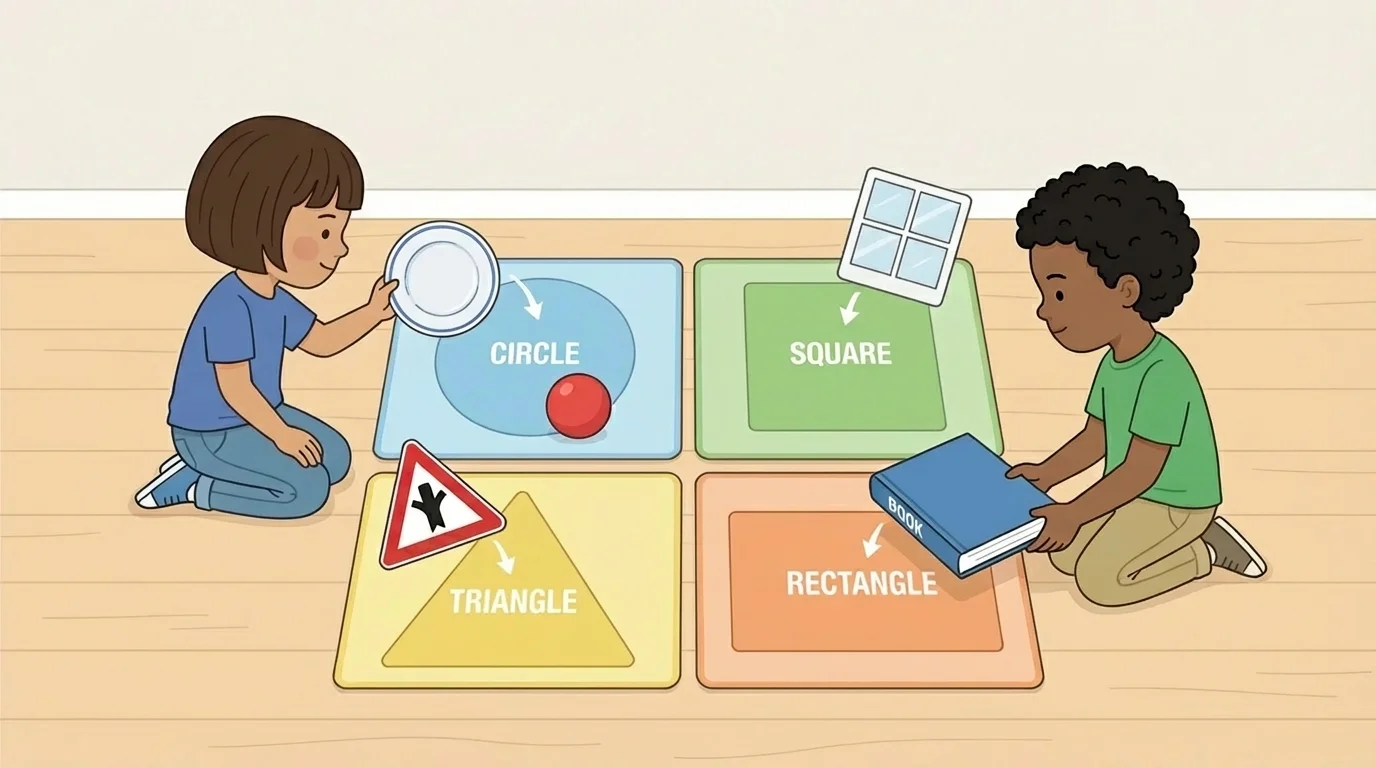
When we sort by shape, we can say, "The clock goes with the circle group because it is round." We can also compare: "The book and the door are not the same size, but both look like rectangles." This kind of speaking helps children develop a clear understanding.
Talking example: sorting by shape
Step 1: Look at an object.
A slice of pizza drawing has three sides.
Step 2: Name the category.
It belongs in the triangle category.
Step 3: Explain why.
"It is a triangle because it has three sides."
Later, when children talk about buildings, signs, toys, and art, shape words help them describe what they see. The shape groups in [Figure 1] remind us that many real objects can fit a shape category even when they are used for different things.
[Figure 2] Another helpful way to sort is by food category. Foods that belong together share something important. An apple and a banana can go together because both are fruits. A carrot can go in a vegetable group. Milk belongs in a drink group.
Food categories help children learn new words and talk about what they eat. A cracker may go into a snack category. Soup and juice are not the same, but both can be described as foods or drinks. The category depends on the rule we choose.
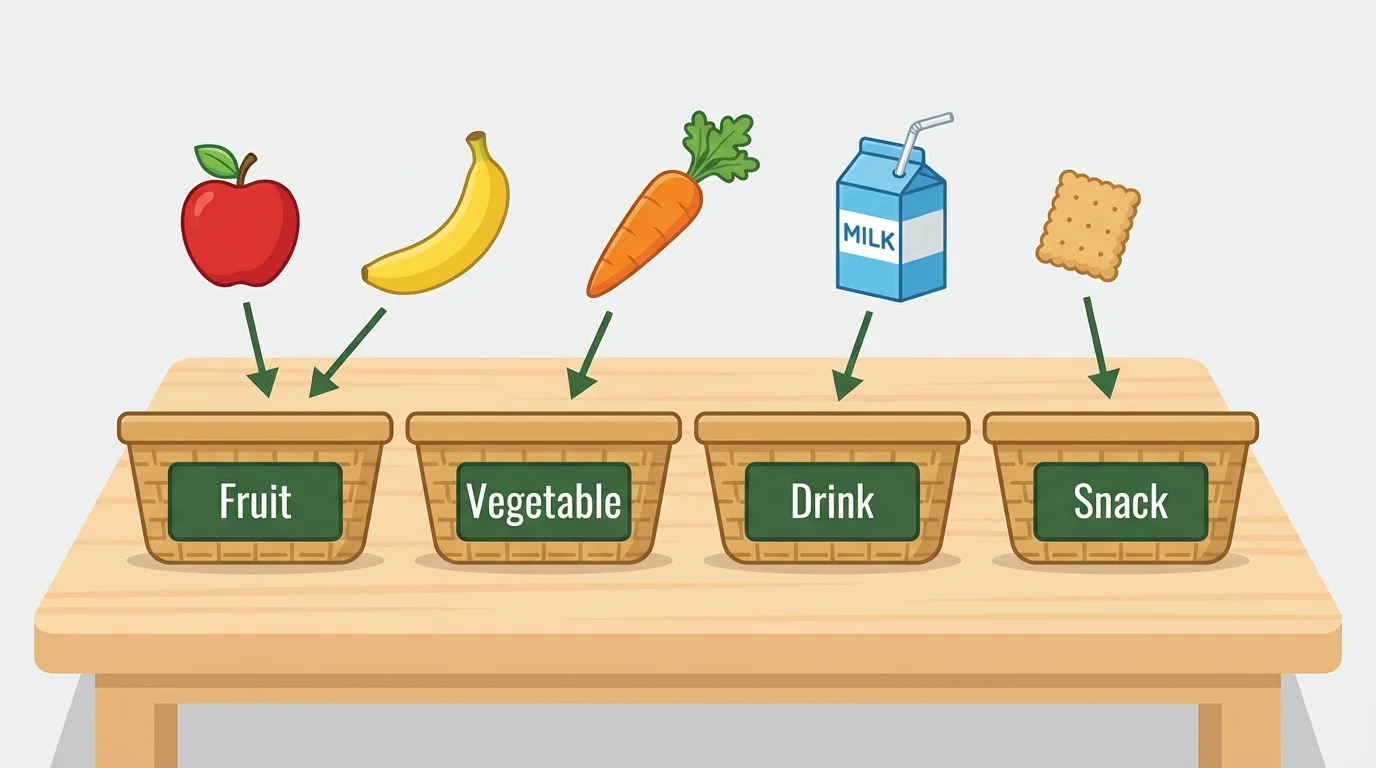
When we sort foods, it is useful to listen to other ideas. One child may say, "Milk is a drink." Another may say, "Milk is part of breakfast." Both are thoughtful ways to sort, but they use different category rules.
Talking about food also connects school to home. In a kitchen or grocery store, people sort foods onto shelves, into lunch boxes, and into meals. The food baskets in [Figure 2] show how categories make choices easier.
Grocery stores use sorting everywhere. Fruits are together, breads are together, and drinks are together so people can find what they need quickly.
Sorting by food category builds vocabulary and helps children explain what they know. It also encourages careful listening, because two people may notice different features of the same item.
Sorting is a language activity as well as a thinking activity. When children speak about what they are doing, they practice clear oral expression. They learn to name objects, name categories, and tell reasons.
Good listeners pay attention to the speaker's ideas. If one child says, "The carrot goes with vegetables because it grows in the ground," another child can respond, "I heard you say carrot is a vegetable." Listening helps children understand, remember, and build on each other's thinking.
Using complete thoughts
When children sort and talk, they grow stronger communication skills by saying complete ideas. Helpful sentence patterns include: "I sorted these by ___.", "This belongs here because ___.", and "These are different because ___."
Words such as same, different, belongs, group, and kind are powerful. They help children describe what they see and make their thinking easy for others to follow.
Here is something exciting: one group of objects can be sorted in more than one way, as [Figure 3] illustrates with the same blocks grouped first by color and then by shape. This teaches children that categories depend on the rule we choose.
For example, imagine a red square block. It can go into a red group if we sort by color. The same block can go into a square group if we sort by shape. The object did not change, but the sorting rule changed.
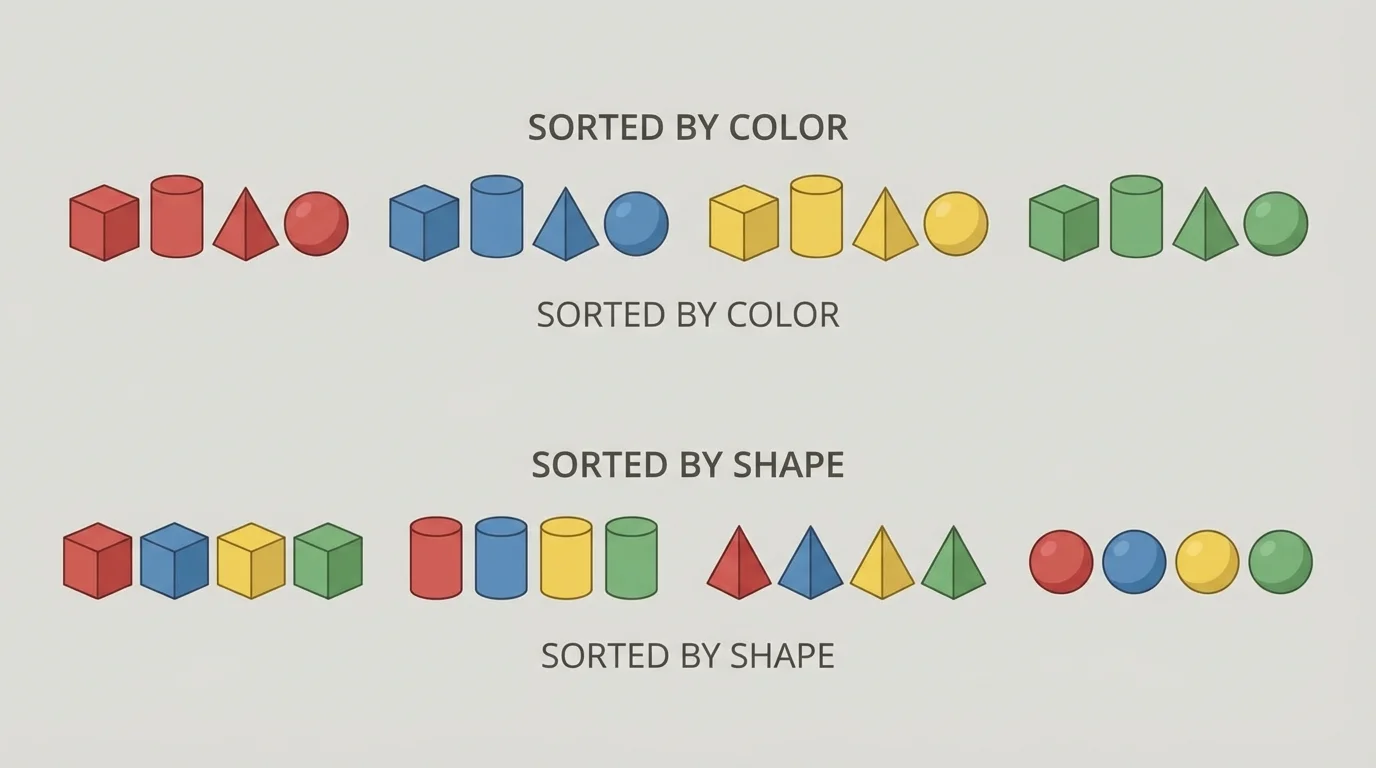
This idea helps children become flexible thinkers. They learn that there may be more than one smart answer when the category rule changes. They also learn to ask an important question: "How are we sorting?"
When we look back at the two ways of grouping in [Figure 3], we see that categories are about noticing a shared feature. The feature might be color, shape, size, use, or kind.
People sort objects every day. We sort laundry. We put forks with forks and spoons with spoons. We place books on a shelf and shoes by the door. In school, we sort pencils, paper, and art supplies. Sorting helps us stay organized and helps us find things quickly.
Sorting also helps us learn new ideas. When children sort animals, they start to notice what makes a bird a bird or a fish a fish. When they sort shapes, they notice sides and corners. When they sort foods, they learn words for things they eat and drink.
You already know many object names from home and school. Sorting uses those words in a stronger way because now you explain why objects belong together.
As children grow, sorting becomes even more useful. They sort letters, sounds, pictures, numbers, and stories. The simple idea stays the same: notice what is alike, make a category, and explain your thinking clearly.
