Have you ever heard a funny phrase like "big brown bear" or "silly snake"? Those word groups can sound bouncy and fun because the words begin with the same sound. Our ears can catch that pattern. When we listen for matching beginning sounds, we are using an important reading skill.
Alliteration happens when words begin with the same first sound. We listen to the sound we hear at the start. If we hear the same beginning sound again and again, the words make a sound pattern.
Alliteration means a group of words that begin with the same first sound when we say them. The first sound at the start of a word is called the onset.
For example, listen to these words: pig, pan, pop. They all start with the /p/ sound. That is alliteration. Listen to these words: dog, sun, map. They do not all start with the same sound, so they are not alliteration.
Alliteration is something we hear. It is about sound, not just about what words look like when they are written.
The onset is the first sound we hear in a word, as [Figure 1] shows with words that all begin the same way. In the word sun, the onset is /s/. In the word ball, the onset is /b/. In the word moon, the onset is /m/.
Good listeners pay attention right away, at the very beginning of the word. If two words start with the same sound, they have the same onset. If they start with different sounds, they do not match.
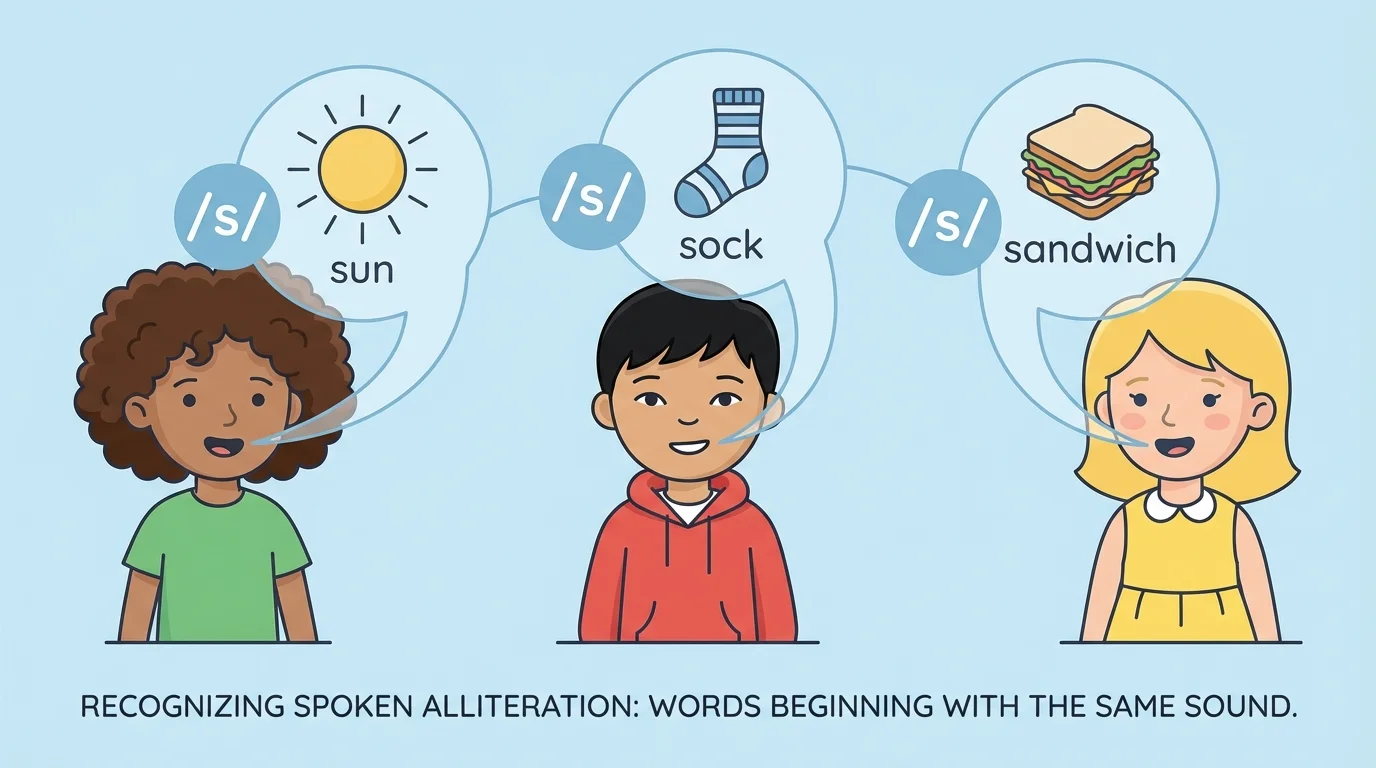
We can listen to just the start of each word. Fish starts with /f/. Fan starts with /f/. Hat starts with /h/. So fish and fan match, but hat does not.
Many tongue twisters use matching beginning sounds. That is why they sound silly and sometimes tricky to say.
Sometimes children think they should listen to the whole word. But for this skill, we only need to focus on the first sound. The beginning is the important part.
A beginning sound can be heard in many different words, and words can be grouped by that sound, as [Figure 2] illustrates. Listen to ball, baby, boat. They all begin with /b/. That makes them a matching group.
Now listen to cat, cake, car. They all begin with /k/. This is another matching group. The words do not have to rhyme. They only need the same first sound.
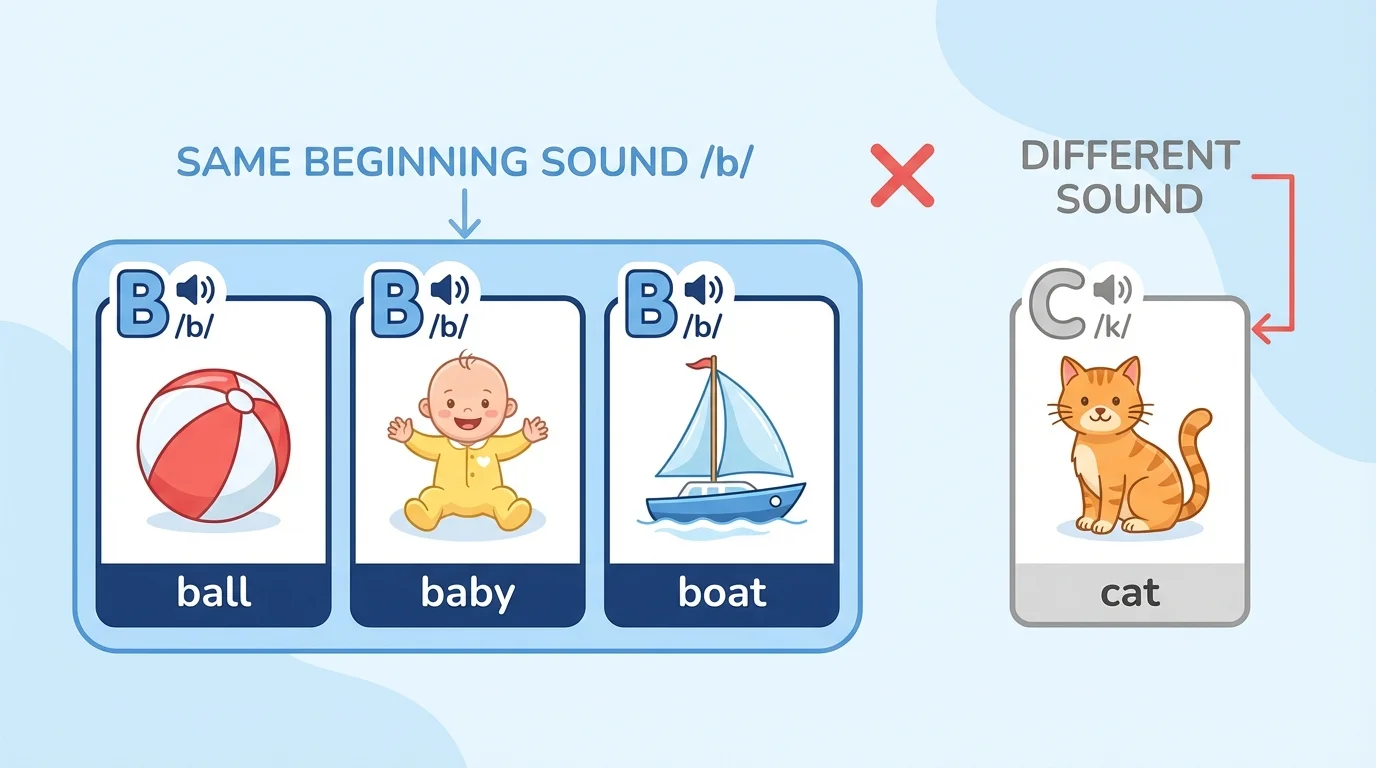
Listen to red, rug, rabbit. They all start with /r/. Listen to leaf, lion, log. They all start with /l/. These are groups of words with the same onset.
When one word does not belong, our ears can notice it. In sock, sandwich, moon, the word moon is different because it starts with /m/, not /s/.
Listening example
Here is how a careful listener can think about spoken words.
Step 1: Say the first word and hear the first sound.
Dog starts with /d/.
Step 2: Say the next word and hear its first sound.
Duck starts with /d/.
Step 3: Compare the sounds.
/d/ and /d/ match, so the words begin the same way.
Dog and duck make a matching beginning-sound pair.
Just as we saw earlier in [Figure 1], the ear notices the very first sound before the rest of the word. That helps us hear whether words belong together.
Listening is more important than staring at letters. Sometimes words may begin with the same letter, and they also begin with the same sound, like mom, milk, and mouse. That is easy to hear.
Sometimes the big idea is still this: we listen to the sound, not only the letter name. If the first sound matches, the words belong in the same alliteration group. If the first sound does not match, they do not.
For young readers, it is helpful to remember: our ears lead the way. We hear the word, notice the first sound, and compare it to the first sound in another word.
You already know that words are made of sounds. This skill uses that same idea: hear a sound, then compare it to another sound.
This is why teachers read poems, rhymes, and playful sentences aloud. Spoken language helps children hear patterns clearly.
Alliteration appears in fun names, songs, and short sentences, as [Figure 3] shows. Listen to Funny Fiona, Bouncy Ben, or Merry Mia. The repeated beginning sound makes the words sound catchy.
It also appears in playful sentences like Silly snakes slither slowly or Busy bees buzz. The words begin with the same sound, so the sentence has a strong sound pattern.
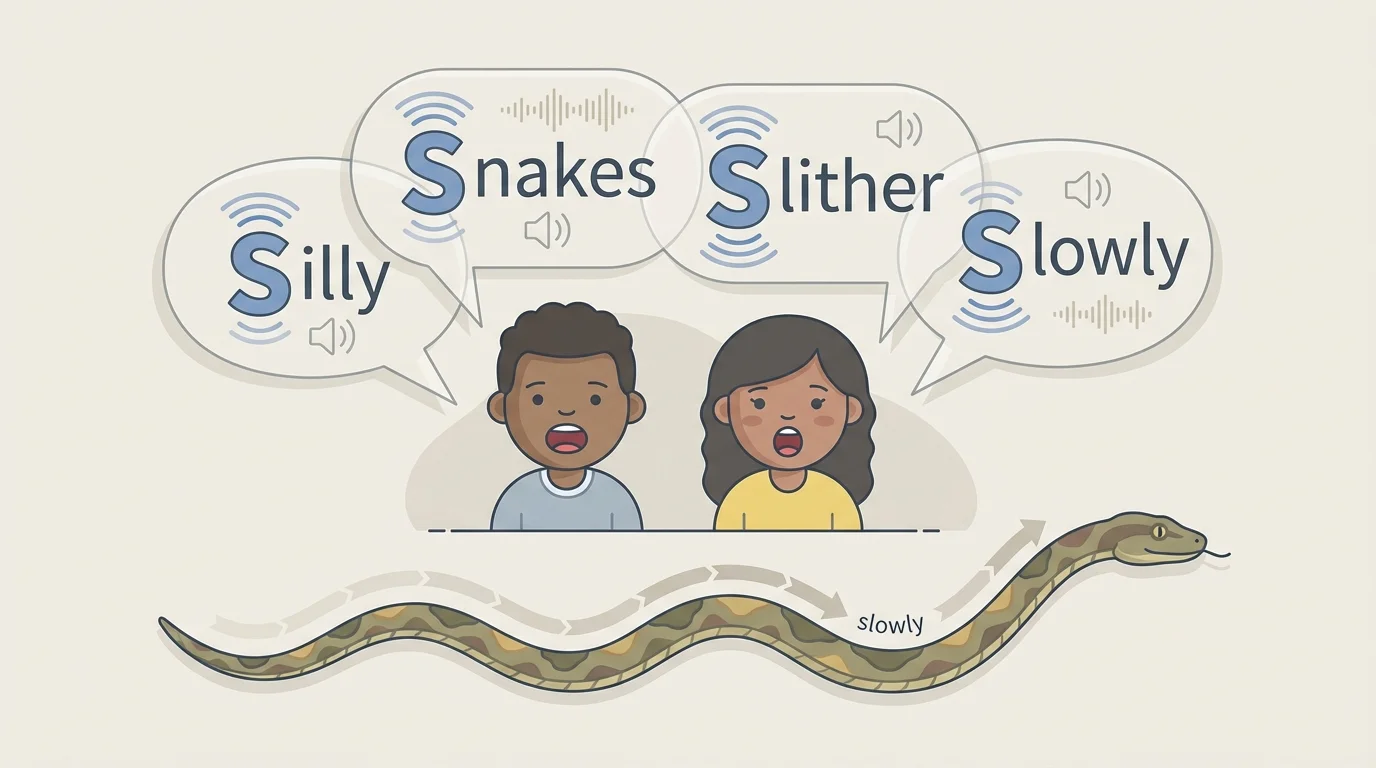
Authors often use alliteration to make language memorable. Children hear it in storybooks, chants, and classroom songs. It helps words sound connected.
Later, when children learn more about print, hearing these sound patterns can support reading and word study. The sound pattern is the first step.
When students hear a sentence with repeated /s/ or /b/ sounds, they are noticing the same kind of matching we saw with grouped words in [Figure 2]. A sentence can hold several words that share one onset.
A careful listener can do three simple things. First, say the word slowly enough to hear the start. Second, notice the first sound. Third, compare it with the first sound in another word.
If the sounds match, the words begin the same way. If the sounds do not match, the words are different at the beginning. This helps children recognize spoken alliteration.
For example, tap and toy both begin with /t/. tap and map do not match because /t/ and /m/ are different. The key is always the first sound.
As shown earlier in [Figure 3], repeated sounds in a sentence are easier to hear when we listen closely to each word's beginning. That is why alliteration sounds musical and playful.
Hearing matching beginning sounds helps children become strong listeners and early readers. It builds awareness that words are made of parts we can hear and compare.
This skill also supports speaking and reading with confidence. When children can notice the onset in spoken words, they are building a foundation for later sound work with letters, spelling, and decoding words in print.
