Have you ever heard a word for the first time and then started noticing it everywhere? That happens with words, just like it happens with songs. When children learn new words, they begin to understand more stories, talk more clearly, and listen with greater care. New words help us tell what we see, what we feel, and what we know.
Words are all around us. We hear words when someone reads a story, when a friend talks, when a teacher gives directions, and when a song is sung. We see words in books, on signs, and in labels. We also use words when we answer questions, tell about our day, or describe something we are holding.
A vocabulary is the group of words a person knows and uses. Some words are already familiar, like dog, jump, happy, and red. Some words are new, like enormous, whisper, fuzzy, or nibble. Learning these new words helps children understand more of what they hear and read.
New vocabulary means words that are not known yet but are being learned. Children can learn new vocabulary by hearing words, seeing them in books, and using them in speech.
When children learn a word, they do more than repeat it. They begin to connect the word to an object, an action, a feeling, or an idea. A child who learns the word giggle understands that it means a light, happy laugh. A child who learns the word enormous knows it means very big.
Sometimes a new word names something: nest, petal, or helmet. Sometimes a new word tells an action: leap, stir, or whisper. Sometimes it tells how something looks, feels, or sounds: smooth, tiny, or loud. New words can fit into many categories of meaning.
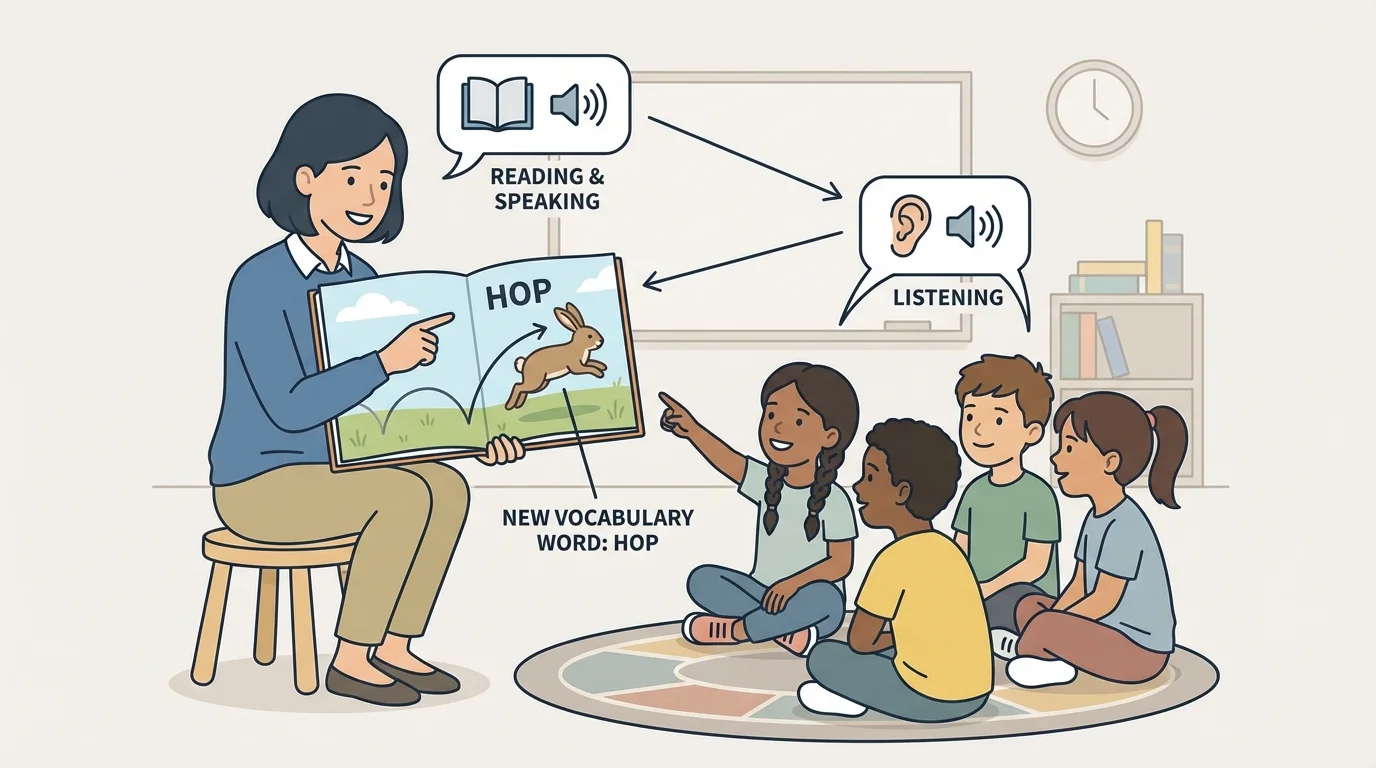
Young children learn words best when the word is taught clearly and used again and again. If a teacher says, "The rabbit will hop across the grass," children can hear the word in a full sentence. If they also see a picture or the action, the meaning becomes stronger.
Children often need to hear a new word many times before it becomes part of their own talking. Hearing, seeing, and saying the same word helps it stay in memory.
That is why language-rich classrooms are full of stories, songs, conversations, and labels. Children are surrounded by meaningful words, not just lists of single words.
[Figure 1] Listening is a powerful way to learn words. A child can hear a context clue in a story and figure out what a new word means. If the teacher says, "The frog leaped into the pond," children can listen to the whole sentence and connect leaped to the frog's movement.
Voice also helps. If someone whispers the word whisper, children can hear what the word means from the sound. If a teacher says, "The soup is hot, so blow on it gently," children can learn the meaning of gently from the calm voice and the careful action.
Listening to stories gives children rich word experiences. In stories, words come with characters, actions, and events. A child may hear, "The sleepy bear curled up in the cave," and learn sleepy, curled, and cave all in one sentence.
Songs and poems also teach vocabulary. Repeating fun lines makes new words easier to remember. When children sing words like twinkle, sway, or march, they hear rhythm and meaning together.
[Figure 2] Books are full of words that grow understanding. In picture books, the illustration helps explain the meaning of a word. If the page says, "The bear is drowsy," and the picture shows a bear with droopy eyes getting ready to sleep, children can connect the picture to the word.
Reading the same book again helps children notice words they missed before. On the first reading, a child may enjoy the story. On the second or third reading, the child may begin to understand and remember words like slippery, gigantic, or peek.
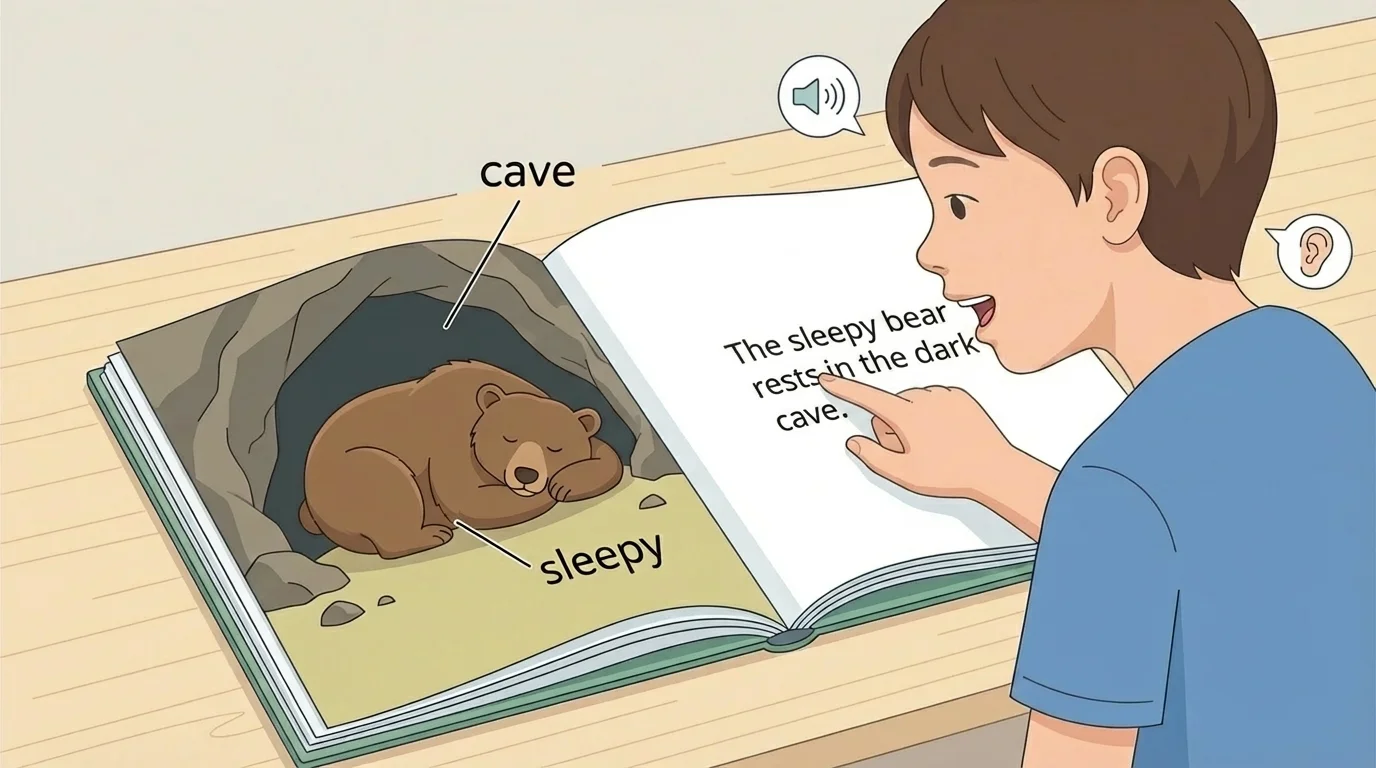
Printed words matter too. Even before children read many words alone, they learn that the words on the page carry the message. Adults can point to a word while reading and say it clearly. This helps children connect spoken language with written language.
Later, when children hear those same words again, they recognize them more easily. The picture support in [Figure 2] makes this connection stronger because children do not rely only on sound; they also connect the word to what they see.
How pictures, words, and meaning work together
Children often learn best when they hear a word, see a picture of it, and talk about it. These three parts support one another. Hearing gives the sound, the picture gives meaning, and speaking gives practice.
That is why reading aloud is so important in early learning. A simple book can teach many words when children listen closely and look carefully.
[Figure 3] Saying a new word aloud helps children remember it better. When a child says, "This apple is crunchy," the word becomes part of real speech. Speaking turns a heard word into a used word.
Children learn vocabulary when they answer questions, describe objects, retell stories, and talk with friends. A teacher might ask, "How does the blanket feel?" A child may first say "soft." Later, the child may learn to say "fuzzy" or "warm." This is how speech becomes richer.
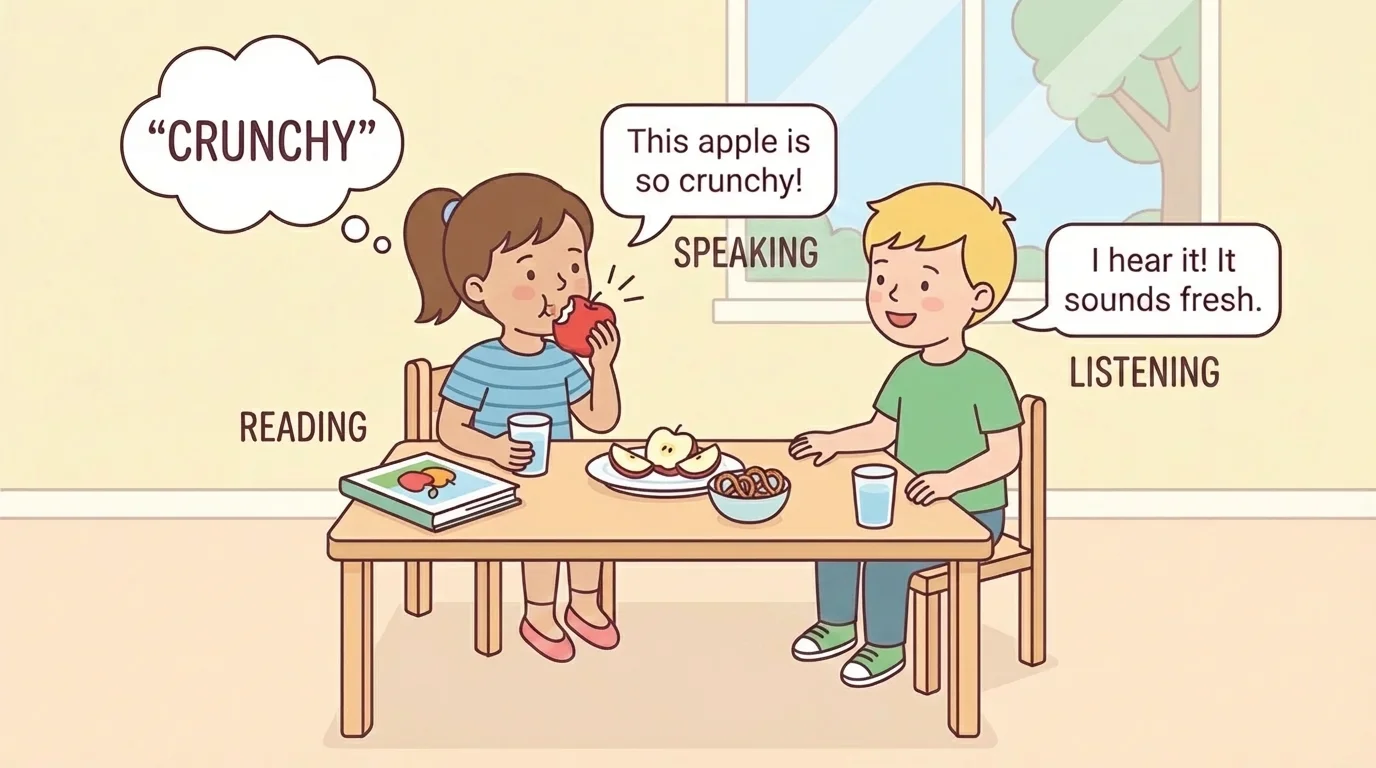
Using a word in a sentence is important. If a child only repeats the word enormous, the understanding may remain limited. If the child says, "The pumpkin is enormous," the meaning is clearer and stronger.
Talking with others also gives a chance to hear words used in different ways. The word bright can describe a bright sun, a bright color, or a bright light. Hearing and saying it in different places helps children understand it more deeply.
Words learned in different ways
Step 1: Hear the word
A child hears, "The bunny will hop."
Step 2: See the meaning
The child watches the bunny move or sees the picture of the bunny jumping.
Step 3: Say the word
The child says, "I can hop too!"
The word becomes easier to remember because the child listened, watched, and spoke.
The same thing happens with describing words, feeling words, and action words. Speaking is not separate from learning. Speaking is part of learning.
New vocabulary grows faster when children use words in many places. A child may hear tiny in a story, use it while building with blocks, and hear it again at home when looking at a bug. Each new use makes the word stronger.
Words can be learned during play, meals, outdoor walks, art, and classroom routines. During cleanup, children hear words like sort, gather, and empty. During art, they hear sticky, smooth, and blend. During science time, they may learn float and sink.
This kind of word learning is meaningful because it is tied to real experiences. As children saw with action words in [Figure 1], understanding grows when a word is connected to something happening. The same is true at home, on the playground, and in the classroom.
Children learn words more easily when adults say the word clearly, explain it simply, and use it again later. Repetition helps. So does asking children to point, show, act, or tell.
Helpful habits include listening carefully, looking at pictures, noticing actions, and asking what a word means. If a child hears the word delicious, the child can learn it from hearing, "This soup smells delicious," and then tasting the food. Senses can support vocabulary too.
Good listeners pay attention to words, tone of voice, and what is happening around them. Good speakers use words to share ideas, ask questions, and describe the world.
Adults can also compare words. A child may know big, and then learn huge or enormous. A child may know walk, and then learn march, tiptoe, or stomp. These word families make language more colorful and exact.
When children listen to language, look at books, and use words in conversation, they become stronger communicators. They understand more, say more, and enjoy language more.
