Have you ever heard a word that sounded brand new, but then suddenly made sense when someone showed you a picture or used it in a sentence? That is how our brains grow stronger with language. We learn many new words by connecting them to things we already know, like our toys, our family, our feelings, and the world around us.
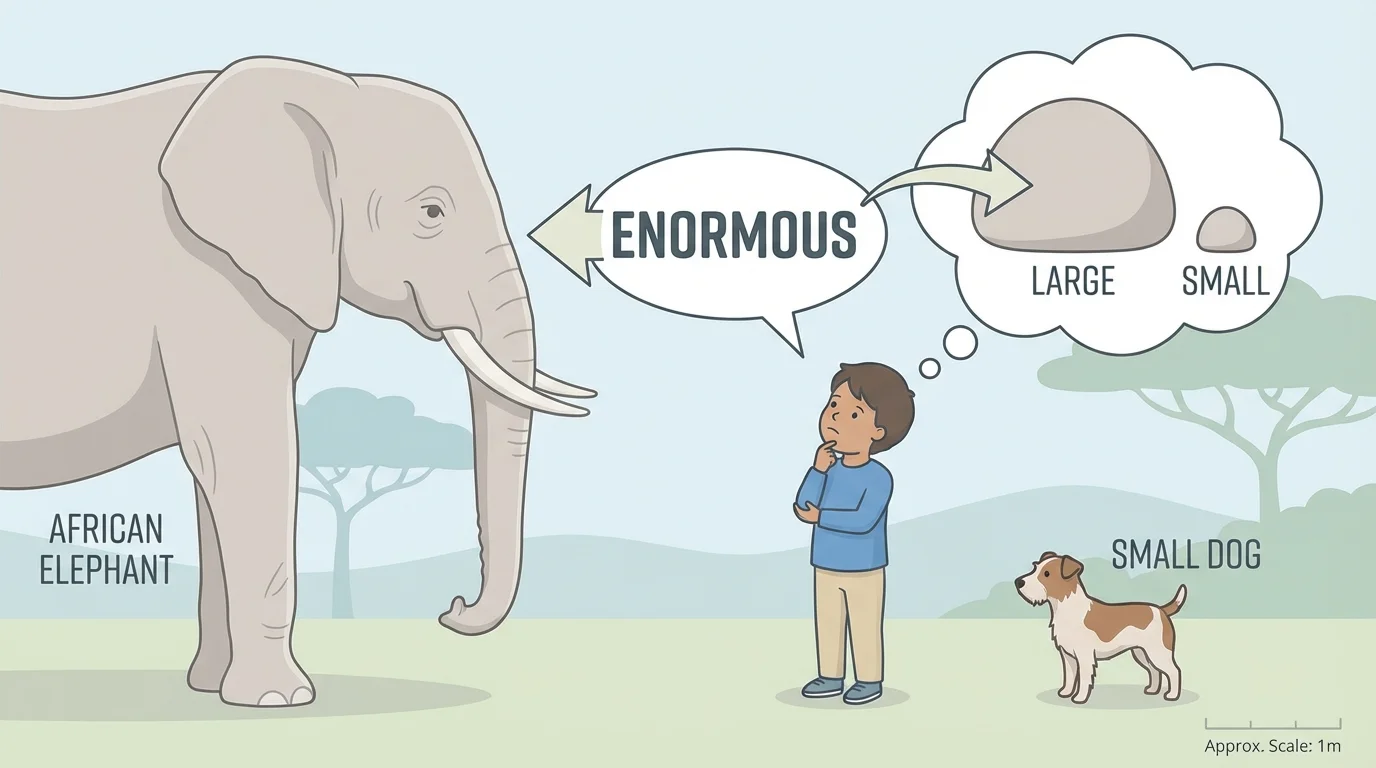
When we hear a new vocabulary word, we do not begin with nothing. As [Figure 1] shows, we already know many ideas. We know what is big and little. We know what it means to run, laugh, eat, and sleep. We know names of colors, animals, and people. A new word can connect to one of these old ideas, such as the difference between a very big animal and a smaller one.
This is called using prior knowledge. Prior knowledge means the things you already know from life, stories, songs, and conversations. If someone says, "That elephant is enormous," you may not know the word enormous at first. But if you already know an elephant is very big, you can connect enormous to the idea of very big.
Sometimes a new word is almost like a word we know. If we know happy, we can learn joyful. If we know mad, we can learn angry. If we know look, we can learn glance or peek. New words often grow from old words in our minds.
Prior knowledge is what you already know. Vocabulary is the words we know and use when we listen and speak.
When we connect a new word to something familiar, the word becomes easier to understand and easier to remember.
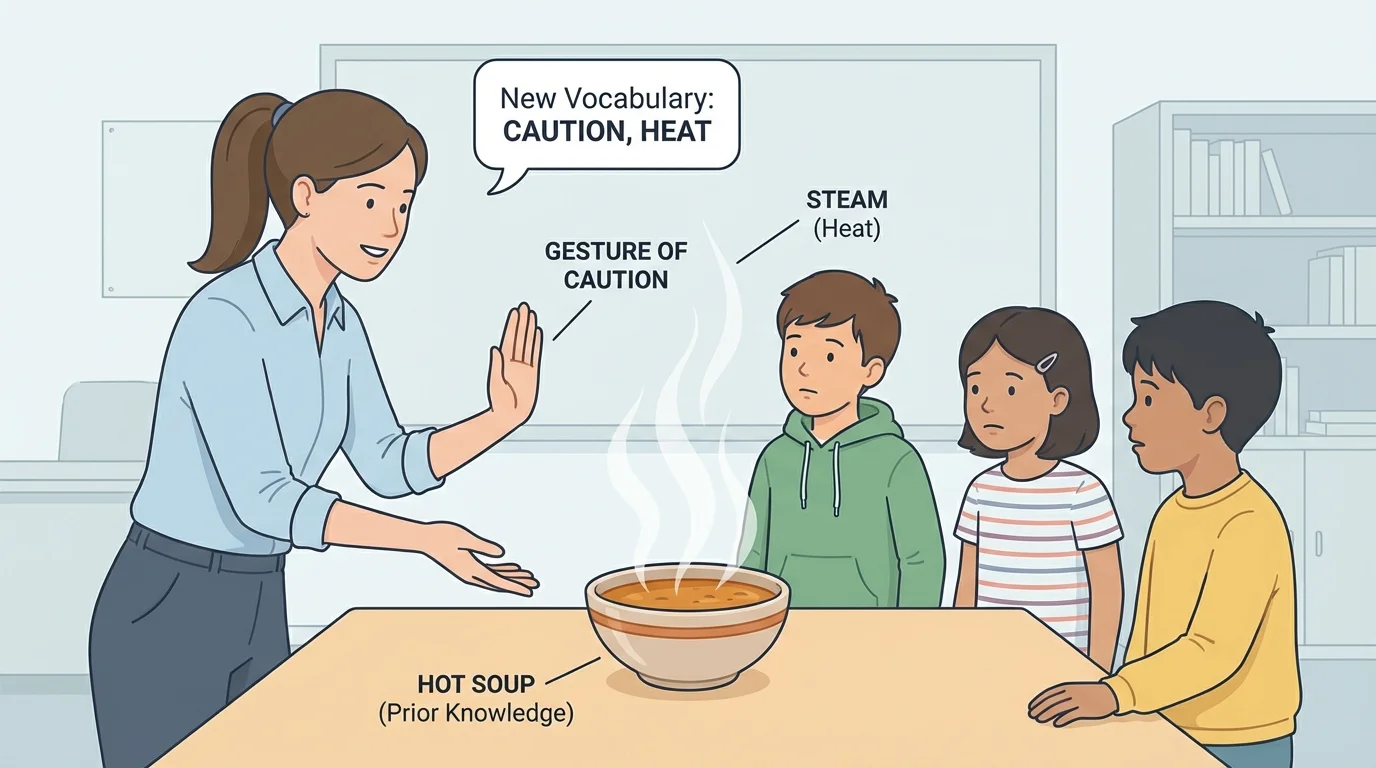
Good listeners use context clues. As [Figure 2] shows, context clues are hints around a word. The hints can come from other words in the sentence, a person's face, a person's actions, or what is happening nearby. The speaker's words and actions can help explain a new word.
If a teacher says, "Be careful, the soup is steaming," children can listen to the words be careful and look at the hot bowl. The steam rising up helps them understand that steaming has to do with something hot.
Listening clues can also come from a speaker's tone of voice. If someone whispers, "The kitten is timid," and the kitten is hiding, we can learn that timid means shy or a little scared. We listen, look, and think.
Body movements help too. If someone says, "Please gesture hello," and they wave a hand, we can understand that a gesture is a movement that shows meaning. We do not learn only with ears. We learn with eyes, ears, and minds together.
Children learn many words long before they can read them. Hearing rich talk, stories, songs, and conversations helps words grow in the brain.
Later, when we hear steaming or timid again, we remember the clues that helped us the first time.
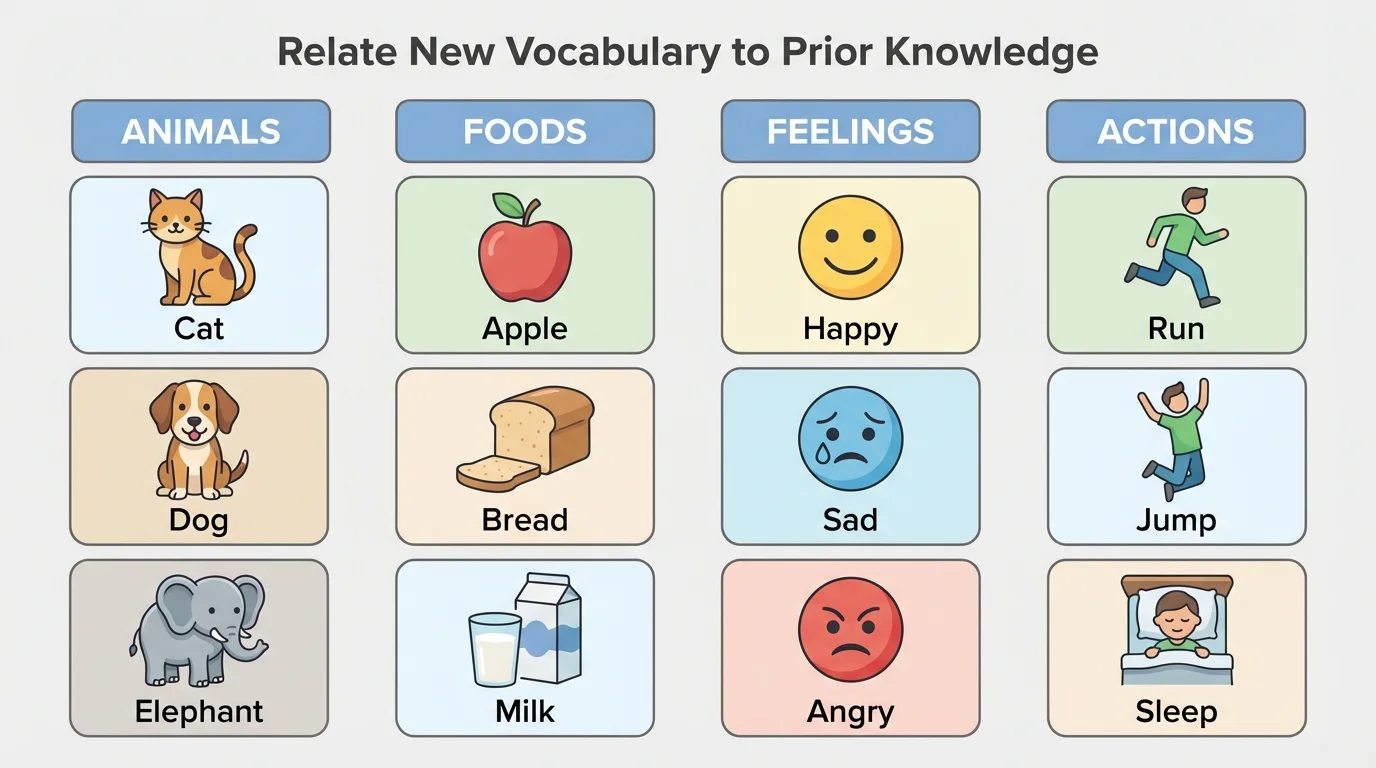
Our brains like to organize words. As [Figure 3] shows, one smart way to learn is to put words into groups. A word can belong to a group like animals, foods, feelings, colors, or actions. A word can also belong to a group of words that mean almost the same thing. This kind of grouping by category helps us remember.
For example, apple, banana, and grape go in a food group. Jump, skip, and run go in an action group. Glad, happy, and cheerful go in a feeling group. When a new word joins a group, it has a place to belong.
We can also compare words. Tiny connects to small. Huge connects to big. Cozy connects to soft, warm, and comfortable. Looking back at [Figure 1], the idea of size helps us understand not just big, but also stronger size words like enormous and huge.
How grouping helps memory
When words are connected by meaning, the brain can find them more easily. Instead of remembering one lonely word, we remember a whole set of related ideas.
Some words are opposites too. Hot and cold are opposites. Fast and slow are opposites. If we know one word, an opposite can help us understand the new one.
Talking helps words stick in our minds. When children say a new word out loud, hear it again, and use it in conversation, the word becomes more familiar. Oral language is powerful because we can try a word, hear other people use it, and connect it to real life.
Suppose a child says, "My blanket is cozy." That child is not just repeating a word. The child is connecting the word to a soft, warm blanket and a comfortable feeling. The word now has meaning.
Children also build vocabulary when they describe things. A child might say, "The puppy is tiny," or "The truck is enormous." These descriptions connect words to objects that can be seen and touched.
Everyday word connections
Step 1: Start with a word you know.
Known word: big.
Step 2: Hear a new word.
New word: enormous.
Step 3: Connect the new word to the known idea.
Enormous means very, very big.
Step 4: Use the word in talk.
"That balloon is enormous."
Children can also ask what a word means. Asking questions is part of good listening and speaking. When we wonder about words, we become stronger language learners.
At snack time, a teacher might say, "Take a tiny bite." If children know what a small bite is, they can connect tiny to very small. At rest time, a teacher might say, "Let's make the room calm." If children see quiet bodies and hear soft voices, they can connect calm to peaceful and still.
During a story, a character may glance out the window. If children know look, and the picture shows a quick look, they can learn that glance means a quick look. During play, a child may dash across the yard. If children know run, they can connect dash to running quickly.
Listening to others talk gives us many chances to learn. In [Figure 2], the children learn from the speaker's words, face, and action at the same time. In the same way, conversations at home, at school, and on the playground help new words make sense.
You already know many words about people, places, actions, colors, and feelings. New vocabulary grows best when it connects to those words you already understand.
Books read aloud are especially helpful because children can hear new words and use pictures, voices, and story events as clues.
We remember words better when we hear them many times and use them in different places. A word learned once may fade away. A word used again and again becomes part of our own speaking.
If a child hears cozy during story time, then hears it again about a sweater, and then says it about a pillow, the meaning grows stronger. The word connects to many warm and comfortable things.
Words become powerful when they are connected, heard, spoken, and remembered. Looking back at [Figure 3], grouping words helps us store them in our minds, and using those words in talk helps us bring them back when we need them.
