Have you ever wondered why birds build nests, what worms eat, or where rain goes after it falls? A big part of learning begins when we ask a question. When we ask a good question, we can look for answers. When we find answers, we learn more clearly.
A question is something we ask because we want to know more. Research starts with a question. Research means finding out by looking, listening, reading, and talking with others. A question helps our brain know what to search for.
Some questions are very big, like "What do animals do?" That is interesting, but it is hard to answer all at once. It is easier to learn when we ask one small, clear question first.
Research means finding out about something. We can do research by asking, observing, reading, and listening.
Source means a place where information comes from, such as a book, a person, or something we see.
Conclusion means the answer or idea we make after learning facts.
When children ask questions in class, they are already becoming researchers. They are learning how to think, how to wonder, and how to look for information with a purpose.
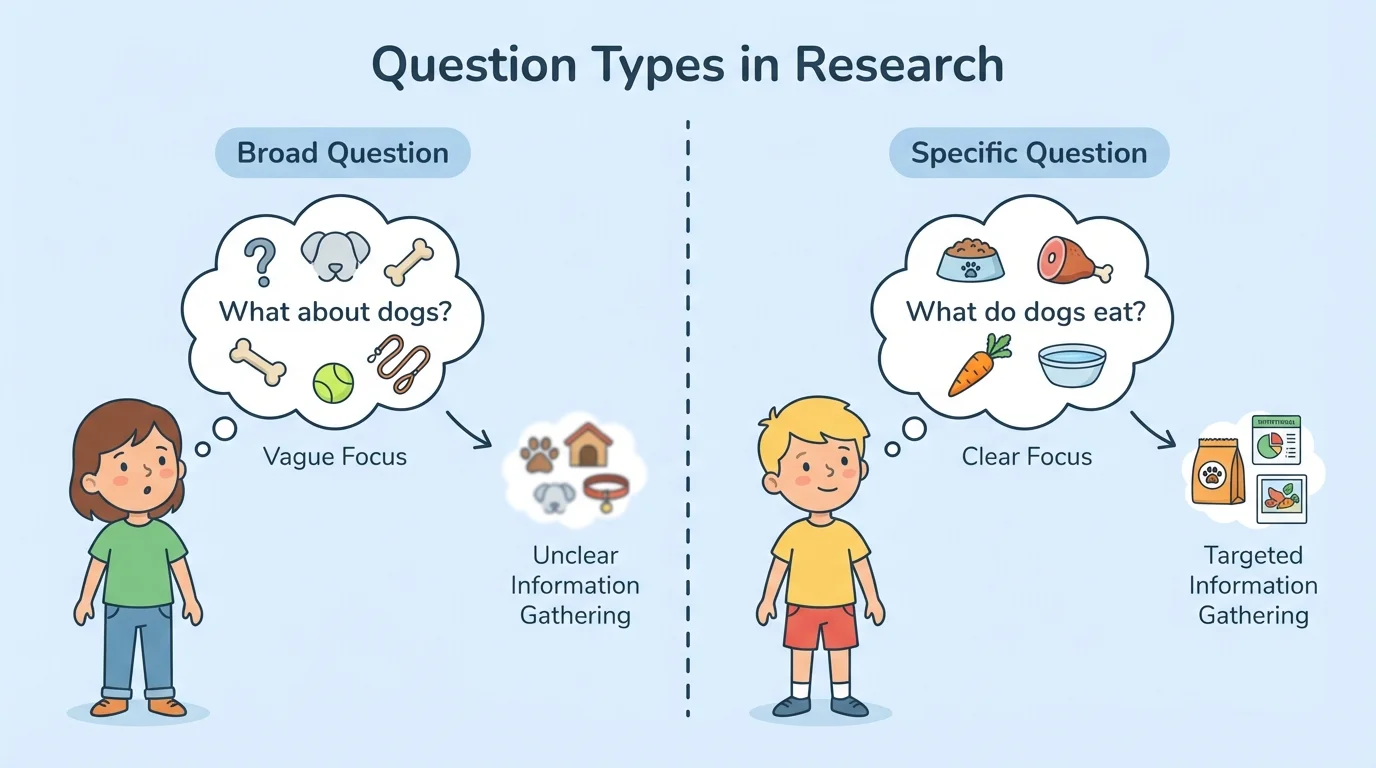
A specific question tells us exactly what we want to know, as shown in [Figure 1]. If we ask, "Tell me about dogs," there are too many possible answers. But if we ask, "What do dogs eat?" we know what kind of information to find.
Specific questions are helpful because they give our learning a clear path. They help us stay focused. Instead of looking for everything, we look for what matters to our question.
Here are some examples of broad and specific questions:
| Broad question | Specific question |
|---|---|
| About plants | What do plants need to grow? |
| About birds | How do birds use nests? |
| About weather | What happens when it rains? |
Table 1. Examples showing how a broad topic can become a specific question.
When a question is clear, it is easier to find facts that fit. Later, when we share what we learned, our answer is clearer too.
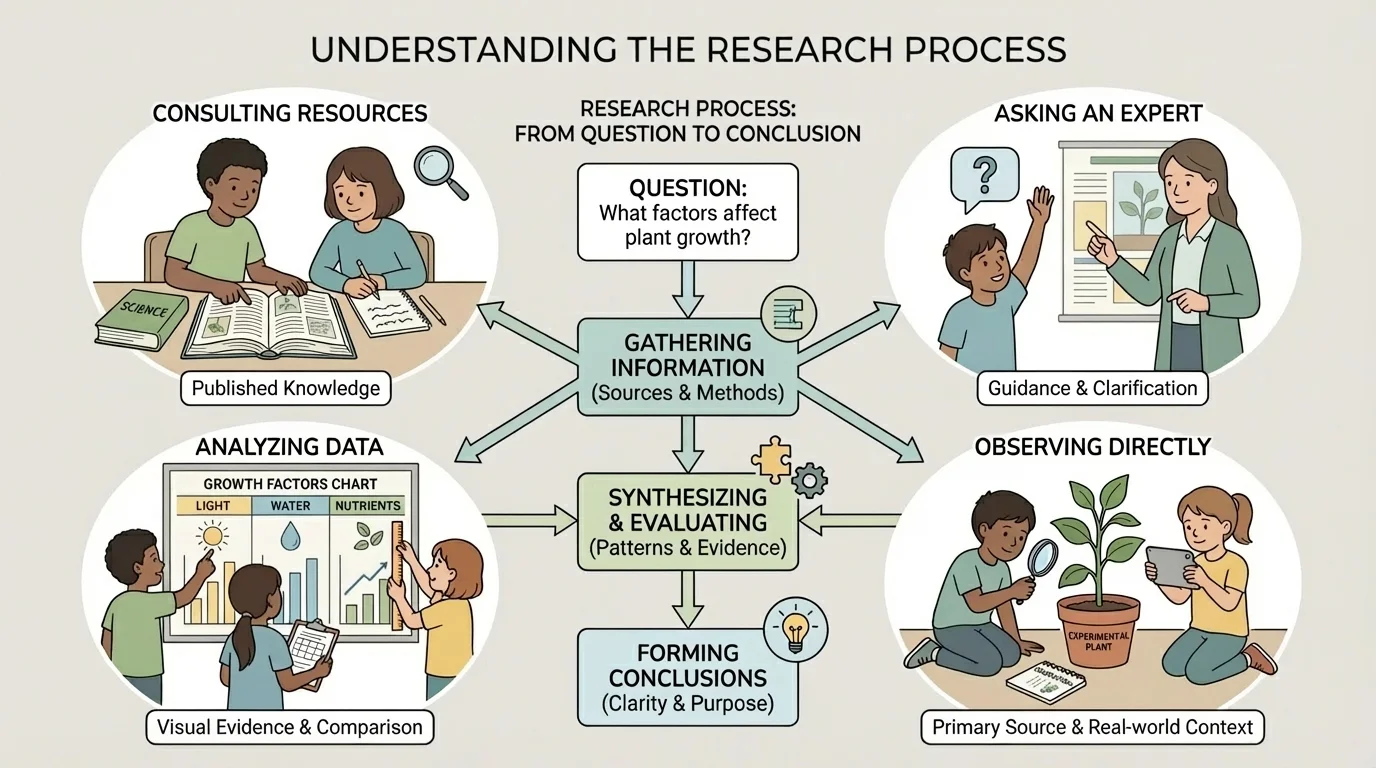
We can learn from many sources, as [Figure 2] illustrates. We may use a book, ask a teacher, listen to a classmate, look at a picture, or observe something with our own eyes.
Sometimes one source gives one piece of information. Another source gives a different piece. If our class is learning about butterflies, one book may show pictures, a teacher may read a story, and children may watch a caterpillar in the classroom.
Working in a group helps us find more information. One child may notice colors. Another child may remember something from a book. Another may ask a helpful question. When we share ideas, we can understand more together.
Looking carefully is called observeing. If we observe a plant, we might notice its leaves, stem, and flower. Observation is a good source of information because we are paying attention to something real.
Scientists, doctors, builders, and teachers all begin by asking questions. Even very young students use the same big idea: ask, find out, and share what they learned.
We do not always need only one kind of source. We can listen, look, and read. Using more than one source often helps us feel more sure about our answer.
Not every fact belongs in every answer. If our question is "What do rabbits eat?" then facts about how fast rabbits run are interesting, but they do not answer the question. We need information that matches the question.
Matching information is called relevant information. Relevant information fits the question. It stays on topic. It helps us learn what we wanted to know.
If we ask, "What do plants need to grow?" good information includes water, sunlight, air, and soil. Information about the color of a toy truck does not help with that question. Good researchers learn to notice which facts belong and which facts do not.
Staying on purpose
When we ask a question, we have a purpose. Our purpose is the reason we are learning. A clear purpose helps us choose the right facts, ignore facts that do not fit, and give a better answer at the end.
As we saw earlier in [Figure 1], a specific question makes it easier to know what information is relevant. The clearer the question is, the easier it is to stay focused.
Research can also happen when we work together. That means we learn with other people. In a classroom, children may sit together, look at the same picture, listen to the same story, or talk about what they notice.
When we work with others, we practice important skills. We listen when someone else talks. We take turns. We compare ideas. Sometimes a friend notices something we missed. Sometimes we help a friend notice something new.
A class might ask, "How do birds use nests?" One child may say, "Nests hold eggs." Another may say, "Birds rest there." A teacher may read a book that adds more facts. Together, the group gathers ideas and builds understanding.
Example: Learning together about rain
A class asks, "Where does rain go?"
Step 1: One child looks out the window and sees puddles on the ground.
Step 2: Another child remembers a book showing water soaking into soil.
Step 3: The teacher explains that some water goes into the ground and some flows away.
The class now has several facts from observation, memory, and a teacher. These facts help answer the question.
Collaborative research does not mean everyone says the same thing right away. It means the group shares, listens, and uses ideas carefully.
After we gather facts, we can make a conclusion. A conclusion is the answer we give from what we learned. We should use facts from our sources, not just a guess.
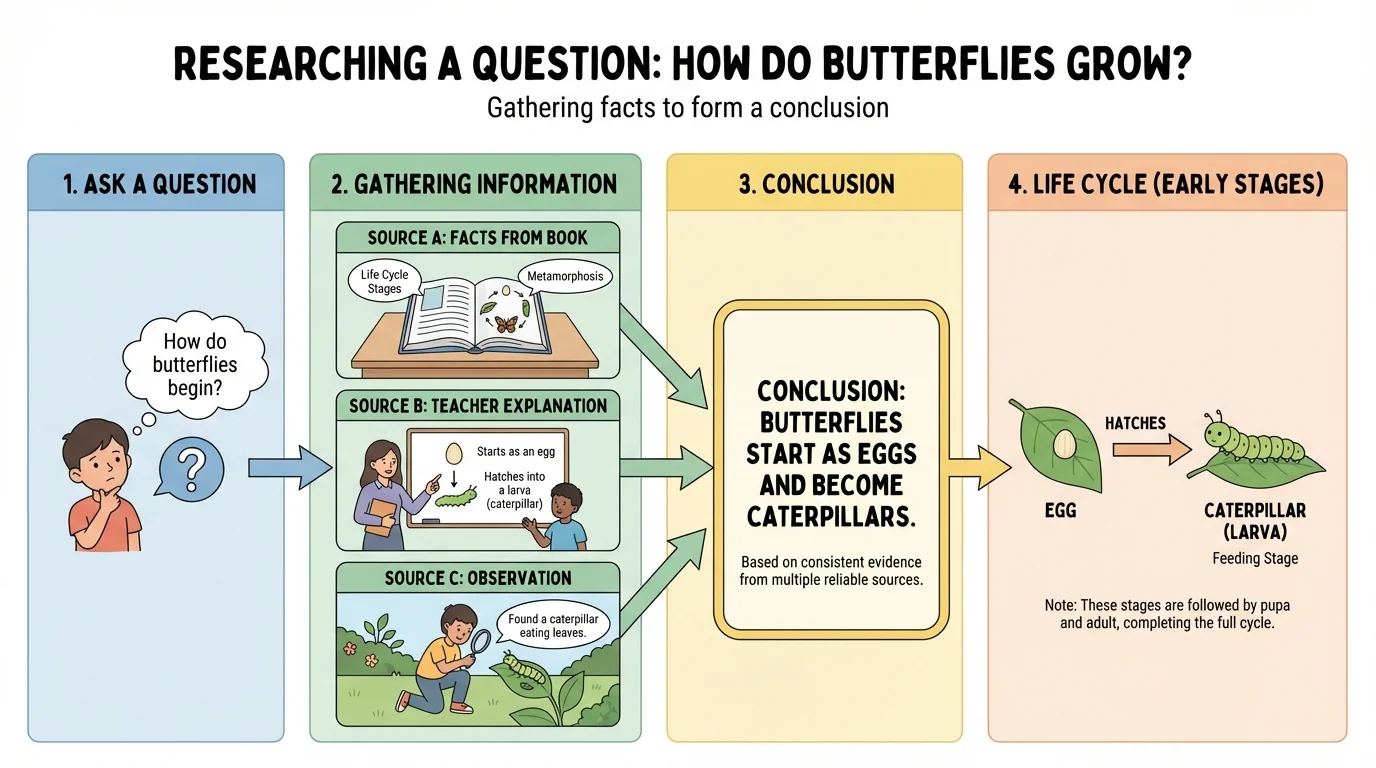
[Figure 3] If our question is "How does a butterfly begin?" we may learn from a book, a teacher, and observation that a butterfly starts as an egg and then becomes a caterpillar. Our conclusion can be: "A butterfly begins as an egg and grows into a caterpillar first."
A good conclusion matches the question. It is clear and simple. It tells what the facts show.
Sometimes we learn new facts that change or improve our conclusion. That is okay. Research helps us get closer to the best answer we can give.
Good researchers try to be careful. They ask one question, gather facts, and check more than one source when they can. If a picture, a book, and a teacher all say similar things, we can feel more confident.
Being clear means saying what we learned in a way others can understand. We can use short, simple sentences. We can say, "Our question was about what plants need. We found that plants need water and sunlight."
Using more than one source, like the group in [Figure 2], often gives a fuller answer. And building a conclusion from facts, like the butterfly example in [Figure 3], helps us explain our thinking clearly.
When you are learning something new, start small. One clear question can help you notice, listen, and learn much more than a very big question with no focus.
Asking questions is one of the best ways to learn about the world. A careful question leads to careful research. Careful research leads to a clear answer.
