Have you ever asked a question that did not fit what everyone else was learning? If the class is talking about trees, asking about pets may be a good question for another time, but it does not help the class learn about trees. Good research starts when we stop and think, What do I need to know right now?
When we do research, we are trying to find out something. Research can mean looking in a book, studying a picture, listening to a teacher, or talking with classmates. Before we begin, we need a purpose. A purpose is the reason we are learning or asking questions.
If our class topic is trees, our purpose might be to learn what trees need, what parts trees have, or which animals live in trees. A question is helpful when it points us toward that learning goal.
Research means finding out information. Inquiry means asking questions to learn. A clear purpose means knowing what you want to learn and why.
When children know their purpose, they can make better choices. They can choose the right book, the right picture, or the right person to ask.
A purpose is like a learning target. It tells us where to look. If we say, "I want to learn why leaves fall," that is a clear purpose. If we say, "I want to know something," that is not very clear.
A clear purpose often starts with simple ideas like these: I want to learn about..., I need to find out..., or My class is studying.... These ideas help us stay focused.
Staying focused on one topic helps research make sense. When your question matches the class topic, the information you find is useful. When your question does not match, the information may be interesting, but it will not help with the learning goal right now.
For young learners, this means asking, "Does my question fit what we are studying?" That small check can help a lot.
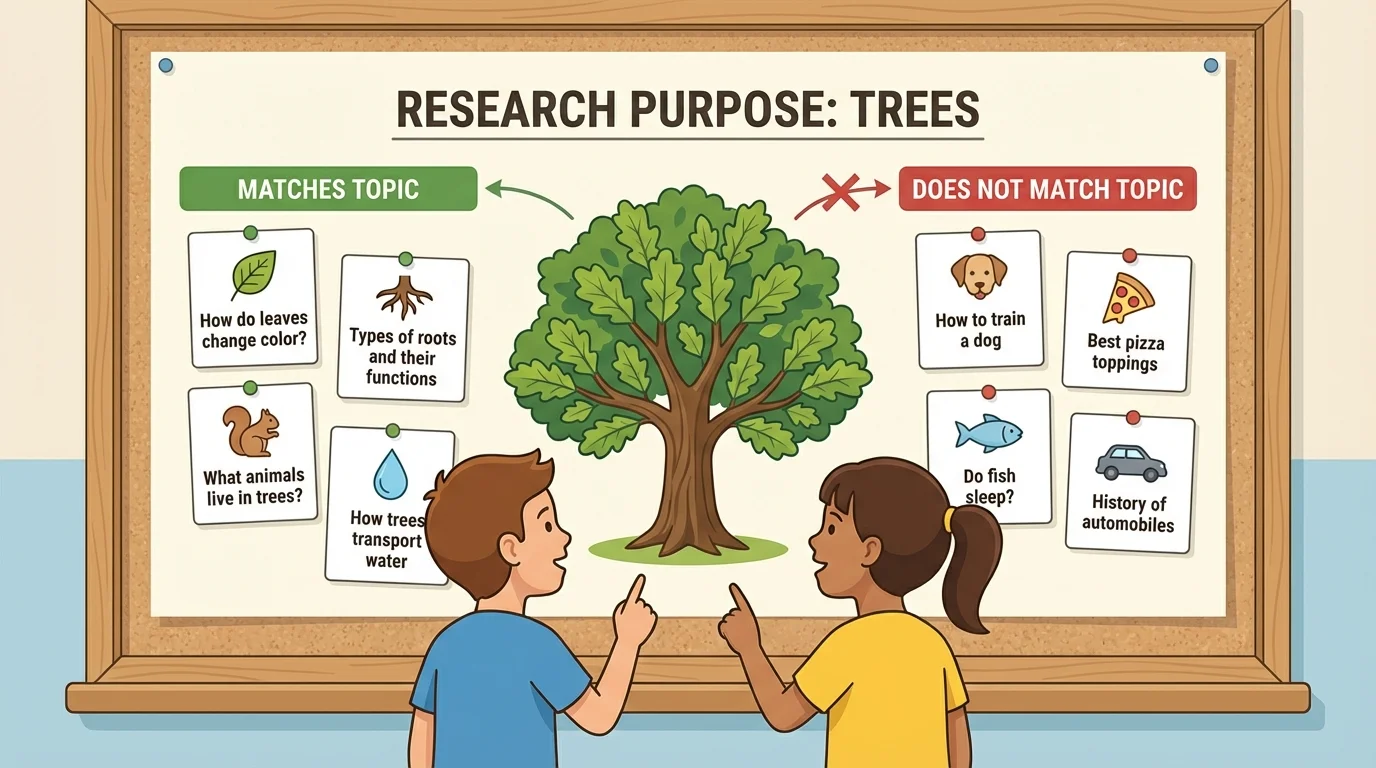
Some questions fit, and some do not. If the topic is trees, these questions match: "Why are tree trunks hard?" "Do birds live in trees?" "What do roots do?" These help us learn about trees, as [Figure 1] shows.
These questions do not match the topic: "What do puppies eat?" "How do fish swim?" "Why do cats purr?" They may be good questions, but they are not about trees.
Sometimes a question is close, but we still need to think. If the class is learning about trees, "Do squirrels climb trees?" matches because it connects to trees. But "What toys do squirrels play with?" does not help much with the tree topic.
Later, when we learn about habitats or animals, we might ask more about squirrels. Good researchers know that a question can be saved for another time.
A good research question is simple, clear, and connected to the topic. It helps us learn something real. Questions often begin with words like what, why, how, or where.
Here are examples for a class studying trees:
These questions are better than one that is too broad, like "Tell me everything about nature." That is too wide. A clear question helps us know what to look for.
Questions that work and questions that do not
Step 1: Topic: trees
The class is learning about trees.
Step 2: Ask one question that fits
"Why do trees need water?" fits because it is about trees.
Step 3: Ask one question that does not fit
"Why do dogs bark?" does not fit because it is about pets, not trees.
The best question is the one that helps us learn more about the class topic.
You can also listen to other students' questions. Sometimes a classmate asks a question that helps everyone think more clearly.
Research is often something we do together. A teacher may read a book aloud. Children may look at leaf pictures, bark samples, or classroom posters. They may share what they notice.
A resource is something that helps us learn. A resource can be a book, a photo, a video, a chart, a teacher, or a classmate. When our purpose is clear, we can pick resources that match our question, as [Figure 2] shows.
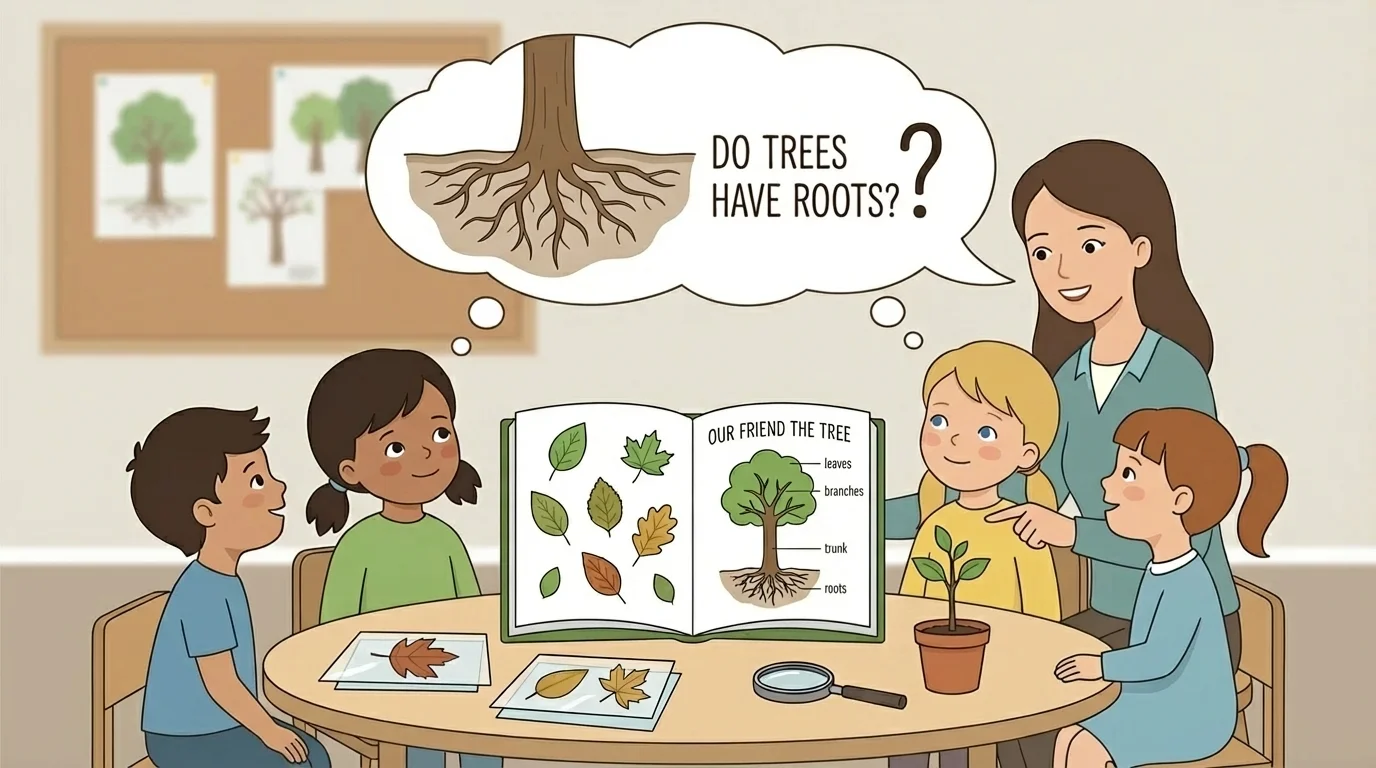
If our question is "What parts does a tree have?" a picture book about trees is a good resource. If our question is "What sounds do dogs make?" that resource may not help because the question does not match the tree topic.
Talking with others can help us improve our thinking. A friend might say, "That question is about animals, not trees," and that helps us get back on track. This is part of collaboration, which means learning together.
Scientists ask questions before they investigate, too. They choose questions that match what they are studying so they can find useful answers.
Just like scientists, children can look closely, ask clearly, and use the right resources.
Sometimes we have many ideas, and we can look at several question cards and pick the one that best fits the topic. We do not need every question at once. We need the question that is most helpful right now.
If the class is studying trees in winter, "Why do some trees lose leaves?" may be the best question, as [Figure 3] shows. "Can birds fly in rain?" may connect a little, but it is not the best fit for the tree lesson.
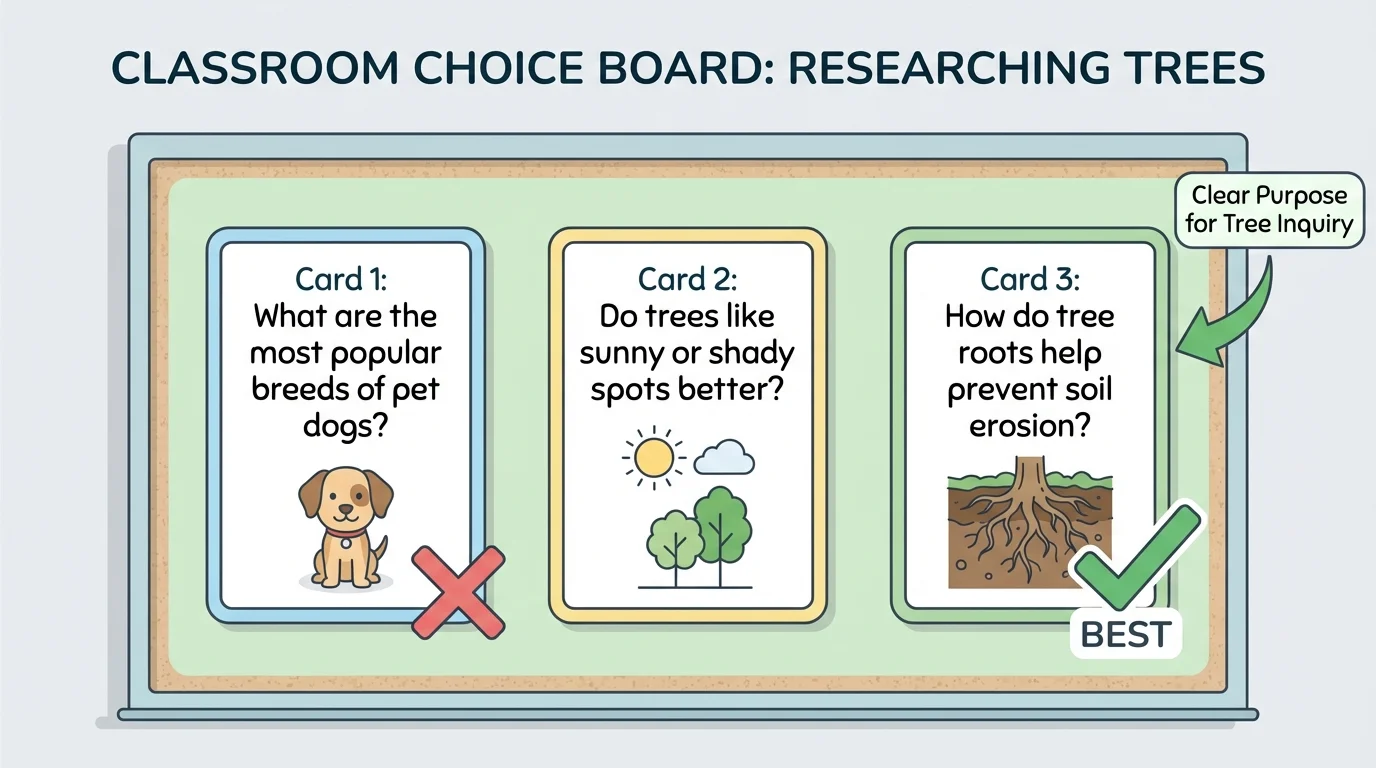
We can ask ourselves simple check questions: Is it about our topic? Will it help us learn? Can we find the answer in our books, pictures, or class talk? If the answer is yes, the question is probably a good one.
As we saw earlier with the sorting in [Figure 1], matching the topic matters. The clearest question helps the whole class learn together.
Sometimes learning one thing makes us think of a new question. That is good. Inquiry can grow. If we learn that birds live in trees, we might next ask, "Why do birds build nests there?" That new question still connects to the topic.
Good researchers can change their question a little when they learn more, but they still keep the topic in mind. The class may begin with leaves and later ask about seeds, bark, roots, or animals that use trees.
Working together, as in [Figure 2], helps children notice which new questions still fit the learning purpose. Friends and teachers can help decide whether a new question belongs now or later.
Questions are powerful, but not every question fits every lesson. The best question is not just interesting. The best question is useful for the topic being studied.
When you know your topic, choose a clear question, and use the right resources with others, you are doing strong research. You are learning with purpose.
