Butterflies change in amazing ways. A tiny egg can grow into a crawling caterpillar and later become a flying butterfly. When children wonder about something this amazing, they can become little fact finders. They can ask questions, look for answers, and make sure the answers are true.
Learning begins with questions. A good question helps us know what we want to find out. We might ask, "What does a butterfly eat?" "Where does a butterfly come from?" or "What happens first in its life?"
When we ask questions, we are doing research. Research means looking for information to learn more. In class, research is not just reading. It can also mean listening, looking closely, talking, and thinking.
Question means something we want to know. Information means facts we learn. Source means the place where the facts come from.
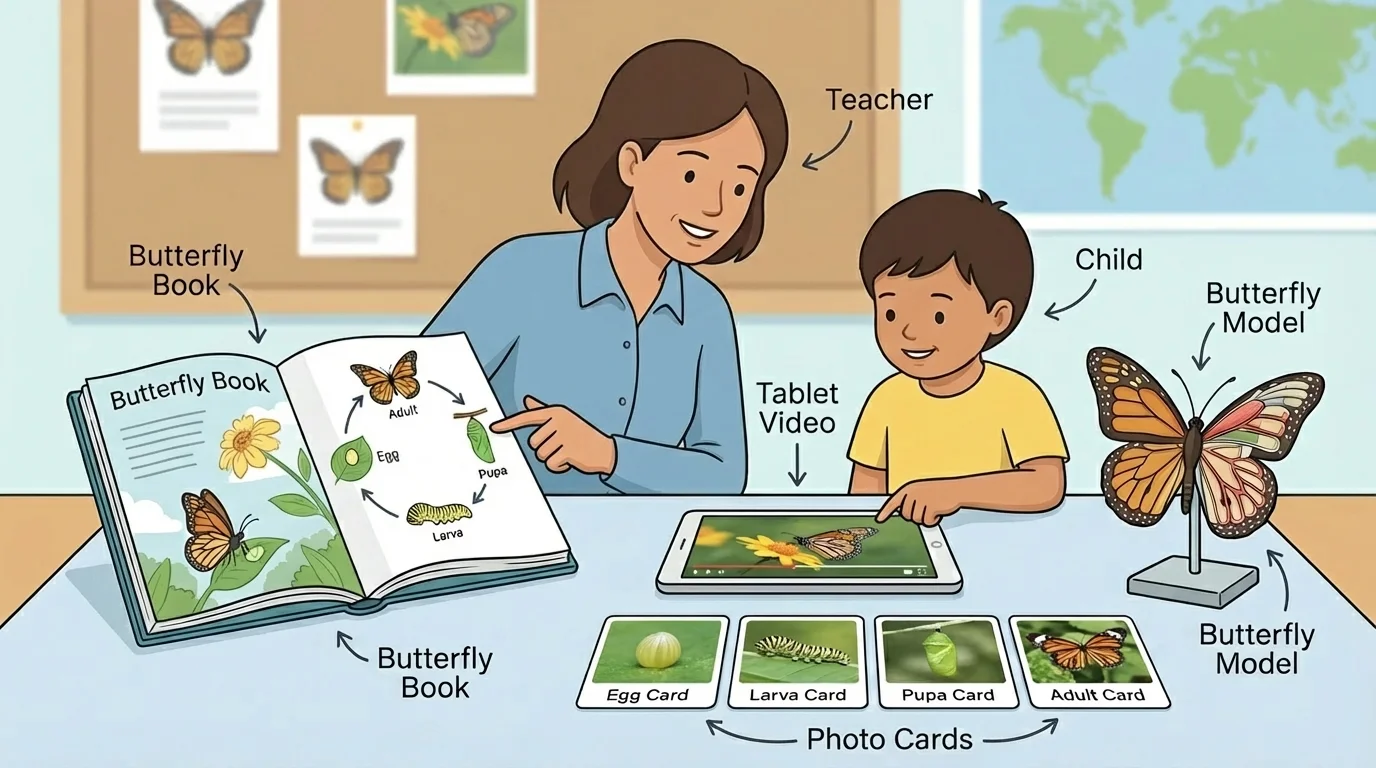
Question words help us ask strong questions. We can use who, what, where, when, and how. [Figure 1] shows some of the sources children can use to find answers. If the class is talking about butterflies, one child may ask what color the butterfly is, and another may ask how the caterpillar changes.
There are many places to find answers. In a classroom, children may use a butterfly book, look at picture cards, watch a short video, listen to the teacher, or study a real photograph or model. Each one is a different kind of source.
A source can be a book, a person, a picture, or a video. Sometimes one source gives one fact, and another source gives more details. For example, a picture may show that a caterpillar has many little legs, while a book may tell us that the caterpillar hatches from an egg.
Using more than one source helps us learn more. If we only look in one place, we may miss an important fact. If we look in several places, we can build a bigger and clearer idea.
Children often learn best in a group. One student may notice a butterfly in a picture. Another may remember a fact from a read-aloud book. A teacher can help everyone put the facts together.
Some butterflies taste with their feet. That means a butterfly can land on a plant and sense if it is a good place to lay eggs.
This is why classroom research is exciting. [Figure 2] shows how students can compare sources to check a fact. The class gathers facts together, and everyone helps the learning grow.
Good learners do not stop when they hear one answer. They check it. Checking means looking again and asking, "Is this true?" One way to check is to compare information from more than one information source.
For example, if a child says, "A butterfly starts as a caterpillar," the class can check a book and a life cycle picture. If both sources show that the butterfly begins as an egg, then the class learns that the first idea was not correct. Checking helps us fix mistakes.
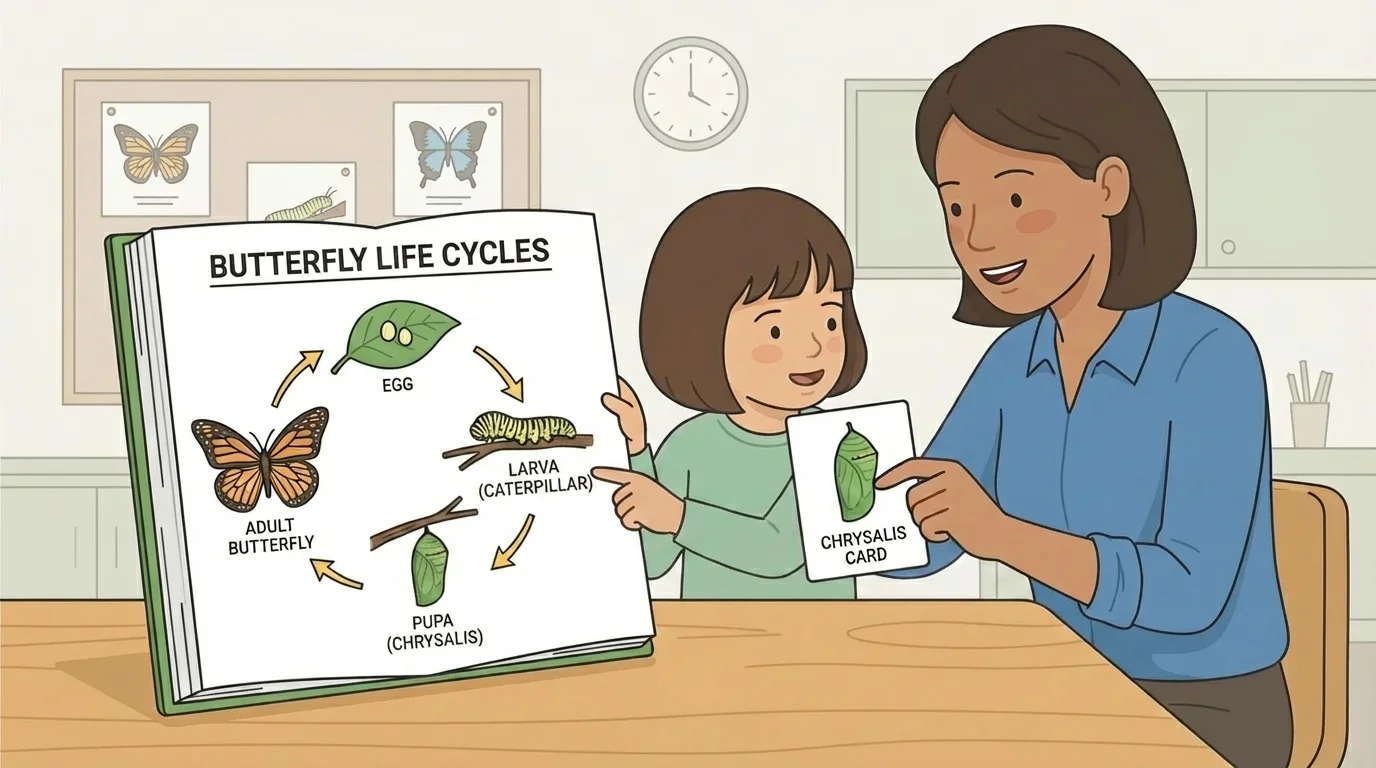
Trusted sources are important. In school, trusted sources may be books chosen by the teacher, classroom posters, nature photos, or careful videos made for children. A teacher also helps students know which facts are safe and correct to use.
Sometimes sources do not match. Then we should pause, ask questions, and look again. Later, when students talk about the butterfly life cycle, they can remember the checking process shown earlier in [Figure 2] and choose the fact that is supported by the class materials.
How checking works
Checking for accuracy means seeing whether a fact is right. Young learners can do this by listening carefully, comparing two sources, and asking a teacher when they are unsure. If the facts match, that is a strong clue that the information is correct.
Checking is part of being a careful learner. [Figure 3] helps show the order of the butterfly life cycle. It shows that finding facts is not guessing. It is thinking, looking, and making sure.
A wonderful example for research is the life cycle of a butterfly. The life cycle is the order of living stages. For a butterfly, the stages go in a special order: egg, caterpillar, chrysalis, butterfly.
Each stage is different. The egg is very small. The caterpillar hatches and eats. Then it forms a chrysalis. Later, an adult butterfly comes out and flies.
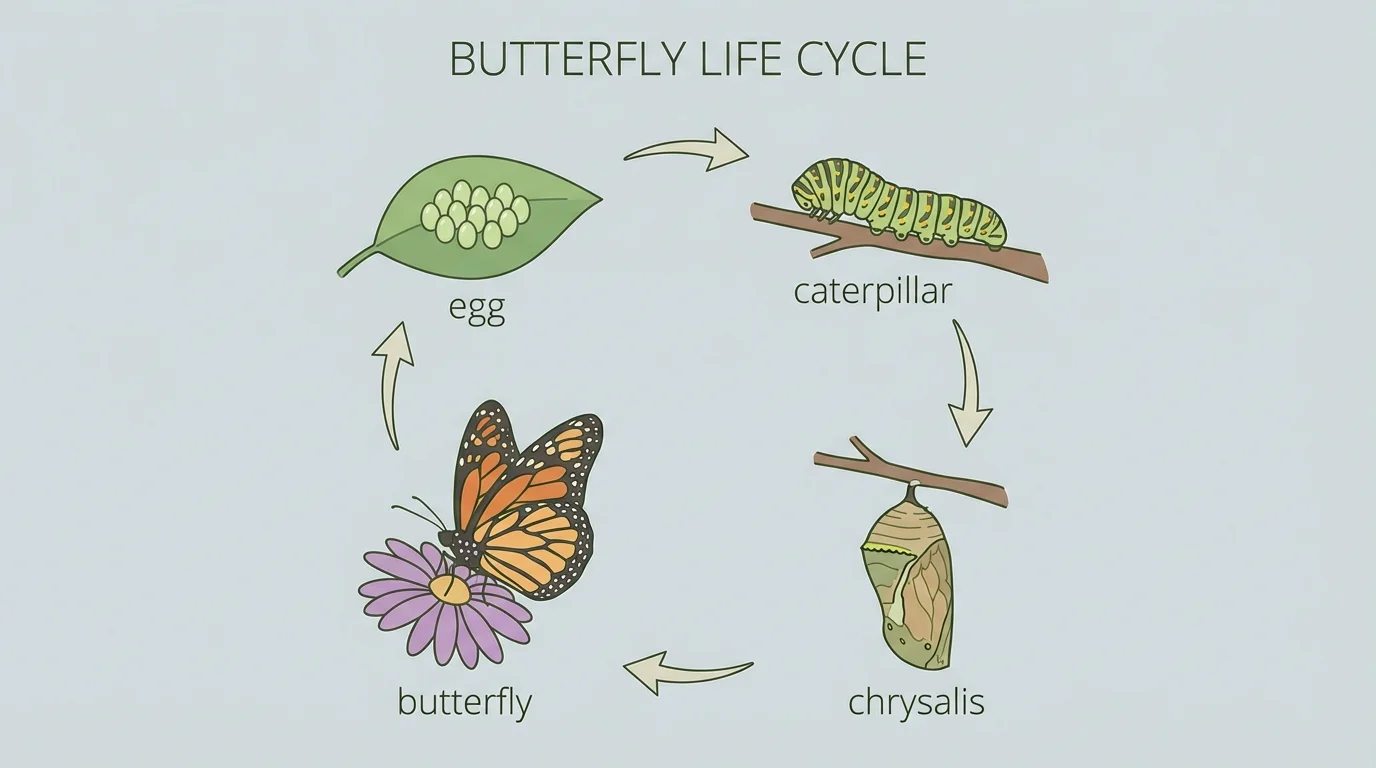
If students ask, "What comes after the egg?" they can look at the life cycle picture and listen to a book. If both say caterpillar, the class has checked the answer. If students ask, "Can a butterfly skip a stage?" the sources help them learn that the stages happen in order.
| Stage | What happens |
|---|---|
| Egg | The butterfly begins life in an egg. |
| Caterpillar | It hatches, crawls, and eats. |
| Chrysalis | It changes inside a covering. |
| Butterfly | The adult butterfly comes out and flies. |
Table 1. The table shows the four main stages in the butterfly life cycle.
When students retell the stages, they are using information they gathered and checked. Looking back at [Figure 3] helps them keep the order correct.
Class discussion example
The class is talking about butterflies.
Step 1: A student asks, "What comes after the egg?"
Step 2: The class looks at a butterfly book and a life cycle picture.
Step 3: Both sources say "caterpillar."
Step 4: The class shares the checked fact: "After the egg comes the caterpillar."
This is a simple way to gather information and check for accuracy.
Butterflies are a good topic because children can see clear changes. The stages are easy to compare, and students can learn how to ask, find, and check at the same time.
Research in early elementary classrooms often happens with others. Children talk in pairs, listen to a read-aloud, point to pictures, and share what they notice. This kind of collaborative learning means working together.
When one child asks a question and another child finds part of the answer, the class learns as a team. A teacher may write down the facts students discover. That helps everyone remember what the group has learned.
Careful listening, taking turns, and looking closely are important classroom habits. These habits help students learn from people and materials around them.
Working together also helps students hear new ideas. One child may say, "I saw the chrysalis in the picture." Another may add, "The book says the butterfly comes out after that." The group checks the order and learns more.
Correct information helps students speak clearly, draw carefully, and explain what they know. If a student draws the butterfly life cycle in the wrong order, checked facts from books and pictures can help fix the drawing.
Gathering and checking information is useful in many real-world situations. People use these skills when they look up weather, learn about animals, read signs, or follow directions. Even young students can begin by asking simple questions and finding true answers.
Being a fact finder means being curious and careful. We ask, we look, we listen, and we check. That is how we learn about butterflies and many other wonderful things.
