Have you ever seen a story where a cat talks, a pig drives a bus, or the moon wears a smile? Those ideas are fun, but they help us learn something important: some things are real, and some things are pretend. When we listen to stories, look at pictures, or watch things happen, we can begin to notice the difference.
Reality means things that are true and can happen in real life. A dog can bark. Rain can fall. A child can jump. These are real things.
Real means something that can happen or is true in everyday life.
Fantasy means something that is make-believe and cannot really happen, like a fish riding a bicycle or a house floating with no help.
Fantasy is make-believe. In fantasy stories, animals may talk, people may fly with no wings, and toys may come alive at night. These parts are not real, but they can still be exciting and fun to read about.
Sometimes we know something is real because we have seen it. We see birds fly, babies cry, and people eat food. Sometimes we know something is fantasy because it breaks the rules of real life. A cow cannot read a book. A tree cannot sing a song with a mouth like a person.
We can look for clues to help us decide if something is real or fantasy, as [Figure 1] shows. A clue is something we notice. We can ask, "Can this really happen?" If the answer is yes, it may be real. If the answer is no, it may be fantasy.
Good clues are things we already know about the world. People walk on the ground. Fish live in water. Cars drive on roads. But dragons breathing fire over a school, or a baby driving a train alone, are fantasy ideas.
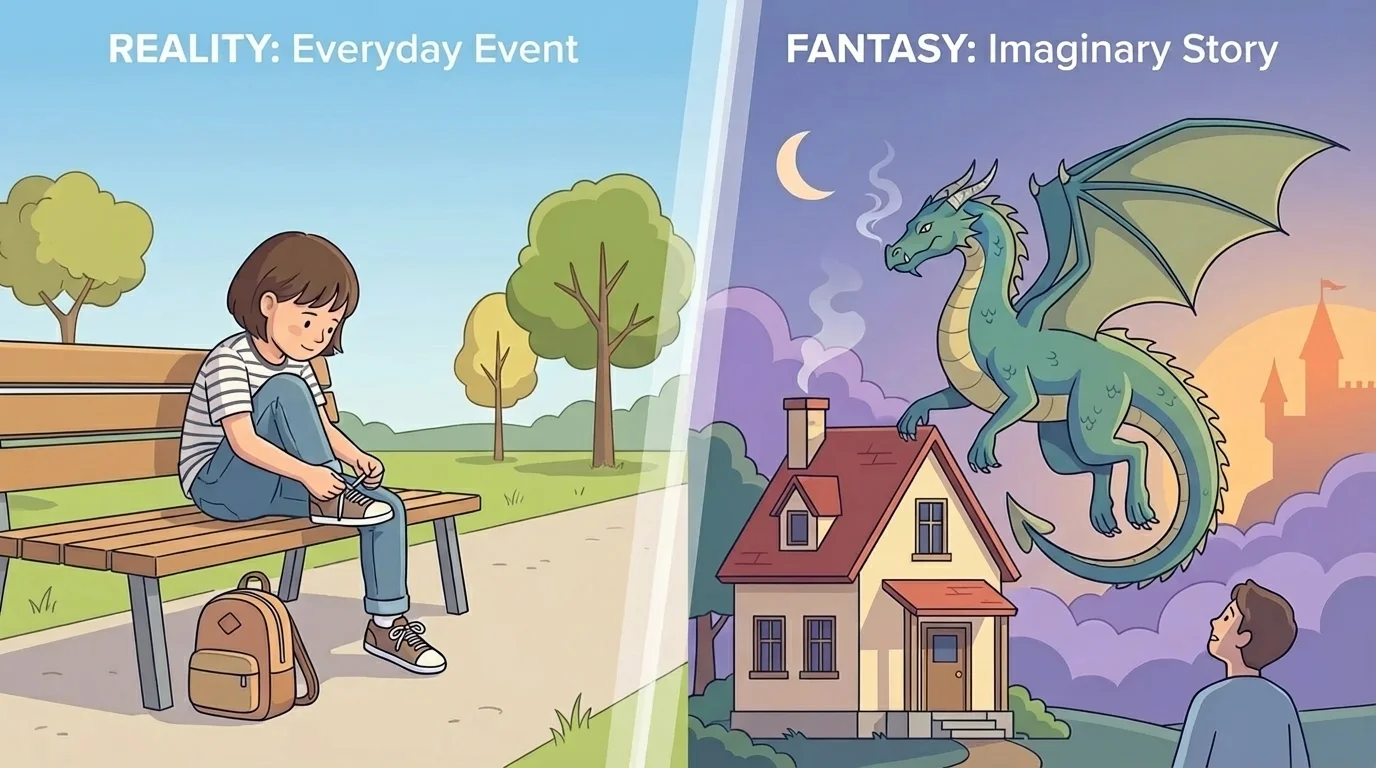
We can also listen to the words in a story. If a story says, "The boy put on his boots and splashed in puddles," that sounds real. If a story says, "The boy jumped and landed on a cloud," that sounds like fantasy.
How we decide
We think about what happens in everyday life. If something matches what people, animals, and objects can really do, it is realistic. If it gives people, animals, or objects impossible powers or actions, it is fantasy.
When we use clues, we are not saying fantasy is bad. Fantasy is wonderful for stories. We are just learning to notice what belongs to real life and what belongs to make-believe.
[Figure 2] Pictures give us strong clues and help us notice what is real or fantasy. If we see a family eating at a table, that looks real. If we see a rabbit wearing a crown and talking into a phone, that picture shows fantasy.
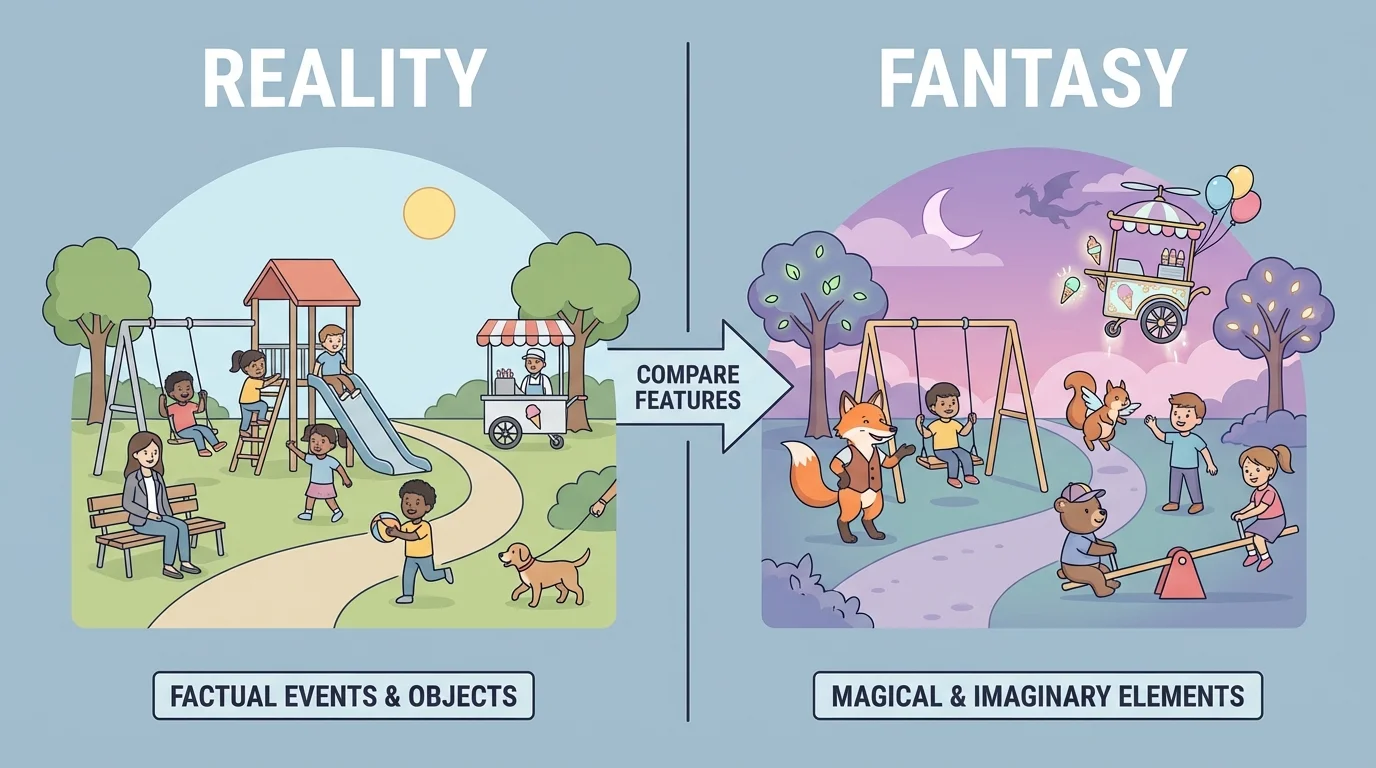
Colors and shapes can be clues too. A picture of a real farm may show chickens, barns, and tractors. A fantasy picture may show purple clouds, dancing apples, or a giant friendly monster having tea with children.
Sometimes artists draw real things in silly ways. A picture can have a real place, like a park, but add fantasy parts, like birds wearing hats. That means the picture has both real and fantasy parts.
Picture example
A picture shows a little girl in bed with a teddy bear. Outside the window, stars sparkle.
Step 1: Find the real parts.
A girl, a bed, a window, and stars are things we know.
Step 2: Look for impossible parts.
If the teddy bear is waving and talking, that part is not real.
Step 3: Decide.
The picture has some real parts and one fantasy part.
As we saw in [Figure 1], comparing ordinary actions with impossible actions makes our thinking stronger. We begin to say not just "fantasy," but also why it is fantasy.
We can also think about events. An event is something that happens. A birthday party is a real event. Snow falling is a real event. A bus driving down the street is a real event.
But if a story says a bus grows legs and runs to the moon, that event is fantasy. If a spoon sings a lullaby and tucks a child into bed, that is fantasy too.
Real events happen in our world. Fantasy events happen in make-believe worlds or in playful stories. When we watch, listen, or look, we can ask, "Could this happen for real?"
Very young children often enjoy pretending because pretending helps their brains grow. When children learn to tell real from make-believe, they become better thinkers and better story listeners.
Some events may feel surprising but are still real. A huge whale is real. A rainbow is real. A person in a funny costume is real. Surprising does not always mean fantasy. Impossible is the bigger clue.
[Figure 3] Many stories mix real life and fantasy. A child may live in a real house, eat real breakfast, and go to a real school. Then a fairy may appear in the bedroom window. The house is real, but the fairy is fantasy.
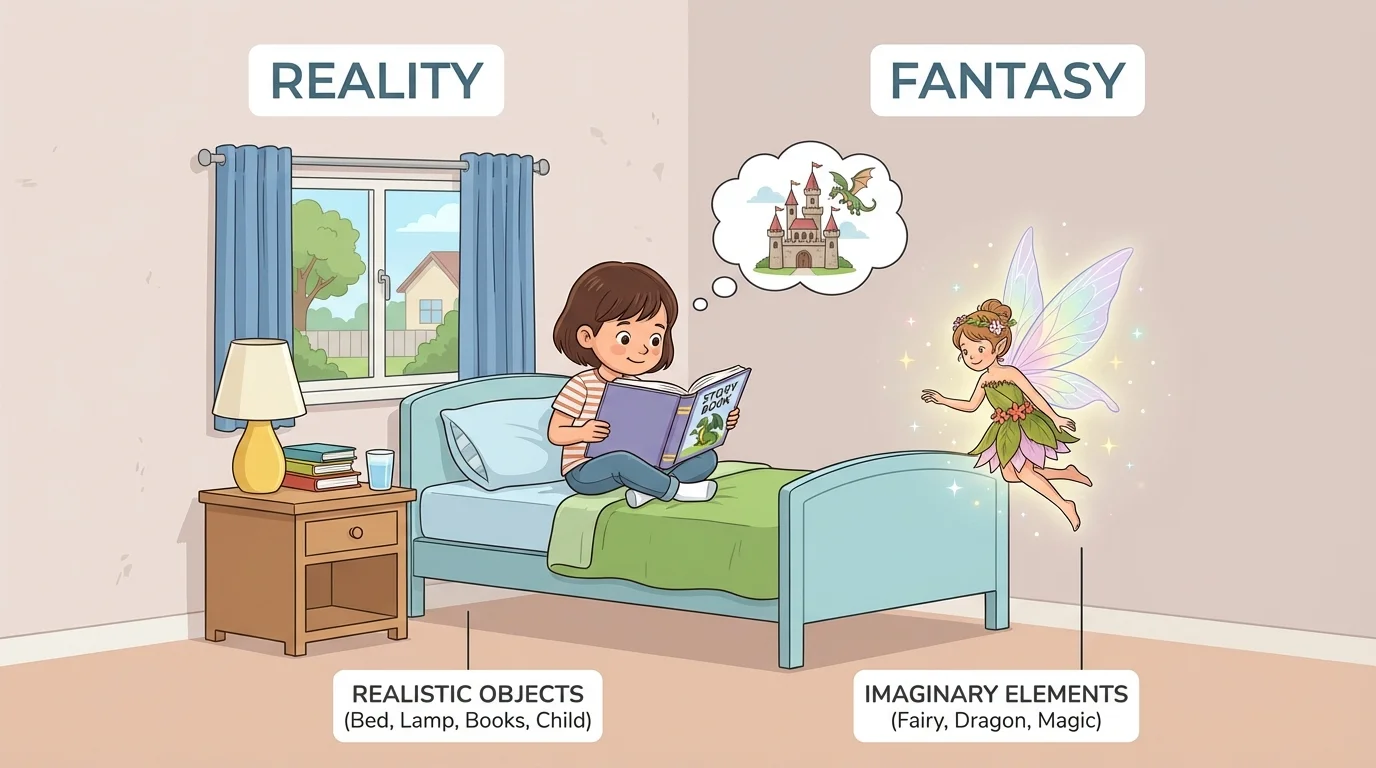
This is important because not every story is all one kind. We can listen for the parts that sound true to life and the parts that are make-believe. A story can have a real setting and fantasy characters. It can also have real characters and fantasy events.
For example, a boy brushing his teeth is real. If his toothbrush suddenly starts telling jokes, that is fantasy. A family riding in a car is real. If the car folds into a bird and flies away, that is fantasy.
Mixed stories
Some books and pictures combine reality and fantasy. Learning to spot both helps us understand stories better. We can enjoy the pretend parts while still noticing what could happen in real life.
Later, when we remember [Figure 2], we can notice how one picture may hold both kinds of ideas at the same time. Real places can have fantasy visitors in storybooks.
When we talk about stories and pictures, useful words help us explain our ideas. We can say, "That is real." We can say, "That is fantasy." We can also say, "That could happen," or "That cannot happen."
These words help us become careful readers and observers. We learn to pay attention to what characters do, what objects do, and what happens next. A dog wagging its tail could happen. A dog cooking soup by itself cannot happen in real life.
Using clear words makes our thinking stronger. Instead of only saying, "That is silly," we can say, "That is fantasy because animals do not talk like people." Instead of only saying, "That looks normal," we can say, "That is real because children really do play at the park."
As shown earlier in [Figure 3], normal rooms, toys, and bedtime routines can stay real even when one magical part appears. Good readers notice both.
You already know many things about the world from home, play, and books. Use what you know to help you decide if something is real or make-believe.
When we understand reality and fantasy, stories become even more interesting. We can enjoy dragons, fairies, and talking cookies while also knowing that real life has its own true wonders, like thunderstorms, kittens, and giant trucks.
