Sometimes our words do two very different jobs. We might say, "I am hungry," or we might say, "Can I have a snack?" One tells something. One asks something. Knowing the difference helps us speak clearly, listen carefully, and share our thoughts and feelings with other people.
When we talk, we do not always use words in the same way. Sometimes we tell what we know, what we see, or how we feel. Sometimes we ask for help, for information, or for a turn. Both ways are important. They help us talk with family, teachers, and friends.
If a child says, "I have blue shoes," the child is telling something. If the child says, "Do you like my blue shoes?" the child is asking something. The words have different jobs, even when they are about the same thing.
Statement is a group of words that tells something. A statement can tell a fact, an idea, or a feeling.
Question is a group of words that asks something. A question asks for an answer.
We use statements to share our thoughts. We use questions to learn more. Good speakers and good listeners can notice which one they hear.
A statement tells something. As [Figure 1] shows, a statement can tell about a toy, a pet, a feeling, or something happening right now.
Here are some statements: "The dog is sleeping." "I feel happy." "My cup is empty." "We are going outside." These all tell something to a listener.
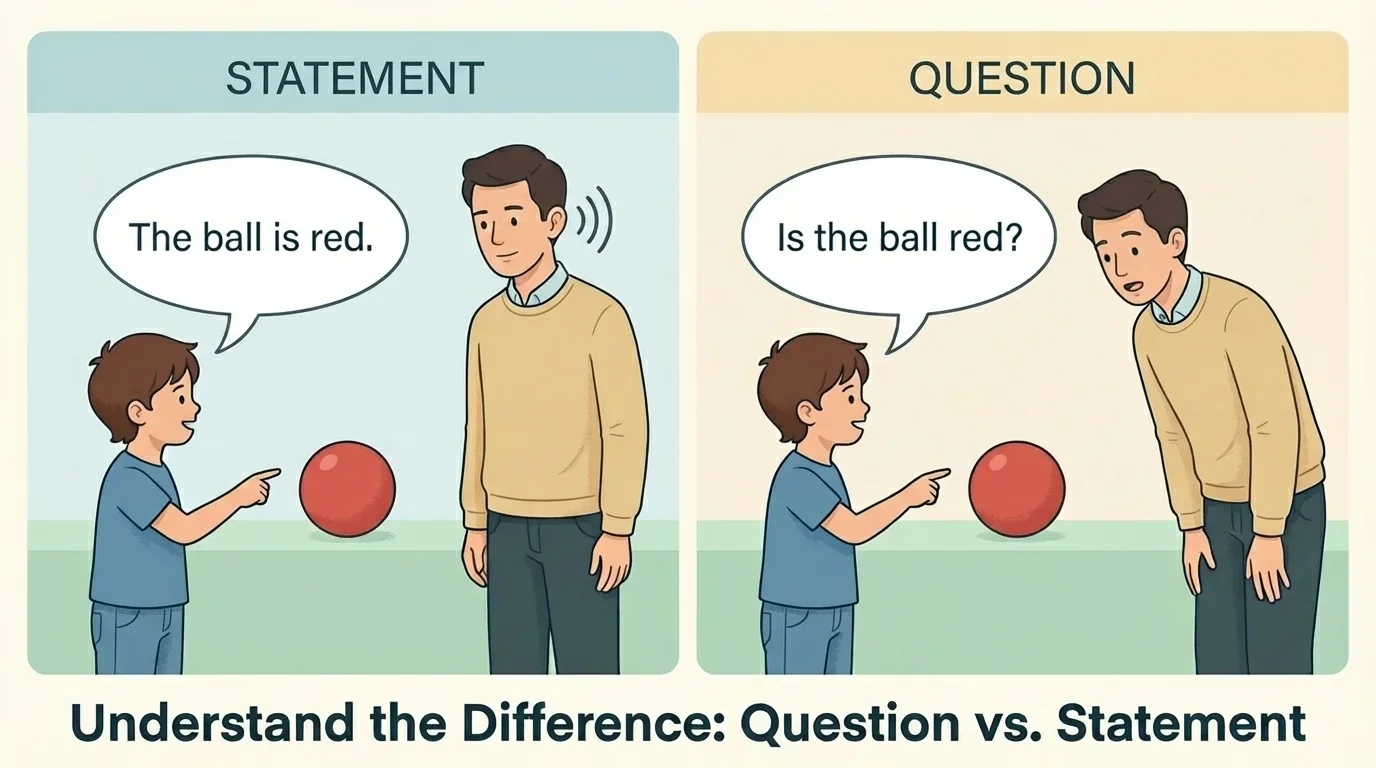
A statement does not ask for an answer. It gives information. When a child says, "I am sad," that statement helps another person understand a feeling. When a child says, "The block tower is tall," that statement shares an idea.
Statements can be about facts and about feelings. "The sun is bright" is a statement. "I like apples" is also a statement. Both tell something.
A question asks something. As [Figure 2] illustrates, a question needs someone to answer with words, actions, or both.
Here are some questions: "Where is my hat?" "Can I play too?" "Are you my partner?" "What is that sound?" Each one asks for an answer.
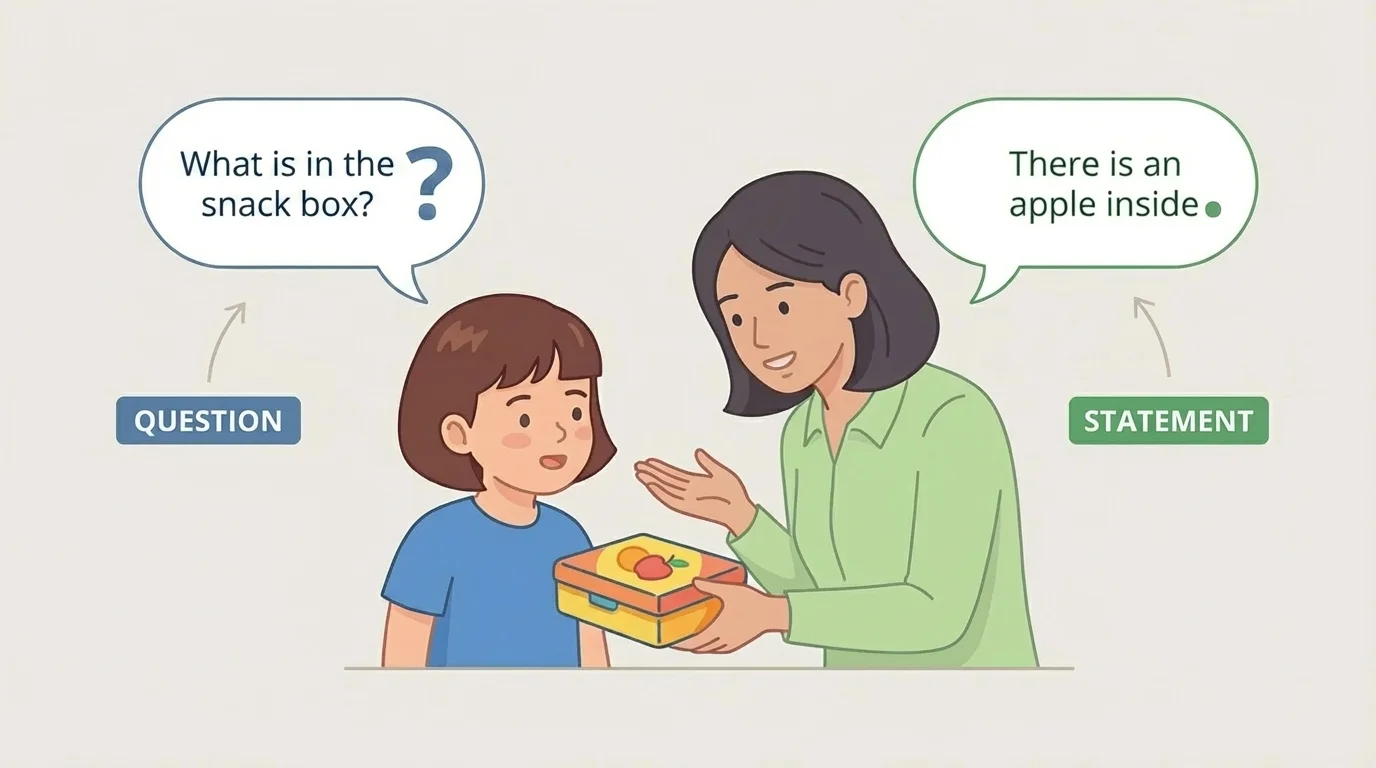
Questions help us learn, get help, and join in. If a child says, "Can you help me?" the child is asking for help. If a child says, "What is your name?" the child is asking for information.
Many questions start with words like what, where, and who, or with helping verbs like can. Not every child needs to learn all those words yet, but hearing them often helps children notice when a speaker is asking.
Different jobs for words
Questions and statements both help us communicate. Statements help us share ideas, needs, and feelings. Questions help us ask for missing information, ask for permission, and invite others to respond. Strong expressive language means knowing which one to use for the job we want our words to do.
When we want to tell, we use a statement. When we want to know, we use a question. This simple difference helps conversations make sense.
We can often hear the difference by listening to voice. As [Figure 3] shows, a statement often sounds calm and finished. A question often sounds as though the speaker is waiting for an answer.
Listen to these two sentences: "You are ready." That sounds like telling. "Are you ready?" That sounds like asking. The words may be close, but the voice helps us know the difference.
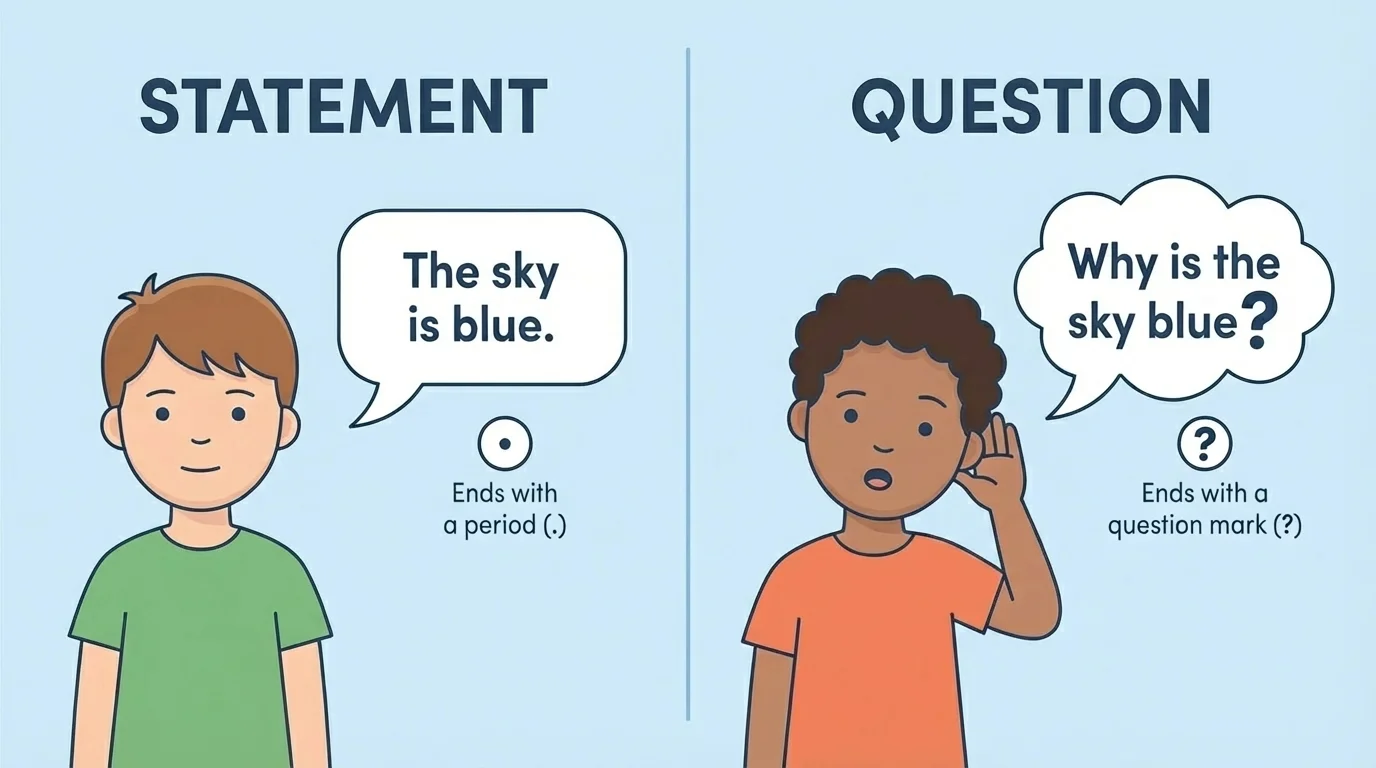
Faces and bodies can help too. A person asking a question may look curious, wait for an answer, or tilt the head a little. A person making a statement may look sure or simply share information. We use ears, eyes, and words together when we listen.
Later, when children hear a friend say, "My turn is next," they can notice it is a statement, much like the calm telling voice we saw in [Figure 1]. When they hear, "Is it my turn next?" they can hear the asking voice, like the curious speaking shown in [Figure 2].
Good listeners pay attention to what the speaker wants. Is the speaker giving information? Then it is probably a statement. Is the speaker looking for an answer? Then it is probably a question.
If someone says, "I dropped my pencil," that is a statement. If someone says, "Can you pick up my pencil?" that is a question. One tells about a problem. One asks for help with the problem.
At school, a teacher may say, "It is circle time." That is a statement. A teacher may also say, "Who wants to sing?" That is a question. At home, a grown-up may say, "Dinner is ready." That is a statement. A grown-up may ask, "Would you like milk or water?" That is a question.
Everyday listening examples
Step 1: Hear the words.
"I made a big tower." These words tell something.
Step 2: Ask what the speaker wants.
The speaker wants to share an idea, not get an answer.
Step 3: Name it.
This is a statement.
Step 4: Try another one.
"Did you make a big tower?" These words ask for an answer.
Step 5: Name it.
This is a question.
Listening carefully helps children answer the right way. A statement may need a comment such as "That is tall!" A question may need an answer such as "Yes" or "It is over there."
Children use language to share thoughts and feelings all day long. "I am excited" is a statement about a feeling. "Can you play with me?" is a question that asks for a response. Both are useful and important.
Questions help children be curious. Statements help children be clear. When children know the difference, they can ask for what they need and tell others what they think. This supports strong speaking and careful listening.
During play, a child might say, "This block is mine." That is a statement. The same child might say, "Can I have the blue block?" That is a question. During snack time, a child might say, "I want more crackers." That is a statement about a need. The child might also say, "May I have more crackers?" That is a question asking politely.
Very young children often understand the difference between asking and telling before they can explain the rule with words. Their ears notice patterns in speech, and that helps them learn how conversations work.
Sometimes the same idea can be said in two ways. "You have a baby sister." That is a statement. "Do you have a baby sister?" That is a question. As we noticed in [Figure 3], the voice and the purpose help us know which one we hear.
When children practice using both kinds of sentences, they become stronger communicators. They can tell what they know, share how they feel, and ask for help, information, or a turn.
