Have you ever heard, "Pick up your cup, put it on the table, and sit down"? That is not just conversation. It is a set of directions. Following directions helps children play games, stay safe, clean up, and learn new things. When we listen carefully, our brains help us remember what to do first, next, and last.
To follow directions, we use listening. Listening means we hear the words and think about what they mean. Sometimes we also look at the speaker's face, hands, or the objects around us. This helps us understand the message.
Good listening means stopping for a moment, paying attention, and waiting until all the words are said. If someone says, "Get your shoes and stand by the door," it helps to listen to the whole direction before moving.
Direction means words that tell someone what to do. A direction can have one part, two parts, or three parts.
[Figure 1] Some directions are short. Some directions have more than one action. When children understand spoken language, they can follow what they hear and do the steps in the right order.
A one-step direction has one thing to do. A two-step or three-step direction has more parts, so the listener needs to remember more actions.
Here are simple examples. One-step: "Clap." Two-step: "Clap and turn around." Three-step: "Clap, turn around, and sit down." Each time, one more part is added.
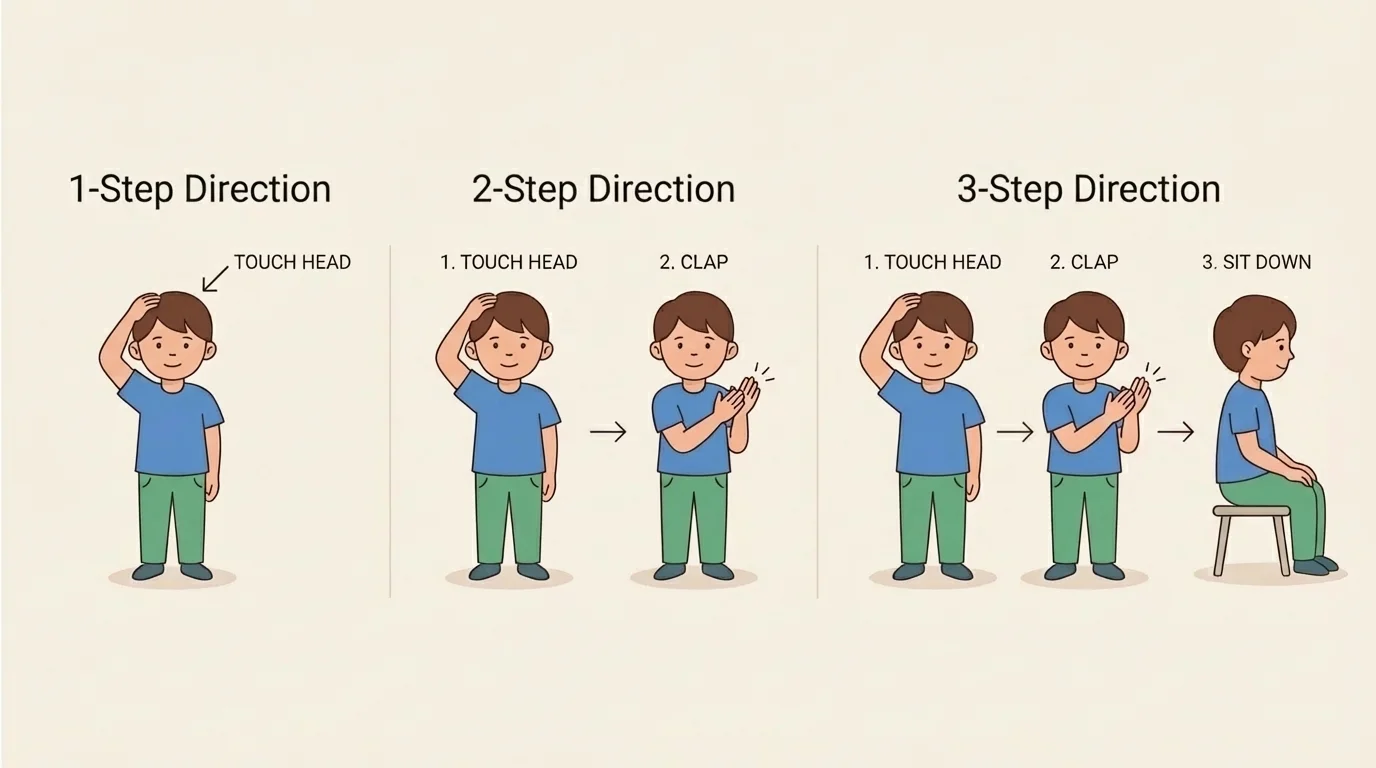
A two-step direction tells you to do two actions. For example, "Pick up the block and put it in the bin." First, pick up the block. Next, put it in the bin.
A three-step direction tells you to do three actions. For example, "Get your coat, open the door, and walk outside." There are three parts, and the order matters.
If the order changes, the meaning may change too. "Wash your hands and then eat" is not the same as "Eat and then wash your hands."
Some words give us big clues, as [Figure 2] shows. Action words tell what to do. Order words tell when to do it. Place words tell where something goes.
Action words are words like touch, bring, open, sit, push, and carry. When we hear the action word, we know the job.
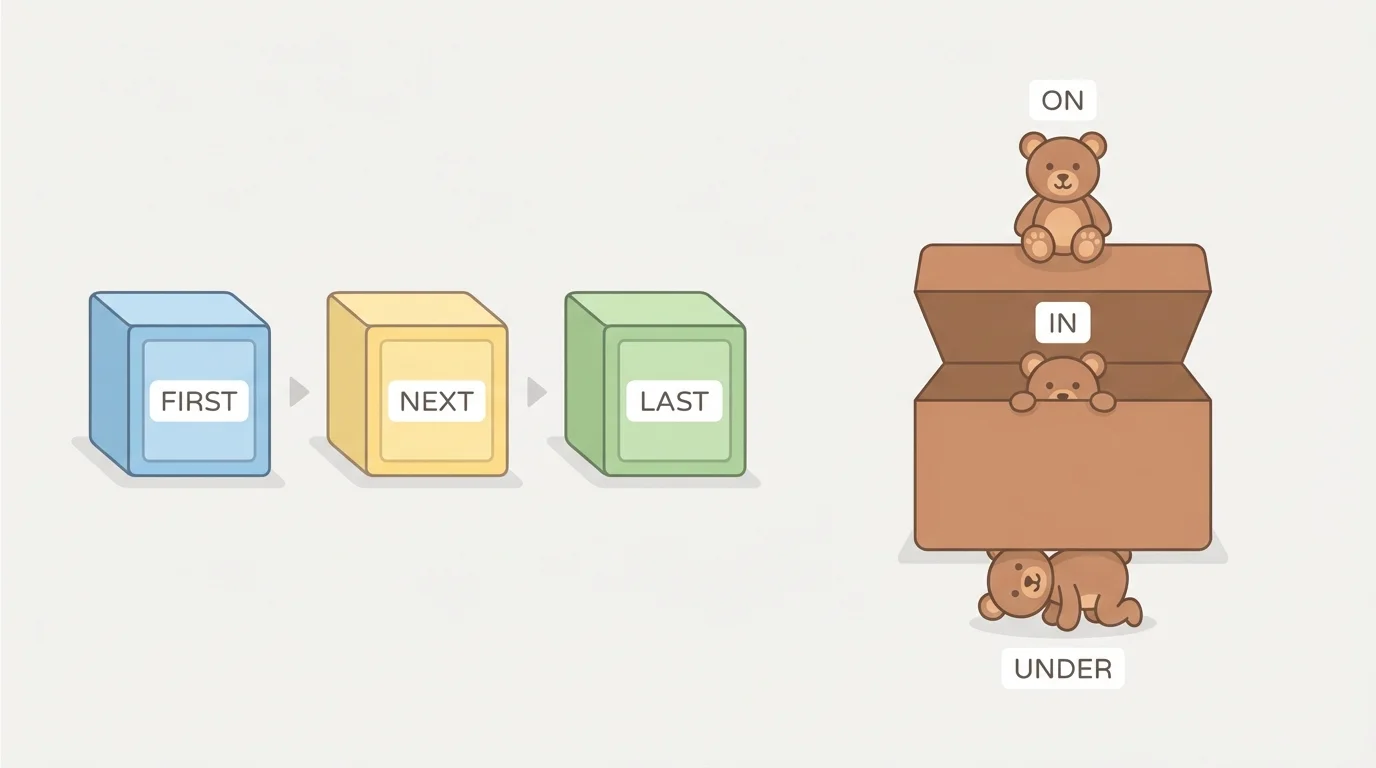
Order words help us know the sequence. Common order words are first, next, then, and last. In "First get your paper, then sit down," the paper comes before sitting.
Place words tell where. Common place words are in, on, under, behind, and next to. In "Put the ball under the chair," the word under is very important.
When children listen for these special words, directions become easier to understand. The block and teddy bear positions in [Figure 2] make these location and order clues clear.
Why order matters
In multi-step directions, each part connects to the next part. Doing the steps in order helps the task work correctly. If a child hears "Take off your backpack, hang it up, and wash your hands," each step prepares for the next one.
Sometimes the same actions can be easy or tricky depending on the words used. "Pick up the red crayon and put it on the table" is easier when the child knows which object is red and where the table is.
[Figure 3] Following directions works best when children use a simple process: listen, remember, do, and check. This process helps children handle directions with two or three parts.
Listen to the whole direction. Do not rush too quickly. Wait until the speaker finishes.
Remember the important parts. Children can quietly think the steps in their heads: "Hat, line up, hands by my sides."
Do the actions in order. Start with the first part, then the next, then the last part.
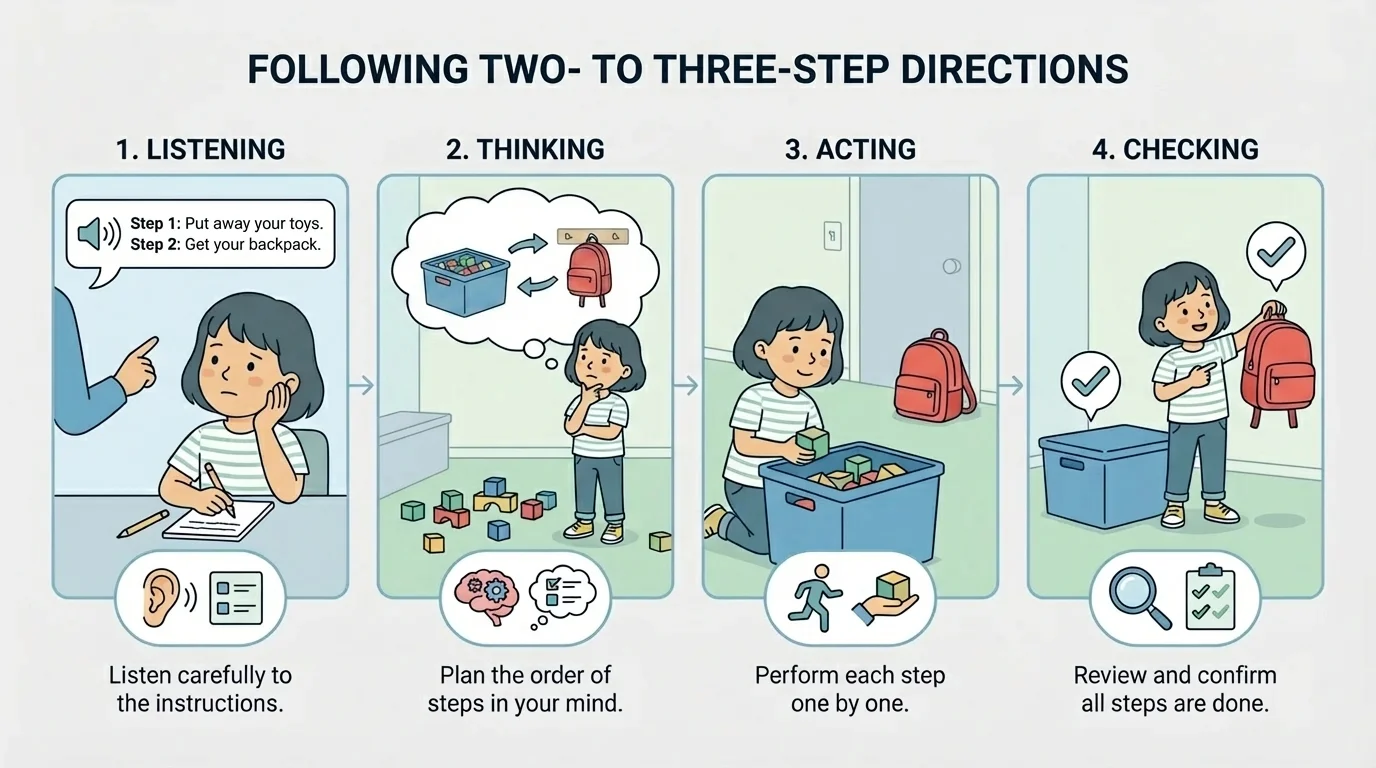
Check when finished. Ask, "Did I do every part?" This helps children notice if they forgot a step.
Examples of following directions
Step 1: Direction: "Touch your nose and clap."
The first action is touch your nose.
Step 2: The next action is clap.
The child does both parts in order.
This is a two-step direction.
Here is another example. "Pick up the book, put it on the shelf, and sit on the rug." A child listens for three actions and does them one by one. The sequence in [Figure 3] matches this kind of careful thinking.
If a child forgets a part, that is okay. The child can listen again or ask for help. Learning to follow directions takes practice over time.
Many games children love, such as follow-the-leader, simple obstacle courses, and cleanup songs, help build direction-following skills because they ask children to listen and act in order.
Sometimes adults also use gestures, pointing, or showing an object while speaking. These extra clues can support understanding, especially when a direction is new.
Directions can feel tricky when there is noise, when a child is excited, or when there are too many things to remember. A child may hear only the first part and miss the rest.
Long directions are harder than short directions. That is why two-step and three-step directions are an important skill. They help children grow from doing one action to doing several actions in sequence.
It also helps when directions are clear and simple. "Get the blue cup, bring it here, and put it on the tray" is easier than a very long sentence with many extra words.
If a child does only one part, the child may need to hear the direction again. Repetition can strengthen understanding. Hearing the same pattern many times helps children learn what to do.
Children use direction-following skills at school and at home. A teacher may say, "Hang up your backpack, wash your hands, and come to the table." A family member may say, "Put your pajamas on and choose a book."
During play, directions help children join games: "Roll the ball to me and then run to the cone." During art, directions help children complete a task: "Take a paper, choose a crayon, and draw a circle."
Safety directions are especially important. When an adult says, "Stop, hold my hand, and wait," the child needs to understand each part quickly and clearly.
When you follow directions, you are using your ears, your brain, and your body together. You listen to the words, think about the meaning, and then do the actions in order.
Following directions is a big part of understanding spoken English. It helps children communicate, participate, and become more independent. Small steps lead to bigger success.
