Have you ever told someone about your toy, and they talked back, and then you answered again? That is how conversation grows. A short conversation can become a longer one when two people listen, answer, and keep going. Talking back and forth helps children make friends, ask for what they need, and share what is in their hearts and minds.
A conversation is when people take turns talking and listening. One person talks, another person listens and answers, and then the talking keeps going. When a conversation has more than three exchanges, it means the talk keeps moving back and forth several times. For young children, this may sound like: "I have a red ball." "I have a blue ball." "Mine bounces high." "Can I see it?" "Yes." That is a longer talk, not just one answer.
Conversation means talking back and forth with another person. Exchange means one turn in a conversation, such as when one person speaks and the other person answers. Listening means paying attention to the other speaker with your ears, eyes, and body.
Good conversations stay on a shared idea for a little while. The idea might be toys, snacks, pets, feelings, or what happened outside. Children learn that they can start a talk, answer in a talk, and add more to a talk.
Talking is a little like rolling a ball back and forth. One person has a turn, and then the other person has a turn. In a strong turn-taking conversation, children wait, listen, and speak when it is their time, as [Figure 1] shows. They do not need long sentences. Short, clear words work well.
Children also use their bodies to help with conversation. They may look at the speaker, face the person, nod, or pause while waiting. These actions help show, "I am listening," or "Now it is your turn."
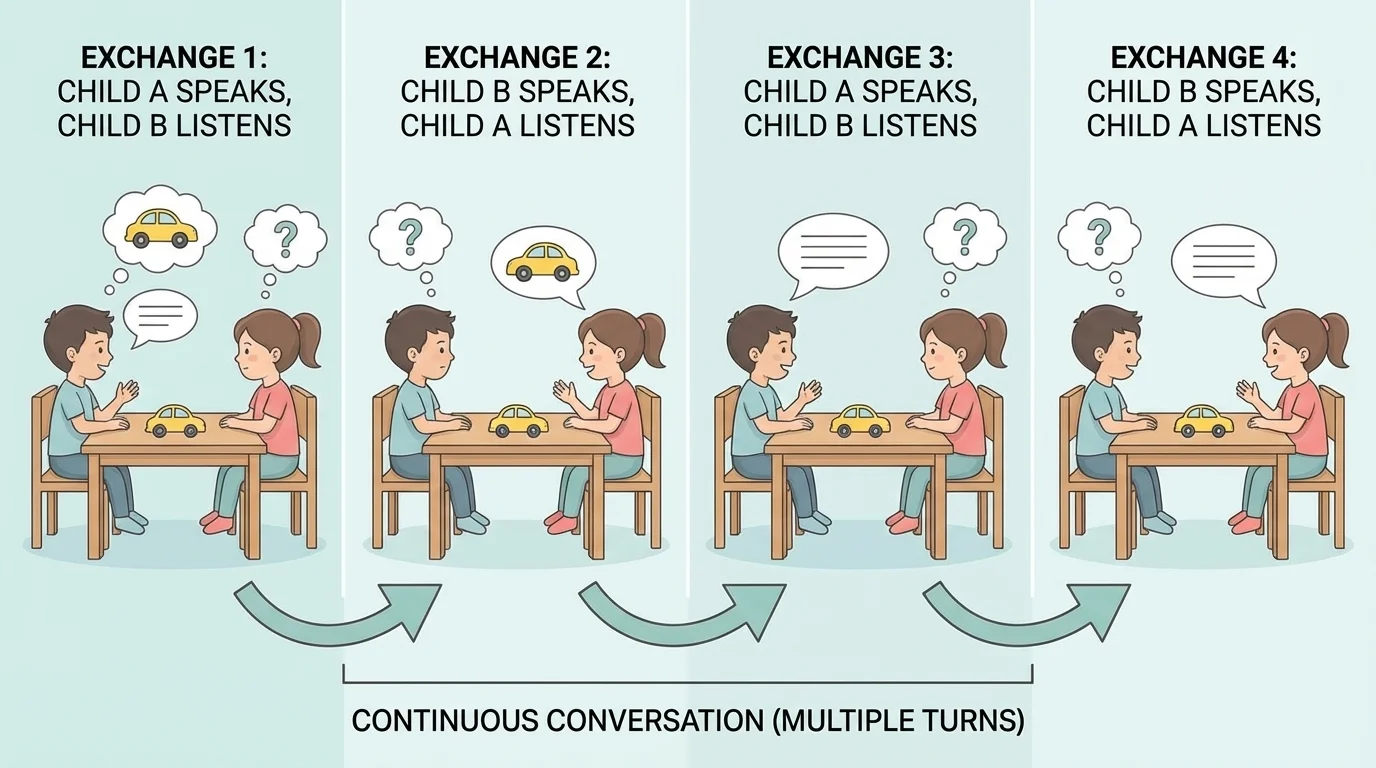
A child might say, "I made a tower." A friend can answer, "It is tall." The first child can continue, "It fell down." The friend can respond, "Make it again!" This kind of back-and-forth helps children learn that conversation is shared, not done alone.
Taking turns helps meaning grow. When children listen first and then answer, they show they understand the speaker. When they add one more idea, the conversation becomes longer and richer. A child can answer with a word, a short sentence, or a feeling: "Yes." "I like it." "That made me sad."
Sometimes taking turns is hard. A child may want to talk right away or may forget to listen. Gentle reminders like waiting, watching, and then speaking help the conversation stay calm and clear.
Conversations are for sharing more than objects. Children use words to share what they think, want, notice, remember, and feel. A child may say, "I want more juice," "I see a dog," "I made a picture," or "I feel mad." These words help others understand them.
Children can also add simple reasons. They might say, "I am sad because Mommy left," or "I want the truck because I was using it." Adding a small reason helps another person understand the feeling or idea better.
Example of sharing a feeling
Step 1: One child says, "I am scared."
Step 2: A grown-up answers, "What scared you?"
Step 3: The child says, "The loud dog barked."
Step 4: The grown-up responds, "The bark was loud. You are safe with me."
This conversation has several exchanges and helps the child feel heard.
When children learn words for feelings, conversations become more helpful. They can tell others when they are happy, excited, frustrated, tired, or proud.
Children talk with peers such as classmates or siblings, and they also talk with adults such as parents, caregivers, and teachers. The talk may sound a little different, but both kinds of conversation matter.
With friends, children often talk about play: "Let's build." "I have the blocks." "I need the big one." "Here it is." "Thank you." With adults, children may answer questions, ask for help, or tell about an event: "I spilled." "Can you help me?" "Yes, let's clean it."
Kind words support both kinds of conversation. Words like "please," "thank you," "hi," and "bye" help children join and end conversations in friendly ways. A child can also learn to say, "My turn, please," or "Can I play too?"
Very young children build language quickly through everyday talk. Simple conversations at snack time, clean-up time, and play time help their speaking and listening grow stronger.
Children do not need perfect grammar to have meaningful conversations. What matters most is that they share an idea, listen, and respond to the other person.
A longer conversation stays on one idea for several turns. Children can keep the talk going by answering and then adding one more thought, as [Figure 2] illustrates. They can also ask a simple question. One answer is good, but an answer plus another idea keeps the conversation moving.
Here is a longer conversation: "What is your snack?" "Crackers." "I like crackers." "Me too." "Mine are round." "Mine are crunchy." This talk has more than three exchanges, and both speakers stay on the same topic.
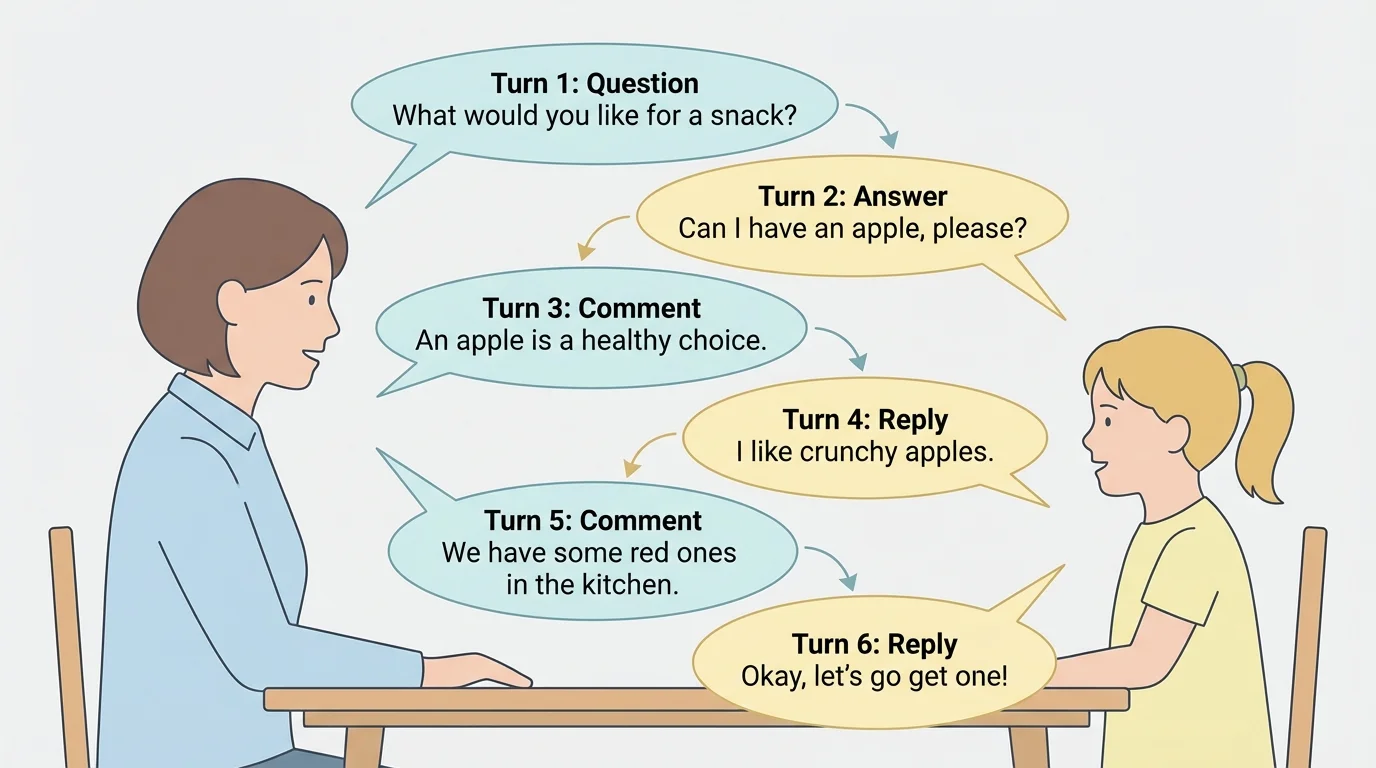
Useful ways to keep talking include answering a question, making a comment, asking "what?" or "where?", and telling one more thing. A child might hear, "Did you go outside?" and answer, "Yes, I ran fast." That extra idea makes the response stronger.
| Conversation move | What it sounds like |
|---|---|
| Answer | "Yes." |
| Add more | "Yes, I played ball." |
| Ask a question | "Where is the ball?" |
| Comment | "That ball is big." |
| Respond to feeling | "You look happy." |
Table 1. Simple ways children can continue a conversation.
As children grow more confident, they begin to understand response that matches the talk. If someone says, "I drew a cat," a fitting response is, "I see the tail," not a sudden change like, "I want shoes." Staying on topic helps conversation make sense.
Sometimes children are shy, upset, or unsure what to say. Sometimes they do not understand the words they hear. Conversation can still continue when they use simple repair phrases. A child can say, "What?" "Help me." "Say it again." "I don't know." These are useful speaking tools.
At other times, a child may leave the topic too fast. Earlier, [Figure 1] shows how turns connect to one shared idea. Returning to the same idea helps. If the topic is blocks, a child can come back with "My block is blue" or "I need one more."
Example of fixing a conversation
Step 1: A teacher says, "Put your cup on the table."
Step 2: The child does not understand and says, "What?"
Step 3: The teacher repeats, "Put your cup here."
Step 4: The child answers, "Okay, here," and puts it down.
Asking for help keeps the conversation going instead of stopping it.
Children also learn that feelings matter in conversation. If a friend looks sad, a child might say, "Are you okay?" If an adult says, "Thank you for helping," a child can answer, "You're welcome." These social responses build connection as well as language.
Longer conversations grow from everyday moments: getting dressed, building with blocks, reading a book, washing hands, or talking about lunch. Every time a child listens, answers, and adds one more idea, conversation becomes stronger.
