When people talk, it can sound like one long string of sound. But our ears can learn a secret: talking is made of little parts called words. When we hear good morning or big dog, we are hearing more than one word. Learning to hear each word helps us understand stories, songs, and directions.
[Figure 1] A word is a piece of what we say. We can say one word, like ball. We can also say two words, like red ball. We can say more words, like the red ball rolls. Our ears learn to hear where one word stops and the next word begins.
When someone says Mommy hugs me, that is not just one big sound. It has separate words: Mommy, hugs, me. Hearing these parts helps us know what the speaker means.
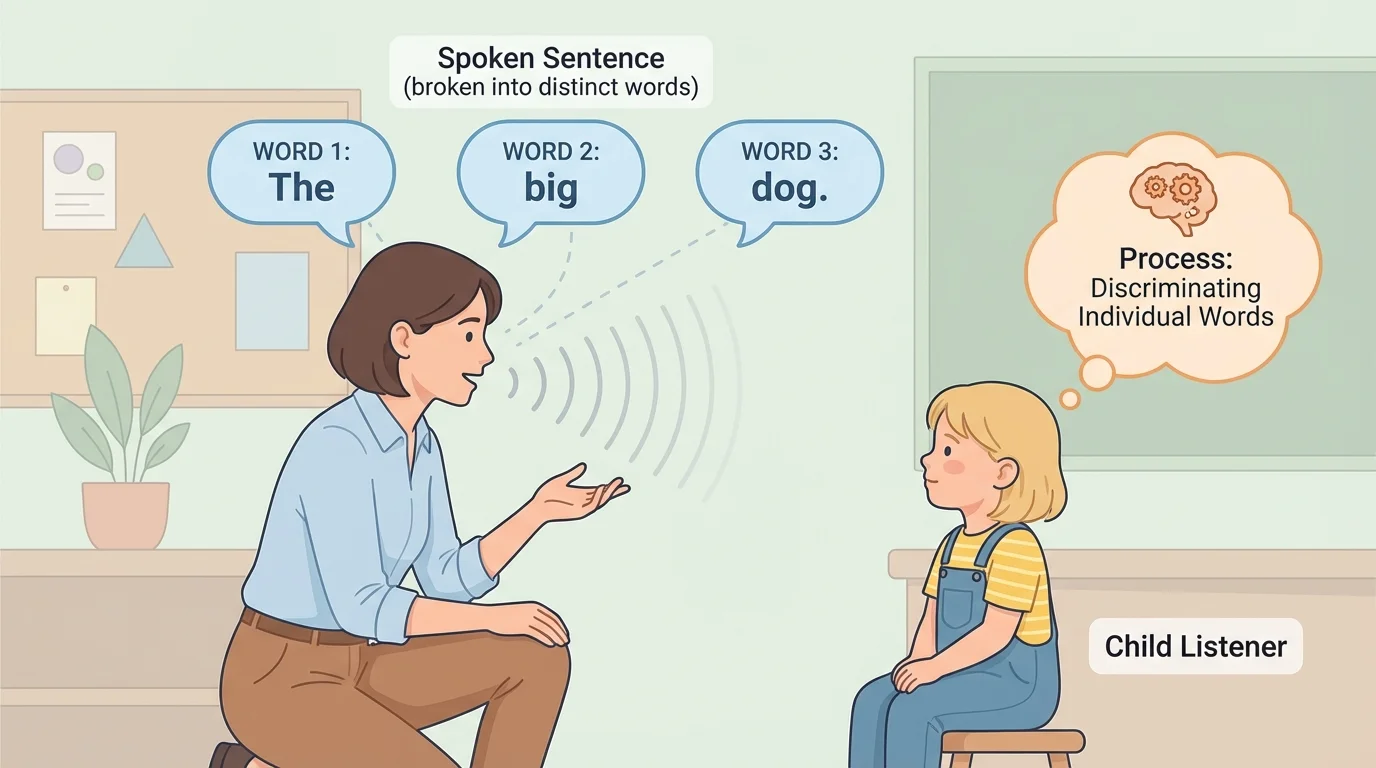
Words are the little parts of spoken language that carry meaning. A sentence or phrase is made of one word or many words said in order.
Sometimes a child may think a whole sentence is one word because it comes out fast. That is okay. Listening carefully helps us begin to pull the words apart.
Some spoken parts are just one word: jump, milk, bye. Some are two words: my shoe, baby sleeps. Some are longer: I see a bird. We listen for each word one by one.
Hearing words in order matters. Blue car and car blue use the same words, but they do not mean the same thing in the same way. Words have places, and their order helps convey meaning.
Listening one word at a time
Children build phonological awareness when they can hear that speech breaks into parts. Before reading print, they learn with their ears that a message can be made of separate words spoken in a row.
Names are words too. Lia is one word. Baby Lia is two words. Come here, Lia has more words. We can hear words in greetings, questions, songs, and storybooks.
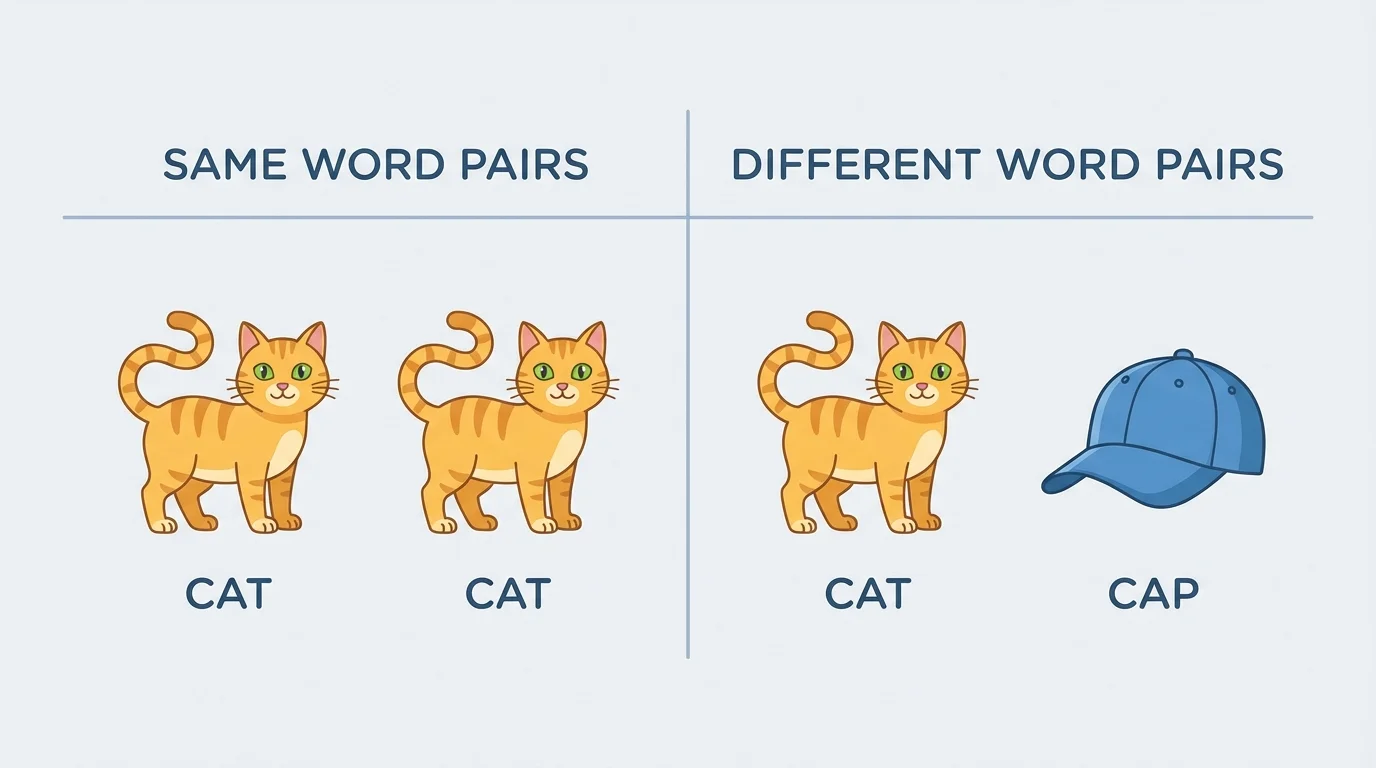
[Figure 2] Sometimes two spoken words match exactly. Sometimes just one little sound changes, and then the words are different. Some pairs are the same and some are different. For example, cat and cat are the same. cat and cap are different.
We can also listen to bigger word groups. big dog and big dog are the same. big dog and dog big are different because the order changed. my cup and my pup are different because one word changed.
Listening examples
Step 1: Hear the pair sun and sun.
Step 2: Notice that both words sound exactly alike.
These words are the same.
Now listen to pig and wig. They are not the same word. Listen to go home and go home; those match. Listen to go home and go now; those are different. Careful listening helps us discriminate between words, which means to notice which words match and which do not.
Some words are short when we say them, like dog or car. Some words are longer, like banana or alligator. A long word is not about a big thing, and a short word is not about a little thing. The word bus is short, but a bus is big. The word ladybug is longer, but a ladybug is small.
Listening to long and short words helps children notice differences in spoken language. This is another way children develop stronger language awareness. We are not reading letters yet; we are listening to how words sound.
The word I is very short, but it is still a whole word all by itself. Even tiny words can carry important meaning.
Words can also be loud, soft, fast, or slow when someone says them, but they stay the same word. If someone whispers cookie or shouts cookie, we still hear the same word.
We hear words everywhere in our day, as [Figure 3] illustrates. At story time we hear the words in a book. At snack time we hear words like more juice or all done. At cleanup time we hear directions like pick up blocks.
Songs are full of words too. In a song, words may be stretched out or sung with music, but they are still words. In conversations, we hear questions like Where is Teddy? and answers like Here he is. Hearing each word helps us understand what is happening.
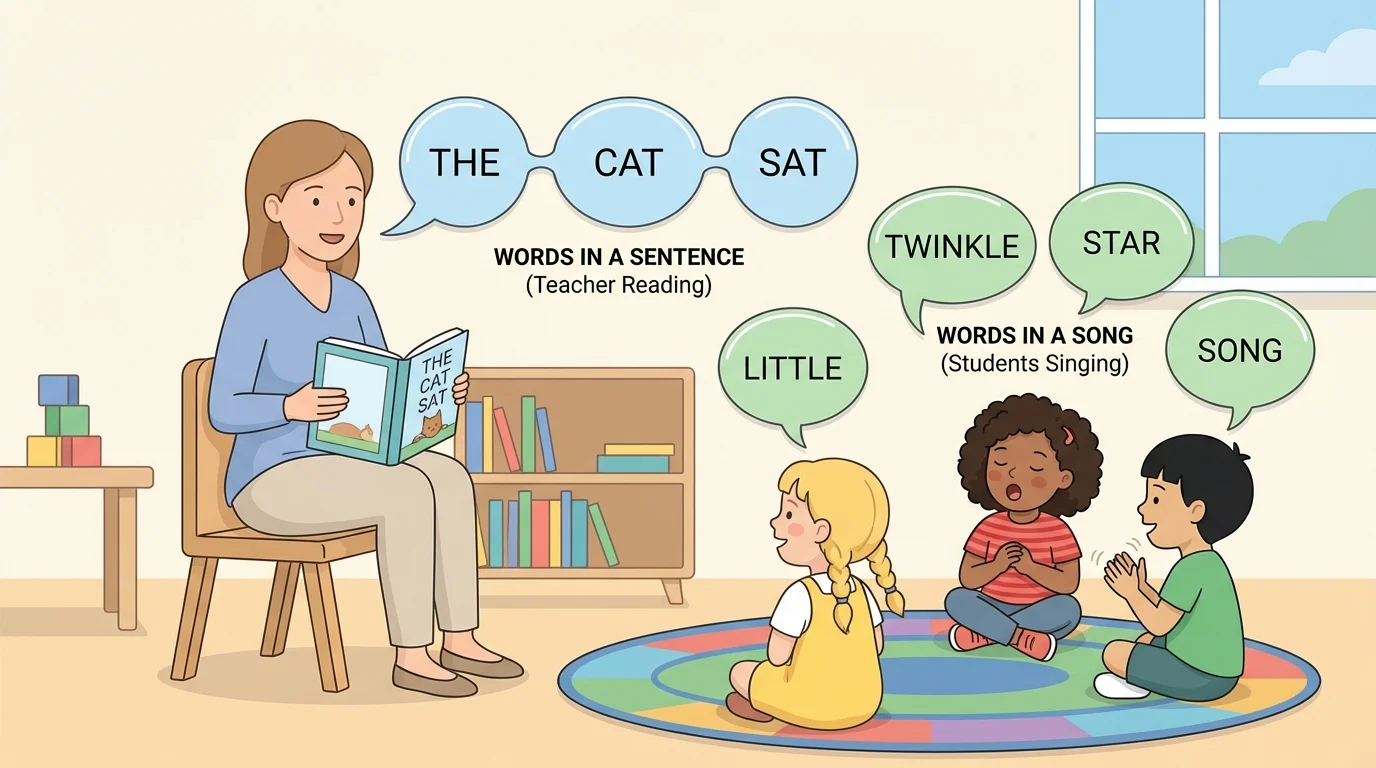
At home, families use words all day long: put on shoes, wash hands, good night. In school, teachers and friends use words to tell, ask, sing, and share. This classroom scene reminds us that language is all around us.
When children can hear separate words, they are getting ready for later reading and writing. They begin to understand that spoken language has parts. First we hear words. Later, we can learn even smaller parts, like beats in words and beginning sounds.
Careful listening also helps with understanding directions. If someone says get your coat, each word helps the message make sense. If we miss a word, the meaning may become harder to understand. That is why hearing words clearly is an important language skill.
The same listening skill from [Figure 2] helps in stories too. If a storyteller says brown bear and later says brown chair, our ears can notice that one word changed. Small changes in words can make a big change in meaning.
