Have you ever noticed that some words feel short and some feel bouncy? When we say cat, it comes out in one quick beat. When we say ba-na-na, our mouths move in more little beats. Those little beats help us hear how words are put together.
A syllable is a part of a word that we can hear when we say the word out loud. It is like a beat in a word. Some words have one syllable. Some words have two. Some words have three or more.
[Figure 1] Listen to these words: dog, mom, and sun. Each one has one syllable. Now listen to apple, baby, and cookie. Each one has two syllables. Then listen to banana, elephant, and tomato. These have three syllables.
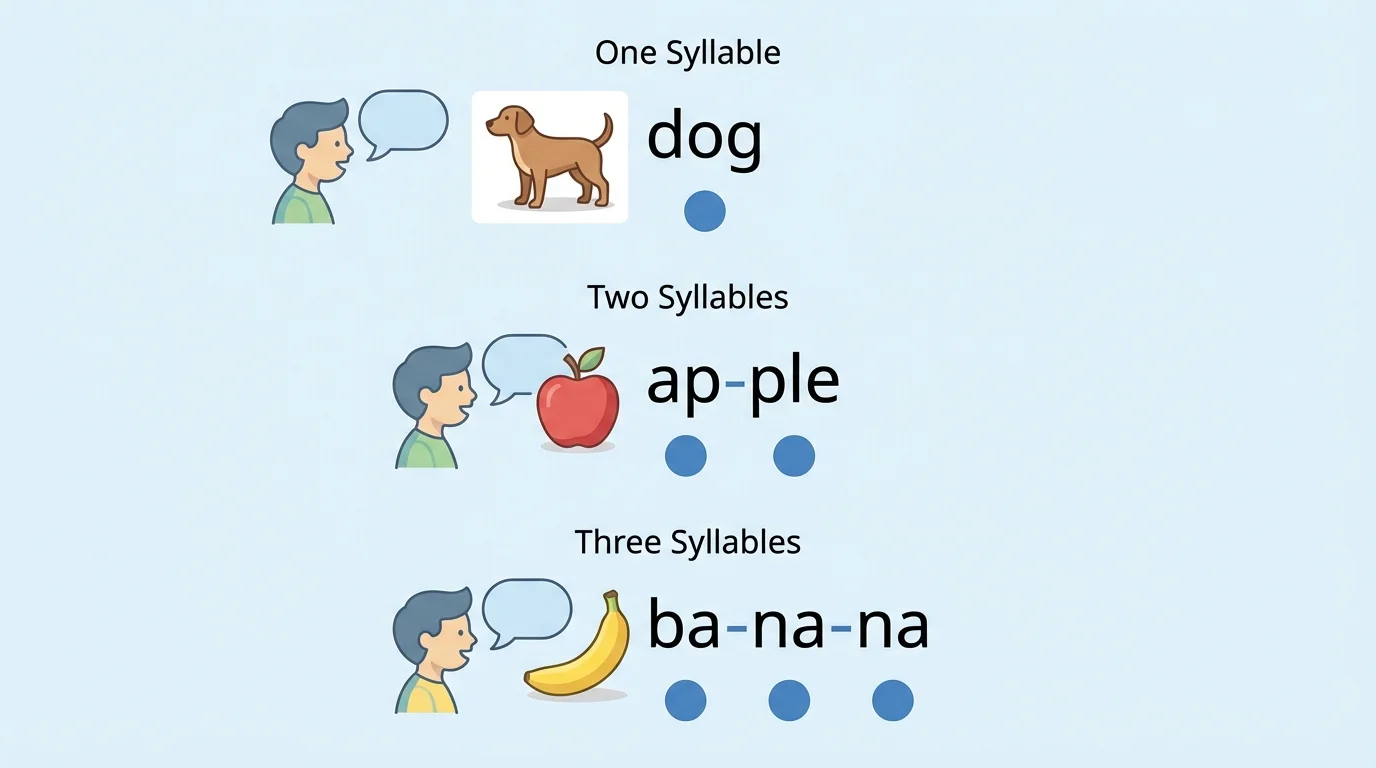
When we hear syllables, we are not counting letters. We are listening to how the word sounds. The word cat has three letters, but it has one syllable. The word baby has four letters, but it has two syllables: ba-by.
Syllable means one spoken part of a word. We hear syllables with our ears when we speak and listen.
Our ears and mouths work together. We say the word, and we listen for each part. This helps us notice that long words can be split into smaller sound pieces.
Some words are short in sound, and some are longer in sound. We can sort them by how many syllables we hear. A word with one syllable comes out in one beat: ball. A word with two syllables comes out in two beats: ta-ble. A word with three syllables comes out in three beats: um-brel-la.
Here are more examples. One syllable: fish, book, jump. Two syllables: rabbit, pizza, tiger. Three syllables: butterfly, computer, family. The number of syllables tells us how many sound parts are in the word.
Sometimes two words may both be long in letters but different in syllables. Green is one syllable. watermelon has many syllables: wa-ter-mel-on. That is why we listen to the word instead of just looking at how long it seems.
Your jaw often drops once for each syllable when you say a word slowly. That is one reason clapping and slow talking can make syllables easier to hear.
[Figure 2] Hearing these parts is called phonological awareness. That means noticing and working with the sounds in spoken language.
One easy way to hear each syllable is to say a word slowly and clap once for each part. One clap matches one syllable. If we say ap-ple, we clap two times. If we say ba-na-na, we clap three times.
We can also tap, nod, or pat our knees. The important thing is to keep one movement for one syllable. Say the whole word first. Then say it slowly. Listen for each part: ti-ger, pen-cil, oc-to-pus.
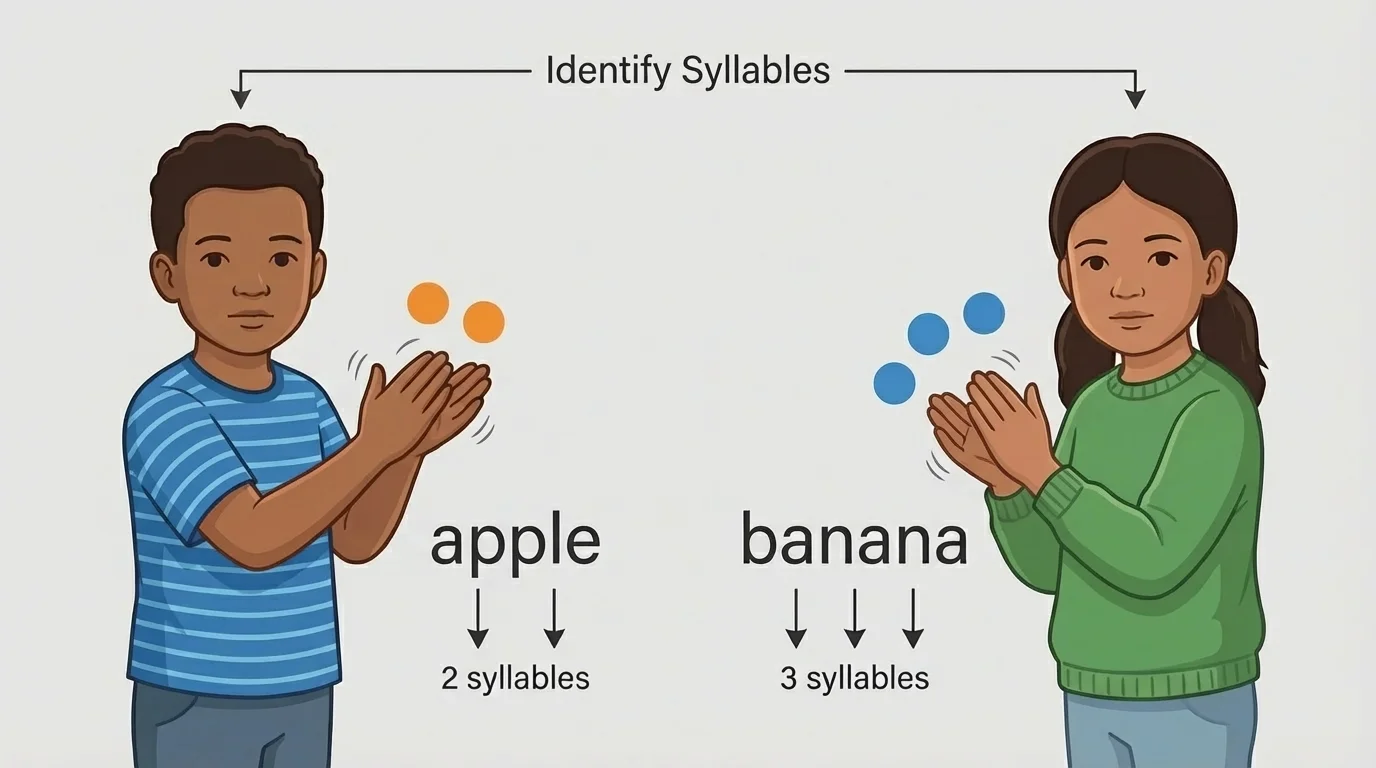
Clapping helps our ears notice where one part ends and the next part begins. When we say cup-cake, we can hear two parts. When we say car, we hear one part. When we say el-e-phant, we hear three parts.
Hearing the parts in familiar words
Step 1: Say the word sun.
It has one beat, so it has one syllable.
Step 2: Say the word ta-ble.
It has two beats, so it has two syllables.
Step 3: Say the word ba-na-na.
It has three beats, so it has three syllables.
When children can hear each separate part, they are better able to say words clearly and notice the sounds inside words.
Now we can discriminate between words. That means we can tell how they are different. In syllables, we can decide whether two words have the same number of parts or a different number.
[Figure 3] For example, dog and ball both have one syllable, so they are the same in that way. cookie and tiger both have two syllables. But dog and cookie are different because one has one syllable and the other has two.
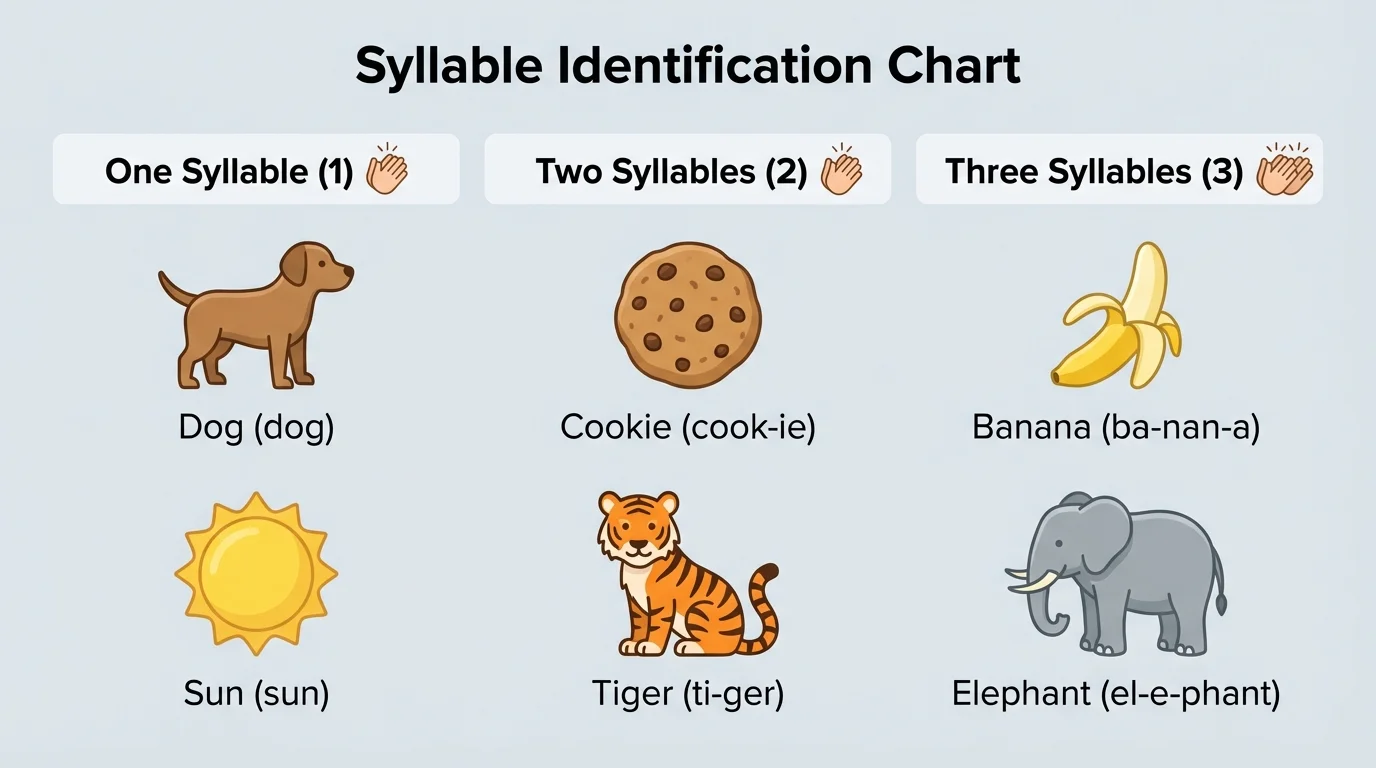
We can compare many words. Baby and apple match because both have two syllables. Cat and banana do not match because one has one syllable and the other has three. Elephant and tomato match because each has three syllables.
Sometimes children first notice the beginning sound of a word, like /b/ in baby. That is helpful, but syllables are different. Syllables are the bigger parts of the whole word. As we saw earlier in [Figure 1], a whole word can be broken into these larger sound chunks.
| Word | Syllables |
|---|---|
| sun | 1 |
| rabbit | 2 |
| cookie | 2 |
| banana | 3 |
| elephant | 3 |
Table 1. Examples of familiar words grouped by the number of syllables they contain.
Looking at groups like these helps us hear patterns. Words can sound alike in length even when they mean different things. That is part of listening carefully to spoken language.
Hearing syllables is an important early reading skill. Before children read many printed words, they can learn to listen to spoken words. They hear the parts, say the parts, and notice whether words are short or long in sound.
This also helps with speaking clearly. If a child says only part of a long word, listening for syllables can help the child hear what is missing. Saying ba-na-na slowly can make all three parts easier to hear and say.
Why syllables matter
Words are made of sound parts. When children notice these parts, they build a stronger path toward listening, speaking, and later reading. Syllables are one of the first big pieces children can hear in words.
Music has beats, and words have beats too. That is why songs, rhymes, and playful talking often make syllables easier to notice. When a child hears one clap for cake and two claps for cup-cake, the difference becomes clear, just as shown earlier in [Figure 2].
As children grow, they use this listening skill with many new words. They can hear that lion has two syllables, alligator has four, and train has one. Careful listening helps them understand how language works.
