Have you ever picked up a book and wondered where to begin? A book is like a little treasure box. It holds stories, pictures, and ideas. When we know how to hold a book, open it, and look through it in order, the story makes sense and is fun to follow.
Books help us learn and enjoy stories. Some books tell us about animals, families, or trucks. Some books tell made-up stories about bears, friends, or bedtime. A book has a special order, so we do not look at it in a mixed-up way. We read the book from the beginning all the way to the end.
Book parts are the important pieces of a book that help us know what it is and who made it. Some main book parts are the front cover, the pages inside, the title, the author, and the illustrator.
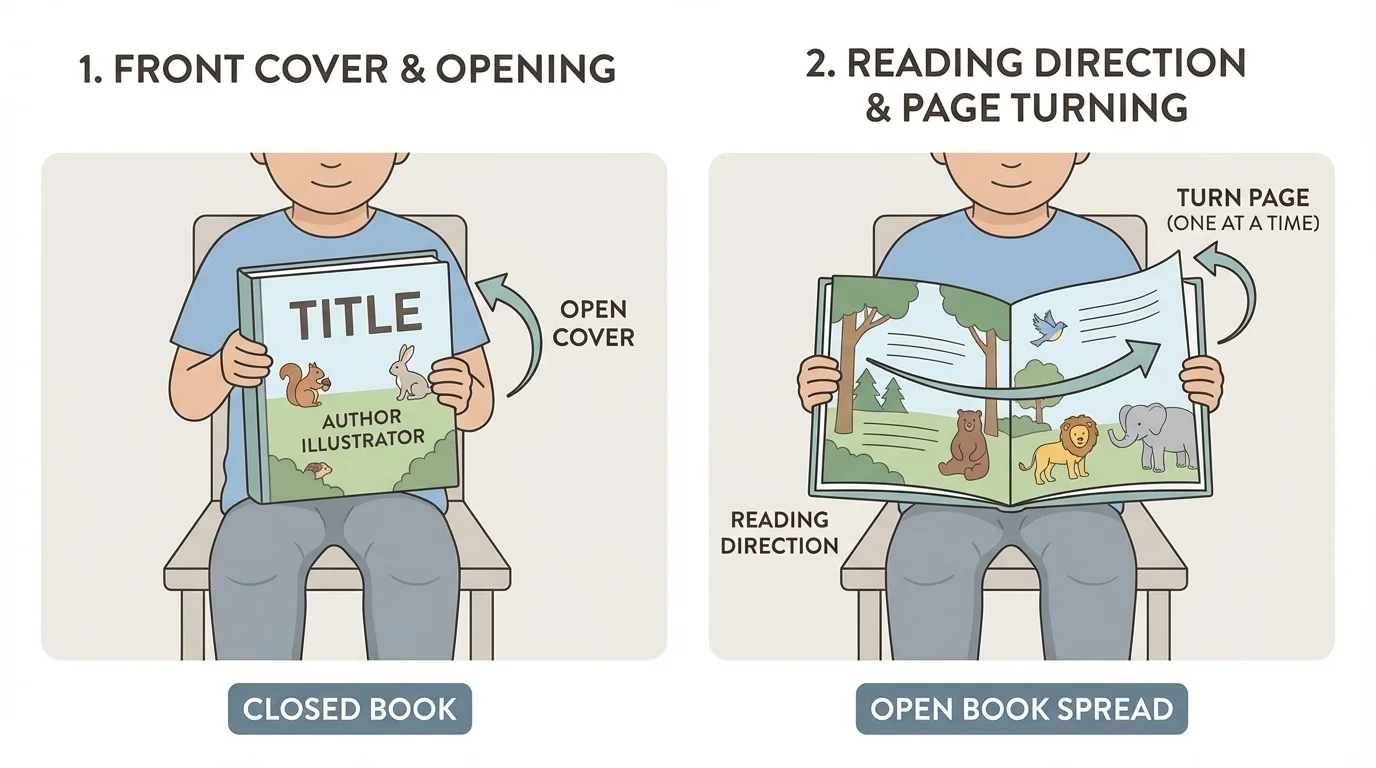
When we hold a book, we look for the front cover first. As shown in [Figure 1], the front cover is the outside front part of the book. It often has a picture that gives us a clue about what the book is about.
We start reading at the front of the book and move to the back. We open the front cover first. Then we look at the pages in order. This helps the story stay in the right order.
We turn pages one at a time. We do not skip all around if we want to hear the whole story. One page comes after another page. When we reach the last page, we are at the end of the book.
Sometimes an adult reads the words aloud. Sometimes a child looks at the pictures and talks about what is happening. Both ways help a child understand a book. The pictures and words work together.
Reading in order helps a story make sense. If a story begins with a puppy waking up, the next pages may show the puppy playing, eating, and going to sleep. Looking at pages in order helps us understand what happens first, next, and last.
When we listen to a story, we can watch the pages turn. As we saw in [Figure 1], each page comes after the one before it. That is why careful page turning matters.
As shown in [Figure 2], a book has special names printed on it. Three of the most important ones are the title, the author, and the illustrator. The title tells the name of the book. The author is the person who writes the words. The illustrator is the person who makes the pictures.
For example, a book might be called Sleepy Bunny. Sleepy Bunny is the title. If Mia Green wrote the words, Mia Green is the author. If Sam Lee drew the pictures, Sam Lee is the illustrator.
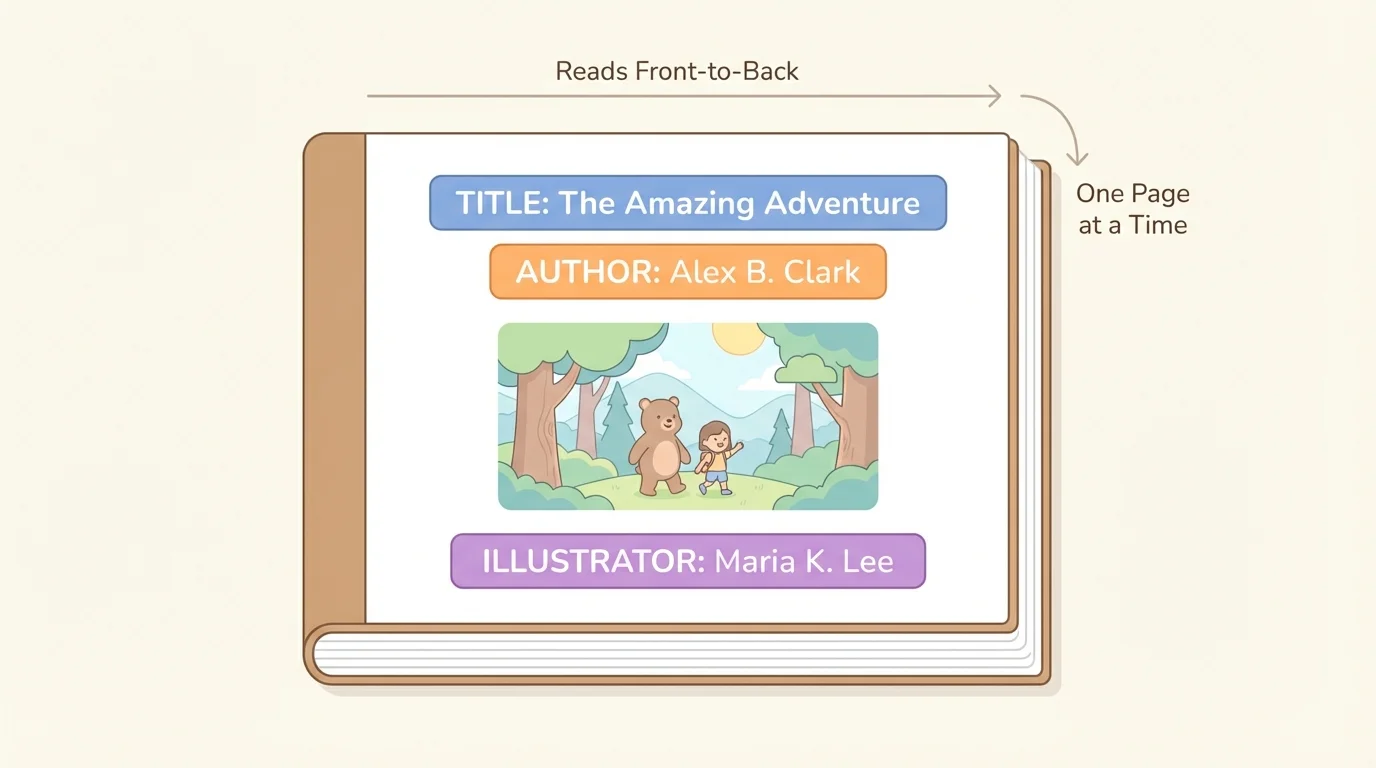
The title helps us know what book we have. The author helps us know who told the story. The illustrator helps us know who made the art. On some books, one person does more than one job. A person may write the words and draw the pictures too.
Looking at one pretend book
Let us look at a pretend book called Big Red Ball.
Step 1: Find the title.
The words Big Red Ball tell the name of the book, so that is the title.
Step 2: Find the author.
If the cover says "by Ana Cruz," then Ana Cruz is the author.
Step 3: Find the illustrator.
If the cover says "pictures by Leo Park," then Leo Park is the illustrator.
Now we know the book's name and the people who made it.
Later, when children choose books on their own, these parts help them talk about books clearly. A child can say, "I want the book called Big Red Ball," or "I like books by this author."
Books have words and pictures. Even before a child can read every word, the cover picture, the title, and the pages inside give clues. A picture of a farm may tell us the book is about animals. A smiling child on the cover may tell us the story is about a family or a friend.
The illustrator's pictures help us see what is happening. The author's words tell the story or information. Together, they help us understand more. When children hear a story again and again, they begin to notice that books always have parts that stay in the same place, like the cover and the pages.
Some children learn the title of a favorite book before they can read the words inside. They recognize the book by its cover picture and by hearing the title many times.
Looking carefully at the front cover helps us get ready for the book. We can ask, "What do I think this book is about?" Then we open it at the front and go page by page.
Books are special tools for learning. We hold them gently. We turn one page at a time instead of grabbing many pages. We keep books clean and dry. Caring for books helps other people enjoy them too.
When a child knows how to hold a book, where to start, and what the title, author, and illustrator are, that child is building strong reading habits. These habits help with stories now and with reading more words later.
