A book can do many amazing things. It can tell a story, teach about animals, show a silly picture, or help us find a word on a sign. When we look at print, we do more than just stare at a page. We talk about it. We ask questions. We answer questions. We share what we notice.
When children look at a book or another printed page, they begin to build meaning. That means they start to understand what the page is about. They may look at the picture first. They may notice letters, colors, shapes, or a familiar word. Then they can talk about what they see.
Talking about print helps children become careful readers. A child might say, "I see a dog," or ask, "Where is the dog going?" These words show that the child is paying attention to the page and thinking about it.
Print materials are things we can read or look at that have printed words, letters, or pictures. They can include books, magazines, signs, labels, menus, and posters.
Some print materials tell stories. Some give information. Some help us know what to do, like a stop sign or a label on a juice box.
Print materials are all around us, as [Figure 1] shows. We can find them at home, at school, in the store, and outside. A bedtime book is print. A name label is print. A sign on a door is print.
Children learn that print has meaning. A book cover tells the name of a story. A label tells what is inside a box. A poster may show a picture and some words. Looking at many kinds of print helps children understand that reading is part of everyday life.
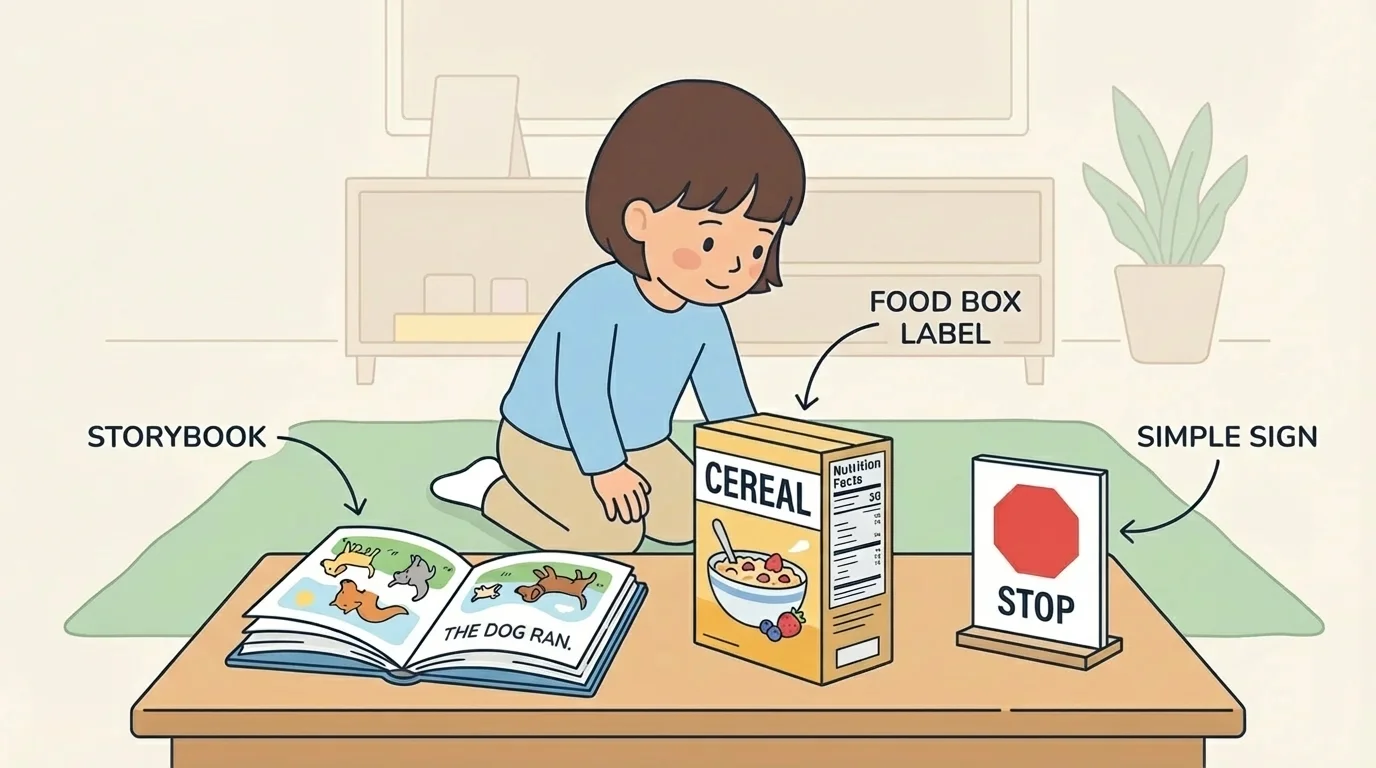
A storybook usually has characters, events, and pages to turn. An information book may show real animals, weather, trucks, or plants. A sign may use just one or two words, but those words are important. Each kind of print gives us something to notice and talk about.
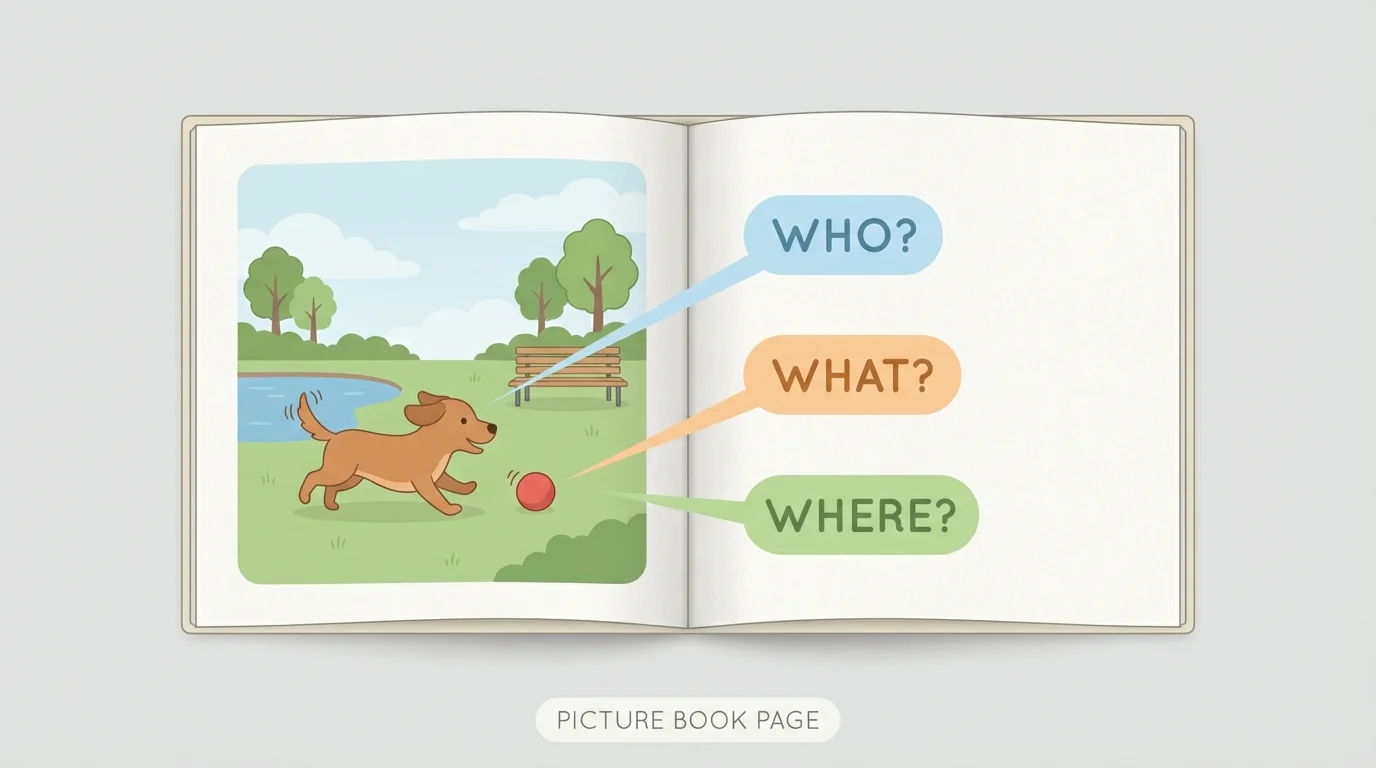
Questions help us look closely. When we ask questions, we are trying to find out more, and [Figure 2] shows how a child can study a page and wonder about it. Good questions can be very simple for young children.
Some helpful question words are who, what, and where. A child looking at a page might ask, "Who is this?" "What is the bear doing?" or "Where is the girl going?" These questions help the child focus on important details.
Questions can also be about feelings and actions. A child may ask, "Is the boy happy?" "Why is the baby crying?" or "What comes next?" Even when a child cannot read all the words yet, the child can ask strong questions by looking at pictures and listening to the book.
Questions help meaning grow. When children ask questions, they do not just name objects. They begin to think about characters, actions, places, and ideas. This helps them understand stories and information more deeply.
Adults and children can ask questions together. An adult may ask, "What do you see on this page?" Then the child may answer and ask a new question too. This back-and-forth talk builds language and understanding.
When children answer questions, they learn to use clues. A question asks for information. An answer gives the information. Children often find answers by looking at the picture, listening to the words, or noticing both together.
For example, if someone asks, "What is the cat doing?" the child might look at the picture and say, "The cat is sleeping." If someone asks, "Where is the bus?" the child may point and say, "On the road." These are strong answers because they match what is on the page.
Sometimes the answer is short. Sometimes it is longer. If the question is "Who is in the story?" a child might answer, "A girl and her puppy." If the question is "What happened?" a child might say, "The puppy ran away, and the girl found him."
Talking about one page
An adult and child look at a page with a red ball under a chair.
Step 1: Ask a question.
"What do you see?"
Step 2: Give an answer from the page.
"I see a ball."
Step 3: Ask another question.
"Where is the ball?"
Step 4: Answer with more detail.
"The ball is under the chair."
The child uses the picture to answer clearly and carefully.
Answering questions also helps children remember what they read or heard. If a child can answer "Who?" and "What happened?" the child is showing understanding.
A comment is something we say about what we notice or think. It is not always a question. It may tell about a picture, a feeling, or an idea, and [Figure 3] shows simple comments children can make while looking at a page.
Children can make many kinds of comments. They can describe: "The truck is big." They can connect: "I have a dog too." They can react: "That page is funny." They can notice details: "The flower is yellow." These comments show attention and understanding.
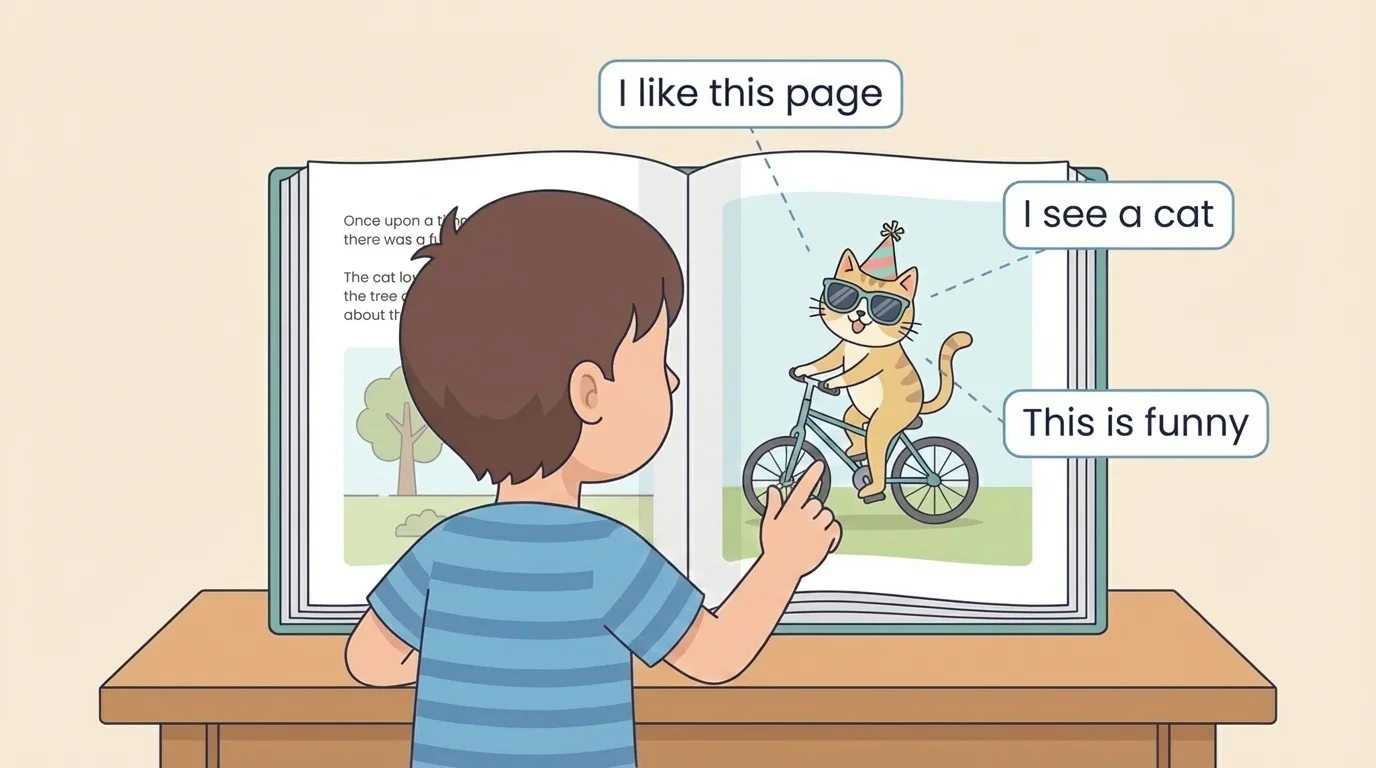
Comments help children stay involved with print. When a child says, "I like this book," that tells a feeling. When the child says, "The moon is up high," that tells an observation. Both are useful ways to talk about print materials.
Children often understand more than they can read by themselves. Pictures, repeated words, and conversation help them build meaning long before they read every printed word.
Comments can also grow into bigger ideas. A child may first say, "There is rain." Later the child may add, "The boy needs an umbrella." That longer comment shows deeper thinking.
When we study one page, we can notice many things. We may see a picture, a title, a character, or an action. We may hear a word that sounds familiar. Looking slowly helps us find details.
For example, on a page with a farm, a child might notice a cow, a barn, and a little duck. The child can ask, "What is the duck doing?" The child can answer, "It is walking." Then the child can make a comment: "The barn is red." This kind of talk shows careful looking.
Earlier, [Figure 2] shows simple question words that help children study a page. Those same question words can be used again and again with new books and new print materials.
We do not only ask and answer questions in storybooks. We can do it with information books, posters, labels, and signs too. If a child sees a label on a snack box, the child may ask, "What is this?" If the label shows crackers, the child may answer, "They are crackers." Then the child may comment, "I eat those at lunch."
In an information book about animals, a child may ask, "Where does the fish live?" The answer may be, "In water." A comment might be, "It has shiny scales." In a storybook, the child may ask, "Why is the bunny hiding?" and then comment, "It looks scared."
| Kind of print | Question | Answer | Comment |
|---|---|---|---|
| Storybook | Who is this? | The girl. | She looks sleepy. |
| Information book | What animal is this? | A turtle. | Its shell is hard. |
| Sign | What does this sign say? | Stop. | That helps cars know what to do. |
| Label | What is in the box? | Cereal. | I see a picture of a spoon. |
Table 1. Examples of questions, answers, and comments for different kinds of print materials.
As [Figure 1] shows, print is not only in books. Children build reading understanding when they notice print in many places.
Talking about print is also a social skill. One person asks, and another person answers. Then the other person may ask a new question. Children learn to listen, wait, and respond.
It helps to speak in clear, simple sentences. "I see a bird." "The bird is flying." "Where is it going?" These small sentences are powerful. They help children share ideas about what they read and see.
Pictures give important clues. Even before children read many words, they can use pictures to think, talk, and learn from print.
When adults listen carefully to a child's answer or comment, they learn what the child understands. When children hear good questions, they learn how to think more deeply about books and other print materials.
