Have you ever opened one book and met a dancing bear, then opened another book and learned about real butterflies? Books can do both. Some books take us into pretend adventures, some help us learn about the real world, and some let us enjoy lovely, playful words. When we listen, look closely, and talk about what we notice, we grow as readers.
[Figure 1] A fiction book tells a made-up story. The story may have animals that talk, children who fly to the moon, or a train that sings a song. These things are fun to imagine, even if they are not real. Fiction helps us wonder, feel, and think.
In fiction, we often meet characters. A character can be a child, an animal, or even a toy in the story. Characters do things, have feelings, and go to places. We may like a brave rabbit, a sleepy kitten, or a friendly giant. We can say, "This is a story," and talk about who is in it and what happens, as shown in [Figure 1].
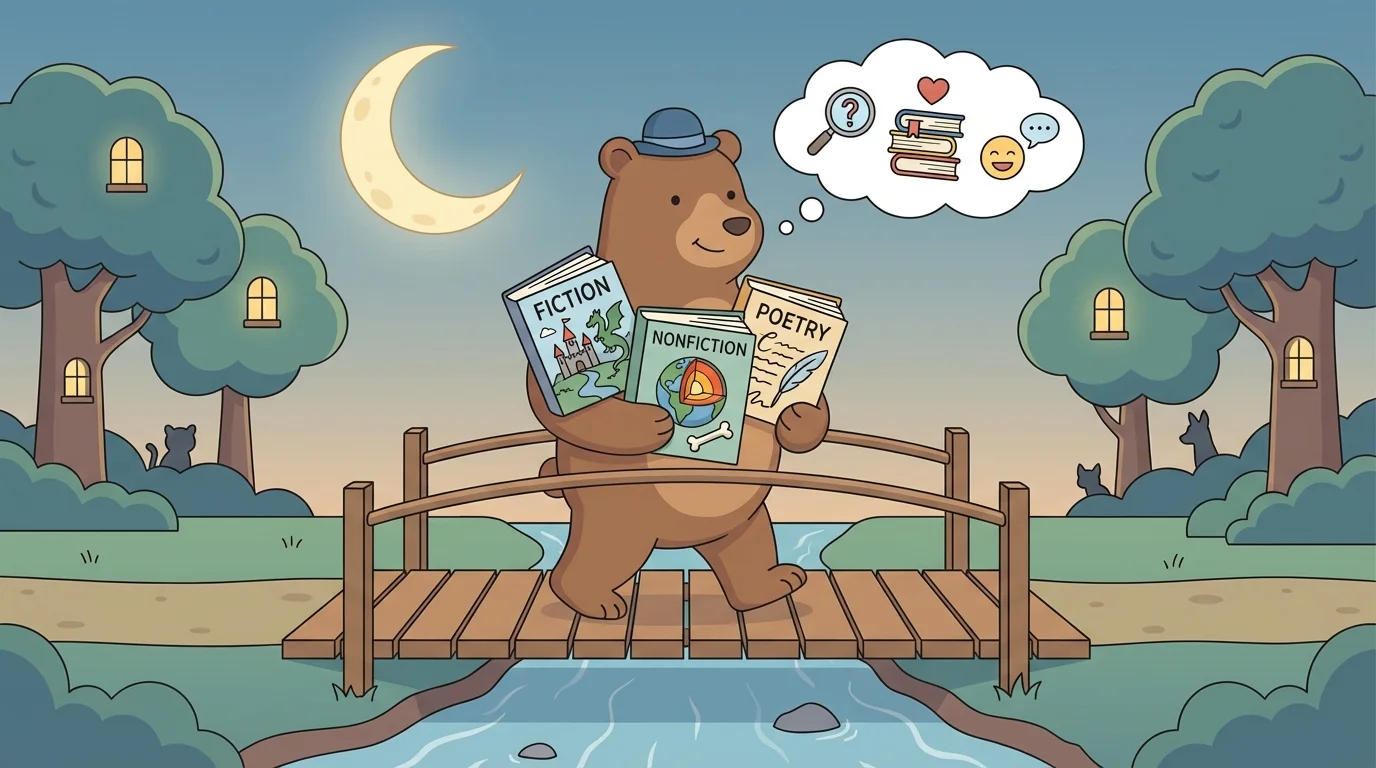
Fiction is a made-up story. Nonfiction is a book that gives true information. Poetry uses words in playful, rhythmic, or rhyming ways.
Some fiction books are silly. Some are calm. Some are about bedtime, friends, farms, trucks, birthdays, or lost mittens. A child can show interest in fiction by picking a favorite story, turning pages, pointing to pictures, or asking to hear the same book again.
[Figure 2] A nonfiction book gives true information about real things. It may be about dogs, weather, families, insects, space, food, or building tools. Nonfiction helps us learn facts about the world.
When we look at nonfiction, we may see photographs or careful pictures of real objects. We can notice details: a turtle has a shell, a seed grows into a plant, and rain comes from clouds. We do not have to read every word to enjoy nonfiction. We can look, listen, and say what we see: "That bird has long legs," or "The fire truck is red," as shown in [Figure 2].
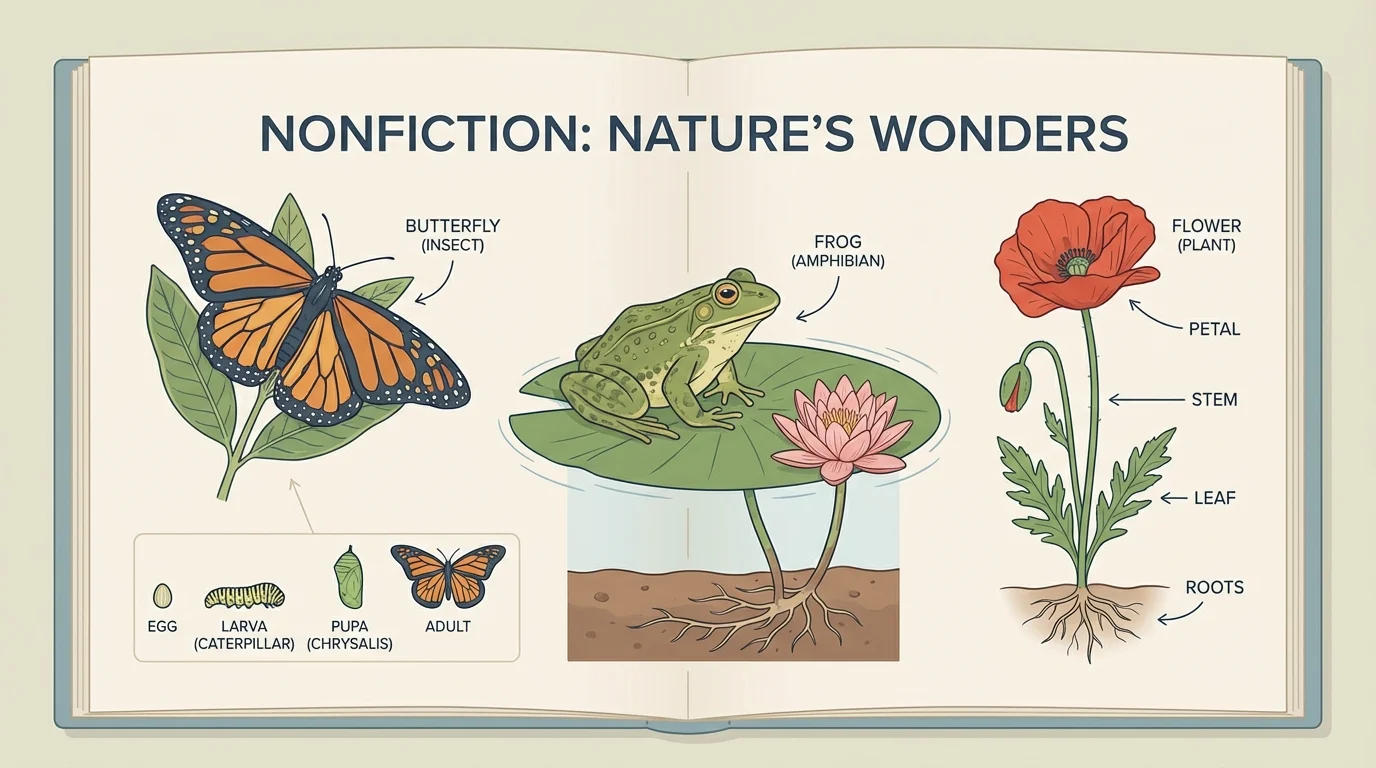
Children often like nonfiction because it connects to their own interests. One child may love books about dinosaurs. Another may want books about families, trains, cats, or the ocean. Liking different topics is part of becoming a reader. Interest grows when children see that books can answer real questions.
Some children ask for nonfiction books again and again because they enjoy learning the names of real things. Looking at a favorite fact book many times helps them notice something new each time.
Later, when we compare books, we can remember that the pretend bear adventure from [Figure 1] belongs to fiction, while the labeled animal page in [Figure 2] belongs to nonfiction.
[Figure 3] Poetry is another kind of literature. A poem may be short, musical, and full of repeating sounds. Some poems rhyme, like "star" and "car." Some poems have a beat we can clap. Poetry invites us to listen carefully to words.
A poem does not have to tell a long story. It can describe rain on a window, a buzzing bee, or a sleepy moon. It can make us feel happy, cozy, excited, or calm. Young children enjoy poetry by hearing patterns, joining repeated lines, and noticing sounds that match, as shown in [Figure 3].
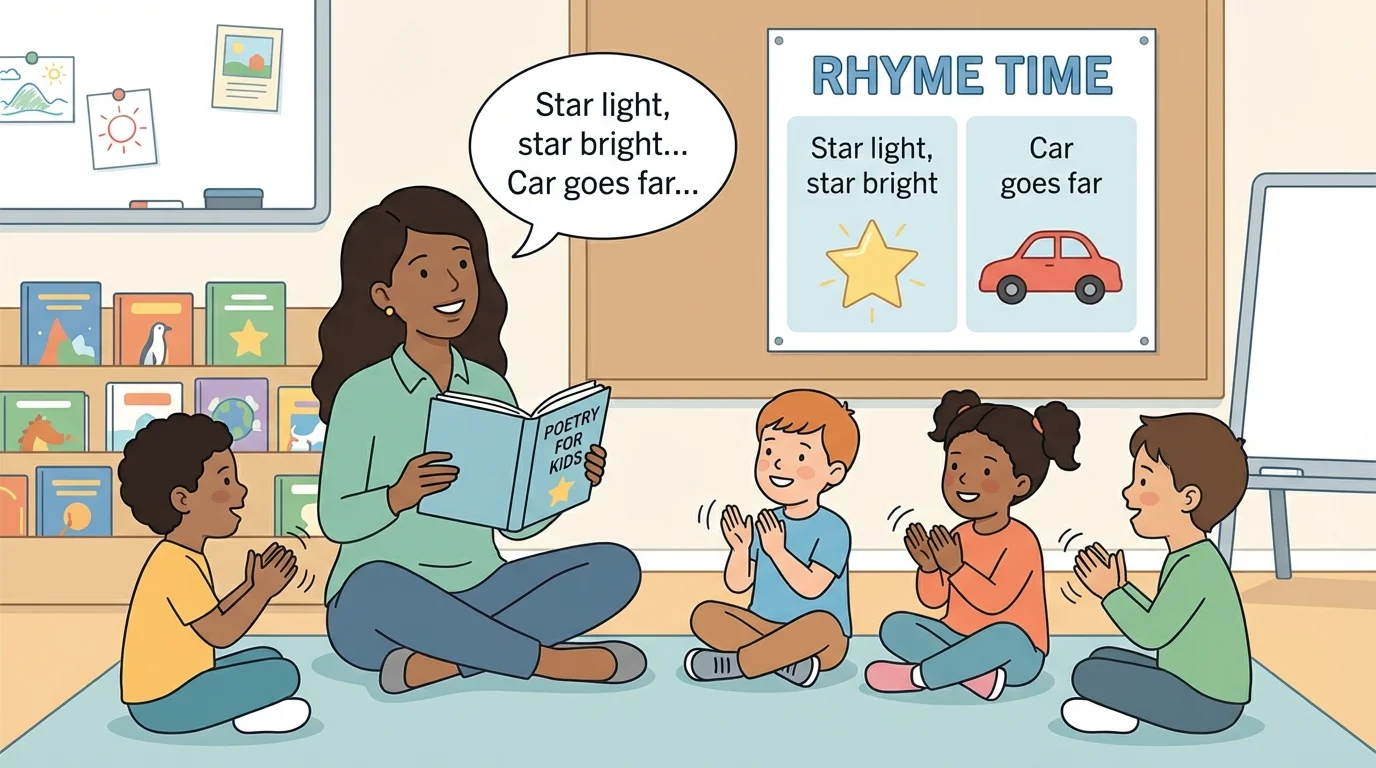
Poetry can be about many topics, just like fiction and nonfiction. There are poems about seasons, pets, family members, food, colors, and bedtime. If a child smiles, sways, repeats a line, or asks to hear the poem again, that child is showing interest in literature.
Literature means the books and poems we read and enjoy. Children can be interested in many kinds of literature and many topics. One day a child may want a story about a little boat. Another day the same child may want a true book about fish. On another day, a poem about splashing puddles may feel just right.
This variety matters. When children explore many topics, they learn that reading is for fun, for learning, and for sharing. A classroom or home may include stories about friendship, fact books about animals, and poems about weather. All of these help children understand meaning from words and pictures.
Different kinds of books help us in different ways. Fiction grows imagination and helps us care about characters. Nonfiction builds knowledge about the real world. Poetry helps us hear rhythm, rhyme, and strong feeling in language. Enjoying all three kinds helps children become curious and confident readers.
As we saw in [Figure 3], even clapping to a poem is part of reading growth because children are listening for patterns and enjoying how language sounds.
Children show interest in literature in many simple ways. They choose a book from a shelf. They bring a favorite book to an adult. They point to a picture. They name something they notice. They listen closely. They ask, "Read it again." They join in on a repeated line. All of these actions show that books matter to them.
Talking about books is important too. A child might say, "The puppy is hiding," in a story, or "That is a real tractor," in a nonfiction book. The child might finish a rhyming pair in a poem. These responses show understanding. Children are not just hearing words; they are thinking about them.
Examples of showing interest
Step 1: A child picks a book about buses and sits down to look at the pictures.
Step 2: The child points and says, "Big wheels!"
Step 3: The child asks to see the bus book again later.
This shows interest in nonfiction on a favorite topic.
Another child may laugh at a silly fox in a story and want to know what happens next. Another may repeat the last word in each line of a poem. These are all important early reading behaviors.
When children are interested in literature, they also begin to learn how to care for books. We hold books gently, turn pages carefully, and put books back where they belong. Caring for books helps keep them ready for the next reading time.
Reading together makes literature even more meaningful. An adult can read aloud, ask simple questions, and pause to let the child notice details. A child may listen quietly, point to a picture, or speak about a favorite page. Shared reading helps children connect stories, facts, and poems to their own lives.
Pictures help tell meaning too. Even before children can read all the words, they can understand a lot by looking closely at illustrations and photographs and by listening to spoken language.
Over time, children learn that books are full of choices. They can enjoy a made-up tale, learn from a nonfiction book, and delight in a poem's sounds. A rich reading life includes all of these.
