Have you ever heard a story and wanted to tell it to someone else right away? That is something readers begin to do. When children listen to books, look at pictures, and think about what they hear, they can share the book again in many ways. They can talk about it, draw it, move like it, or act it out.
Retelling means sharing what a book says in your own way. A child does not need to repeat every word in the book. A retell can be simple and clear. It can tell who was in the book, what happened, where it happened, or what new fact was learned.
Retell means to tell again what happened in a story or what was learned from a book. Story means a book with characters and events. Information book means a book that teaches facts about the world.
When we read or hear a book, we pay attention to the important parts. In a story, important parts may be the character, the place, and the big things that happen. In an informational book, important parts may be facts, names, pictures, and details that teach something real.
To retell well, children first listen and look carefully. They notice pictures, actions, and words. They may remember one big part or several little parts. A preschool retell can be short, such as "The bunny was sad, then he found his mom." That is still a real retell.
Children often remember best when they think about who, what, and where. For a storybook, they might say, "A girl baked bread in the kitchen." For an information book, they might say, "Bees make honey and live in a hive." These simple details help the listener understand the book.
Remembering the important part
Retelling is not about saying every page. It is about holding onto the most important idea. A child may remember one favorite event, one strong feeling, or one true fact. That important part becomes the center of the retell.
Pictures in books help memory too. When children look at illustrations, they can often recall what happened before and after. They may use the pictures as clues to help them speak.
One easy way to retell is through conversation. A conversation is talking and listening with another person. In conversation, children can share a story in order. [Figure 1] They might say, "First the puppy ran away. Next the child looked for the puppy. Last the puppy came home."
Order words help make a retell clear. Good order words are first, next, then, and last. Children can also name a favorite part: "My favorite part was when the duck splashed in the pond." If the book is nonfiction, they can say a fact: "Penguins live where it is cold."
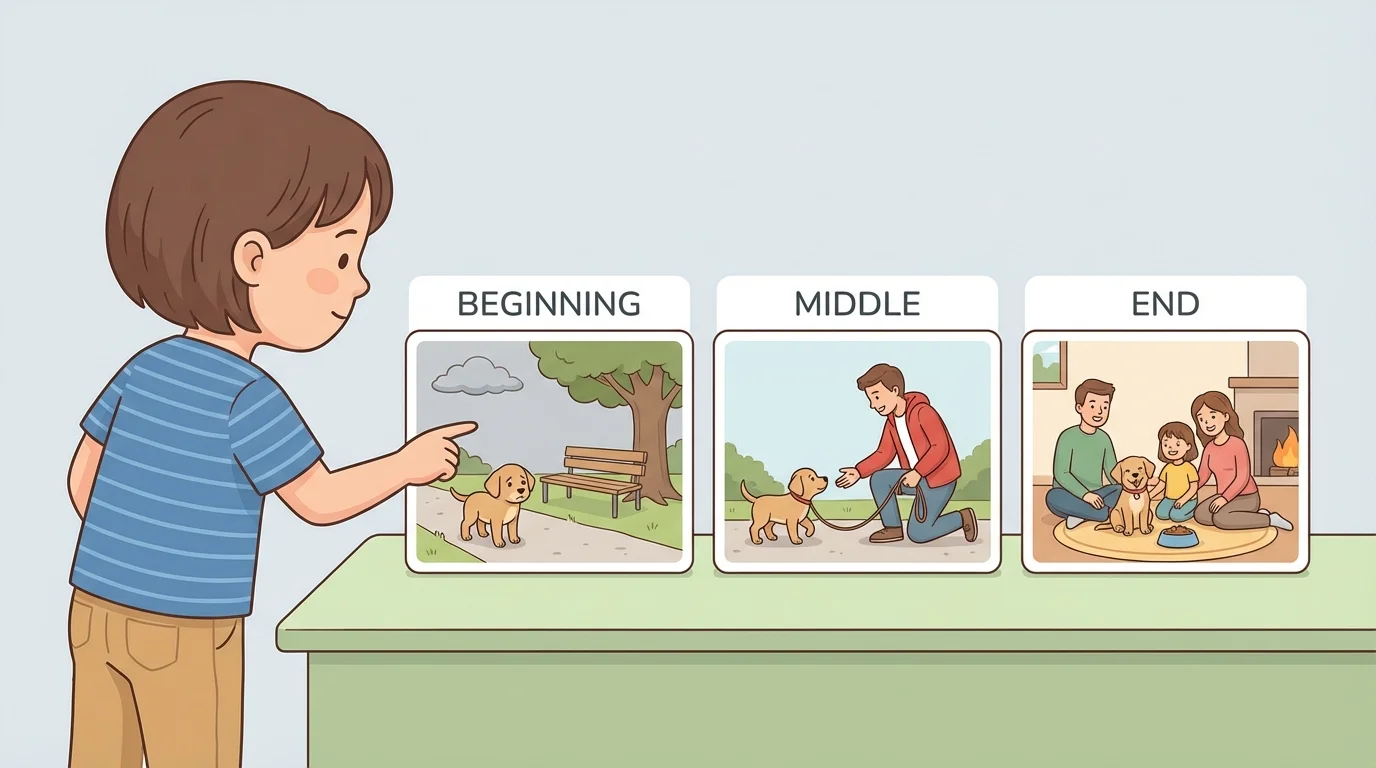
A child does not need long sentences for a retell. Short sentences can still hold meaning. "Bear was sleeping. Bear woke up. Bear ate berries." Those words tell what happened. When a listener hears the events in order, the retell makes sense.
Sometimes a child retells by answering gentle questions. "Who was in the book?" "What happened?" "What did you learn?" These questions help a child pull ideas back from memory. Later, the child may not need the questions and can tell more independently.
Conversation retell examples
Example 1: Storybook retell
"The little bird was hungry. Then it found a worm. Then it fed its babies."
Example 2: Talking about a favorite part
"I liked when the train went through the tunnel because it was dark."
Example 3: Information book retell
"A seed goes in the dirt. It gets water and sun. Then it grows into a plant."
Later, when children hear another story, they can still use the same pattern we saw in [Figure 1]: tell the start, tell what happened next, and tell how it finished or what was learned.
Children can also retell through artwork. [Figure 2] That means they use art to show something from the book. A drawing can tell who is in the story, where they are, and what they are doing.
Art does not need to look exactly like the book picture. It only needs to show the idea. A child might paint a large blue fish from a sea book. Another child might make a paper sun for a book about weather. If the art includes important details, it becomes a retell.
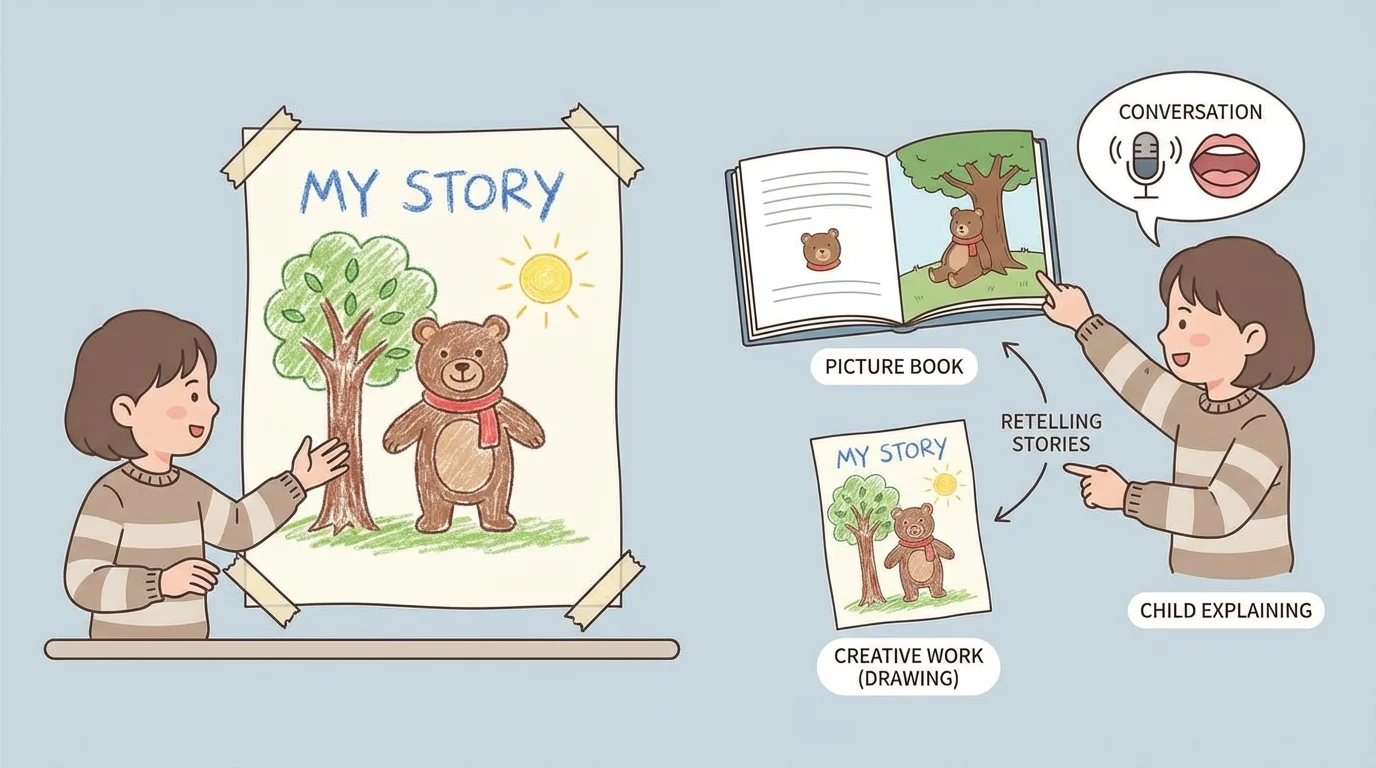
Sometimes children use blocks, clay, or collage pieces instead of crayons. They may build the house from a story or shape an animal from an information book. This kind of work helps them think again about the book's details.
Art can also show feelings. A child may use dark colors for a stormy part or bright colors for a happy ending. The picture becomes a way to share understanding, not just decoration.
Young children often remember more when their hands are busy. Drawing, building, and painting can help a story stay in the mind.
When children talk about their picture, they practice retelling again. They might say, "This is the bear under the tree. He lost his scarf. Then he found it." The artwork and the words work together.
Some books almost ask the body to join in. Children can retell with creative movement by moving like a character, an animal, or even the weather. They may stomp like a giant, flutter like a butterfly, or sway like a tree in the wind.
Movement helps children show action and feeling. If a story character is sneaking, the child can tiptoe. If a rabbit is excited, the child can bounce. If an information book teaches how a caterpillar changes, the child can curl up small and then slowly stretch wide like a butterfly.
Movement carries meaning
Creative movement is not random motion. It shows an idea from the book. The body can represent speed, size, feeling, and change. When a child moves with purpose, the movement becomes a retell.
This is especially helpful for children who understand more easily through doing. A child may not say many words yet, but may clearly show "the frog jumped into the pond" with a crouch and a leap.
Movement can also follow sequence. First a child pretends to plant a seed. Next the child reaches up like a sprout. Last the child opens arms wide like a flower. The body tells the order of the information.
Another exciting way to retell is through drama, or pretend acting. [Figure 3] In drama, children take roles and show what the characters do. One child may be the bear, one may be the friend, and one may be the narrator who tells what happens.
Simple props can help. A scarf can become a cape. A paper crown can become a king's crown. A stuffed animal can stand in for a story character. These small objects help children remember the book and stay in their role.
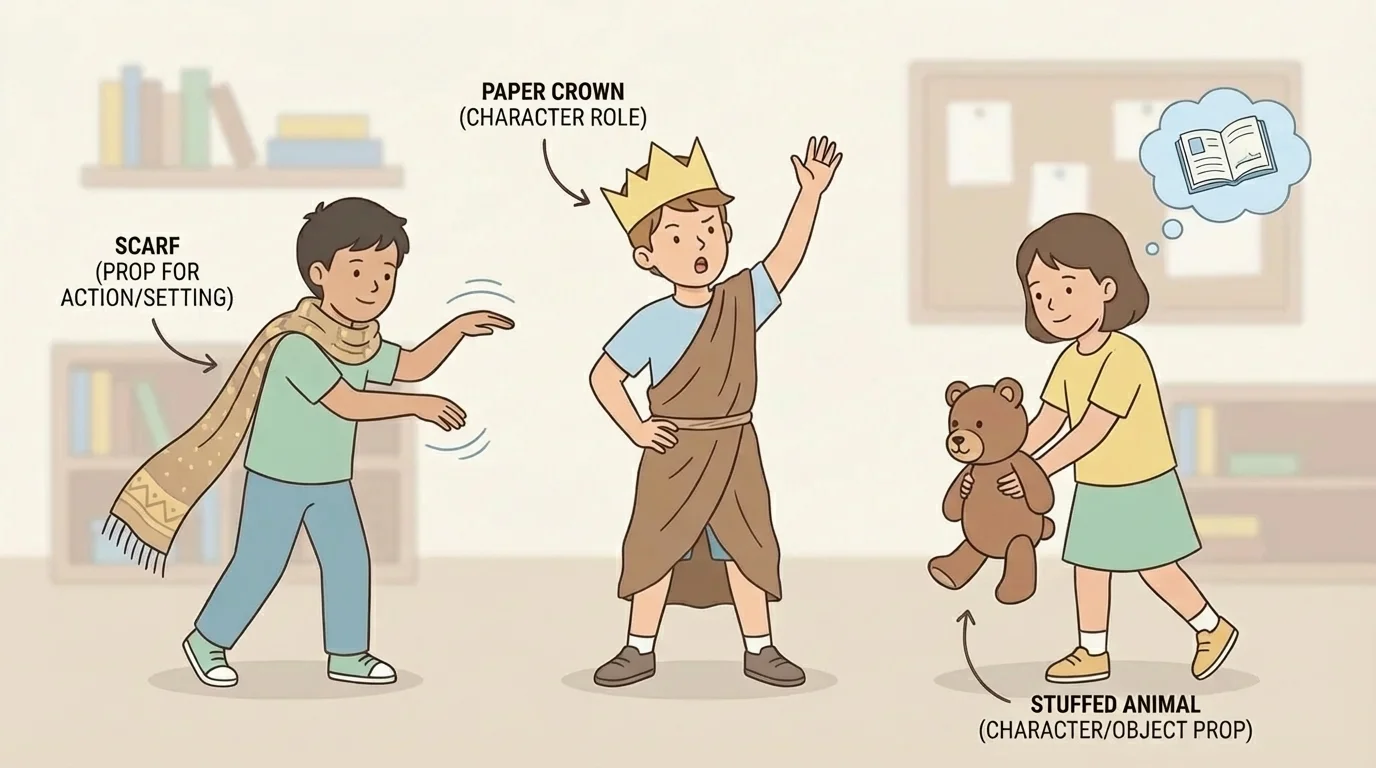
Acting out a book does not have to be perfect. Children may use only one scene. They may act the beginning, a favorite middle part, or the ending. They may also use voices and faces to show how characters feel.
Drama can retell information books too. Children might act like firefighters helping people, or pretend to be animals moving in their habitats. They are still sharing what the book taught, just in a dramatic way.
Pretend-play retell
Step 1: Choose a book part
A child chooses the part where the hen gathers seeds.
Step 2: Pick roles or actions
One child is the hen. Another child is the dog. Another child tells what happens.
Step 3: Act the events in order
The hen asks for help, gathers seeds, and plants them.
This acting sequence retells the book with body, words, and feeling.
Much later, children can still remember the dramatic scene we met in [Figure 3] because acting helps fix characters and events in memory.
Retelling a storybook and sharing information from a book are similar, but not exactly the same. A storybook usually has characters and events. An information book usually has facts and real details. Both kinds of books can be shared clearly.
In a story retell, children often say who the character is, what problem happened, and what happened next. In an information retell, children often say what the topic is and one or more facts. For example, after a book about rain, a child may say, "Clouds got dark. Rain fell on the plants." After a book about trucks, a child may say, "Dump trucks carry heavy dirt."
| Book type | What children often retell |
|---|---|
| Storybook | Characters, setting, events, favorite part, ending |
| Information book | Topic, facts, parts, actions, real-world details |
Table 1. The table compares what children commonly share when retelling storybooks and information books.
When children retell either kind of book, they are building understanding. They show that books have meaning. They also learn that meaning can be shared in more than one form: speech, picture, motion, or acting.
Books can be enjoyed in many ways. Looking at pictures, listening to words, and talking about ideas all help children understand what they read or hear.
Every retell may look a little different. One child may speak a lot. Another may draw. Another may move. Another may act. All of these ways can show real understanding when they connect to the book's important ideas.
