A single swirl of crayon can mean a race car, a puppy, or a trip to the park. That is one of the exciting things about early writing: children begin to show what they know, remember, and imagine by making marks. Writing does not start only with neat words. It starts when a child uses marks to say, "This is something important."
Representation means showing something in another way. A child may make lines, dots, loops, or swirls and say, "This is my house," or "This is Dad." Those marks are not random to the child. They carry meaning.
When children make marks, they are learning that paper, cardboard, chalkboards, and other surfaces can hold their thoughts. A fast zigzag might represent rain. A big round shape might represent a ball. A page full of color might represent a birthday party. Early writing is a way to communicate.
Scribble is an early mark made with a writing tool. Shape is a simple form such as a circle, line, or square. Picture is a drawing that shows something. Letter is a symbol in the alphabet that can be used in writing.
These early forms all matter. A scribble can tell a story. A shape can stand for an object. A picture can show an experience. A letter can be the beginning of a word or a name.
Children use many tools to create meaning: crayons, markers, pencils, chalk, paintbrushes, and even fingers in sand or shaving foam. Each tool makes a different kind of mark. Thick crayons make bold lines. Small pencils can make tiny marks. Paintbrushes can make long, smooth strokes.
Holding and using a writing tool helps children practice control. They learn that their hand movements can make lines go up, down, around, and across. This control supports both drawing and writing. At this age, the goal is not perfect form. The goal is purposeful mark-making.
Some children press hard and make dark lines, while others make light, soft marks. Both kinds of marks can carry meaning and show ideas.
Children also learn simple writing habits. They notice that paper has a front and back, that marks stay on a page, and that a page can keep a memory. A drawing of a snack, a pet, or a playground moment becomes something that can be looked at again.
Early writing often begins with a scribble. A scribble may look like loops, lines, or quick back-and-forth marks, but it can still represent something important, as [Figure 1] shows when marks grow into shapes and simple drawings with meaning. Children may say, "This says dinosaur," or "This is my grandma."
As children grow, they often begin using familiar shapes in their marks. A circle can become a face, a wheel, or the sun. A square can become a house or a window. Lines can become legs, roads, or falling rain. Shapes help children organize what they want to show.
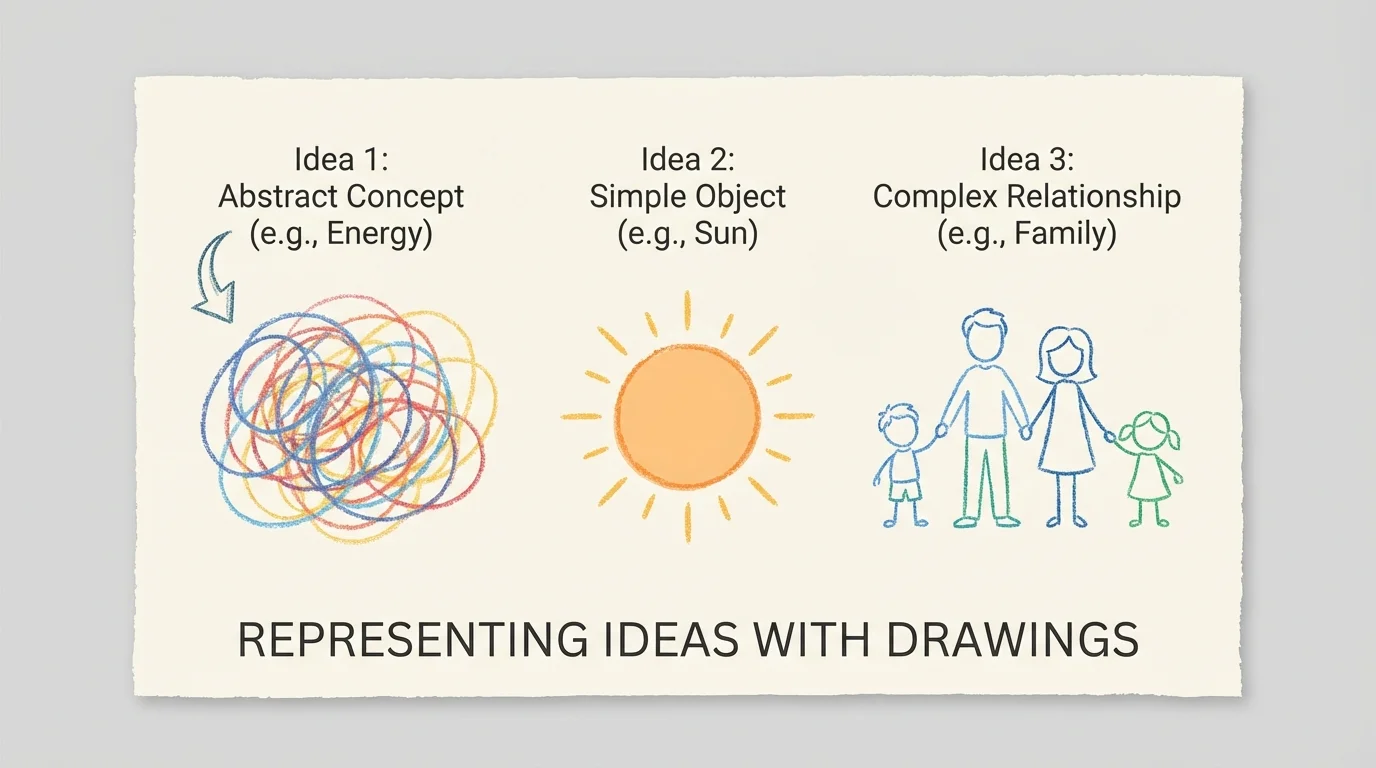
A picture gives even more detail. A child might draw a family at dinner, a dog in the yard, or a big splash in a puddle. Pictures help others understand the child's message. Even when the drawing is simple, it can hold a rich story.
Sometimes children combine all three: scribbles, shapes, and pictures. A child may draw a cake, add circles for candles, and make lines underneath that stand for "Happy birthday." This combination shows growing understanding that different kinds of marks can work together.
Early writing grows step by step
Children often move from broad scribbles to more controlled shapes, then to pictures, letter-like marks, and letters. This growth does not happen the same way for every child, and children may use several stages at once. What matters is that the child is using marks to communicate meaning.
Later, the same idea from [Figure 1] appears again when a child adds more detail. A round scribble that first meant "ball" may later become a clearer circle with stripes for a beach ball. This change shows that representation becomes more exact over time.
Children also begin to notice letters in books, signs, labels, and their own names. They may try to make letter-like marks or write letters they know. The first letter of a child's name is often very important.
A child named Maya might write a big M next to a drawing and say, "That stands for Maya." Another child might write B near a ball drawing. At first, one letter may stand for a whole word or idea. This is an important step in learning that letters carry meaning too.
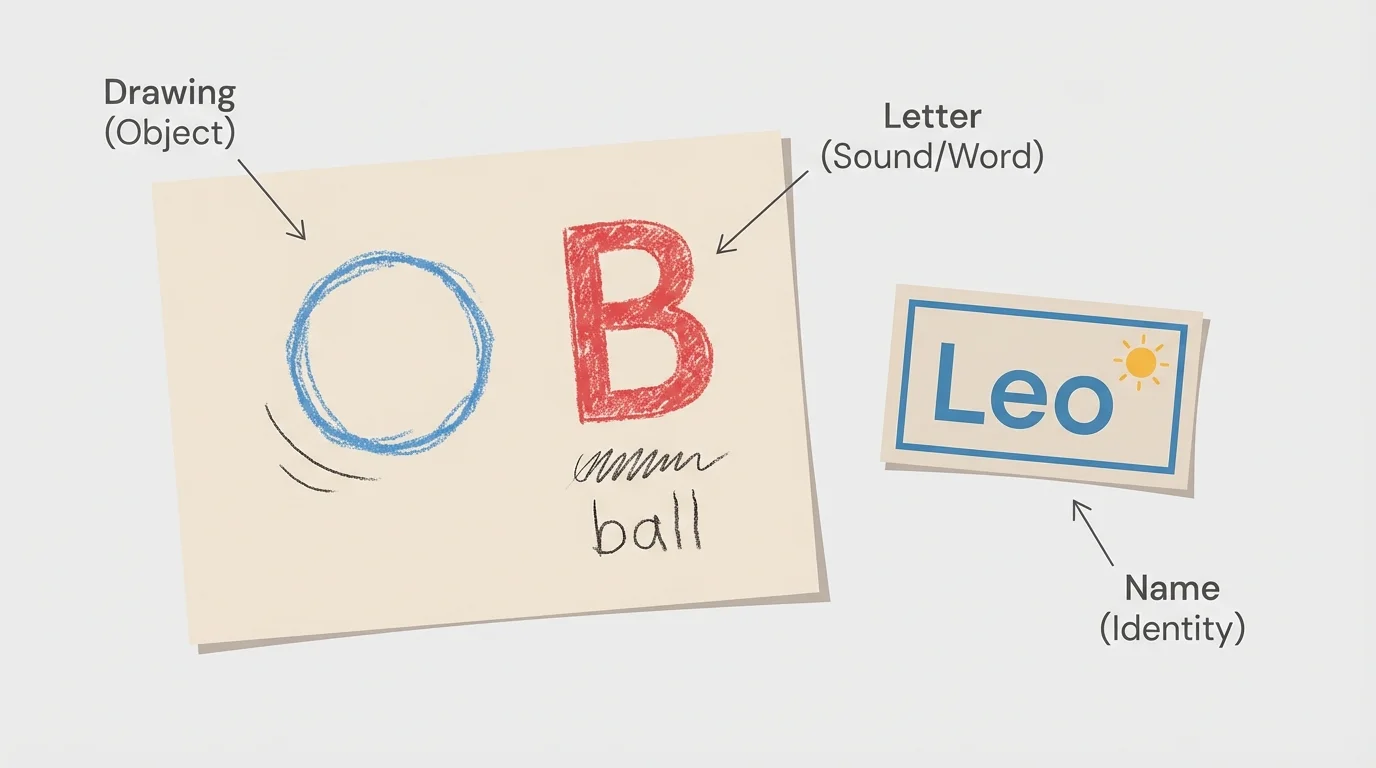
Letter-like marks are also part of growth. These may look almost like real letters but are not yet standard forms. They show that the child is noticing how writing looks and is trying to use similar symbols.
Children may mix pictures and letters on one page. A drawing of a cat with a C, or a self-portrait with the letters from a name, shows that they are connecting visual representation and written symbols. This is a strong beginning for later writing.
Examples of meaningful early writing
Step 1: A child draws long blue lines.
The child says, "It is raining." The lines represent rain.
Step 2: A child draws a round shape with smaller circles on top.
The child says, "It is a snowman." The shapes represent body parts.
Step 3: A child draws a dog and writes D.
The picture and letter work together to represent the dog.
Much later in the lesson, the idea in [Figure 2] still matters: one familiar letter can help a child label a drawing, remember an object, or connect spoken language to written symbols.
Children do not only represent objects. They also represent stories, experiences, and ideas. A child might draw a slide and two friends to show a trip to the playground. Another child might make many dots and say they are cookies for a party. These marks show memory and imagination.
Early writing can represent feelings too. Dark, strong strokes may stand for thunder. Bright circles may stand for balloons and happiness. A tiny drawing in one corner may show a sleeping pet. Children use marks to share what they notice and how they feel.
You already know that speaking tells others our ideas. Early writing is another way to share those ideas, even before full words are written.
Sometimes adults may not understand a child's marks right away. That is why it is helpful to listen when a child explains, "This is me at the zoo," or "These are the cupcakes." The child is the author and can tell what the page means.
When children talk about their own marks, they are learning that writing can be "read" for meaning. A child may point to a scribble and tell a whole story. The marks help the child remember and organize ideas.
This rereading moment is very important. It shows that the child understands that writing and drawing are for communication. Even if the marks do not look like standard adult writing, they still have purpose.
"My marks mean something."
— An important idea for every beginning writer
Listening to a child read back a page helps build confidence. It tells the child that thoughts, memories, and ideas are worth saving and sharing.
Beginning writers grow in many ways. They move from big arm motions to smaller hand motions. They make marks with more control. They use shapes more clearly. They begin to add pictures, letter-like forms, and letters. Growth is not a race. It is a process.
One child may mostly scribble today and draw detailed pictures tomorrow. Another may love writing the first letter of a name again and again. Both are learning. Early writing includes experimenting, noticing print in the world, and making meaningful representations.
The most important idea is that children use scribbles, shapes, pictures, and letters to stand for something. A page can hold a pet, a family, a storm, a snack, a dream, or a story. That is the beginning of writing.
