A note on the fridge, a name on a picture, a tiny scribble on a card—writing is everywhere. Young writers begin by making marks, then shapes, then letters, and soon those letters become words. Every time a child copies, traces, or writes a letter, the hand and brain work together to share a message.
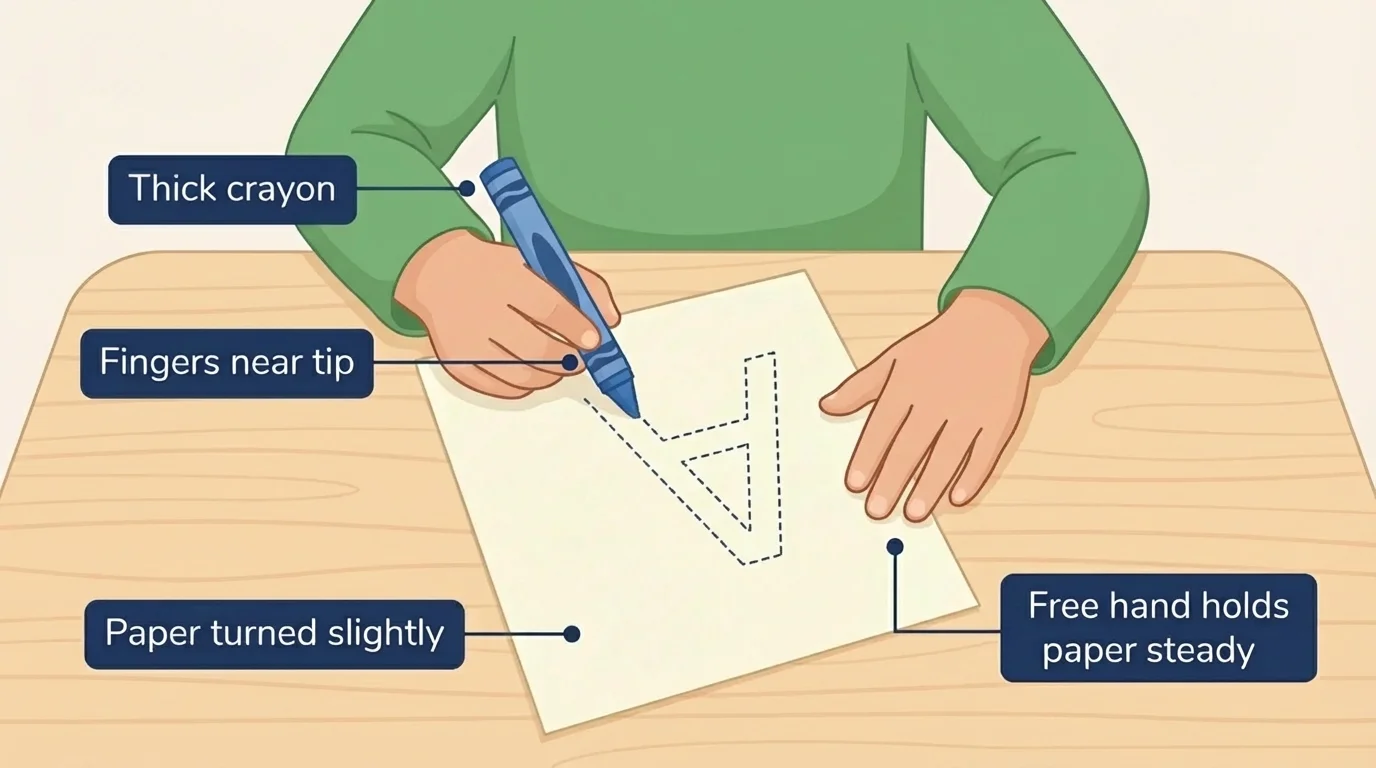
A writing tool can be a crayon, marker, pencil, or chalk. Early writers do not need perfect writing. They need tools that feel good in the hand and make clear marks. A thick crayon or marker is often easier to hold and move. Hand position, finger control, and paper placement work together, as [Figure 1] shows, to help the child make steady lines and curves.
When children write, one hand can hold the paper still while the other hand moves the tool. This helps the paper stay in place. Sitting at a table or on the floor with paper on a firm surface makes writing easier. Gentle control matters more than neatness at this age.
Writers may draw lines, dots, circles, and zigzags before they make letters. These marks are important. They build hand strength and control. A straight line, a curved line, and a circle are parts of many letters.
Copy means looking at a letter or word and making one that looks the same. Trace means going over a line that is already there. Independent writing means making a letter or word by yourself, without going over lines.
These three kinds of writing are all useful. Children often begin with big arm movements, then use smaller finger movements. Over time, writing becomes more controlled and easier to read.
When a child copies, the eyes look at a model and the hand tries to make the same shape. A model might be one letter, like A, or a familiar word, like mom or cat. Copying helps children notice letter shapes, sizes, and directions.
Some copied letters may be large, wobbly, or turned the wrong way. That is normal in early writing. A child may copy the first letter of a name before copying the whole name. Seeing a clear model helps the child compare: "This is the one I see, and this is the one I made."
Many young children learn to write the letters in their own names first because those letters feel important and familiar. A name often becomes a child's first meaningful word in print.
Copying can include uppercase letters, lowercase letters, or simple words. At first, children may copy only part of the word. For example, they may see dog and write only d. This still shows that they are connecting print to meaning.
[Figure 2] Tracing gives the hand a path to follow. Instead of making the whole shape alone, the child moves on top of a line that is already printed. This helps build memory for how a letter looks and how it moves on the page.
Tracing often begins with simple lines and shapes: straight lines, curved lines, loops, and circles. Then children trace letters. Large letters are easier first because they give more room for the hand to move. Tracing can also help children learn where a letter starts and where it ends.
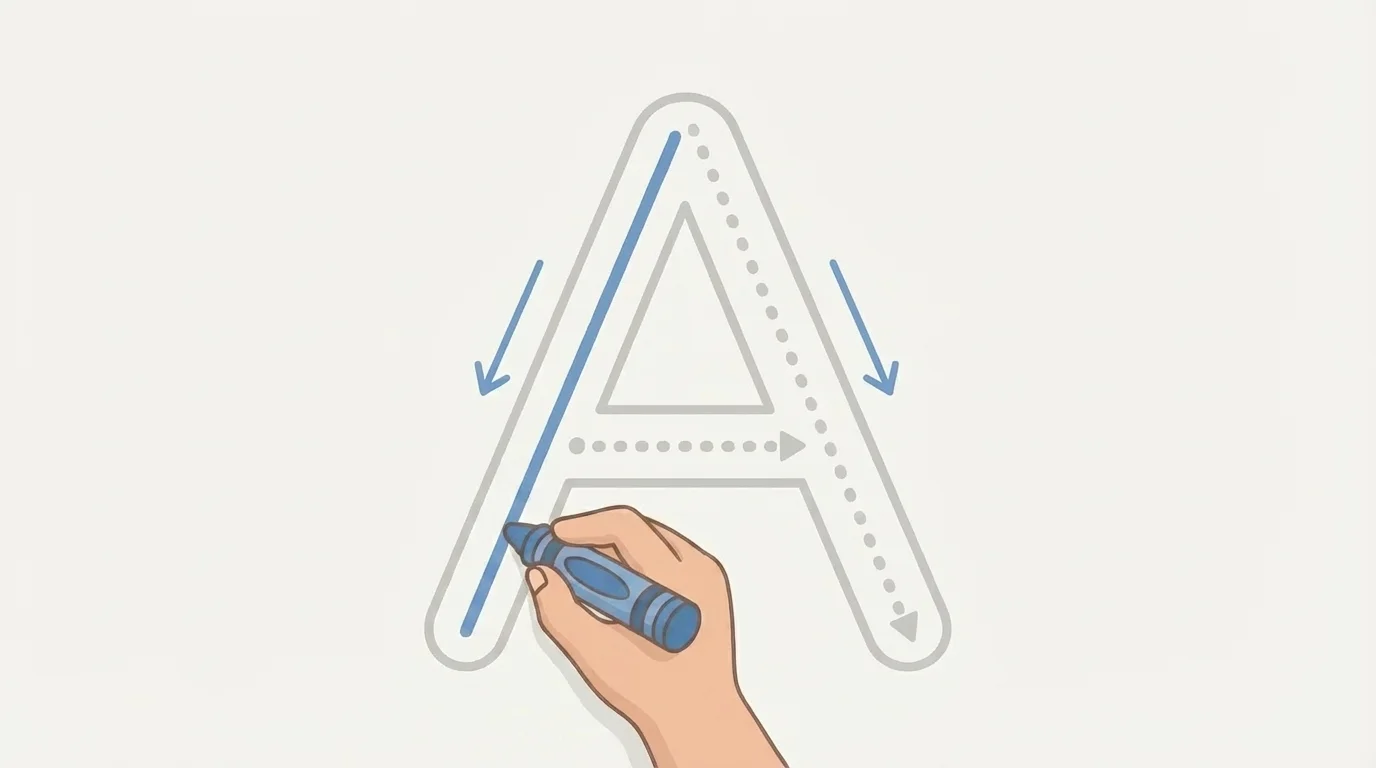
A traced letter may not stay exactly on the line. That is all right. The goal is to practice moving in the same shape. Over time, tracing supports better control, smoother movement, and stronger awareness of letter forms.
Tracing words can also be meaningful. A child might trace Sam, Mom, or hi. When the word is familiar, the child begins to connect the look of the word with its spoken form.
From movement to memory
Early writing grows when children repeat helpful movements. Tracing lets the hand practice a path again and again. After enough practice, the child begins to remember the shape and can try to make it without tracing.
Later, the same idea returns when children write alone. The tracing path is gone, but the memory of the movement stays. That is why tracing can be a bridge between watching and doing.
[Figure 3] To write independently means a child makes letters or words without drawing over a model. This might be one letter from memory, a name, or a simple word from daily life. The growth from model to memory is clear.
Independent writing at this age may include letter-like forms, some correct letters, and some scribbles mixed together. A child may write M for a name, or write a row of shapes and say, "That says daddy." This is important because the child understands that writing stands for words and ideas.
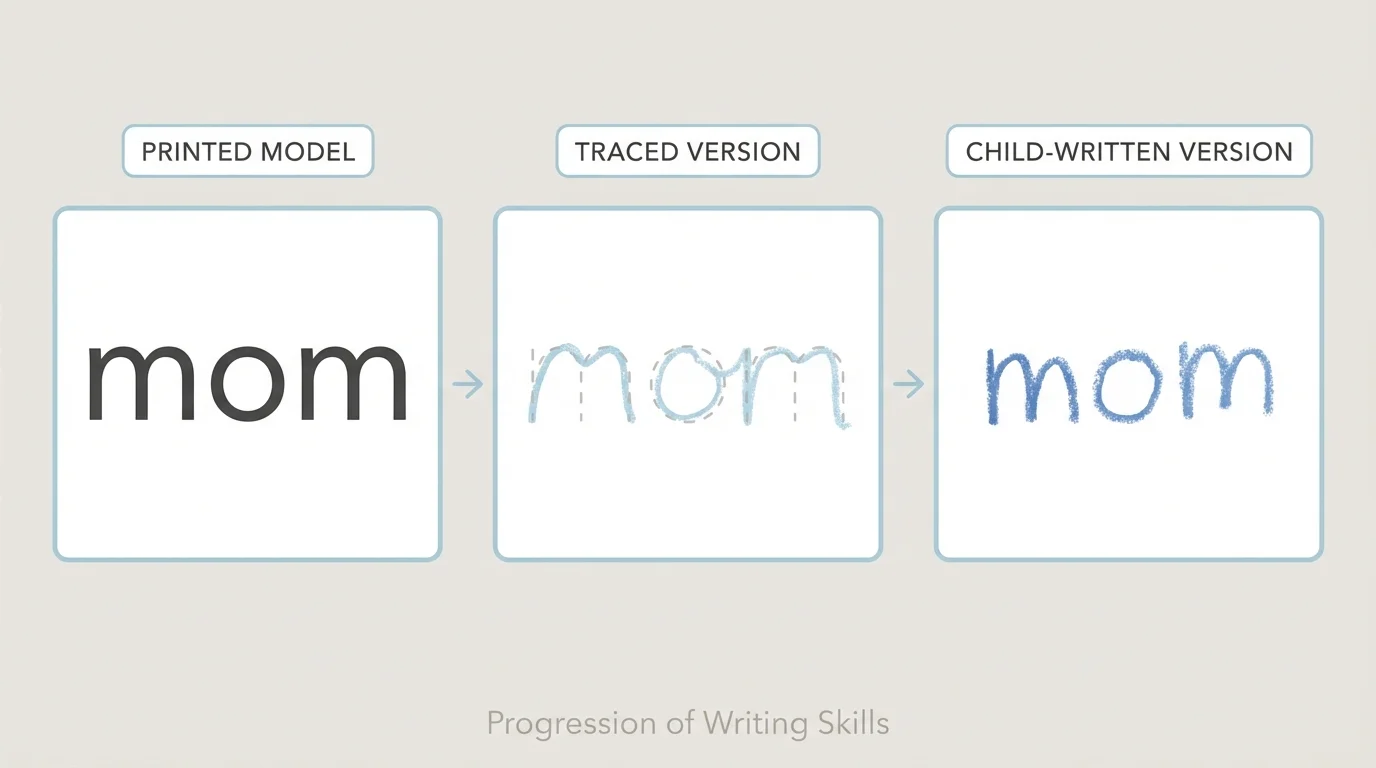
Some children write familiar words first. Common examples are a first name, mom, dad, hi, or a favorite label seen often. Other children begin by writing single letters they know. Both are part of early writing development.
Early writing examples
Step 1: A child sees the name Ava on a card.
Step 2: The child copies A and then tries the rest of the name.
Step 3: Later, the child writes A alone on a drawing.
This shows growth from copying to independent writing.
Children do not need every letter to be correct for the writing to matter. Early attempts show that they are learning that print carries meaning. As with the word sequence in [Figure 3], each stage supports the next one.
Letters are symbols we use to write words. In early childhood, "good" writing does not mean perfect lines or perfect spelling. It means the child is using tools, making intentional marks, and trying to represent language with print.
Children begin to notice writing left-to-right in English. They also start to notice that print usually moves from top to bottom on a page. They may leave spaces between marks or words, though not always. These are early writing conventions, and they grow with experience.
Size and shape may vary a lot. One letter may be very big and the next very small. Some letters may be upside down or reversed. These variations are common in young writers. What matters is that the child is experimenting with forms and learning how symbols work.
Children already know many messages can be shared without speech: pictures, gestures, and signs all communicate. Writing is another way to communicate, using marks, symbols, letters, and words.
As children gain confidence, they often combine drawing and writing. A picture of a dog with the word d or dog beside it shows an important connection between image, sound, and print.
Early writing depends on fine motor skills, which are the small hand and finger movements used for careful actions. Picking up crayons, pressing lightly or firmly, and changing direction all support writing growth. [Figure 1] remains useful here because it shows how body position, paper placement, and hand use support control.
Children also benefit from large movements before small ones. Drawing in sand, making lines with paint, or moving a finger along a big letter helps the body learn the shape. Then the same shape becomes easier to make on paper with a smaller tool.
Confidence matters. A child who feels safe to try will write more often. Praise for effort, such as "You made a long line" or "You wrote the first letter of your name," helps children see themselves as writers.
"Writing begins long before words are spelled correctly."
Copying, tracing, and independent writing work together. Copying helps children look closely. Tracing helps children follow a path. Independent writing lets children use memory, ideas, and growing control to make print of their own.
