Something tiny can become a big idea: a cup tips over, a block tower falls, or a plant looks droopy. When young learners stop, look, and ask questions, they begin to think like little researchers. They learn that a problem is not just something wrong. A problem is also something we can wonder about, talk about, and try to help.
A problem is something that needs help, fixing, or figuring out. A shoe that will not go on, a puzzle piece that does not fit, or a toy car that will not roll can all be problems. Children first learn by noticing, "Oh no," "It fell," or "It is stuck."
Problem means something is not working the way we want, or something makes us wonder. Solution means an idea or action that may help the problem.
When we notice a problem, we do not have to know the answer right away. We can stop and look. We can listen. We can think about what happened first. Then we can begin to ask questions.
Questions help us look closely at a problem, as [Figure 1] shows with children talking about a spill. A good question can be very simple: What happened? Where did it go? Why is it wet? How can we help? Asking questions is how we begin to learn more.
Children can ask questions with words, gestures, or faces. A child may point to a broken crayon and ask, "Why?" Another child may look at a dark cloud and ask, "Rain?" These are early ways of doing inquiry, which means finding out by wondering and asking.
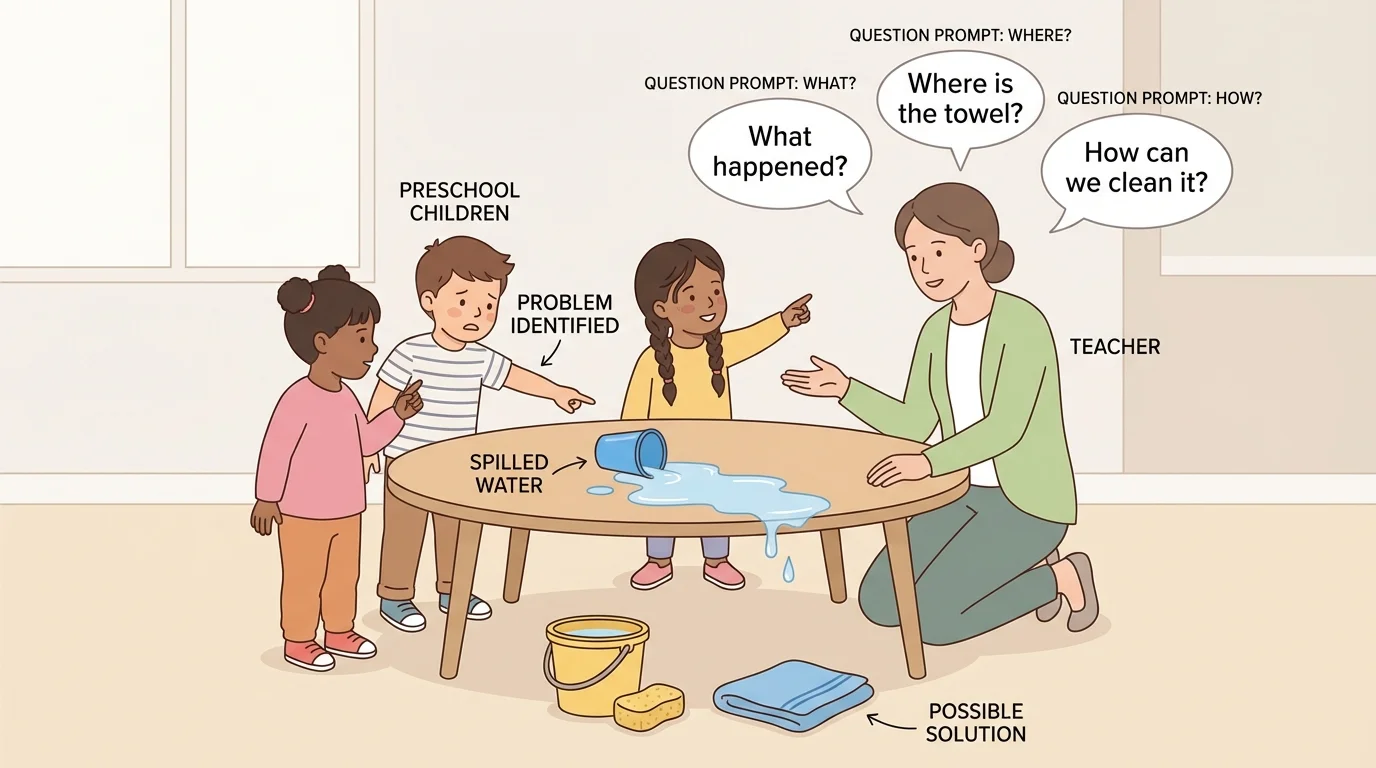
Some helpful question words are what, where, why, and how. Very young children may not say long sentences yet, but they can still wonder. Both "What is this?" and "How fix it?" are strong starts.
Even very young children learn more when they ask their own questions. A small question can lead to a big discovery.
Questions also help children stay calm. Instead of only feeling upset when something goes wrong, they can begin to think, "What can I do next?" That is an important habit for learning with others.
When children work with friends and adults, they collaborate, or work together. During shared looking and trying, [Figure 2] illustrates how one child can test, one can watch, and one can talk. Collaborative exploration means using eyes, ears, hands, and words together.
Working together can sound like this: "I see it." "You try." "My turn." "It goes fast." "Again!" These simple words matter. They help children share ideas and learn from one another.
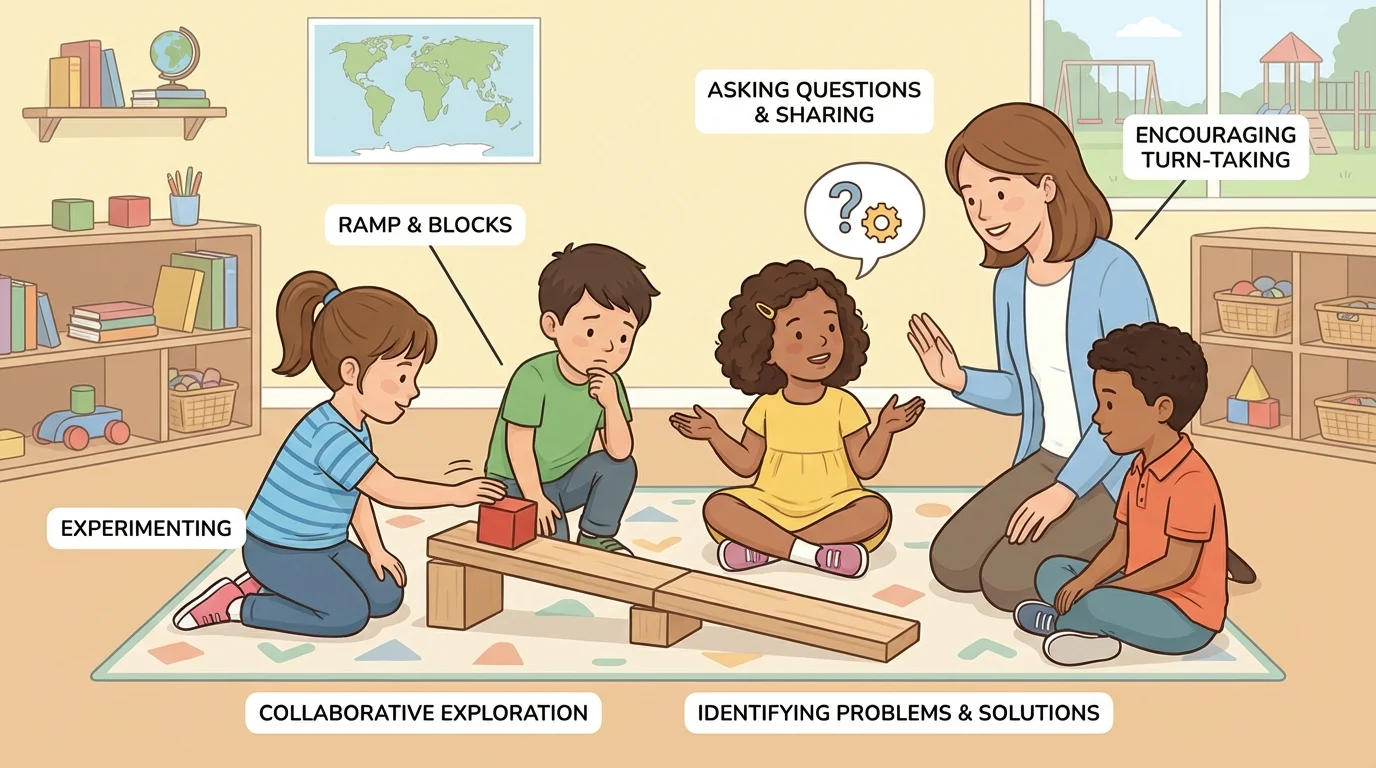
Exploring together also means taking turns, listening, and watching what happens. One child may put a block on a ramp. Another child may notice it slides. Another may say, "Big one fast." Together, they begin to find out what the materials do.
Exploring helps us learn
Children learn by trying things out. They can touch, move, compare, and observe. When they do this with other people, they hear new ideas and notice more than they might notice alone.
Adults can support this by saying simple prompts: "What do you see?" "What changed?" "What should we try now?" These prompts keep the focus on noticing and thinking, not only guessing.
A solution is something we try to help a problem. Sometimes there is one solution. Sometimes there are many. If water spills, a towel can help. If a tower falls, children can build again with a wider bottom. If a toy is out of reach, moving a chair might help.
Children do not need perfect answers. They need chances to try ideas. One idea may work a little. Another may work better. This teaches that solutions can be tested.
Simple problem and solution ideas
Step 1: Notice the problem.
The paper is sliding off the table.
Step 2: Ask a question.
"How can we keep it here?"
Step 3: Try a solution.
Move the paper to the middle of the table.
Step 4: Check what happened.
The paper stays on the table. That idea helped.
Not every solution works the first time. That is all right. Children can try again, change one thing, and keep wondering. This is part of learning to explore.
After exploring, children can begin to say simple facts. A fact is something true that we noticed or learned. Facts can be very short, such as "The towel is wet," "The block rolled down," or "The plant was dry."
Fact means something true. We can often see, hear, or check a fact during our exploration.
Stating facts helps children separate what they know from what they are still wondering. A child might say, "The cup fell." That is a fact. Then the child might ask, "Why did it fall?" That is a question. Both are useful.
Facts can come after careful watching. The group with the ramp, as we saw earlier in [Figure 2], might say, "The block moved down," or "The big block moved too." These are beginning science and research ideas in child-friendly form.
A classroom plant can become a wonderful little research story. In one corner, a plant looks droopy. The children notice that the leaves are hanging down. This observation begins a group investigation, and [Figure 3] shows the children moving from noticing to helping.
The teacher asks, "What do you see?" One child says, "Plant down." Another touches the soil and says, "Dry." A child asks, "Water?" These are early questions and early facts. The children are identifying the problem and thinking of a possible solution.
Then the group gives the plant water and checks it later. After some time, they notice the plant looks better. Now they can say facts: "The dirt was dry." "We gave water." "The plant looks up." These are simple, true statements about what happened.
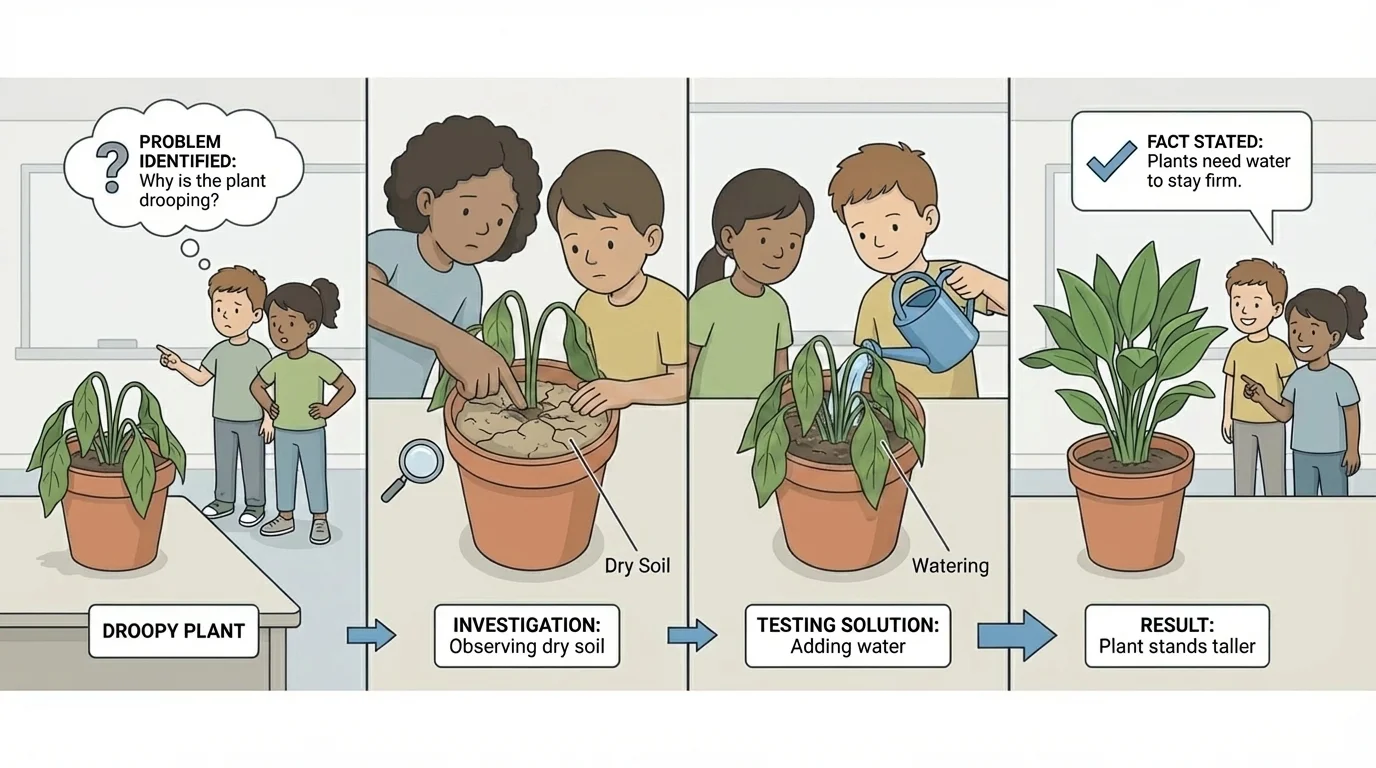
This kind of shared exploration helps children understand that questions lead to actions, and actions help us learn. The same pattern works for many classroom problems: a missing toy, a noisy block structure, a rolling ball, or melting ice.
You already know how to look, touch, point, and talk about things around you. These are important tools for asking questions and finding answers.
As with the spill in [Figure 1], children often begin with what they can see right away. Then they ask simple questions. Then they try to help. Last, they tell facts about what happened. This is a strong beginning for research, design, and learning with others.
